Contents
Marlboro Trees Need a Late Summer Risk Check
Marlboro homeowners have spent this summer watching mature trees carry a lot of weather. From Morganville and the established neighborhoods off Route 79 to Tennent Road, Route 520, Robertsville Road, and the wooded edges around Big Brook Park, large oaks, maples, tulip poplars, pines, and ornamental trees stand over homes, long driveways, pools, patios, fences, play areas, and carefully maintained landscapes.
The summer of 2026 gave those trees a real structural test. On August 7, the National Weather Service severe thunderstorm warning included Marlboro in a line of storms capable of producing 60 mph wind gusts, with possible damage to trees and power lines. Earlier, Marlboro was under a severe thunderstorm watch and flood watch on July 28, and the township also experienced an August heat advisory with heat index values around 103 degrees. Heat, humidity, repeated thunderstorms, lightning, heavy rain, and saturated soil can stress a tree even when the tree remains standing after the weather clears.
That is why late August and early fall are one of the best times for a professional tree risk evaluation in Marlboro. Hidden damage is different. A branch union may have opened slightly in the wind. A root plate may have shifted in wet soil. A lightning strike may have injured the trunk or roots without immediately browning the entire crown. Internal decay may be working behind solid looking bark. Our end of summer tree inspection guide explains why this is the season to compare how a tree looks now with how it looked before the storms.
Marlboro also has many larger residential lots where trees can seem safely distant until you consider what is actually underneath them. A leaning tree along a property line can reach a neighbor, fence, shed, or utility service. We have worked throughout Marlboro and Morganville for decades, and our local Marlboro tree care experience helps us evaluate these properties in the context of the mature landscapes, heavier soils, open lawn exposure, and large homes common in the township.
Michael Hufnagel tells homeowners, “The summer storm does not have to knock the tree over to change it. If the roots moved, a union cracked, or decay was exposed, the next storm may be testing a different tree than the one you had in June.” With more than 25 years of hands on Monmouth County experience, we use inspection to separate normal tree form from defects that need pruning, restoration, monitoring, or removal.
Hidden Storm Damage We Look For in Marlboro Trees
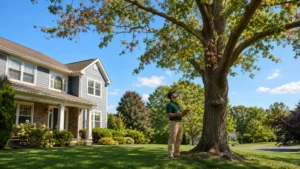
A real tree inspection starts at ground level and works through the entire structure. We look at the root flare, soil surface, trunk, major leaders, branch unions, crown balance, deadwood, old wounds, previous pruning, site changes, and the targets beneath the tree. The International Society of Arboriculture Tree Risk Assessment guidance emphasizes evaluating the tree together with the site and the consequences of failure. For a homeowner, the practical questions are simple: what could break or uproot, what would it hit, and can we reduce the risk before fall weather arrives?
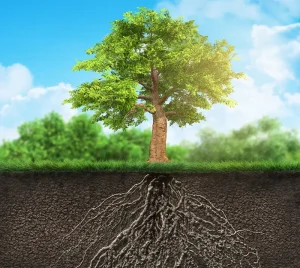
Root problems deserve special attention on inland Marlboro properties. Heavier soils can hold water after repeated rain, and mature roots may already be limited by driveways, patios, additions, grading, irrigation work, or utility trenches. Saturated soil by itself does not mean a tree will fall, but it matters when anchoring roots are decayed, cut, compacted, girdled, or confined. Our guide to weak tree roots and failure prevention explains why a full green canopy does not guarantee that the root system is still providing dependable anchorage.
Rot is another condition that can stay hidden until a storm exposes it. Mature hardwoods may have cavities behind bark, decay at an old pruning wound, soft wood inside a trunk seam, or fungal activity around the root flare. Our article on hidden tree rot explains why mushrooms, cavities, loose bark, old wounds, hollow sections, and cracks deserve a closer look rather than a quick visual guess from the driveway.
Lightning and high wind can create injuries that appear slowly. Some lightning strikes blow bark off immediately. Others leave a vertical scar, crown injury, root damage, or delayed dieback that becomes more obvious weeks later. We inspect lightning exposed trees for bark separation, cracking, new discoloration, branch death, and changes in vigor. Our lightning damaged tree guide goes deeper into the delayed symptoms homeowners often miss after a loud summer storm has already moved away.
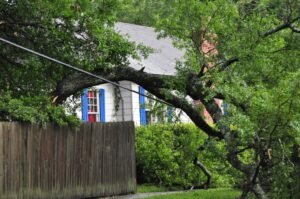
Multi stem trees are another recurring concern on mature properties. Codominant leaders can grow together for years while included bark, old cracks, decay, or unequal weight gradually reduce the strength of the attachment. Wind loading can widen a seam without causing immediate failure. The U.S. Forest Service hazard tree guidance identifies cracks, cavities, decay, deadwood, and weak forks as important defect indicators. In a Marlboro yard, those defects become more important when the potential fall zone includes a roof, garage, driveway, pool, play area, or neighboring property.
Signs That Deserve a Marlboro Tree Inspection Before Fall
- A new lean, increasing lean, soil lifting, root plate movement, or cracking around the base
- Dead, broken, hanging, or suddenly lowered branches after summer thunderstorms
- Open seams, split leaders, cracked unions, or movement in a multi stem tree
- Mushrooms, cavities, soft wood, loose bark, hollow areas, or old storm wounds
- Discolored leaves, thinning foliage, one sided dieback, lightning scars, or early leaf drop
One warning sign does not automatically mean the whole tree needs to come down. It means the tree should be evaluated before another round of wind and rain removes the homeowner’s ability to choose the timing and the solution.
Tree Risk Mitigation Can Preserve Valuable Marlboro Trees
Inspection should lead to the least aggressive solution that reasonably addresses the problem. Many Marlboro trees can be preserved with targeted pruning, deadwood removal, reduction of an overextended limb, storm damage restoration, improved clearance, or a monitoring plan. Our professional tree pruning guide explains why the goal is not to make a mature tree small. The goal is to remove or reduce the parts that are creating unnecessary load while keeping enough live canopy to support tree health.
Reduction pruning can be especially valuable on large shade trees with long horizontal limbs extending toward a house, driveway, pool, or patio. By shortening selected branch ends and transferring growth to suitable laterals, we can reduce leverage without stripping the interior canopy.
Some trees need restoration over more than one visit. A tree with several years of neglect, old storm damage, poor past cuts, or an unbalanced crown may benefit from staged work. We may remove deadwood and the highest priority defect now, then reassess growth and structure later. Our storm season tree risk assessment explains why monitoring can be a legitimate recommendation when a defect appears stable and the tree still has enough sound structure to remain in place.
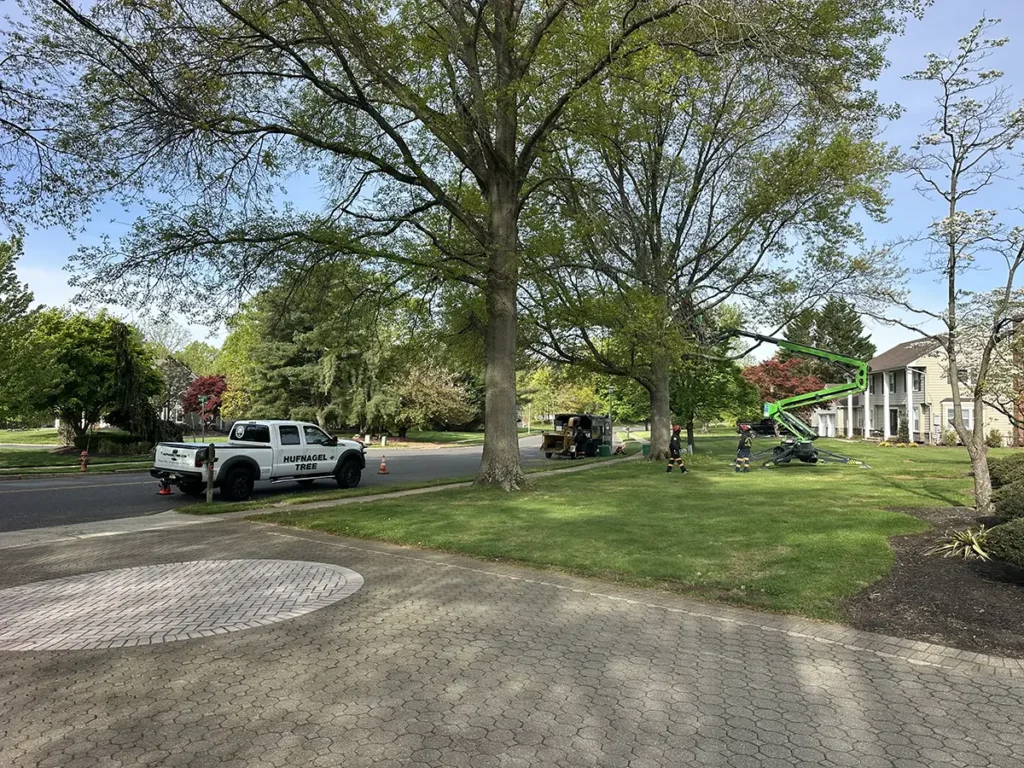
Aerial inspection may also be appropriate when the important question is high in a mature crown. A crack, hanger, cavity, or old tear out can be difficult to judge from the lawn when it is forty or sixty feet above the ground. Our aerial tree inspection and health assessment service allows a qualified arborist to get closer to upper canopy defects when the ground view does not provide enough information.
Mike Hufnagel puts it this way: “If we can reduce the defect and keep a good tree, that is usually the better result. But preservation only makes sense when the remaining structure is dependable enough for the house, driveway, pool, and people underneath it.” That balance is why a certified arborist evaluation should come before either aggressive cutting or automatic removal.
When Remediation Is a Better Choice Than Immediate Removal
- Remove deadwood and broken hangers while preserving the healthy trunk and root system
- Reduce overextended limbs that are carrying unnecessary leverage over a target
- Restore storm damaged crowns gradually instead of stripping the tree in one visit
- Monitor stable defects with photos, notes, and follow up inspections after major storms
- Protect root zones and correct avoidable site stress when dependable structural roots remain
When those measures cannot reduce the risk to a reasonable level, planned tree removal becomes the responsible next step, and in Marlboro that decision may also involve a municipal permit.
When Tree Removal and Marlboro Permit Facilitation Become Necessary
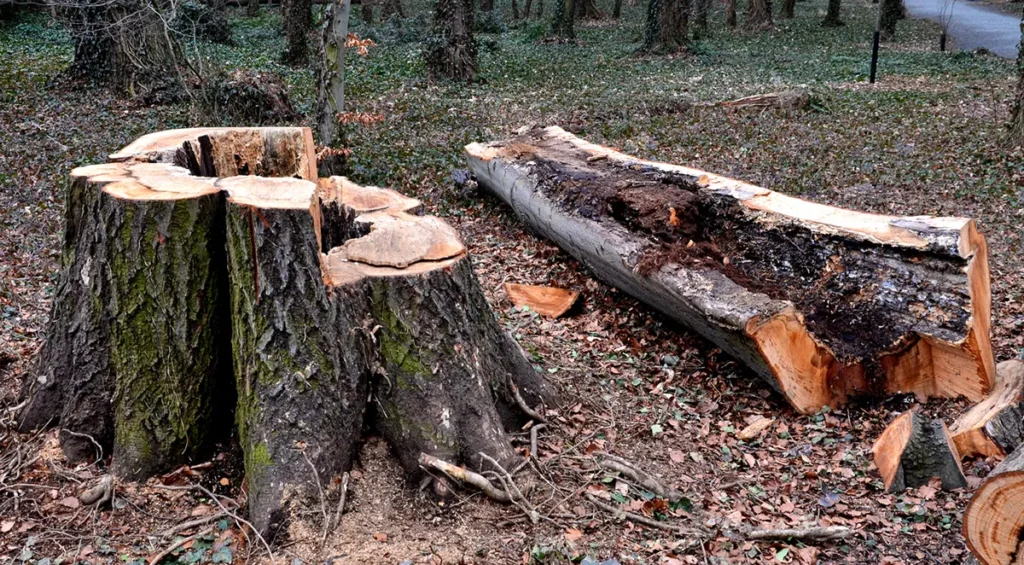
Removal becomes appropriate when the defect is too severe to manage with pruning or monitoring. Advanced decay at the root flare, major anchoring root loss, active root plate movement, catastrophic trunk cracking, extensive crown death, severe lightning damage, or a failing codominant union can make retention impractical. Our tree removal service starts with the condition of the tree, then plans the work around access, structures, landscaping, utilities, rigging, equipment, debris handling, and cleanup.
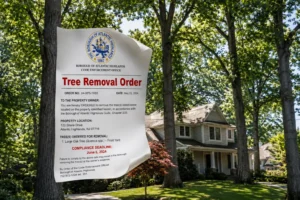
Marlboro homeowners should also check the township rules before cutting a regulated tree. Under Marlboro Township’s tree ordinance, a person seeking to destroy, cut, or remove a tree over eight inches DBH generally must apply to the Conservation Officer in the Township Engineering Division unless an exception applies. The ordinance specifically lists dead, diseased, injured, or danger of falling trees among criteria that can support removal, and it allows the application to be field checked before a permit is issued.
That is where the condition assessment and the permit process meet. We can help identify root instability, decay, structural cracks, crown death, storm damage, or other findings that explain why removal is being recommended. Our tree removal permit guide helps homeowners understand why local requirements need to be checked before work begins.
New Jersey also regulates professional tree care. The New Jersey Board of Tree Experts provides consumer information on licensed tree experts and registered tree care businesses, while Rutgers NJAES guidance on hiring tree care professionals explains why large tree pruning and removal should be handled by qualified professionals.
For Marlboro homeowners, our advantage is continuity. We can inspect the tree, explain the defect in normal language, recommend remediation when it is practical, plan controlled removal when it is not, and help the homeowner navigate the tree condition portion of the permit process. We have hands on experience throughout Marlboro, Morganville, Manalapan, Freehold, Colts Neck, Holmdel, and surrounding western Monmouth County communities, so we understand both the trees and the residential settings where the work has to happen.
What Marlboro Homeowners Gain by Calling Before the Next Storm
- A certified arborist opinion on whether the tree can be retained safely
- A clear explanation of rot, root issues, lightning damage, cracks, lean, or crown decline
- A practical plan for pruning, restoration, monitoring, or controlled removal
- Help organizing the tree condition information needed when a permit is involved
- Competitive pricing from an experienced local crew backed by hundreds of five star reviews
Calling before the next storm gives you time to compare options, schedule work normally, and deal with permit questions before a damaged tree turns the decision into an emergency.
Schedule a Marlboro Tree Risk Evaluation With Hufnagel Tree Service
If a tree in Marlboro is leaning differently, dropping branches, showing unusual discoloration, hiding cavities behind vines, carrying a cracked multi stem union, or simply does not look the same after this summer, have it checked. We provide certified arborist inspections, tree risk evaluations, aerial inspections when needed, pruning, restoration, storm preparation, and safe removal based on the actual condition of the tree.
Hufnagel Tree Service brings more than 25 years of hands on local experience, competitive pricing, responsive service, careful cleanup, and hundreds of five star Google reviews. We have worked throughout Marlboro and Morganville as well as Manalapan, Freehold, Colts Neck, Holmdel, Old Bridge, and nearby communities. Our job is to tell you what the tree needs, not to force every inspection toward removal.
Call (732) 291-4444 to schedule a Marlboro tree risk evaluation before fall weather puts this summer’s hidden damage under another round of wind and rain.
Schedule Service Now!
From precision pruning and safe removals to health assessments and preventative care, Hufnagel Tree Service delivers expert solutions backed by decades of experience. We offer certified insight, fair pricing, and a commitment to doing what’s best for your landscape.
Learn More About Our Services
Related Articles
Tree of Heaven Removal Near Manasquan River in NJ
Weak Tree Roots: Inspection and Failure Prevention