Contents
Tree Protection in Rumson Starts With a Borough Shaped by Two Rivers
Rumson was formed by an act of the New Jersey Legislature on March 15, 1907, and confirmed by a referendum on June 18, 1907, after it was carved out of Shrewsbury Township, according to Wikipedia. The borough covers 7.11 square miles, and more than 28 percent of that total is water, with the Navesink River and the Shrewsbury River shaping its edges. The 2020 census counted 7,343 residents, and the borough shares land borders with Fair Haven, Little Silver, Middletown, and Sea Bright.
That mix of river frontage, old estates, and a borough with its own written rules is why tree protection in Rumson is a bigger subject than whether a tree looks large. Rumson asks owners to settle some questions before a tree comes down, and the answers depend on the trunk, the species, and who owns the ground it stands on. Our tree risk evaluation work starts with the tree and the property, then connects both to what the borough requires.
After almost 30 years working throughout Monmouth County, we have seen that late October is a good time to plan this kind of work. Leaves are still on many trees, so the crown is easy to read, and winter weather has not yet added its load. Permits, replacement plans, and scheduling all take time, so the weeks before winter are a sensible moment to ask questions.
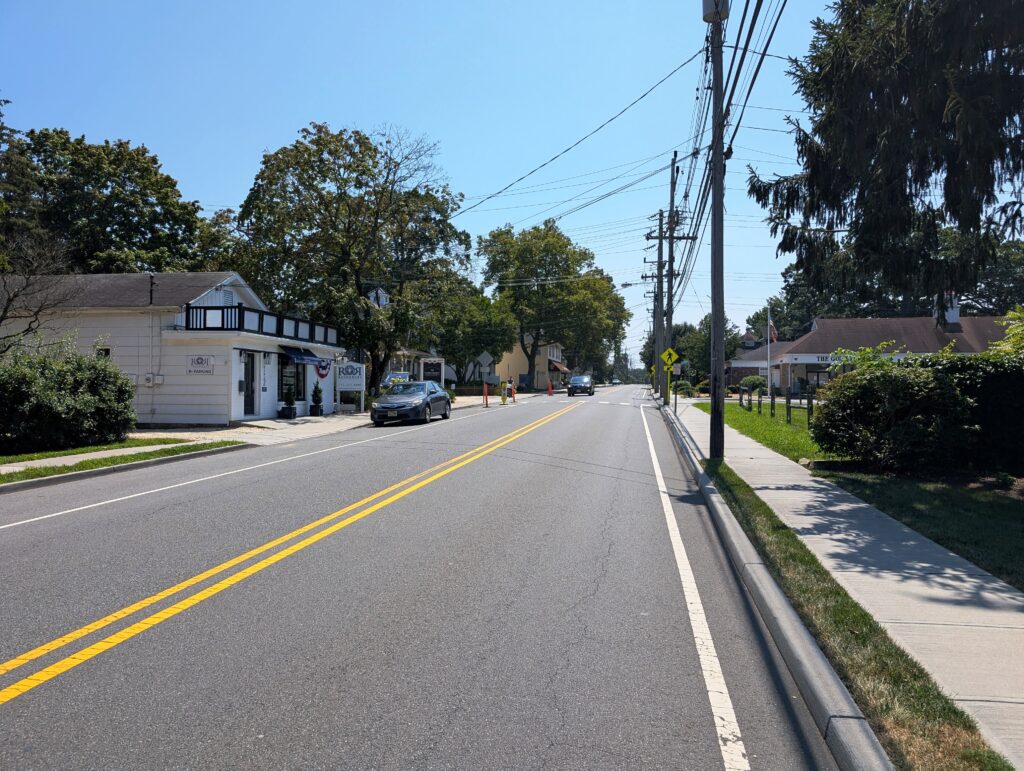
The photograph above shows East River Road, which is County Route 10, looking toward Ward Lane in Rumson. Large trees stand close to the road, the sidewalk, and the overhead wires, with very little room between them and the buildings. That is a common picture in Rumson, and it shows why a removal or a heavy pruning cut can affect more than one property at a time.
Open water and public land sit close to many Rumson streets. Wikipedia lists Meadowridge Park, Piping Rock Park, Riverside Park, Rogers Park, Teddy’s Playground at Victory Park, and West Park among the borough’s public parks, and it notes that many 19th century estates line the rivers and Rumson Road, which is County Route 520. Trees near water deal with wind that has a long open path, and trees on older estates have often stood for generations. Wind does not cause decay, but it tests whatever weak union or hidden defect is already there, and we want to find those weak points before the first hard Nor’easter does it for us.
Rumson Permit Rules Depend on Trunk Size, Species, and Ownership
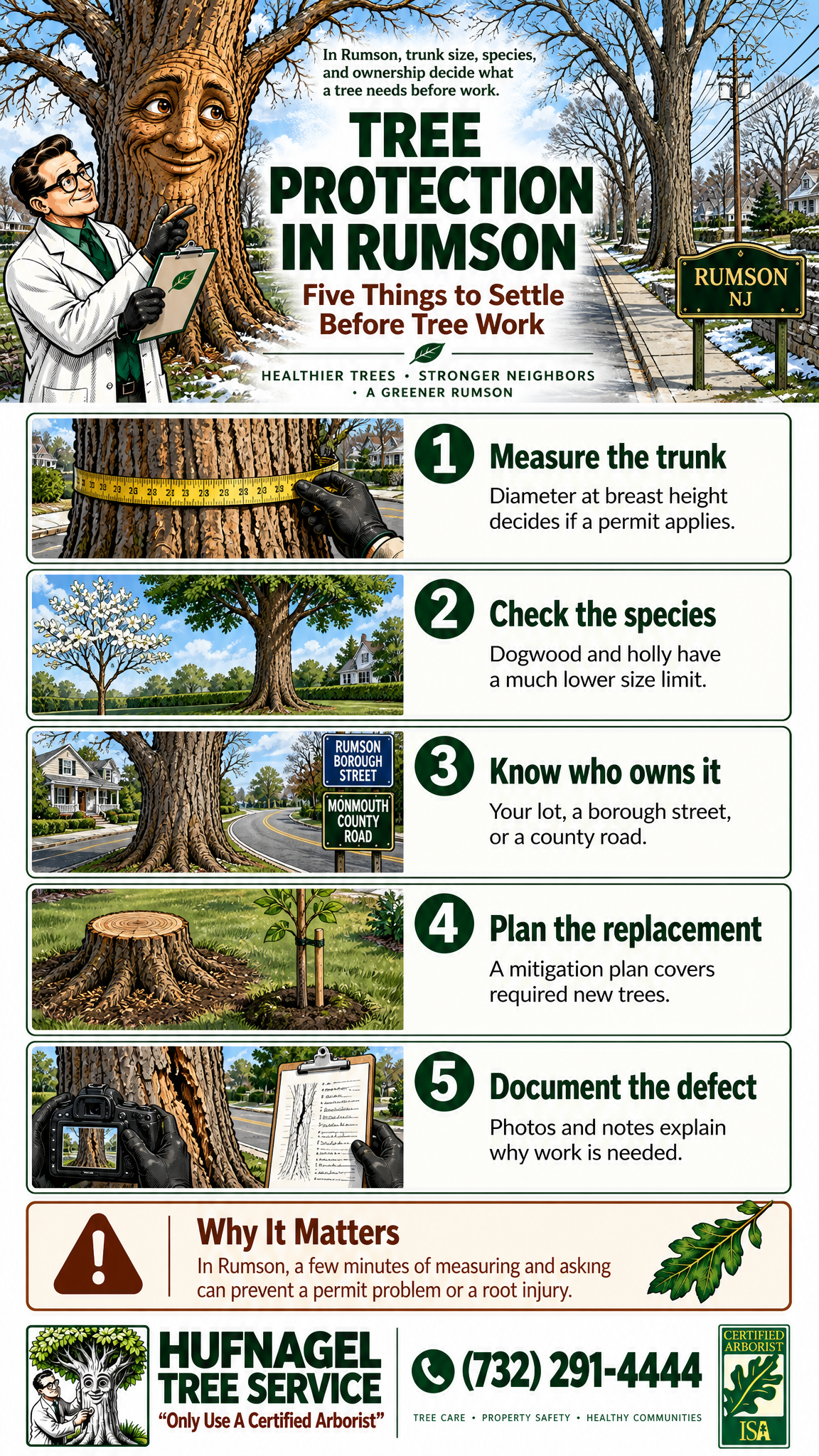
Rumson publishes its basic tree removal rule on the borough zoning code page. It says a permit is required to remove or relocate a tree greater than six inches in diameter at breast height, which is the measurement most arborists call DBH. The page sets lower limits for some species, saying one inch DBH or larger for any dogwood or American holly, and two and one half inches DBH or larger for other ornamental trees. Those numbers are the reason tree protection in Rumson begins with a tape measure and a species check, not with a saw.
Diameter at breast height is measured at a standard point on the trunk. The New Jersey erosion control standard for tree protection describes it as the diameter of the tree 4.5 feet above the ground on the uphill side. That height avoids the swelling at the base, so a leaning or multi stem tree can need a second look to measure correctly. A small dogwood in a front bed can fall under the permit rule while a larger shrub like tree beside it does not, so homeowners should measure before they assume a tree is too small to matter.
The borough page also says a Tree Mitigation Plan is required when replacement trees are required. In plain terms, a permit may come with an expectation that new trees go in to replace what comes out. We think about that from the first visit. Before we recommend a removal, we look at where a replacement could grow without crowding a house, a drive, or the roots of the trees that stay, because a plan that works on paper but not in the soil does not help anyone. The page links the borough’s current application regulations and fees on its own site, so we do not quote any amounts here and ask homeowners to read them directly.
Ownership matters as much as size. The borough’s Shade Tree Commission page says the commission oversees shade and ornamental trees and shrubs on borough streets, except county roads, along with parks and parkways. Rumson Road is County Route 520 and East River Road is County Route 10, so a tree beside a county road may fall under a different office than a tree beside a borough street. We do not guess in these cases. We ask the borough which rules apply to a specific tree and get the answer before any work is scheduled. Our guide to tree removal permits explains how the process usually works across the area.
Condition is the other half of the question. The International Society of Arboriculture says in its Recognizing Tree Risk brochure that there is no such thing as a completely safe tree, and that a professional arborist is the best person to judge how serious a warning sign is. We treat a permit as a record of why a tree needs work, so we document the defect and the target together. Our guides to hidden tree rot and codominant stems show two problems that can sit out of view from the street. We also do not assume that a damaged or dead tree is exempt from a borough rule, because the page does not say so, and we ask before we cut.
Mike Hufnagel puts the working rule this way: “A permit tells you what the borough needs to see. It does not tell you what the tree needs. We start with the tree, the roots, and what is underneath it, and the paperwork makes more sense after that.” That is why an evaluation in Rumson begins with the tree and not with the form, and it is why two similar trees on the same street can lead to different recommendations.
Five Things to Settle for Tree Protection in Rumson Before Any Work
- Measure the trunk at breast height, about four and a half feet above the ground.
- Check the species, because dogwood and American holly have a much lower size limit.
- Confirm who owns the tree: your lot, a borough street, or a county road.
- Ask whether the work needs a tree mitigation plan for required replacement trees.
- Photograph the defect and the target so the reason for the work is documented.
None of these steps asks a homeowner to climb a ladder or pick up a saw. Look from the ground, measure, photograph, and ask the borough. Some trees need only monitoring. Others need targeted pruning, restoration, support, or removal. Once the paperwork questions are clear, the next question is what is happening under the lawn, because roots decide how a tree handles construction, grading, and wind.
Roots Decide How Rumson Trees Survive Construction, Grading, and Wind

Most of the damage that shows up in a Rumson tree years later started at ground level. The Standard for Tree Protection During Construction says roots commonly extend well beyond the drip line, and it tells builders to protect a zone around each tree they plan to save. The standard estimates that protected root zone from the trunk diameter. It multiplies DBH in inches by 1.5 for older, unhealthy, or sensitive species, or by 1.0 for younger, healthy, or tolerant ones, and it reads the result as a radius in feet. A mature tree with a 24 inch trunk can therefore have a protected root zone that reaches 24 to 36 feet in every direction.
The same standard sets rules that read like common sense once a homeowner has seen the damage. Feeder roots should not be cut inside the protected root zone. Boards are not to be nailed to trees during building work. Damaged bark is to be removed and no paint applied, and cuts on limbs are to be made at the outside edge of the branch collar with no flush cuts. These are the habits of a crew that expects the tree to live, and they are the ones we look for when we review a plan for a Rumson property.
Grade changes are another quiet source of trouble. The standard includes separate drawings for tree protection in fill areas and in cut areas, which tells us how seriously it treats both. Soil piled over roots can smother them, and soil cut away can sever them. Rumson has a long history of building and rebuilding on large lots, so a tree that looks untouched may be living in a very different grade than it grew up in. We ask what changed on a property because that history often explains a tree that is thinning or leaning.
Some species handle this work worse than others. The standard lists a group as severely affected by compacted construction fills, including beech, dogwood, sugar maple, black oak, pin oak, red oak, white oak, pines, and tuliptree. Many of those are common on shore and river properties, and several are big shade trees. That does not mean they cannot be saved. It means a plan for a lawn near an oak or a tuliptree needs more care than a plan for a tolerant species, and the homeowner should hear that before the equipment arrives.
Mulch and moisture belong in this picture too. Rutgers says in its guide to over mulching trees and shrubs that when oxygen in the soil drops below 10 percent, root growth in most trees declines, and that symptoms can take several years to appear. It says total mulch depth should not exceed 3 inches, and that mulch should stay 8 to 12 inches away from mature tree trunks. Pulling mulch back is a simple fix that helps a tree without a saw. Our guide to weak tree roots shows what we look for at the root flare, and our tree health management work covers what a stressed tree needs once the cause is found.
When a crew has to cross a lawn, the route and the surface matter. Ground protection mats spread the weight of equipment so wheels and tracks do not press the soil under a tree into a tight layer. We plan the route before work starts, keep it clear of the root zones we can avoid, and ask homeowners where irrigation lines and utilities run. A few minutes of planning on the ground can prevent a root problem that would not show for seasons, and that is the kind of problem a homeowner cannot easily trace back to the cause.
Root Zone Protection Steps Before Rumson Building or Grading Work
- Fence the protected root zone before equipment arrives and keep machines and stockpiles outside it.
- Use ground protection mats where equipment must cross a lawn near a mature tree.
- Keep trenches and utility lines away from the trunk, because roots reach beyond the drip line.
- Never nail boards, signs, or ties into a trunk during building work.
- Hold mulch back from the trunk and keep the total depth at three inches or less.
Protection is cheaper in effort than repair. When the roots are sound and the base is clear, a tree can often keep its structure with light work. When they are not, the fix may be as plain as moving mulch or changing the route of a machine. With the roots understood, the last step is to look up and decide what the crowns on a Rumson property are asking for before winter.
Mature Rumson Estate Trees Need Pruning, Wire, and Replacement Planning

Many Rumson properties hold trees that are much older than the houses beside them. The borough grew as a wealthy New York summer colony in the 19th century, according to the encyclopedia entry on Rumson, and many of those estates still line the rivers and Rumson Road. A tree that old has been pruned, storm tested, and sometimes damaged by digging more than once. Our job is to read that history in the crown and decide what the tree can reasonably carry through another winter.
Pruning decisions come first because poor pruning creates risk. The USDA Forest Service guide How to Recognize Hazardous Defects in Trees says that topping and tipping lead to decay in the remaining stub, which then makes a very poor support for the branches that regrow. We do not top trees and we do not thin a tree for wind as a blanket rule. Good pruning removes deadwood and reduces end weight where it matters, and it leaves healthy structure alone. For trees that need more than pruning, our storm proofing work looks at support, load, and what the next storm will ask of the tree.
Wires and structures change the plan. A mature oak over a driveway, a spruce over a roof, and a limb that reaches toward a service line each ask for a different cut, and none of them is a job for a homeowner with a ladder. We look at what sits under the crown first, then decide what to reduce. Our look at hidden damage from seasonal storms shows how damage can stay out of sight until a later storm puts the weak spot under load, which is why we walk the whole tree before we write a recommendation.
Removal is the last option on our list, not the first. When a tree has a decayed base, moving roots, or a structure that cannot be corrected, tree removal is risk mitigation and not a failure of tree care. In Rumson that decision also brings the permit questions from earlier, so we confirm the measurement, the species, and the ownership before a date is set. We can help with the permit paperwork when it is needed, and we explain the reason for the removal in plain terms that match what the borough will want to see.
Hauling is part of the plan. The borough home page lists a form to schedule bulk pickup, but it does not say whether that service takes tree debris, so we do not assume it does. We settle where the wood goes before any cut is made, and we go over it with the homeowner so nobody is left with a pile that cannot move. If a job produces chips, they can often be spread around the roots of trees that remain, which is the same advice the state standard gives for chips from poor trees.
Some trees come back from damage and some do not. Our tree restoration work is for trees that can still be saved after a storm, a bad cut, or years of neglect, and it starts with an honest look at what structure is left. We also keep the earlier work in mind. Our tree risk mitigation in Rumson article covers how we approach exposure and storm risk in the borough, and this article adds the protection and permit side of the same trees.
Mature Tree Decisions We Walk Through on Rumson Properties
- Which trees are sound enough to keep with pruning for deadwood and end weight.
- Which trees carry a defect that needs support, restoration, or removal.
- Where wires, drives, and structures sit under each crown we are reviewing.
- Which permit or mitigation steps apply before any removal is scheduled.
- Where replacement trees can grow without crowding roots or structures.
A good plan for a mature property sorts trees into what to keep, what to correct, and what to replace, and it puts that plan in order. The goal is not to remove as much as possible or to save everything. The goal is to give each tree the work it actually needs and to make sure the borough has what it asks for. With those pieces in place, the remaining step is to book the review.
Call Hufnagel Tree Service About Tree Protection in Rumson Before Winter
If you have mature trees near your Rumson home, driveway, river frontage, or property line, schedule an evaluation before winter weather arrives. We provide tree health management, tree risk evaluations, pruning, storm proofing, restoration, and tree removal when a tree cannot be managed safely.
Hufnagel Tree Service is led by a certified arborist with almost 30 years of local experience and more than 280 five star Google Maps reviews. We inspect first, explain what we found in plain terms, and recommend only the work that changes the outcome for your trees and your property.
Call or text (732) 291-4444 to schedule tree protection in Rumson before the first hard freeze. More of our local work is collected in the Rumson location archive.
Schedule Service Now!
From precision pruning and safe removals to health assessments and preventative care, Hufnagel Tree Service delivers expert solutions backed by decades of experience. We offer certified insight, fair pricing, and a commitment to doing what’s best for your landscape.
Learn More About Our Services

Related Articles
Tree Risk Mitigation in Rumson, NJ
Summer Ornamental Tree Pruning in Middletown, NJ
Tree Risk Evaluation Services Near Marlboro NJ