Contents
Weak Tree Roots: How Inspections and Tree Health Care Reduce Failure Risk
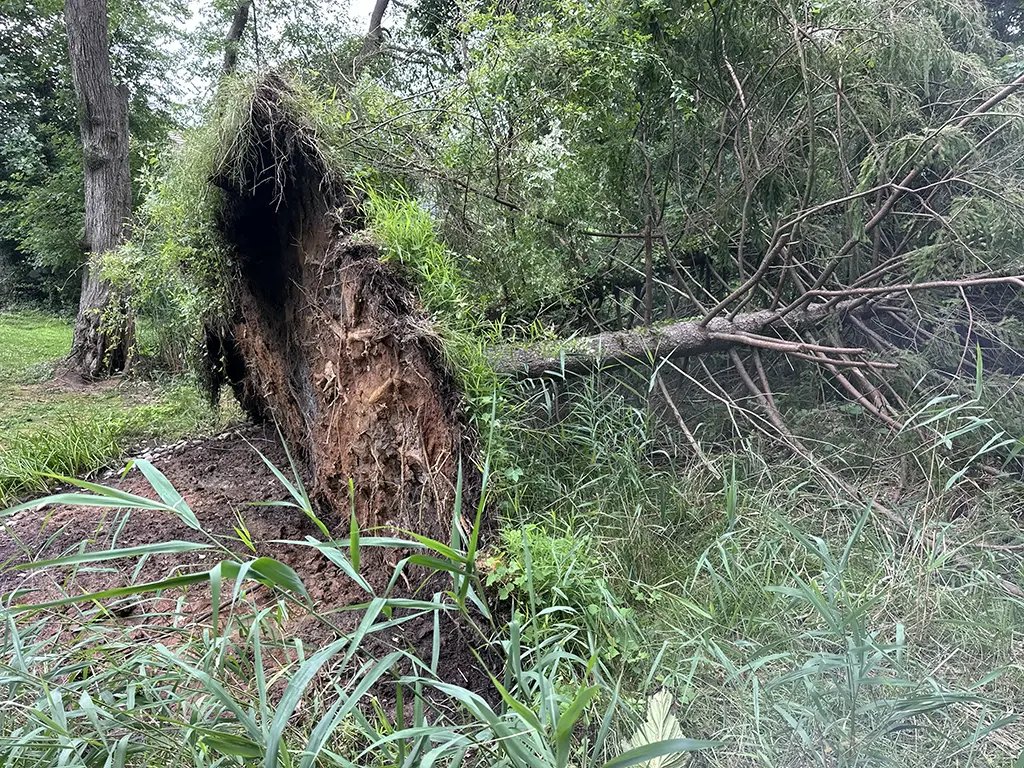
When a mature tree falls over, the damage can look sudden. In many cases, the storm is only the final force applied to a root system already compromised by decay, restricted growth, construction damage, saturated soil, compaction, girdling roots, or years of declining health. The canopy may remain green while the tree gradually loses the anchorage needed to support it.
At Hufnagel Tree Service, we use more precise terms than simply calling every fallen tree weak-rooted. We look for insufficient anchorage, root plate instability, structural root decay, severed roots, restricted rooting volume, stem-girdling roots, and root-zone stress. Some of these conditions can be corrected or managed early. Others mean the tree can no longer be retained safely.
This distinction matters throughout Monmouth County. Coastal trees face strong winds and salt exposure, while inland properties may have compacted clay, poor drainage, old construction disturbance, or large trees confined between pavement and foundations. Heavy rain can soften the soil while a full crown catches wind, allowing the root plate to rotate and lift.
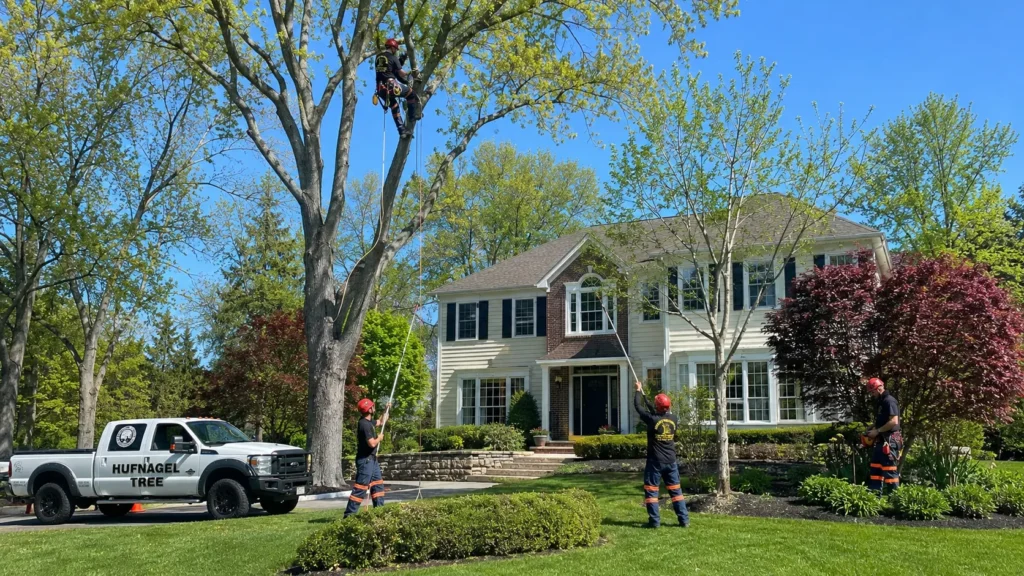
Our certified arborists inspect the tree as one connected system, from the crown and trunk to the root flare, soil, drainage, and targets below. We preserve viable trees through responsible tree health management while identifying trees that require pruning, monitoring, restoration, or removal before root-related failure causes injury or property damage.
Weak Tree Roots and the Mechanics of Uprooting
Roots collect water and nutrients, but they also anchor the trunk and crown to the soil. The Colorado State Forest Service overview of tree physiology identifies anchorage as one of the root system’s primary functions. A tree depends on both living roots and soil that can hold those roots securely under load.
Most landscape trees do not stand on one deep taproot. Their roots spread outward through upper soil layers, with large structural roots branching into smaller roots. The International Society of Arboriculture planting guidance notes that most roots develop near the soil surface. This is normal, but it becomes vulnerable when roots are cut, decayed, confined, or surrounded by damaged soil.
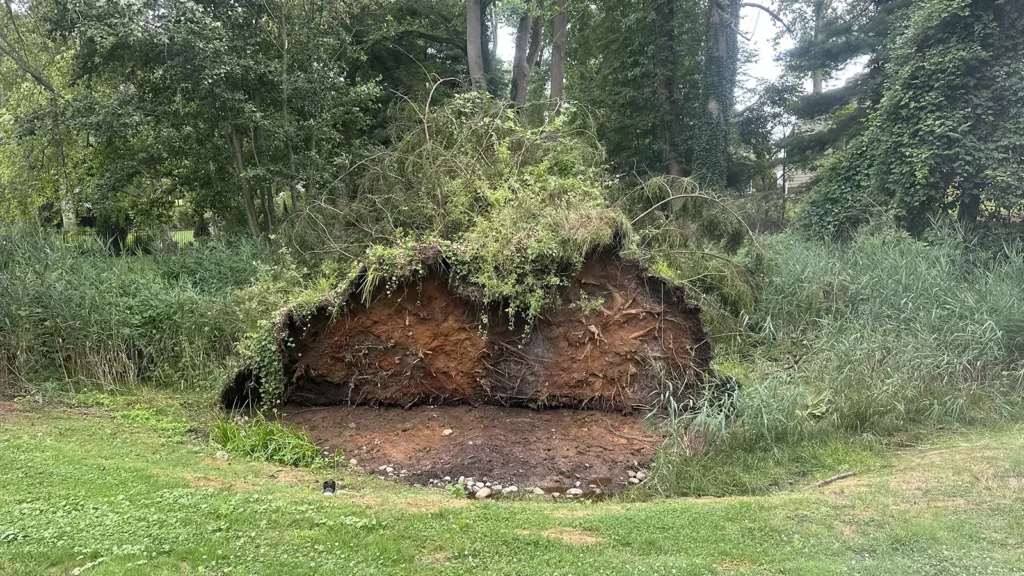
During wind, the crown acts as a lever. Force travels down the trunk and into the structural roots and surrounding soil. A stable tree distributes that force through its root-soil system. A compromised tree may rotate at the base, lifting soil and roots on one side. Arborists commonly describe this moving mass as the root plate.
Wet weather can make the problem worse. Saturated soil may provide less resistance to root movement, especially where roots are shallow, restricted, or decayed. The University of Minnesota storm damage guidance warns that trees with inadequate root systems or stem-girdling roots may blow over or break near the ground.
“A tree does not need to look dead to have a serious anchorage problem,” says certified arborist Michael Hufnagel. “The roots may be losing strength below ground while the canopy still carries enough foliage to catch tremendous wind.” Understanding the root-soil system explains why the next step is identifying what damaged or restricted it.
Root Conditions That Reduce a Tree’s Anchorage
- Decayed or dead structural roots near the trunk and root flare
- Major roots severed by trenching, excavation, driveway work, or utilities
- Stem-girdling roots compressing the trunk or structural roots
- Roots confined by pavement, foundations, walls, or compacted soil
- Saturated, eroded, filled, or altered soil that no longer supports normal root function
A tree may tolerate one limitation for years, then lose stability when several conditions overlap. The cause is often found in the history and treatment of the surrounding root zone.
How Healthy Root Systems Become Compromised
Soil compaction is a common root-zone problem. Vehicles, construction equipment, repeated traffic, and material storage press soil particles together and reduce pore space. Rutgers explains in its guide to assessing soil compaction that compaction can impede root growth, limit water and nutrient uptake, reduce gas exchange, and create conditions that favor root disease.
Excavation can cause immediate structural damage. Trenches for drainage, utilities, irrigation, fencing, pools, patios, and driveways may cut roots far from the trunk. The Rutgers site protection guidance identifies compaction, adding or removing soil, and severing roots during trenching as leading causes of construction-related tree decline and death.
Grade changes create different stress. Adding soil can reduce oxygen movement and bury the root flare, while removing soil can expose or cut roots and alter drainage. Paving can limit infiltration. The ISA publication on avoiding tree damage during construction recommends protecting a defined root area before work begins.
Some root defects begin at planting. Container roots may circle, trees may be installed too deeply, or the planting space may be too small. The University of Maryland explanation of girdling roots describes roots that grow around the trunk and gradually restrict movement of water, nutrients, and carbohydrates. They may also compress the trunk flare and reduce stability.
Root decay and chronically wet soil can further reduce the sound tissue holding the tree. Drainage changes, flooding, buried root collars, injuries, and disease organisms may all contribute. “Tree health services work best before major structural roots are gone,” Michael Hufnagel explains. “We can improve conditions around living roots, but we cannot regrow a root that has rotted away or been cut through.”
Property Changes That Deserve a Root-Zone Review
- A new driveway, walkway, patio, pool, addition, wall, or utility trench
- Heavy equipment, dumpsters, soil piles, or repeated parking beneath the canopy
- New fill soil, grading, drainage changes, or standing water near the trunk
- A deeply planted tree, mulch mound, or missing trunk flare
- Recent clearing that exposed a formerly protected tree to more wind
Property improvements do not automatically make a tree unsafe. They do create reasons to document root disturbance and inspect for symptoms before decline becomes advanced.
Warning Signs of Root Damage and Root Plate Instability
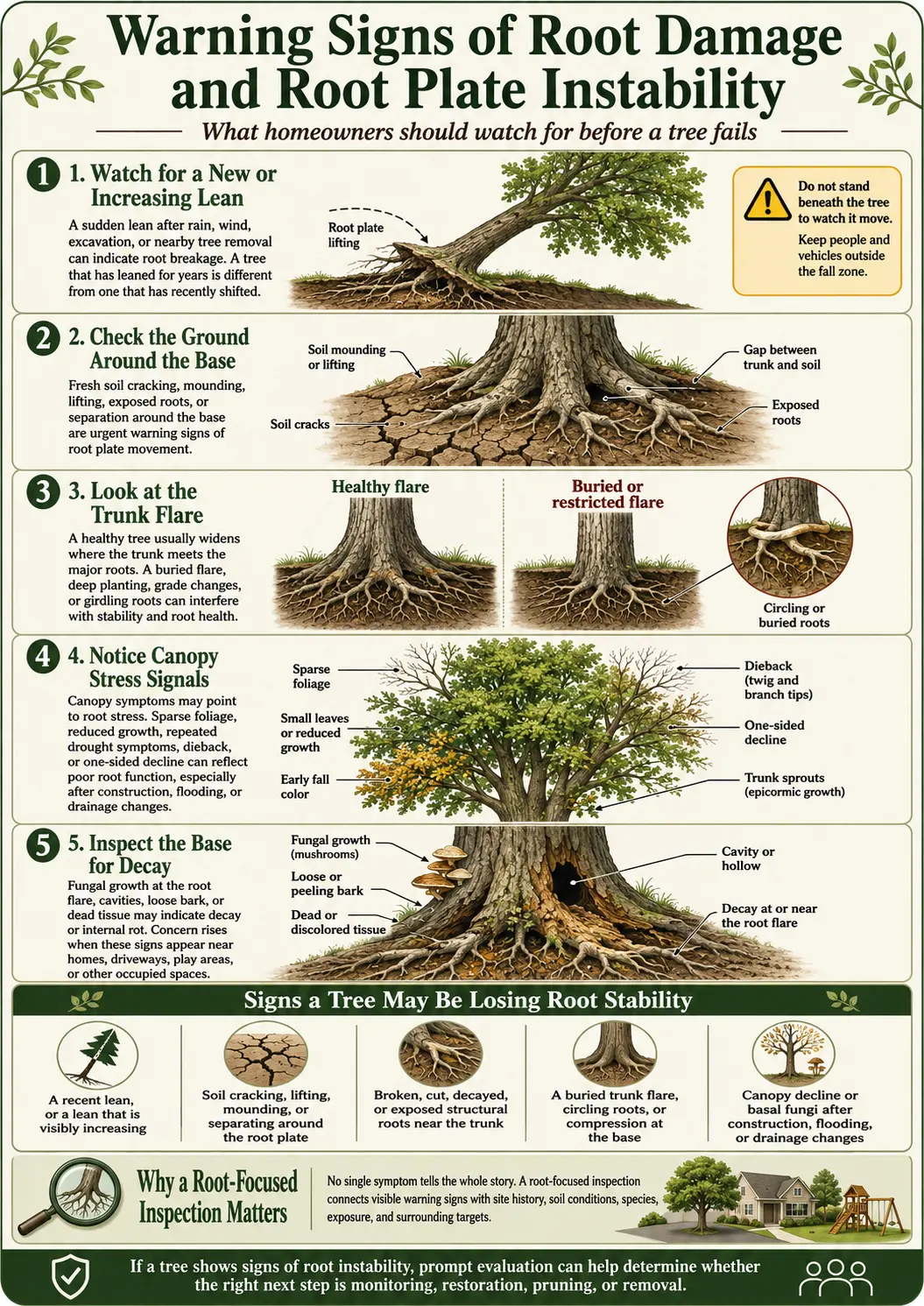
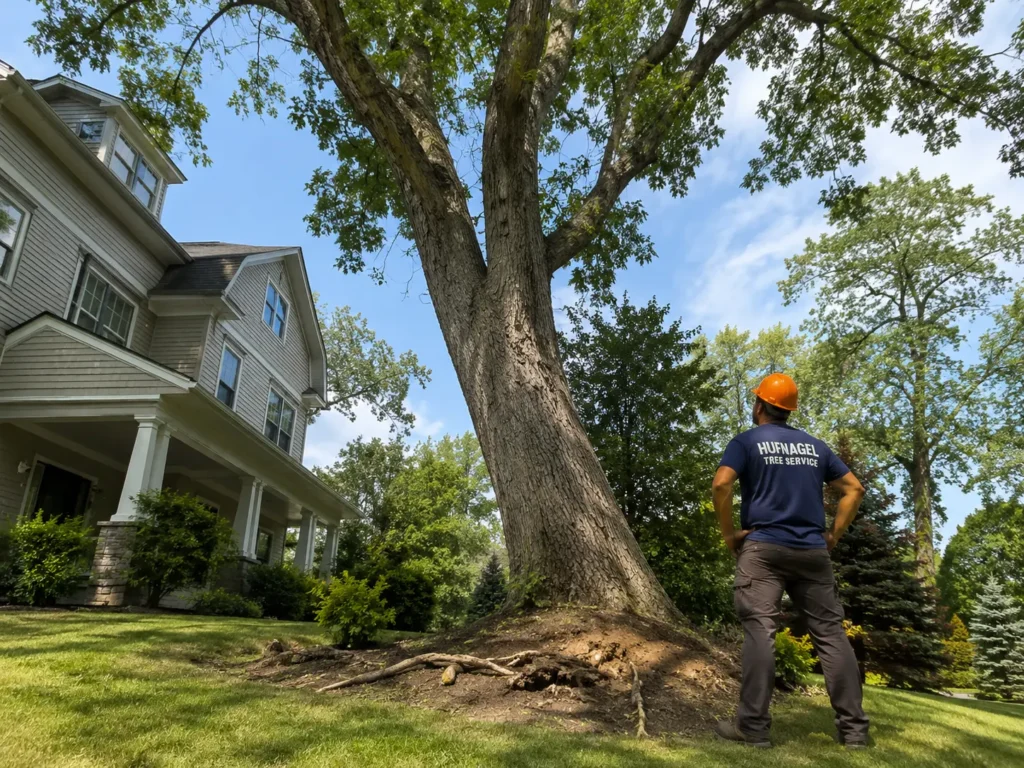
A new or increasing lean deserves prompt attention, especially after rain, wind, excavation, or nearby tree removal. A tree that has always leaned may have developed compensating growth, but a sudden lean can indicate root breakage. Penn State Extension’s guidance on leaning trees notes that uprooting in wet soil can lift the root plate opposite the lean.
Look closely at the ground around the base. Fresh soil cracks, a mound lifting on one side, exposed roots, gaps between the trunk and soil, or movement when wind pushes the crown are urgent signs. Do not stand beneath the tree to watch it move. Keep people and vehicles away from the potential fall zone.
The trunk flare provides useful information. A healthy trunk normally widens where it meets the major roots. A trunk that enters the ground like a straight pole may be planted too deeply, buried by grade changes, or affected by girdling roots. The ISA’s tree quality guidance emphasizes a visible flare and roots that extend outward rather than circle.
Canopy symptoms may point toward root stress without proving a structural defect. Sparse foliage, small leaves, premature fall color, dieback, reduced growth, repeated drought symptoms, or sprouts along the trunk can indicate poor root function. One-sided decline may correspond with roots cut or compacted on that side of the property.
Fungal growth at the root flare, cavities near the base, loose bark, or dead tissue should also be evaluated. The University of Maryland’s tree removal decision guide advises that fungi on the tree can indicate internal rot and that sudden lean may reflect weakened roots. Concern rises when these signs occur near occupied areas.
Signs a Tree May Be Losing Root Stability
- A recent lean or a lean that is visibly increasing
- Soil cracking, lifting, mounding, or separating around the root plate
- Broken, cut, decayed, or exposed structural roots near the trunk
- A buried trunk flare, circling roots, or compression at the base
- Canopy decline or basal fungi following construction, flooding, or drainage changes
No single symptom tells the entire story. A root-focused inspection connects what is visible with the site’s history, soil conditions, species, exposure, and surrounding targets.
What a Certified Arborist Examines During a Root-Focused Inspection
The inspection begins with context. We consider species, size, wind exposure, soil, drainage, recent weather, and what would be struck if the tree failed. We also ask about excavation, paving, utilities, flooding, grade changes, nearby removals, and when the lean or canopy symptoms first appeared.
At the base, we examine the trunk flare, root collar, visible structural roots, soil surface, and root plate. We look for girdling roots, wounds, decay, cavities, mushrooms, buried bark, erosion, cut roots, soil cracks, and evidence that the trunk or root mass has shifted.
The canopy and trunk are inspected at the same time because root stability cannot be separated from the load above. A dense, asymmetric, or overextended crown creates different forces than a balanced crown. Dead limbs, topping damage, weak attachments, trunk defects, and vines can increase the consequences of a root problem.
A ground-based inspection has limits. Roots are hidden, soil conditions vary, and decay may not produce an obvious mushroom. When findings warrant it, an arborist may recommend closer root collar examination, soil evaluation, decay investigation, monitoring, or reassessment. The goal is a responsible decision, not false certainty.
Recommendations must match the defect. A viable tree may need root-zone protection, drainage correction, careful pruning, soil improvement, or monitoring. A tree with active root plate movement, extensive root decay, or major root severance may require removal. A proper tree risk evaluation separates manageable conditions from unacceptable risk.
What a Root-Focused Tree Inspection Should Consider
- The root flare, root collar, visible roots, soil, and root plate movement
- Construction history, trenching, compaction, grading, paving, and drainage
- Crown size, balance, defects, storm exposure, and wind load
- Homes, vehicles, roads, utilities, play areas, and neighboring property
- Whether preservation can improve stability or removal is safer
Inspection is the decision point. Tree health work should begin only after the arborist determines that enough sound roots and stable soil remain to support the tree.
Tree Health Services That Can Reduce Root-Related Failure Risk
Root-zone protection is often the most important preventive service. Keeping vehicles, equipment, stored materials, and repeated traffic away from roots helps preserve soil structure. Proper mulch can moderate moisture and temperature, but it should cover the soil rather than pile against the trunk. Irrigation and drainage should prevent repeated drought or saturation.
Where compaction is present and the tree remains viable, an arborist may recommend targeted soil improvement or decompaction. The ISA guide for treating trees damaged by construction explains that improved aeration may support root growth when conditions allow. It cannot repair roots that have been severed or destroyed by decay.
Pruning may reduce specific loads when performed conservatively for a defined reason. Removing deadwood, shortening overextended limbs, or correcting an imbalanced crown can reduce leverage on a viable root system. Heavy crown removal and topping are not substitutes for root stability and may create new defects.
Early planning can prevent damage. An arborist can define a root protection area before excavation, route trenches away from major roots, advise on grading and drainage, and document tree condition before construction. Young trees can be checked for planting depth, circling roots, and restricted root balls while correction is more practical.
Some root defects cannot be reduced to an acceptable level. A tree that moves at the base, has extensive structural root decay, or has lost critical anchoring roots may need professional tree removal. When preservation remains reasonable, our tree restoration and tree pruning services are based on the tree’s actual condition.
When Preventive Care Can Help and When Removal Is Safer
- Protect and improve the root zone when sound structural roots remain
- Correct drainage, compaction, planting depth, or girdling-root concerns when appropriate
- Use selective pruning to manage load, never to disguise unstable roots
- Monitor trees after construction, flooding, storms, clearing, or changes in lean
- Remove trees when root loss, decay, or movement makes dependable anchorage unlikely
A certified arborist inspection cannot guarantee that a tree will never fail. It can identify correctable stress, uncover warning signs, reduce avoidable damage, and remove trees that are no longer safe before the next storm tests them.
For an honest evaluation of weak tree roots, root-zone damage, leaning trees, or root plate instability, call or text Hufnagel Tree Service
Only use a certified arborist to determine whether the right next step is tree health care, pruning, restoration, monitoring, or safe removal.
Hufnagel Tree Service serves Monmouth County with certified arborist care backed by more than 25 years of local experience and over 200 five-star Google reviews.
Schedule Service Now!
From precision pruning and safe removals to health assessments and preventative care, Hufnagel Tree Service delivers expert solutions backed by decades of experience. We offer certified insight, fair pricing, and a commitment to doing what’s best for your landscape.
Learn More About Our Services
Related Articles