Contents
The Trees That Worry You in June Are Usually Talking Already
Tree risk assessment is one of the most important services a homeowner can schedule before storm season becomes urgent. A tree rarely fails without showing some kind of clue first. The clue may be a widening lean, a cracked union, a heavy limb over a bedroom, mushrooms near the root flare, bark splitting along the trunk, dead tips high in the canopy, soil movement after rain, or a limb that suddenly looks lower than it did last month. Our job is to read those signs before wind, rain, and saturated soil make the decision for you.
At Hufnagel Tree Service, we look at risk through the lens of tree structure, site conditions, species behavior, and the target below the tree. A weak limb over an open back corner of a large lot is different from the same limb over a garage, deck, playset, sidewalk, driveway, or power service. That is why a real assessment is not just someone pointing up and saying, “that looks bad.” It is a careful review of what could fail, how likely it is to fail, and what damage or safety issue it could create if it does.
This service-first approach fits the way Monmouth County properties actually work. Bay shore homes in Keyport and Union Beach, hillside and waterfront properties in Highlands and Atlantic Highlands, tight residential lots in Red Bank and Shrewsbury, mature neighborhoods in Rumson and Fair Haven, and shore-facing landscapes in Sea Bright, Monmouth Beach, Long Branch, Oakhurst, and Wanamassa all face different versions of the same problem. Trees grow above valuable spaces, and storms expose weak points fast.
Michael Hufnagel says it this way: “The tree you inspect in calm weather is the tree you have a chance to manage. The tree you first notice during a storm has already taken control of the schedule.” That is the reason we encourage homeowners to schedule risk evaluations before the first serious tropical system, nor’easter, or severe thunderstorm line pushes across the county. Waiting until a limb is on the roof leaves fewer options and usually costs more.
We also consider what has changed recently. Construction, grading, trenching, new driveways, patio work, drainage changes, irrigation changes, and repeated soil saturation can all affect a tree that looked stable for years. A storm-season assessment is not only about the tree standing there today. It is about the history of the site and whether that tree is still supported the way it used to be.
Tree Risk Evaluation for Weak Limbs, Decay, Lean, Roots, and Storm Targets
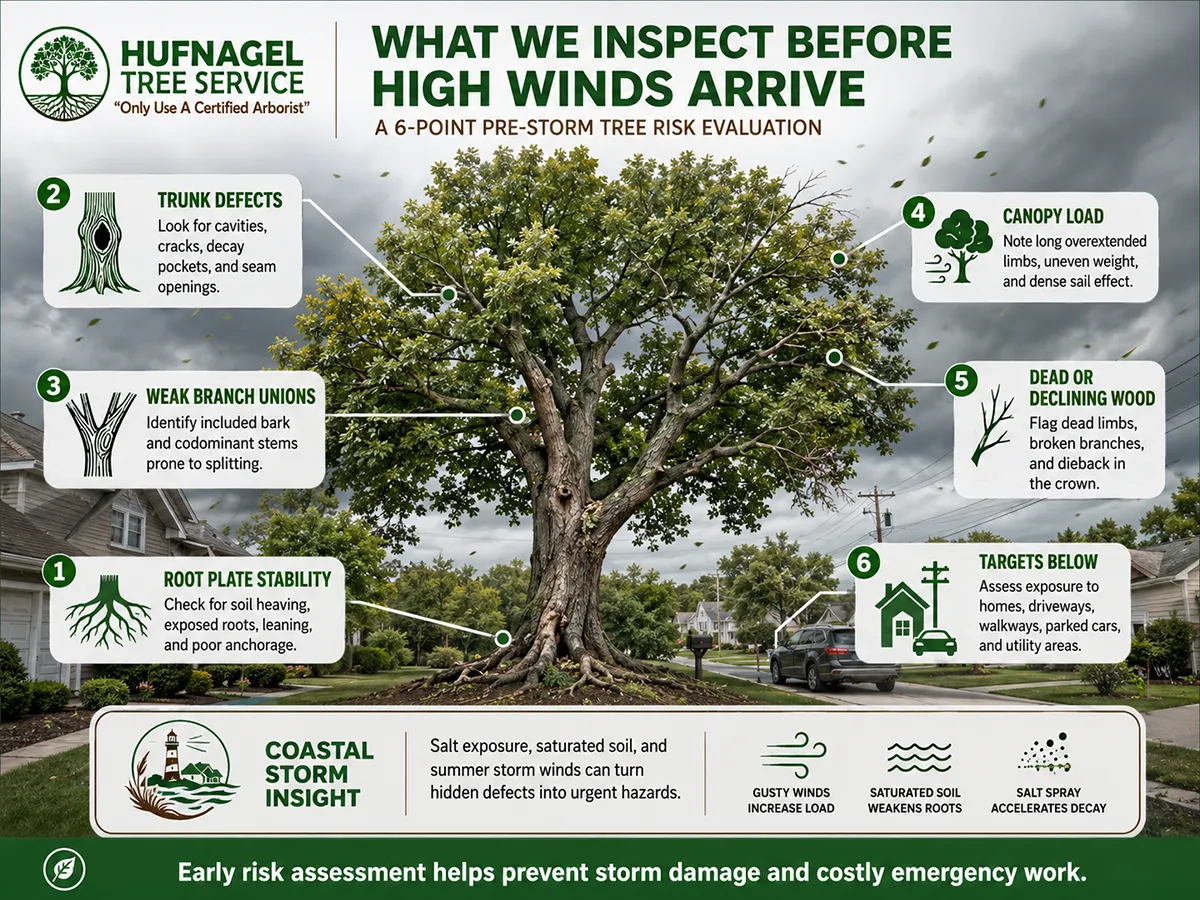
A tree risk evaluation begins with observation, but it does not stop there. We look at the canopy for deadwood, broken hangers, cracks, excessive end weight, included bark, old storm wounds, poor branch spacing, and uneven load. We look at the trunk for cavities, seams, fungal activity, bark loss, old topping damage, and changes in taper. We look at the base for girdling roots, heaving soil, decay, trunk flare burial, drainage issues, and signs that the tree’s anchoring system may be compromised.
That inspection matters because storm failure is not always obvious from the ground to an untrained eye. A tree can be fully leafed out and still have a dangerous union. A maple can look green but carry decay inside a major stem. A pine can seem upright but have root stress after repeated saturation. An oak can be strong overall but still have one overextended limb positioned over a roof. Risk often sits in the details, which is why experienced arborist judgment is so valuable.
Local exposure changes the risk profile. In Keyport, Union Beach, Belford, Leonardo, and Port Monmouth, bay wind can press into canopies while wet soil reduces root holding strength. In Highlands and Atlantic Highlands, elevation, slopes, and waterfront gusts can put uneven force on mature trees. In Rumson, Little Silver, and Fair Haven, older trees often grow near homes, fences, driveways, and ornamental beds, leaving limited room for failure. In Ocean Township, Oakhurst, Wanamassa, Long Branch, and West Long Branch, fast summer growth and shore weather can add weight quickly.
One of the most important parts of risk evaluation is deciding whether pruning, monitoring, cabling, restoration, or removal is the right response. Not every imperfect tree needs to come down. At the same time, not every tree can be saved responsibly. Our role is to explain the condition clearly, recommend work that fits the actual risk, and avoid both panic-based removals and false reassurance. Homeowners deserve a straight answer, especially when a tree is close to the house.
When a tree does need to be removed, professional planning matters. Hufnagel Tree Service provides tree removal with careful rigging, property protection, and jobsite cleanup. When the tree can stay, we may recommend selective pruning, weight reduction, deadwood removal, crown cleaning, or health-focused care instead. The best assessment gives you a path forward, not just a warning. From there, storm preparation becomes the next practical step.
What a Storm-Season Tree Assessment Should Clarify
- Which limbs or trees pose the most immediate concern.
- Whether pruning, restoration, monitoring, or removal is the safest recommendation.
- How local wind, soil, slope, and target areas affect risk.
- Which defects are cosmetic and which defects could become safety issues.
- What work should be handled before severe weather arrives.
A useful risk assessment does not scare homeowners into unnecessary work. It gives them a prioritized plan that separates urgent hazards from manageable maintenance.
Storm Damage Prevention Through Pruning, Clearance, and Practical Preparation
Tree storm proofing does not mean making a tree immune to hurricane-season weather. No honest arborist can promise that. What we can do is reduce avoidable failure points, improve clearance, remove dead or compromised limbs, correct dangerous end weight where appropriate, and identify trees that should not be left standing through another storm cycle. The goal is risk reduction, not magic.
Storm preparation often starts with pruning. Dead limbs should not be left hanging over roofs, cars, service wires, patios, fences, or walkways. Heavy branches with poor attachments may need selective reduction. Canopies that are rubbing the house or pressing against gutters may need clearance. Trees with old breakage may need cleaning so damaged wood is not waiting for the next gust. The work should be strategic, because stripping a canopy can make wind exposure worse, not better.
We pay particular attention to homes near water, slopes, and mature tree lines. Along the bay shore in Keyport, Union Beach, and Leonardo, exposure can change block by block. In Highlands and Atlantic Highlands, a tree at the top of a slope may handle wind differently than a tree tucked behind a structure. In Sea Bright and Monmouth Beach, salt and wind can stress evergreens and ornamental plantings before a storm even arrives. In Red Bank, Shrewsbury, and Tinton Falls, saturated soil and older residential trees can create different concerns during prolonged rain.
An expert tip we give homeowners is to look after rain, not only during wind. Saturated soil, standing water, new cracks in the ground, fresh leaning, and root flare movement can signal a problem before the next storm. Also look for limbs that stay low after rain has passed. A branch that does not rebound may be carrying excessive weight or internal damage. These are the details that help us decide whether pruning is enough or whether the tree needs a more serious recommendation.
Homeowners should also pay attention to trees that suddenly drop small dead limbs on calm days. That can be normal in limited amounts, but repeated shedding near a roof, patio, or driveway is worth a closer look. The pattern matters. One fallen twig after a dry week is different from frequent deadwood, fresh cracks, or limbs breaking after every storm cell.
For homeowners who want to understand the company behind the assessment, the About Hufnagel Tree Service page explains the certified arborist approach we bring to tree care. Our storm preparation work is built around safety, honest recommendations, and preserving trees when preservation is responsible. When preservation is not responsible, we say that too. The right decision before storm season is the one that protects people, property, and the long-term health of the landscape.
Storm Preparation Steps That Actually Reduce Tree Problems
- Remove dead, cracked, hanging, or storm-damaged limbs before high winds arrive.
- Reduce dangerous end weight without stripping the canopy or creating stress growth.
- Create clearance around roofs, gutters, siding, driveways, patios, and walkways.
- Watch soil and root areas after heavy rain for movement, lifting, or new lean.
- Prioritize trees over homes, parking areas, play areas, and frequently used outdoor spaces.
Storm preparation is most useful when it is scheduled before the county is watching the forecast every hour. Once winds are on the way, safe tree work becomes harder, availability tightens, and options narrow.
Call Hufnagel Tree Service Before Storm Season Chooses for You
If your trees are hanging over the roof, crowding the driveway, blocking walkways, pressing into the house, or growing too heavy after spring rain, call Hufnagel Tree Service at (732) 291-4444. Our certified team of arborists serves Keyport, Union Beach, Matawan, Hazlet, Belford, Leonardo, Atlantic Highlands, Highlands, Sea Bright, Monmouth Beach, Rumson, Fair Haven, Little Silver, Red Bank, Ocean Township, Oakhurst, Wanamassa, Long Branch, Middletown, and surrounding Monmouth County communities.
We bring local experience, professional equipment, licensed and insured tree care, and a practical understanding of how Monmouth County trees respond to storm season. For tree risk assessment, storm preparation, pruning, removal, and honest guidance before severe weather arrives, call Hufnagel Tree Service and get a clear plan before the next warning is on your phone.
Schedule Service Now!
From precision pruning and safe removals to health assessments and preventative care, Hufnagel Tree Service delivers expert solutions backed by decades of experience. We offer certified insight, fair pricing, and a commitment to doing what’s best for your landscape.