Contents
Tree Trimming in Shrewsbury Township Starts With Three Streets and One Way In
Shrewsbury Township is the smallest municipality in New Jersey by area, and its map explains why. According to the township website, the township was formed on October 31, 1693, and was created as a township by the state legislature on February 21, 1798, but today it consists of three streets: Crawford, Barker, and Belshaw. Wikipedia lists its area at 0.1 square miles and its 2020 population at 1,076, which gives it the highest density in Monmouth County.
That geography changes how we think about tree trimming in Shrewsbury Township. When houses, garden apartments, driveways, and wires sit this close together, one limb can overhang several properties, and a cut that helps one yard can leave a heavy side for the next. Our tree trimming and pruning service starts by looking at the whole canopy and everything under it, not just the tree named on one deed.
After almost 30 years working throughout Monmouth County, we have seen how late fall shows the shape of a tree that summer leaves hide. With the leaves coming down and the weather still workable, this is a practical time to plan trimming before winter wind and wet snow add load.
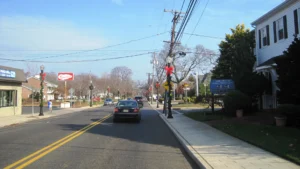
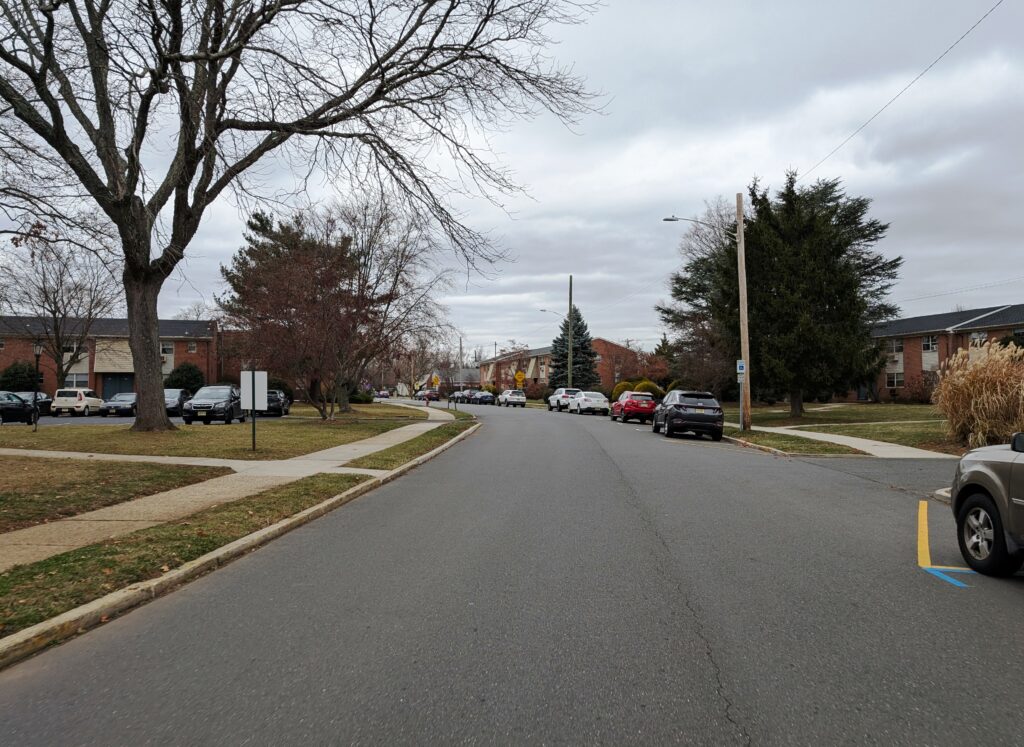
The photograph above shows Crawford Street, which Wikipedia calls the longest road in the township, looking north in December. A large bare tree stands on a lawn between a sidewalk and a row of brick buildings, with evergreens farther down the block and a utility pole and wires beside the road. A bare canopy like this one is the easiest to read, because every limb, fork, and dead twig shows against the sky. Wikipedia counts 1.49 miles of roadway in the township as of May 2010, all of it maintained by the municipality, and nearly every foot of it has a tree within reach of a roof, a car, or a wire.
Wind is the other part of the setting. The National Weather Service says nor’easters are most frequent and most violent between September and April, with gale force winds from the northeast and nearly always heavy rain or snow. A tree standing alone on a lawn between buildings catches that wind, and a limb that was only a nuisance in summer can become the one that breaks under load. Our tree storm proofing work and our trimming work are planned around that same season.
Every Cut on a Close Lot Needs a Reason
The International Society of Arboriculture explains in its guidance on pruning your trees that light removal of weak, dead, or diseased limbs can happen at any time of year with little effect on the tree. It adds that growth and wound closure are greatest when pruning takes place before the spring growth flush, and that heavy pruning of live tissue just after that flush should be avoided, especially on weak trees. For a homeowner in late October, that points to a simple plan: deadwood and hazards now, and any larger structural work through the dormant season.
That timing matters on the three streets of the township because the work is rarely a single cut. A tree beside a garden apartment building may have deadwood over a roof, a limb leaning toward a wire, and a crowded union higher in the crown, and each of those calls for a different cut at a different size. We write the work in order of consequence, so the limb over the roof comes first and cosmetic shaping comes last, if it is needed at all.
Size is the request we hear most often, and it is the one that needs the most care. ISA describes reduction as cutting back leaders and branch ends to secondary branches large enough to take over, at least one third the diameter of the cut stem, and says reduction keeps the form and structure of a tree in a way topping does not. The same page calls topping perhaps the most harmful pruning practice known and says it can lead to risk, stress, and decay. We name topping only to reject it.
In a small lot, the pressure to make a tree smaller is real, because a mature tree can fill most of a yard. The better answer is usually to find what is actually causing the problem. A limb touching a roof needs a clearance cut at the right branch union. Heavy end weight over a parking space needs selective reduction. A crowded canopy may need only the interior deadwood removed. In each case the tree keeps its shape and its ability to heal, which is what tree trimming in Shrewsbury Township should accomplish.
We also look at what a cut will leave behind. A wound that is too large, or a stub left past the branch collar, can become the entry point for decay years later, and on a tree that stands over a shared fence line that is a problem for two households. Our tree health management work follows the tree after the cut, because a trimmed tree that declines has not been helped. Where we find two stems of equal size pressing together, we explain what to do about it in our guide to codominant stems.
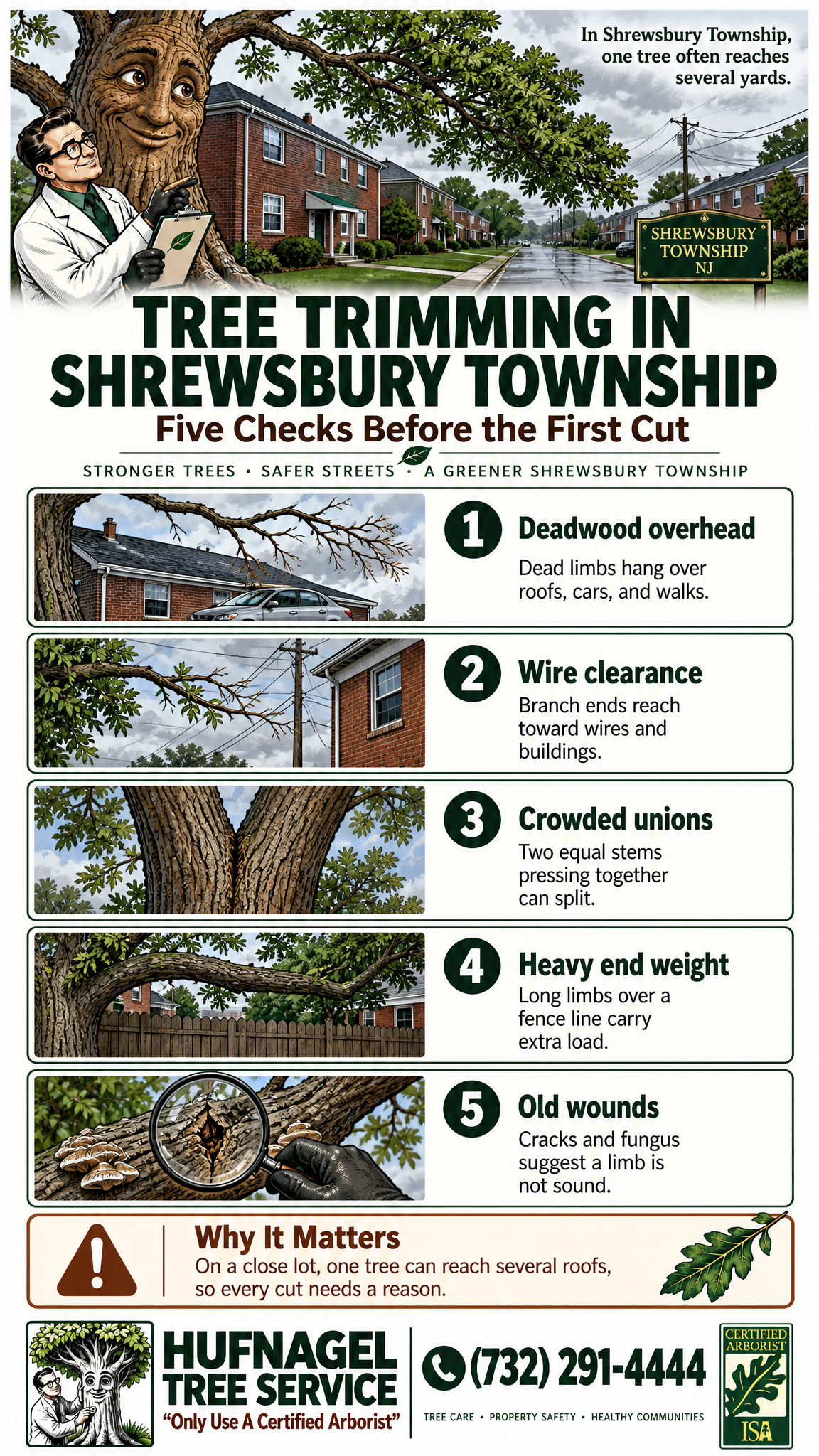
Mike Hufnagel puts the rule for close lots this way: “On a lot this small, a tree is never only one household’s tree. Before I decide where a cut goes, I want to know whose roof, fence, car, and driveway sit under that limb.” That is the reasoning behind every plan we write for a close set of properties. The tree is judged by what it can reach, and the cut is chosen to change that, not to make the tree look neat.
Questions We Ask Before Trimming a Tree on a Close Lot
- Dead or hanging limbs over roofs, parking spaces, walks, and neighboring yards.
- Branch ends reaching toward wires, gutters, chimneys, and the sides of buildings.
- Crowded unions where two stems of equal size press against each other.
- Heavy end weight on long limbs that reach across a shared fence line.
- Old wounds, cracks, and fungus that suggest a limb may not be sound.
Answering those questions before the first cut keeps the work small and focused. A trim that responds to a real defect or a real conflict is easier on the tree than a trim that chases a shape, and it gives neighbors a clear reason for what they see from their side of the fence. Once the cuts are chosen, the next part of the job is practical, because close lots limit where a crew can set up and where the limbs can go.
Tight Access and Shared Fences Change How the Work Is Planned
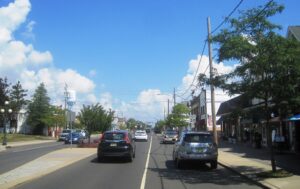
Shrewsbury Township has one way in. Wikipedia says Shrewsbury Avenue, County Route 13, is the only vehicle access, and the township website tells residents that questions about other streets, including Shrewsbury Avenue, can go to Shrewsbury Borough. For a crew, that means equipment arrives through a neighboring borough and then works on streets with cars parked along the curb, as the photograph at the top of this article shows.
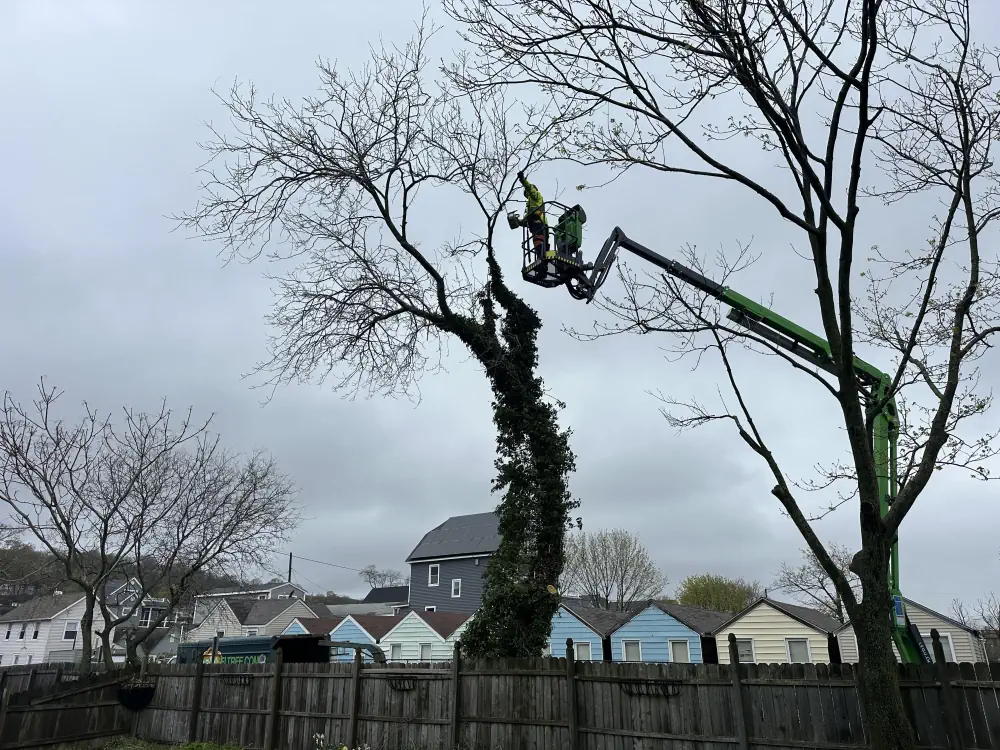
Parking, narrow frontage, and shared drives decide where a chipper truck can sit, where a lift can set up, and whether a limb can be lowered whole or must be handled in pieces. The photograph in this section shows a lift reaching into the crown of a tall tree from a backyard behind a wooden fence, a setup that lets a crew work over small lots without a climber crossing a neighbor’s roof. Not every lot allows it, and we decide on site, after we have looked at the ground, the gates, and the wires.
Density makes the stakes clear. Wikipedia gives the township about 10,855 people per square mile, the highest in Monmouth County. For a tree, that is not an abstract number. Where homes sit close together, a falling limb has a target in nearly every direction, and a tree with deadwood over a car or a roof has more at stake than the same tree on a larger parcel. A defect that is low concern over an open field can be much more important over a roof or a frequently used walkway, and that is why we tie every trimming decision to what is underneath the canopy. Our tree risk evaluations use the same logic.
Shared canopies raise a simple question about who decides. We work for the owner of the tree, and we encourage a conversation with neighbors before the crew arrives, because the crew may need to reach over a fence, cross a shared drive, or block a parking space for a few hours. When a neighbor has a concern about a limb, we are glad to look at it from both yards and explain what we see, but we do not cut a tree we have not been asked to work on.
Wires are the other limit. The photograph at the top of this article shows a utility pole and overhead wires beside the road, and any branch near a line is work we handle with care rather than a project for a ladder. We tell homeowners to stay clear of limbs that touch or lean on wires, to photograph them from a distance, and to call the utility and then call us. Nobody should pull, cut, or lean a ladder against a tree that has a wire on it.
We also plan around the season. With the leaves down, branches over buildings and wires are easy to see, and a crew can work with a clear view of each cut. Winter work on firm ground leaves less mark on a small lawn than a wet spring does, and the job is finished before a nor’easter tests the tree. A little planning in the fall also leaves room for a second look if the first one turns up something unexpected.
Access and Neighbor Checks That Keep a Trimming Day Smooth
- Parking space for a truck and chipper near the front of the property.
- A clear path from the work area to the street for cut limbs.
- Gates and side yards wide enough for a crew or a small machine.
- Overhead wires, service lines, and meters noted before anyone climbs.
- A word with neighbors who share the drive, the fence, or the canopy.
None of these checks is complicated, but together they decide whether a trimming day is calm or chaotic. A homeowner who has thought about parking, gates, and neighbors has already made the work safer and shorter. The last piece of the plan is the one people forget until the limbs are on the ground, and that is where the cut wood goes.
Cut Limbs Need a Plan Because Brush Is Not Part of Bulk Pickup
The township’s recycling page sets out the rules for bulk pickup, and brush and yard debris are among the items it says will not be accepted. The page also lists registration at Town Hall and set pickup days, and those dates change from year to year, so a homeowner should check it before counting on bulk pickup for anything. A pile of limbs left at the curb after a trimming job is not something the township is set up to take on that schedule.
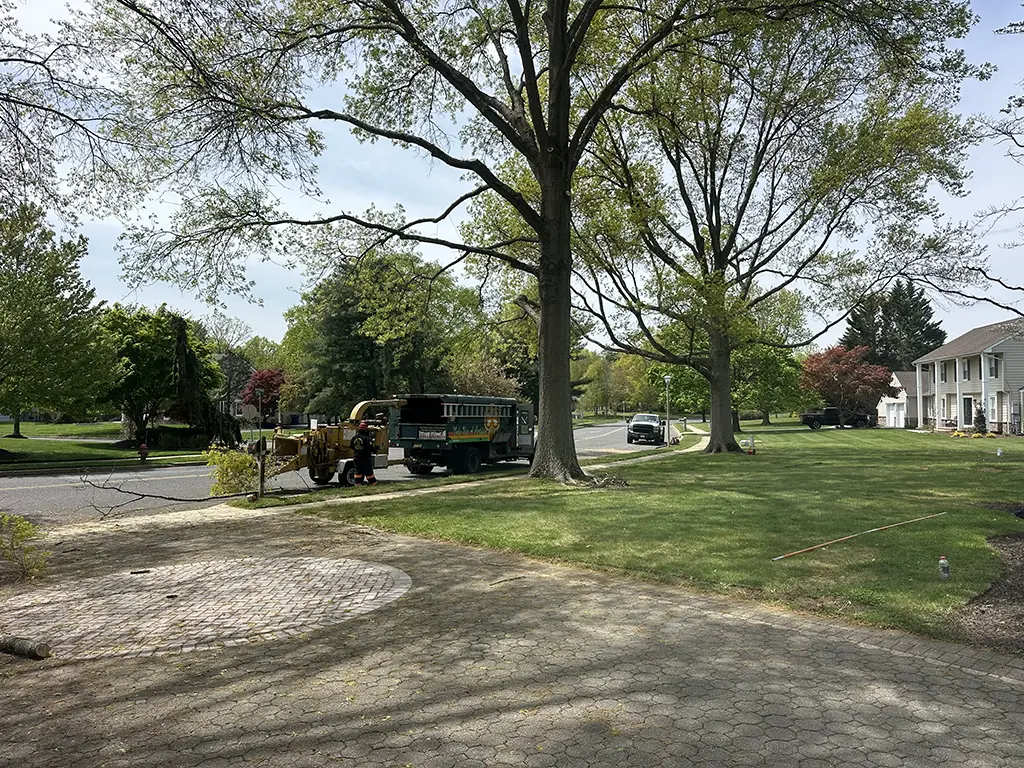
That rule shapes how we write a trimming plan. A homeowner who hires a crew to cut should not be left with a stack of branches and a lawn full of twigs. We plan for cleanup as part of the job, and we leave the property clear when we leave. The photograph in this section shows a chipper set up at the curb under a row of mature trees on a residential street, which is the same kind of setup that works on close streets where there is nowhere else to put debris.
The township website also says that smoking, fire pits, and chimineas are prohibited, with fines up to $2,000. Burning cut limbs is not a disposal route here, and we would not suggest it on a lot where a neighbor’s house is a few steps away. The same site publishes ordinances on a range of waste topics, so a homeowner who is unsure about what to do with cut material can read them or call the township office on Crawford Street.
The township’s stormwater page lists a yard waste collection ordinance along with ordinances on illicit connections to the storm sewer and improper disposal of waste. Those are worth reading before anyone sweeps leaves or twigs toward a street drain. In a township with only three streets, what goes down one drain affects everyone nearby, and we keep debris out of the road and off the drains as a matter of routine.
Some trees need more than trimming. When a limb problem turns out to be a trunk, root, or decay problem, we say so. Our guide to hidden tree rot explains how decay can hide inside a tree that looks fine from the street, and our guide to tree removal permits helps homeowners find out what rules apply before anything comes down. We recommend removal only when the structure leaves no responsible alternative, and we explain why.
We also suggest a follow up. After the first strong wind of the season, look at the trimmed tree from the ground for new cracks, hanging limbs, or a changed lean, and photograph anything that looks different. Our earlier article on tree health management in Shrewsbury Township covers the roots, mulch, and road salt side of the same trees, and it pairs well with a trimming plan.
Cleanup and Aftercare Habits for a Trimmed Tree
- Keep cut limbs, twigs, and chips out of the street and away from drains.
- Do not plan to burn brush, because the township prohibits fire pits.
- Check the trimmed tree from the ground after the first strong wind.
- Photograph new cracks, hanging limbs, or a changed lean from a safe distance.
- Call us instead of climbing or cutting anything that looks unstable.
Good trimming does not end when the last limb is chipped. A tree that is checked after the first hard wind, and a lawn that is clear of debris, show that the work did what it was meant to do. That attention to the whole job, from the first look at the canopy to the last pass of the rake, is how we approach every property in a place as compact as this one.
Call Hufnagel Tree Service About Tree Trimming in Shrewsbury Township
If you have mature trees near your Shrewsbury Township home, parking space, or shared fence line, schedule an evaluation before winter weather adds load. We provide tree risk evaluations, tree health management, pruning, restoration, and removal when a tree cannot be managed safely. You can also read more local articles in our Shrewsbury Township category.
Hufnagel Tree Service is led by a certified arborist with almost 30 years of local experience and more than 280 five star Google Maps reviews. We inspect first, explain what we found in plain terms, and recommend only the work that changes the outcome for your trees and your neighbors.
Call or text (732) 291-4444 to schedule tree trimming in Shrewsbury Township before the first coastal storm arrives.
Schedule Service Now!
From precision pruning and safe removals to health assessments and preventative care, Hufnagel Tree Service delivers expert solutions backed by decades of experience. We offer certified insight, fair pricing, and a commitment to doing what’s best for your landscape.
Learn More About Our Services
Related Articles
Tree Health Inspection Services Near Fair Haven, NJ
Tree Risk Inspections in Sea Girt, Spring Lake & Little Silver
Matawan Tree Storm Damage: What Summer Wind Leaves Behind