Contents
Tree Health Management in Rumson Reflects a Borough Built Among Oak and Beech
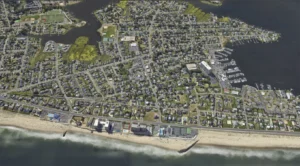
Rumson became a borough on March 15, 1907, when the legislature cut it from Shrewsbury Township, and Wikipedia lists its area at 7.11 square miles, of which 2.05 square miles is water. The Navesink and Shrewsbury rivers border the old estates, Rumson Road runs through town as County Route 520, and the borough sits about 36 feet above sea level. Tree health management in Rumson begins with that setting, because water, wind, and old plantings shape how every tree here ages.
The borough’s own Shade Tree Commission page says the original tree resource was mostly native oak and beech forest, and that the borough is now over 90 percent developed. What remains is a mix of surviving forest trees, estate plantings from the summer colony years, and newer yard trees. Our tree health management service and our tree risk evaluation work both start by reading which of those groups a tree belongs to, because each group tends to show trouble in a different way.
After almost 30 years working throughout Monmouth County, we have seen that late fall is the best moment to judge a canopy for health. The leaves have come down, structure is visible, and the problems of the growing season have left their marks on bark, buds, and branch tips. A tree that looked acceptable in July can reveal thin crowns, dead wood, and wounds that a full canopy hid, and that evidence is easiest to read before winter weather arrives.
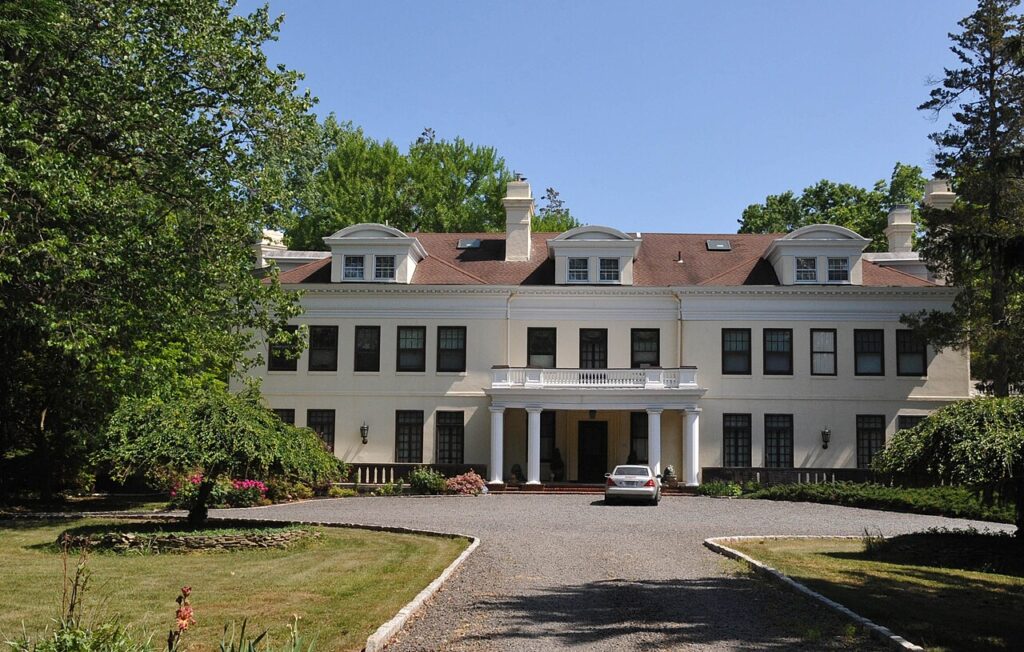
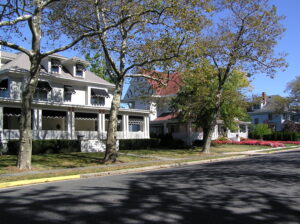
The photograph above shows a Colonial Revival estate house in Rumson framed by mature shade trees, with weeping specimens flanking the gravel drive. Houses like this one are typical of the summer colony that Wikipedia describes, when wealthy New York bankers and industrialists built along the rivers around 1900. A century later the trees planted for those properties are often the largest living things on the lot, and they are doing their work close to roofs, drives, and gates.
Rumson’s exposure is a mix of river wind, saturated low ground near the water, and the open sky over large lawns. A large tree on an open lawn catches wind from every side, and a tree near a riverbank stands in soil that holds water longer after heavy rain. Both conditions add stress on top of age, which is why tree health management in Rumson has to look at the site as well as the tree. Our guide to weak tree roots explains the base level warning signs, and our guide to hidden tree rot explains why a green crown can sit above a trunk that is failing inside.
Beech Leaf Disease Is the Health Problem Rumson Owners Can Check From the Ground
Beech is the first species we think about in a borough that began as oak and beech forest. Beech leaf disease is caused by a nematode, a microscopic worm, that lives in the leaves and buds of beech and does not infect the woody tissue, according to the Rutgers fact sheet on the disease. The sheet says the disease was first discovered in Ohio in 2012 and has since spread to several states. It is a leaf problem first, but a repeated leaf problem becomes a whole tree problem.
The Rutgers Plant and Pest Advisory reported in December 2021 that the disease was first found in New Jersey in 2020 and had been confirmed in ten counties, Monmouth among them. That is a regional fact, not a report about any one yard in Rumson, and we do not claim that any particular tree here is infected. What it does mean is that an owner with a beech should know what to look for, because the early signs are easy to miss from a distance.
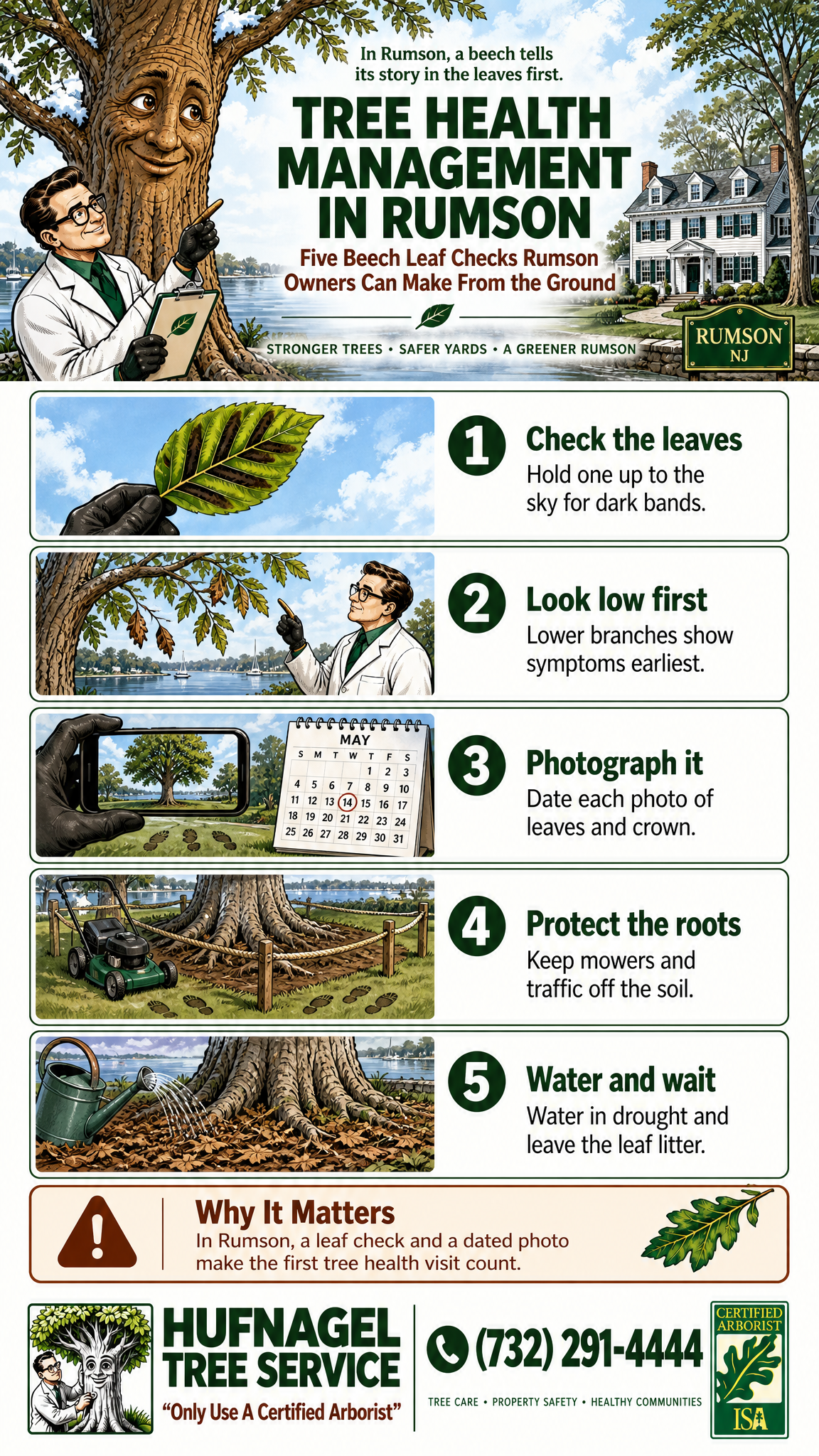
The Rutgers sheet says infected bands between the parallel leaf veins look opaque against the translucent healthy tissue, and it advises holding a leaf up to a light source such as the sky. That check takes a minute and needs no tools. Banded leaves can become thickened, hardened, and sometimes yellowed, and heavily infected leaves become malformed, shriveled, and shed. Because defoliation usually starts in the lower canopy and moves upward, the lowest branches are where an owner should look first.
The same sheet describes what happens over time. Later buds can be smaller, stunted, or aborted, crowns thin, and branches die back. It says mortality can occur within one to two years in small saplings and within six to ten years in large mature trees. That timeline matters for estate beeches, because a mature tree has years in which a response can still be planned. A thinning crown is a reason to start documenting, not a reason to assume the worst.
Treatment is a conversation for a professional, and the Rutgers sheet is careful about it. It describes thiabendazole, injected at the root flare, as currently the most effective option, best used on beech larger than ten inches in diameter with less than 50 percent dieback, and applied only every other year, with June the best timing in New Jersey. It also says pruning and raking leaves have not been shown to prevent the disease. Whether a given beech is a candidate depends on size and condition, which is exactly what an assessment establishes.
Mike Hufnagel puts the beech rule this way: “A beech with odd leaves is not a tree to guess about. We look at the leaves, the crown, and the roots together, and we tell the owner what we see before anyone talks about doing anything to the tree.” That keeps the visit about evidence. It also gives an owner a simple order of operations, which is to look at the leaves, photograph them, and then call, rather than reaching for a ladder.
Five Beech Leaf Checks Rumson Owners Can Make From the Ground
- Hold a leaf up to the sky and look for dark bands between the veins.
- Check the lowest branches first, where defoliation tends to begin.
- Photograph leaves, buds, and the crown with the date each season.
- Keep mowers and foot traffic away from the root zone under the canopy.
- Water a stressed beech during drought and leave fallen leaf litter in place.
The watering and leaf litter advice comes from the Rutgers sheet, which also suggests protecting any underplanted native trees from deer. None of these steps cures a tree, and we do not pretend they do. They reduce avoidable stress while the tree is assessed, and they leave the owner with a record that makes the next decision easier. A beech is only one species on a Rumson lot, so the next question is who looks after the trees around it.
Most Rumson Trees Stand on Private Land, So Owner Records Matter

Rumson draws a clear line between public and private trees. The borough’s Shade Tree Commission page says the commission oversees the regulation, planting, care, and control of shade and ornamental trees and shrubs in borough highways, parks, and parkways, and it excludes county highways. Members are appointed by the Mayor and serve without pay. The page also links to a tree removal application, and the Borough Hall number is on the same page for questions about which rule applies.
The commission’s about page says it was formally established in 1962, and that the majority of the borough’s tree resources lie on private property. That is the fact that shapes our work most. A borough with this much development and this much private land depends on owners to notice problems early, since no one is walking each estate looking up. Our earlier article on tree protection in Rumson covers the permit side of that responsibility.
The same page says public trees are mainly twelve species along roadway rights of way, and that Rumson has been recognized as a Tree City USA for 29 consecutive years. A Tree City record reflects a borough that plans for its trees, and the page lists an ongoing maintenance program, ordinance revisions, public education, and training among its goals. Owners can support that effort by keeping their own trees in good condition, especially along the street edge where a private tree and a public one share a view.
The page also notes that in 2019 a resident’s tree of roughly 250 years, a ginkgo, was named the New Jersey State Champion. We mention it because it shows what a well kept tree can become in this soil and climate. A champion tree does not appear by accident. It survives because owners over many decades protect the roots, avoid severe pruning, and respond to changes, which is the same set of habits we ask of every Rumson homeowner with a mature tree.
A health visit goes faster and teaches more when the owner arrives with a history. Dated photographs from the same spot each season show a lean, a thinning crown, or a new crack far better than memory does. Notes about construction, trenching, or grade changes near the roots are just as useful, because root damage often shows up in the crown years later. We use those records to separate slow, natural change from change that deserves attention now. Our guide to codominant stems shows one structural finding that photographs capture well.
When a tree touches a service wire, or a limb hangs in the crown after a storm, the answer is different. Stay clear, never climb or cut it yourself, and call the utility about any wire contact. Our article on storm season risk assessment explains how we rank what to look at first, and our guide to tree removal permits explains how borough rules usually work when a tree must come out.
Tree Health Records Rumson Owners Should Keep Before a Visit
- Dated photographs of the whole tree from the same spot each season.
- Close photographs of leaves, bark wounds, cracks, and any fungus on the trunk.
- Notes on trenching, paving, or fill placed near the roots in recent years.
- A list of what sits under the canopy, such as roofs, drives, and walks.
- Any borough notice, application, or permit paperwork that mentions the tree.
These five items cost an owner little, and they turn a first visit into a useful assessment. They also help when the borough or a neighbor asks questions, because a dated record is a fact, not an impression. Once the history is clear, the next job is to look at the tree itself, and late fall is a good time to do that, because the structure of a hardwood is bare and easy to read.
Winter Is a Sensible Time to Turn Health Findings Into Pruning and Restoration
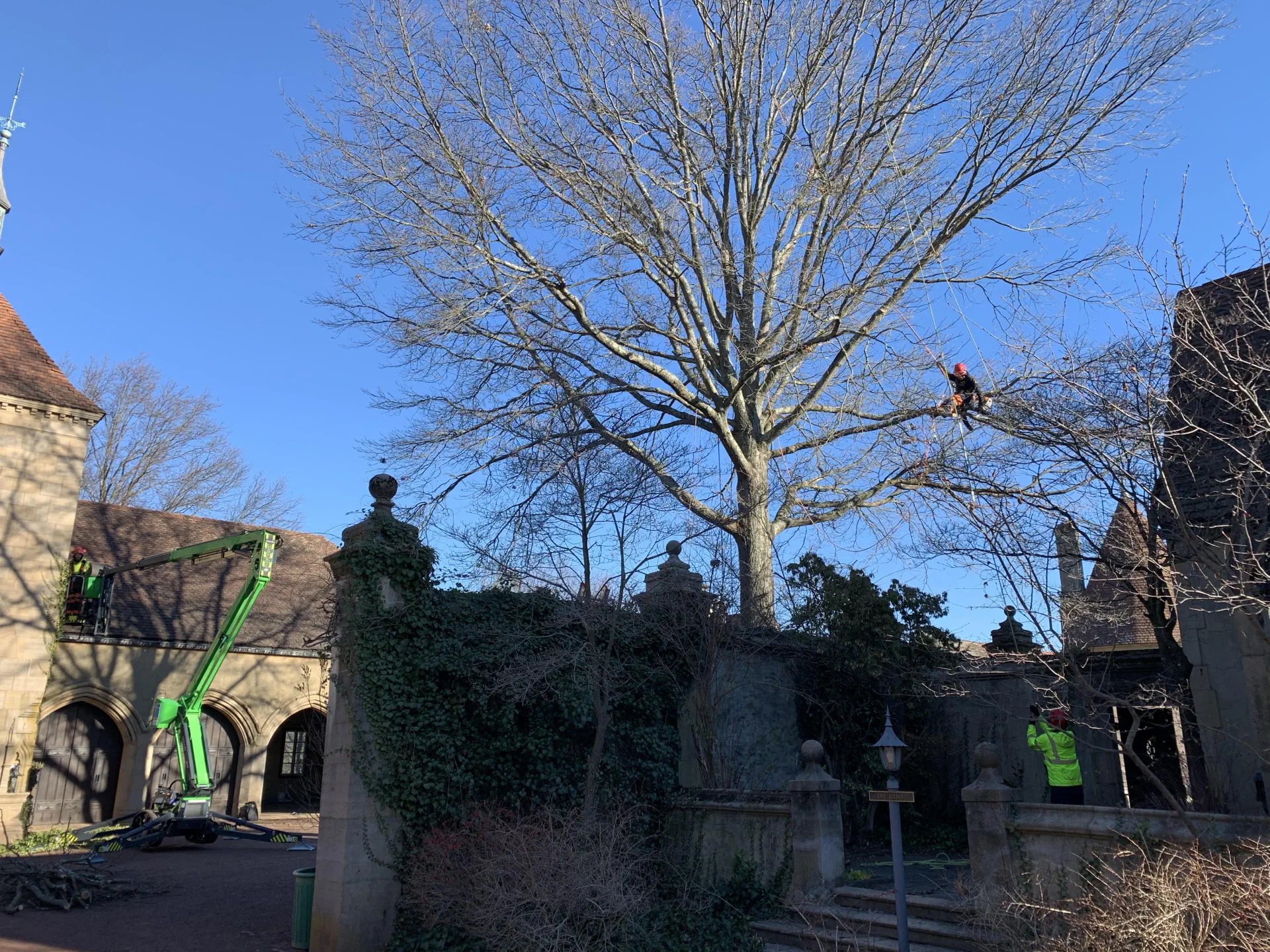
A bare canopy tells an arborist a great deal. With the leaves down, we can follow each limb back to its union, see where two stems press together, and spot dead wood that was hidden in summer. Dieback at the branch tips, a thin upper crown, or a patch of missing bark each points to a different cause. That is why tree health management in Rumson often comes down to reading the whole tree rather than one symptom.
The root zone gets the same attention. Rumson’s lots are large, and owners understandably like to improve them, but trenching for irrigation, new patios, and driveway work all cut or bury roots. A tree can lose a share of its roots on one side and look normal for a few seasons before the crown shows it. We look for soil changes, buried flare, and mulch piled against the trunk, and we ask what has changed on the lot since the tree was last healthy.
Some trees need only monitoring. Others need targeted pruning, restoration after a storm has taken a limb, support for a weak union, or removal when decay or root movement leaves no responsible alternative. Not every defect means removal, and we do not try to “thin a tree out” as a blanket prescription. The goal is not to make a tree smaller. The goal is to remove the specific dead wood, weight, and defect that a storm would find first.
Our tree trimming and pruning work follows from the findings. A long limb with heavy weight at its tip over a roof, a dead branch over a drive, or a crossing pair of limbs rubbing each other can each be corrected with a reasoned cut, and we explain the purpose of the cut before it is made. We never top a tree, because topping weakens structure and invites decay. Dormant weather is a practical time for this work because the cuts are easy to plan with the canopy bare.
After a storm or a hard season, tree restoration can repair a damaged crown by cleaning up torn wounds and encouraging sound regrowth. Where a sound tree has a weak union worth keeping, support such as cabling can be considered. And when a tree has decayed at the base or its roots have moved, tree removal is a safety decision, not a failure of tree care. We explain which of these applies and why, and we say plainly when a tree should simply be watched.
Winter weather tests all of this. A tree with a thin crown and stressed roots carries wind and wet snow less well than a vigorous one, and a Nor’easter in November can find a weakness that was already there. Our tree storm proofing approach and our health assessments share the same logic, which is to find the defect before the weather does. Healthy structure is left alone, and the work is limited to what changes the outcome.
Practical Tree Health Options for Rumson Properties
- Monitoring with dated photographs for trees that show change but no danger.
- Targeted pruning to remove dead wood and weight over roofs, drives, and gates.
- Root zone care that keeps mulch back from the trunk and traffic off the soil.
- Restoration or support for storm damaged limbs and weak branch unions.
- Removal only when decay or root movement leaves no responsible alternative.
No tree service can honestly guarantee that a tree will never fail in severe weather. What a good plan can do is reduce predictable risks, document the tree, and keep what is healthy. In Rumson that also means respecting the borough process and the people who care for its public trees. With a plan in hand, the only remaining decision is timing, and the quiet months of winter are a sensible time to act.
Call Hufnagel Tree Service for Tree Health Management in Rumson Before Winter Weather
If you have mature trees near your Rumson home, driveway, gate, or river facing lot, schedule an assessment before winter storms arrive. We provide tree health management, tree risk evaluation, tree trimming and pruning, restoration, and removal when a tree cannot be managed safely.
Hufnagel Tree Service is led by a certified arborist with almost 30 years of local experience and more than 280 five star Google Maps reviews. We inspect first, explain what we found in plain terms, and recommend only the work that changes the outcome for your trees and your property.
Call or text (732) 291-4444 to schedule a tree inspection and a plan for tree health management in Rumson before the next Nor’easter arrives. Our Rumson tree articles list more local guidance.
Schedule Service Now!
From precision pruning and safe removals to health assessments and preventative care, Hufnagel Tree Service delivers expert solutions backed by decades of experience. We offer certified insight, fair pricing, and a commitment to doing what’s best for your landscape.
Learn More About Our Services
Related Articles
Matawan Tree Storm Damage: What Summer Wind Leaves Behind

Winter Storm Proofing Trees in Sea Bright NJ: Get Prepared