Root Flare Care in Allenhurst NJ: Mulch, Grade, and Historic Street Trees

Allenhurst’s shade trees stand close to porches, walks, and Deal Lake, and mulch or fill can bury the root flare. Learn what to check at the base of a tree.
Share This Article

Contents

Root Flare Care in Allenhurst Begins in a Small Historic Borough

Allenhurst is one of the smallest boroughs on the Monmouth County shore, and its trees have been part of the plan from the start. According to Wikipedia, the Coast Land Improvement Company bought Abner Allen’s 120 acre farm in 1895 to build a resort community, and the borough was incorporated on April 26, 1897, from part of Ocean Township. It covers only 0.28 square miles, including water, and counted 472 residents in 2020.

That small footprint shapes how we think about root flare care in Allenhurst. The large shade trees here stand a few steps from porches, sidewalks, curbs, and driveways, so every foot of soil around a trunk gets used for something else. Mulch, fill, pavers, and edging pile up against those trunks over the years, and the part of the tree that matters most, the root flare, is often the first part to be buried. Our tree health management work starts by looking at exactly that spot.

After almost 30 years working throughout Monmouth County, we have seen how a tree can look healthy from the street while it struggles at the base. Late fall is a good time to check, because the leaves are coming down, the weather is calm, and a problem found now can be corrected before winter wind and wet snow put a load on a weakened tree.

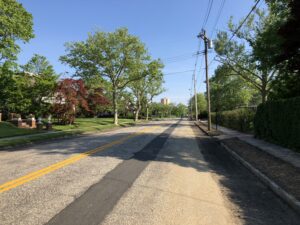
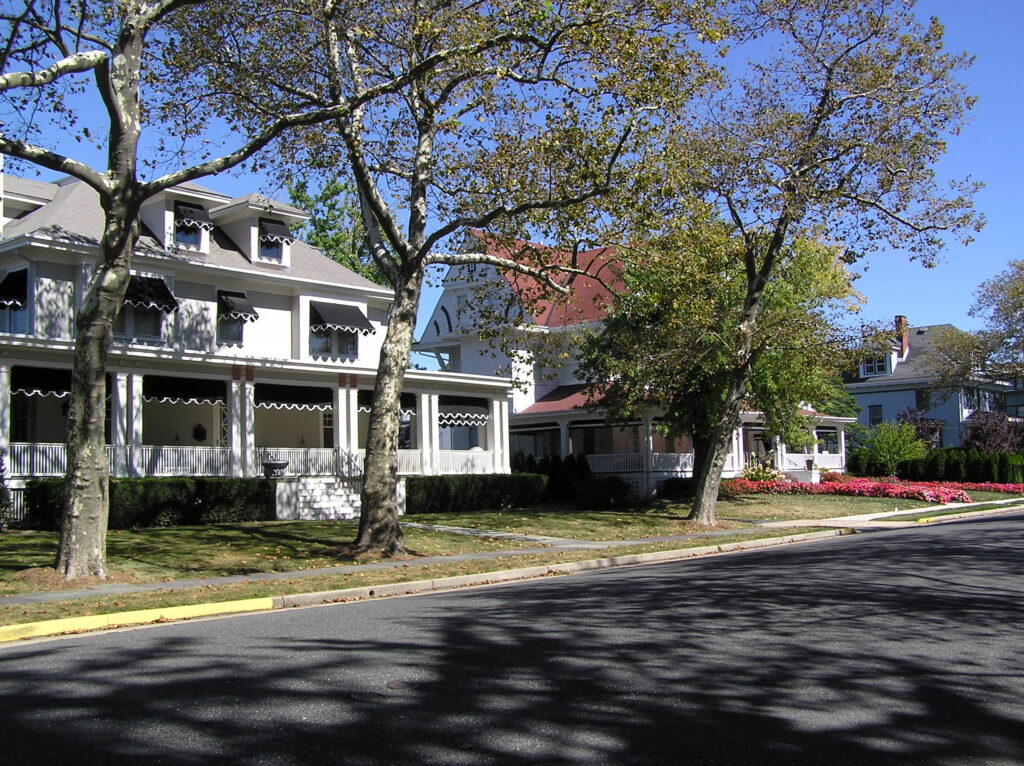
Large shade trees along a street of Victorian porch houses in the Allenhurst Residential Historic District under a blue sky
Mature shade trees in front of porch houses in the Allenhurst Residential Historic District. Photo: Apc106, CC BY-SA 3.0, via Wikimedia Commons.

The photograph above shows part of the Allenhurst Residential Historic District, where mature shade trees line the street in front of wide porch houses. The National Park Service record for the district lists the periods 1875 to 1949 and the Late Victorian and revival styles, and Wikipedia counts 412 contributing buildings in a district bounded by Cedar Avenue, Hume Street, Elberon Avenue, Main Street, and the ocean. Houses of that age tend to have trees of the same era beside them, and those trees have had a long time to collect changes at their bases.

Water is part of the story too. The Deal Lake Commission, chartered in 1974 by the seven shoreline towns, says the lake covers about 158 acres with 12.5 miles of shoreline, and Allenhurst has its own section of that shore. Soil that stays wet is where a buried root flare does the most harm, and a borough with the ocean on one side and a lake on the other has plenty of damp ground. We keep that in mind whenever we look at an older tree here.

Root Flare Starts Where the Trunk Meets the Soil

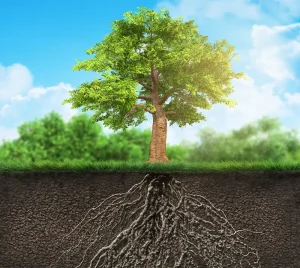
The root flare is the area at the base of the trunk where the top roots emerge, which is why it is also called the trunk flare or root crown. The University of Maryland Extension explains in its post Free the Flare, written by Christa Carignan in January 2024, that a healthy tree should visibly widen as it meets the ground. When it does not, something is usually covering it.

A buried flare is a quiet problem. The same post says stem girdling roots can form unnoticed when the flare is buried, growing around the trunk instead of outward and squeezing the tissue that carries water and nutrients. Yellowing leaves, smaller leaves, scorch, dieback at the branch tips, and bark cracking can follow, and the stressed tree becomes more attractive to pests. By then the cause is hidden under mulch or soil, which is why the crown so often gets blamed first.

Montana State University Extension describes the same pattern in its guide to deep planting and grade change. It says the most obvious sign is a trunk that does not widen where it meets the soil, and that trees set too deep tend to lack vigor and have a shortened life expectancy. It lists premature leaf drop, wilting, scorch, yellowing, and stunted growth, and it notes that digging out the trunk often turns up girdling roots.

That is why root flare care in Allenhurst begins at ground level and not in the canopy. We start by kneeling at the trunk, pulling back any mulch by hand, and finding where the trunk actually meets the roots. Then we follow the major roots outward and look at the soil around them for raised ground, cracks, or fresh movement. Only after that do we look up into the crown, because the top and bottom of a tree are connected, and the bottom usually tells us more.

Targets still decide how urgent a base problem really is. A tree with a hidden defect beside a porch roof, a sidewalk, or a neighbor’s fence has very little room to fail safely. Our tree risk evaluation measures what a defect could reach, and a trunk that looks sound from the curb can still need a close look at its base. We explain how weak roots show themselves in our guide to weak tree roots, and the signs overlap with what a buried flare produces.

The University of Maryland post adds that maples are especially prone to girdling roots, so any maple with a straight sided base deserves a second look. Mike Hufnagel puts it simply: “A tree is only as sound as the spot where it meets the ground, and that is the spot homeowners bury first. Uncover it before you worry about anything above it.”

What We Check at the Base of Allenhurst Trees

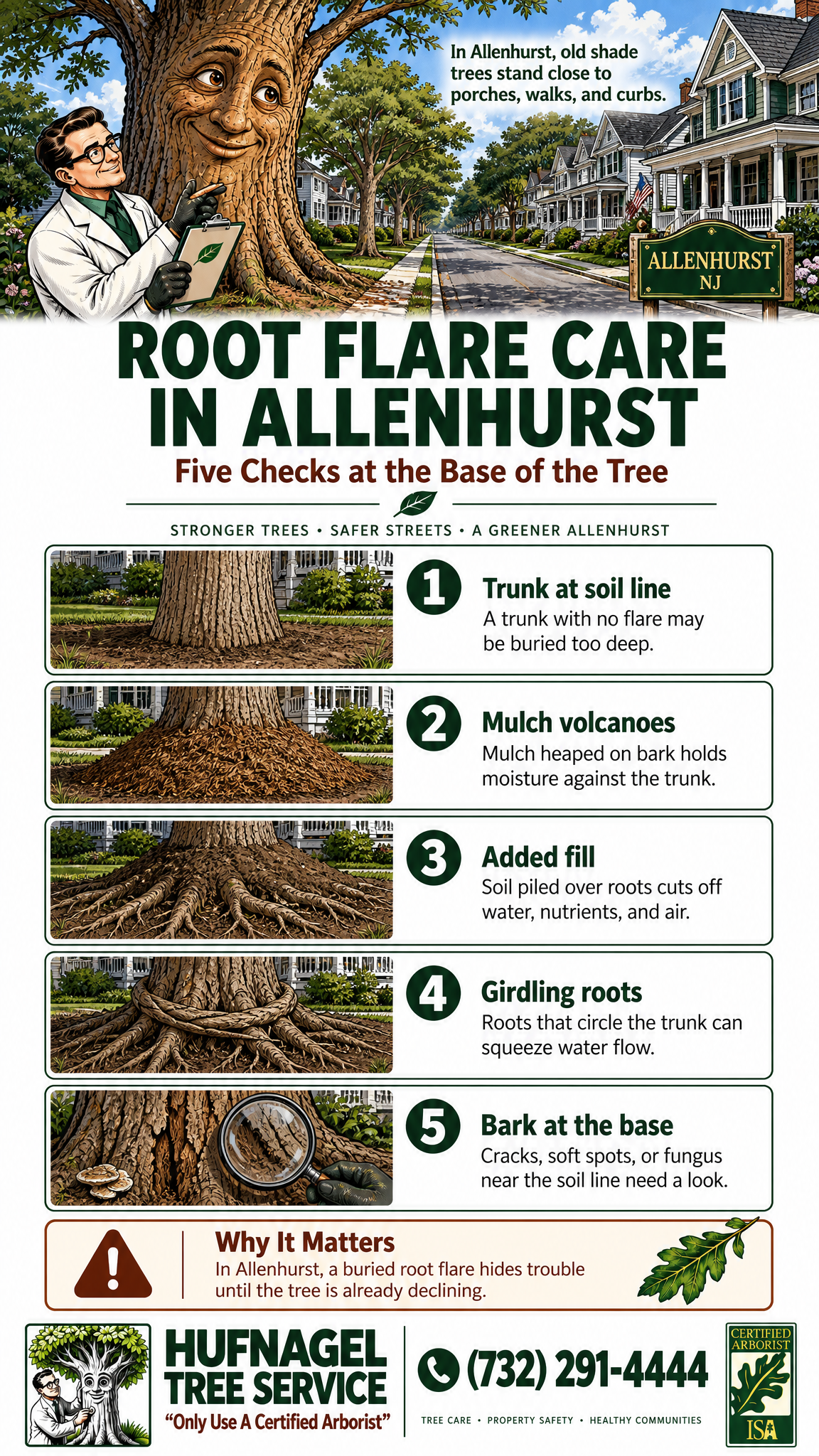
  • Whether the trunk widens at the soil line or drops straight down like a post.
  • Mulch piled against the bark or heaped higher than a few inches.
  • Soil or fill added over the roots since the tree was planted.
  • Roots that circle or cross the trunk instead of growing outward.
  • Cracked bark, soft spots, or fungus close to the soil line.

No single item on that list decides a tree’s future, and many trees show none of them. When we do find one, the answer is usually some mix of uncovering the base, adjusting the mulch, pruning, monitoring, or, when the tree cannot be made safe, removal. What matters most is that the base gets looked at before anything else is done, and that leads straight to the question of what has been piled around it.
Mulch, Fill, and Grade Changes Decide What Roots Can Breathe

Mulch is the most common reason a flare disappears, and it is almost always applied with good intentions. The University of Maryland post recommends a gap of 3 to 12 inches between the mulch and the trunk, a mulch depth of about 2 to 4 inches, and a wide, shallow ring instead of the heaped mounds that rise a foot or more around the trunk. Those mounds are often called mulch volcanoes, and they look tidy from the street while they bury the part of the tree that needs air.

The damage is not only cosmetic. The same post says excess mulch buries the flare and encourages roots to grow from the trunk, and it lists lower bark rot, reduced oxygen to the roots, and more disease and pest pressure among the results. A tree that is already dealing with drought, compaction, or road salt has less to spare, so a small mulch habit can decide how well it handles the next hard season. We covered those other stresses in our fall tree care article for Allenhurst.

Fill and grade changes cause the same problem on a larger scale. The Montana State guide says most tree roots grow in the top six inches of soil, where water, nutrients, and air are most available, and that excess soil added on top limits the tree’s access to all three. It also says nearby landscape construction and grade changes can leave a tree sitting too deep. On small lots, a new patio, a walkway, or a raised bed is often built within a few feet of a trunk, and the soil has to go somewhere.

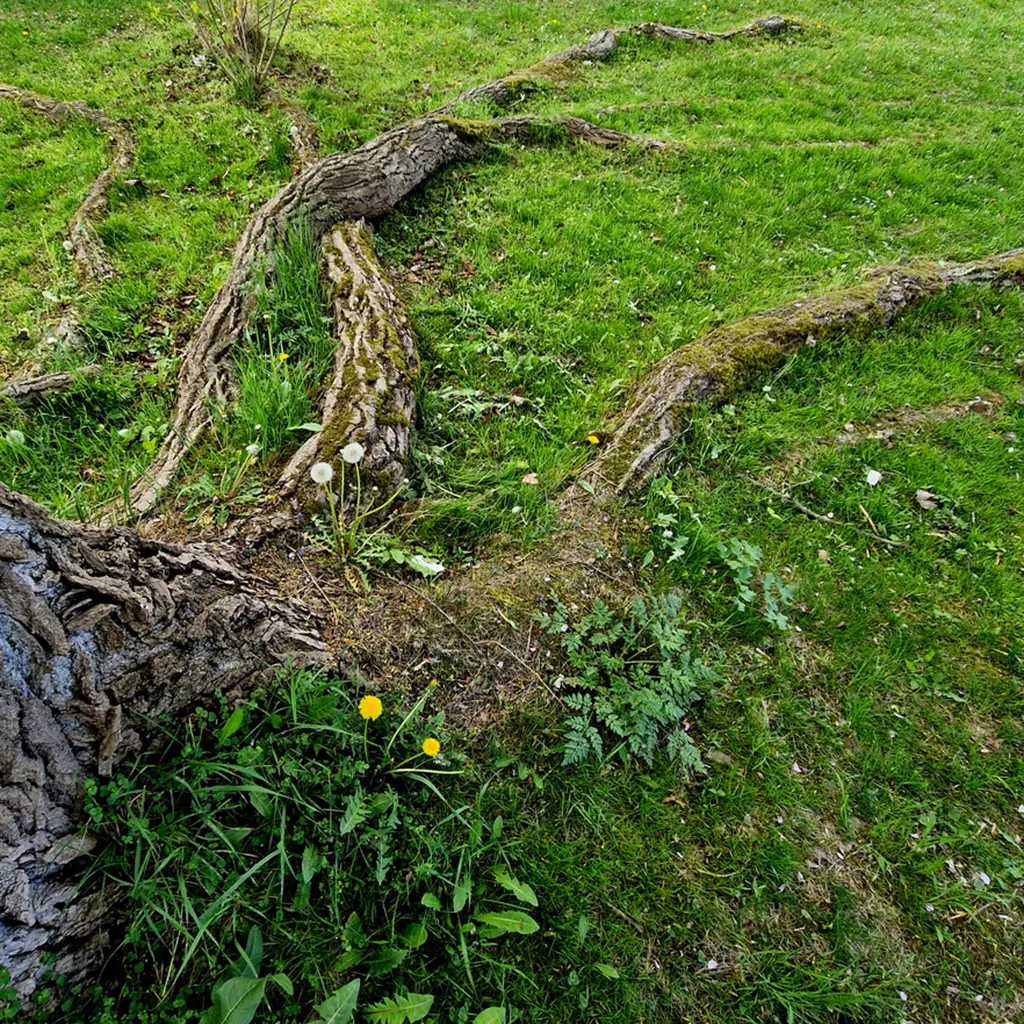
The photograph in this section shows large surface roots running across a lawn from the base of a trunk. Roots like these are normal on many older trees, and they are a reminder of how much of a tree’s anchor lives right under the surface. When that ground is covered with fill, compacted by equipment, or cut for a new edging, the roots lose the air and water they depend on. We look at the lawn around a trunk as carefully as we look at the trunk itself.

Established trees have a remedy when the flare is already buried. Montana State recommends a root collar excavation, which means removing the excess soil and mulch around the trunk down to the point where it flares into root growth. That work needs a plan, because digging near the roots of an old tree can injure them, and it is a good reason to call an arborist before anyone picks up a shovel. Newly planted trees that were set too deep may be better lifted and replanted, according to the same guide.

We also pay attention to what a buried base can do to a tree’s stability. A tree whose roots have been starved or girdled may anchor less well than it looks, and we take that into account when we judge how it will handle wind and wet soil. Our tree storm proofing starts with the same ground level questions, because a storm tests the root system long before it tests the crown.

Ground Level Habits That Protect the Root Flare

  • Pull mulch back so a clear gap surrounds the trunk.
  • Keep mulch about 2 to 4 inches deep in a wide, flat ring.
  • Check where the trunk meets the soil after any landscape work.
  • Keep fill, stone, and edging off the root zone of mature trees.
  • Photograph a base that looks buried and call us to have it checked.

These habits cost very little and protect the part of the tree nobody sees. A flare that stays visible gives the tree what it needs to stay anchored and to recover from storms and dry spells. The other half of the plan concerns the setting around the tree, and in Allenhurst that means old lots, hard surfaces, and a lake close by.

Historic Lots, Hard Surfaces, and Deal Lake Shape the Work

The historic setting changes how we talk with homeowners. A district listed on the National Register for its architecture invites careful work, and the trees that stand beside those houses are part of how the streets look and feel. We respect that by preserving whatever can safely be kept, and we try to explain plainly when a tree can no longer be made safe. Often the first step is simply uncovering the base and watching for a season before anything bigger is decided.

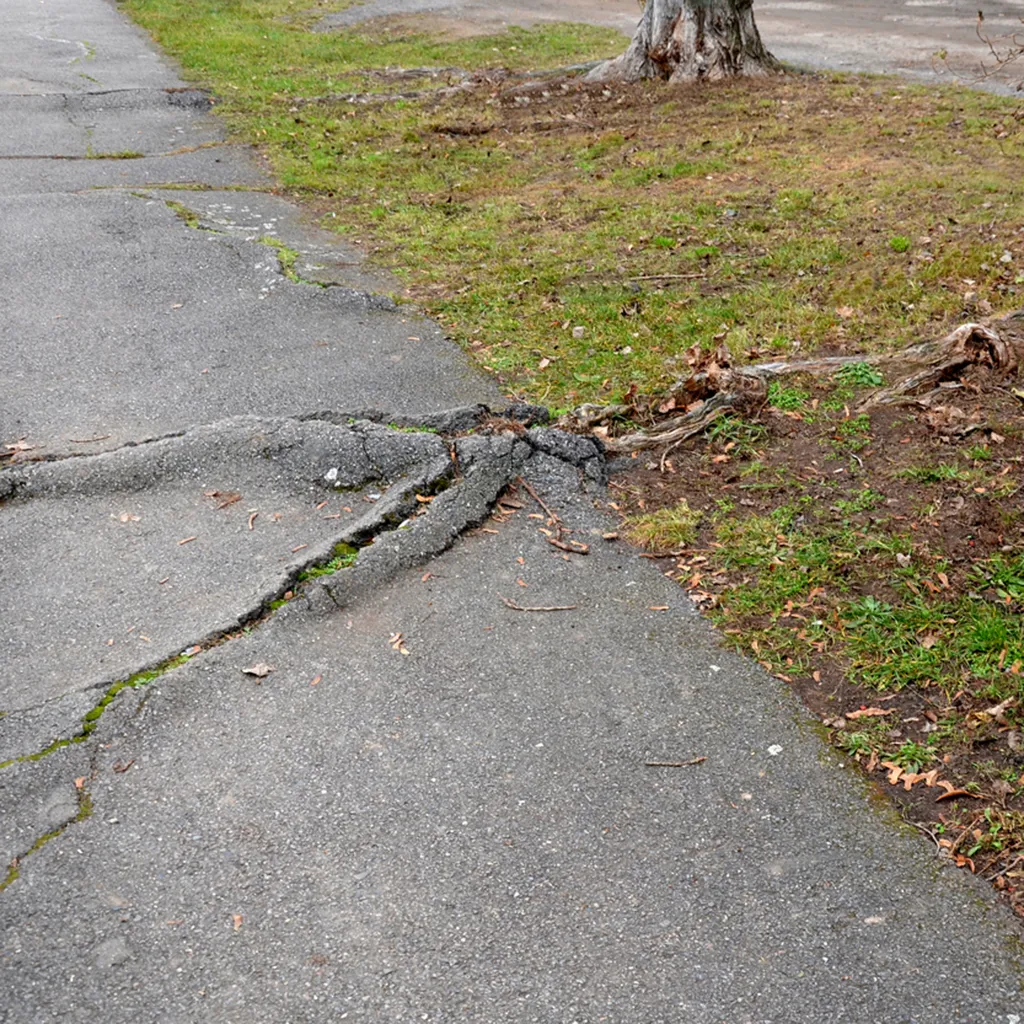
Hard surfaces raise their own questions. The photograph in this section shows a tree whose roots have lifted and cracked the pavement beside it, a scene familiar to anyone with large trees near a walk. The easy fix is to cut the offending root, but a large root cut close to the trunk can weaken the tree and open a wound that never closes. We would rather look at the whole picture, including the flare, the soil, and the paving, and recommend a repair that leaves the tree stable.

The lake adds a rule of its own. The Deal Lake Commission states that strict compliance with NJDEP regulations applies to land within 50 feet of the lake shoreline and within 50 feet of any stream draining into it, and it advises owners to contact the NJDEP before maintenance or construction along the shore. We are not lawyers and we do not give legal advice. A homeowner with a tree near the water should ask the state first, and we plan our work around the answer.

Large trees near the shore do fall. The commission’s page on tree removal after Superstorm Sandy says it hired a contractor to remove a large oak that had blocked the right of way west of the railroad tracks in the Allenhurst section of the lake. A tree like that was not a surprise to the people who lived near it, and a close look at the roots is often the best way to learn which trees are most likely to give trouble before a storm arrives.

Dormant season timing helps with all of it. With the leaves down, we can see the structure of a tree and the ground around it clearly, and the soil is not yet frozen. That is the right window to uncover a flare, adjust mulch, and decide whether a few pruning cuts will reduce the load on a stressed tree. Our tree trimming and pruning follows one rule, which is that every cut has to have a purpose. We also wrote about summer trimming in Allenhurst and Deal for the other side of the year.

Decay and weak unions are the other things a close look can turn up. A base that has been buried for years can hide rot, and we explain how that works in our guide to hidden tree rot. Multi stem trees add their own risk at the fork, which we cover in our guide to codominant stems. If a tree must come down, our guide to tree removal permits explains the general process, and the borough is the place to confirm its own rules.

Questions We Answer Before Working Near an Old Allenhurst Tree

  • Does the trunk widen at the soil line, or has the flare been buried.
  • Has fill, mulch, or paving been added over the roots in recent years.
  • Would a repair to a walk or edging require cutting a major root.
  • Does the tree stand within 50 feet of the Deal Lake shoreline.
  • Is the tree close enough to a porch, wire, or roof to raise the urgency.

Those five questions keep the work honest. They slow us down just enough to avoid a wrong cut or an unnecessary removal, and they make sure the homeowner understands why each step is recommended. A good plan for an Allenhurst property is short, specific, and tied to what the trees actually need. It often involves uncovering something and leaving the rest alone, and when the plan is ready, the last step is getting it scheduled.

Call Hufnagel Tree Service About Root Flare Care in Allenhurst

If you have mature trees near your Allenhurst porch, walkway, driveway, or lakeside lot, schedule an evaluation before winter weather adds load. We provide tree risk evaluations, tree health management, pruning, restoration, and removal when a tree cannot be managed safely. You can also read more local articles in our Allenhurst category.

Hufnagel Tree Service is led by a certified arborist with almost 30 years of local experience and more than 280 five star Google Maps reviews. We inspect first, explain what we found in plain terms, and recommend only the work that changes the outcome for your trees and your property.

Call or text (732) 291-4444 to schedule root flare care in Allenhurst before the first coastal storm arrives.

Schedule Service Now!

From precision pruning and safe removals to health assessments and preventative care, Hufnagel Tree Service delivers expert solutions backed by decades of experience. We offer certified insight, fair pricing, and a commitment to doing what’s best for your landscape.

Where Do You Need Service?
Please Enter Your Contact Information
Are You A New or Existing Customer?
How Can We Help You?

Thank You!

Your Message Has Been Sent

We Will Contact You About Your Inquiry Shortly.

We Could Not Find A Direct Link To A Tree Removal Permit Application For The Town You Selected.

Please contact your local municipality to determine if a permit is required for your tree removal project. They will provide you with the most accurate and up-to-date information.