Contents
Hidden Tree Rot in Deal Starts Where Big Trees Meet a Fully Built Borough
Deal was incorporated as a borough on March 7, 1898, from part of Ocean Township, according to Wikipedia. The borough’s own history page says Deal stayed a farming and fishing settlement until the latter part of the nineteenth century, and that by the early 1890s developers had bought the land and laid out a residential community with very little commercial space. Norwood Avenue, the old turnpike, now serves as the Main Street of the town.
That layout shapes how we think about hidden tree rot in Deal. The borough covers about 1.32 square miles, the 2020 census counted 900 residents, and the town comes alive in summer around the Deal Casino and Conover Pavilion. Any mature tree in a fully built borough has had many seasons to collect wounds, old pruning cuts, and root disturbance, and our tree risk evaluation work starts with what each tree could reach if it failed.
After almost 30 years working throughout Monmouth County, we have seen that a tree can look full and green while decay hollows its trunk or base. Fall is a good time to look, because leaves still help us read the crown and winter weather has not yet added its load.
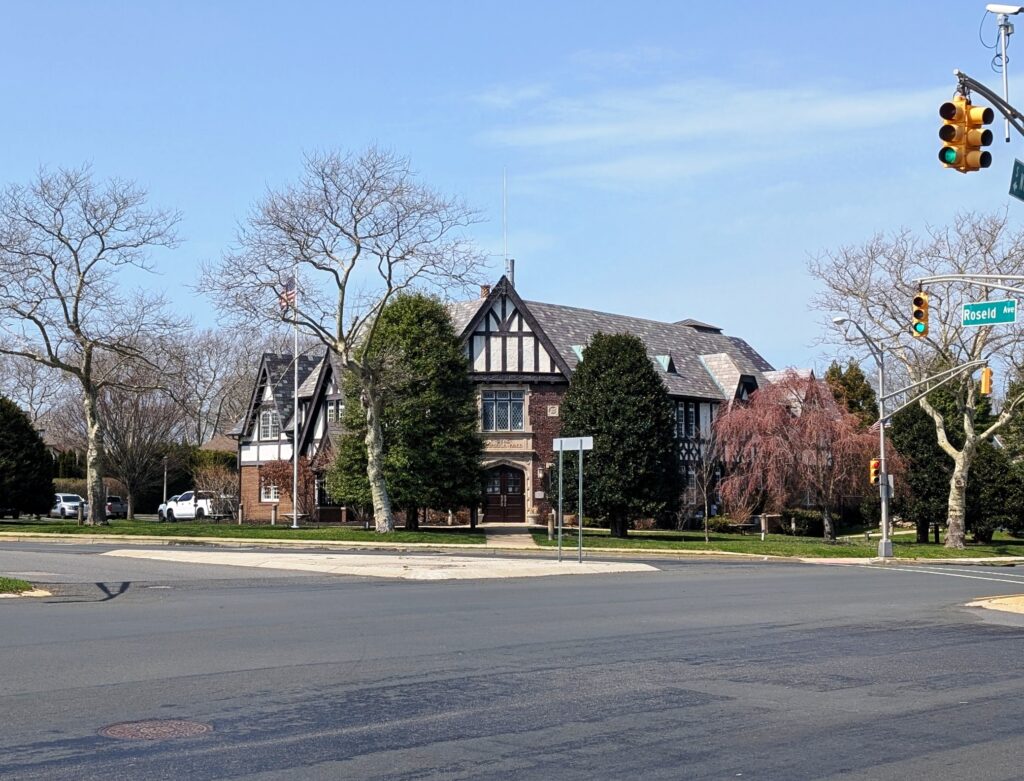
The photograph above shows Deal Borough Hall at 190 Norwood Avenue, a Tudor style building with large mature trees standing in front of it and at the corner. It was taken in April, before the trees leafed out, and the bare crowns show the branch structure we read first. It also shows what many Deal lots look like: big trees close to a building, a road, and a sidewalk, with very little room to spare.
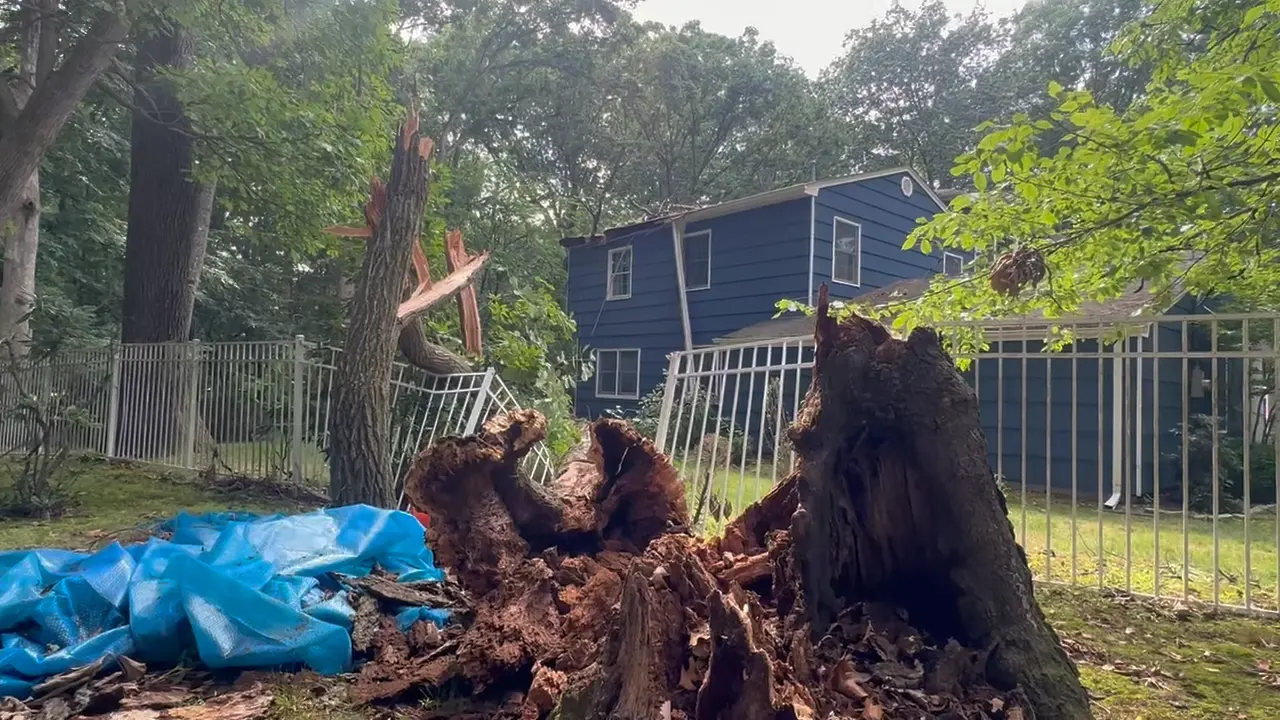
Deal sits on the Jersey Shore, so its trees take the same coastal wind as every other shore town. Wind does not cause decay, but it tests wood that decay has already weakened. A trunk with a sound outer shell and a hollow core can carry its own weight through a calm week and then fail in the first hard Nor’easter. That is the pattern we want to catch before winter, while there are still choices to make.
Decay Works From the Inside Out, So the Outside Can Mislead
The Forest Service guide How to Recognize Hazardous Defects in Trees says a tree usually decays from the inside out, eventually forming a cavity, while sound wood keeps being added to the outside as the tree grows. The same guide says trees with a sound outer shell may be relatively safe, depending on the ratio of sound to decayed wood and on any other defects present. It also says that decay, by itself, does not make a tree hazardous.
We agree with that, and it shapes how we work. Decay alone is not a reason to condemn a tree, and a tree with a hollow core can stand for many more years when the shell is thick and the crown is managed. But the outside of a tree can mislead a homeowner in both directions. A trunk can look rough and be sound, and it can look smooth and carry a column of rot behind the bark.
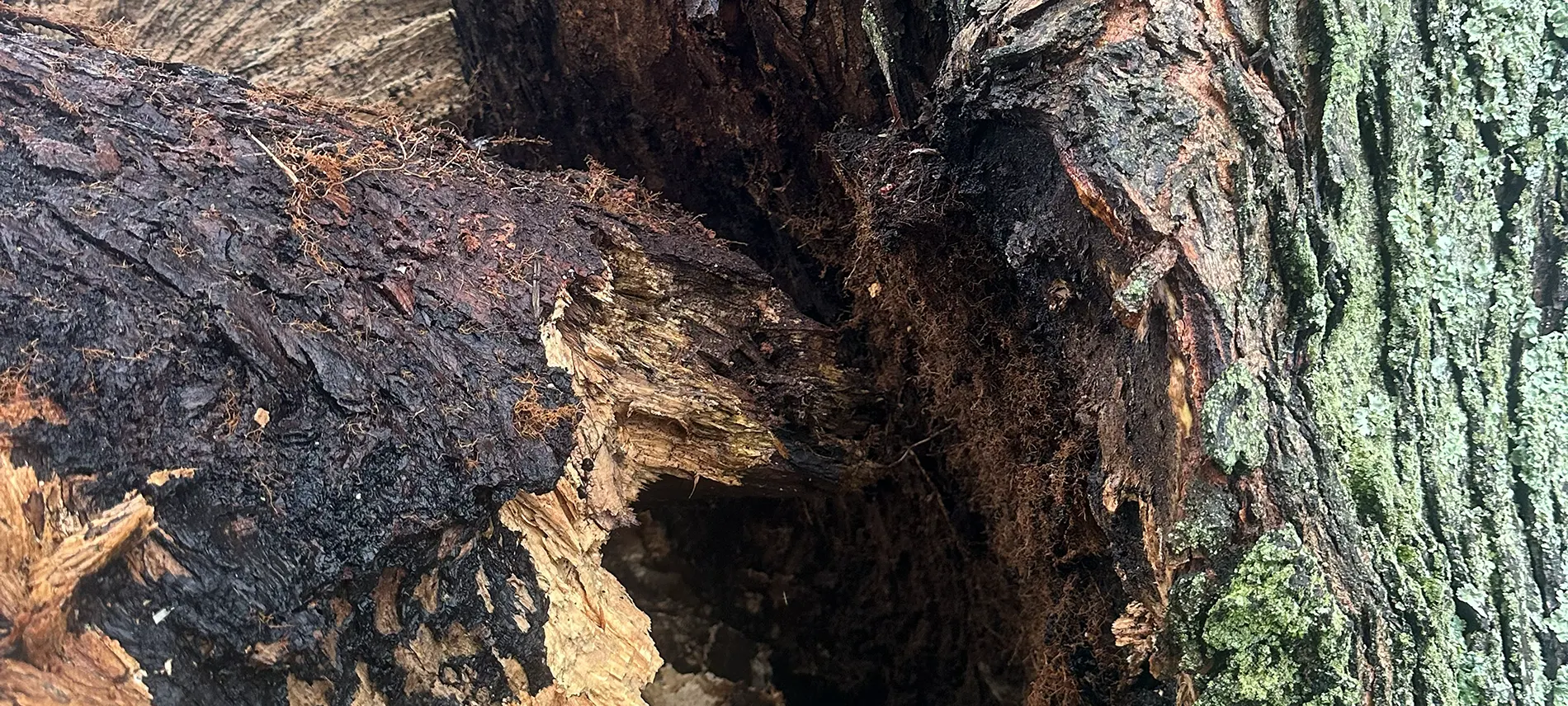
The guide describes advanced decay as wood that is soft, punky, or crumbly, or a cavity where the wood is missing. It names mushrooms, conks, and brackets growing on the root flare, the stem, or the branches as signs of advanced decay. A conk is the shelf or bracket shaped fruiting body of a fungus, and it tells us the fungus is already established inside the wood.
The wood decay fungi fact sheet from UMass Amherst adds that wounded or weakened trees are the ones most open to invasion, and that wounds and old pruning cuts are the main way these fungi get in. It notes that many older trees that fail in storms had already lost much of their strength to decay, and that this loss is hard for amateurs to detect and difficult even for professionals to evaluate. That is a sober way to describe the job, and it is why we spend time on the base and the unions and not only on the leaves.
In a borough as fully built as Deal, the target matters as much as the decay. A weak limb over an open lawn is a different problem from the same limb over a roof, a driveway, a hedge line, or a neighbor’s fence. Every tree risk evaluation we do connects the defect to the thing it could hit, and that is how we decide whether a tree needs watching, pruning, support, or removal.
Our guide to hidden tree rot explains how a hardwood can lose its strength from the inside, and our tree health inspection piece shows a tree that failed on a clear day because the wood holding it up was already gone. Mike Hufnagel describes the problem this way: “A tree can stand through a lot of weather and still be mostly shell. The question is how much sound wood is left and what it is holding up.” That question is the reason we look at the root flare, the unions, and the ground before we recommend anything.
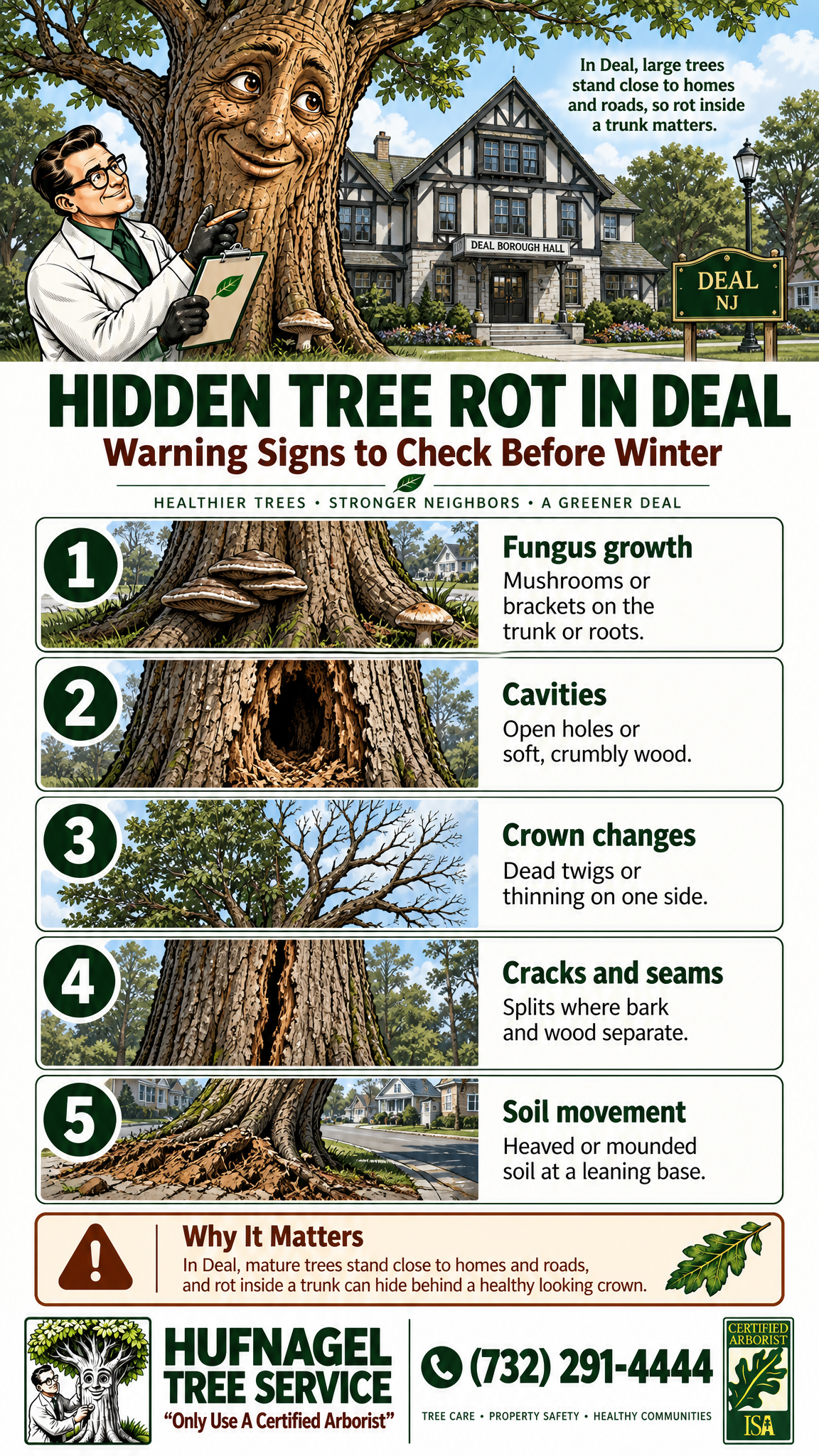
Warning Signs of Hidden Tree Rot to Check Before Winter
- Mushrooms, conks, or brackets growing on the trunk, the root flare, or major roots.
- Cavities or soft, crumbly wood where an old wound or pruning cut never closed.
- Dead twigs or thinning leaves in one part of the crown compared with last season.
- Cracks or seams where bark and wood have separated along the trunk or a union.
- Soil that has heaved, mounded, or cracked near the base of a tree that now leans.
None of these signs proves a tree is failing, and none of them calls for a homeowner to climb a ladder or pick up a saw. Look from the ground, take photographs, and compare the tree with itself next season. Some trees need only monitoring. Others need targeted pruning, restoration, support, or removal. Once we know where the decay sits, the next question is what it is doing to the structure, because a cavity and a conk tell us different things.
A Cavity or a Conk Is a Clue, Not a Verdict
The Forest Service guide is careful about when decay becomes a reason to act. It says to take action when advanced decay is associated with cracks, weak branch unions, or other defects, and when a decayed branch is large enough to cause injury. It also lists advanced decay in the root flare or buttress roots as a reason to act. Those conditions line up with what we see on mature trees: a cavity matters most when it sits where the tree carries its load.
The guide also gives a measurable threshold. It says to take action when the thickness of sound wood is less than one inch for every six inches of trunk diameter at any point on the stem. We mention the number so homeowners understand how an inspection works, not so anyone tries it at home. Measuring sound wood takes training and tools, and the guide itself says that evaluating the safety of a decaying tree is usually best left to trained arborists.
The Recognizing Tree Risk brochure from the International Society of Arboriculture makes a similar point. It says there is no such thing as a completely safe tree, and it lists mushrooms at the base and cavities among the signs worth a closer look. It also says the severity of what you see is best judged by a professional arborist, which is the step many homeowners skip.
Preservation comes first in our approach. When a decayed tree has a thick sound shell and a manageable crown, we look at ways to reduce end weight, remove deadwood, and support weak unions so the tree can stay. A tree that has lost most of its sound wood at the base is a different case, and removal is then risk mitigation and not a failure of tree care. The goal is not to remove every tree that has decay. The goal is to keep the good trees and deal honestly with the ones that no longer have a dependable structure.
Pruning can also be the cause of the problem. The guide says that topping and tipping, which cut branches back to stubs, lead to decay in the remaining stub, which then makes a very poor support for the branches that regrow. The UMass fact sheet makes the same connection between pruning wounds and decay fungi. We do not top trees, and we choose every cut for a reason, which is why proper pruning is part of keeping a tree free of rot, not a separate job.
Roots deserve the same attention as the crown, because decay at the base is often connected to injury below ground. Our guide to weak tree roots explains what we look for at the root flare. We also keep tree health management in mind during every visit, since a tree that is stressed by drought, compaction, or buried roots has less ability to wall off a wound. Our earlier look at tree risk inspections in Deal covers how we read a property before we read a tree, and the same order applies to decay.
How We Judge a Decayed Tree Before Recommending Any Work
- Where the decay sits, whether in the root flare, trunk base, main union, or a single limb.
- How much sound wood surrounds the decay compared with the diameter of the trunk.
- Whether cracks, weak unions, or a new lean are found along with the decay.
- What the tree could strike, such as a roof, driveway, hedge line, or neighboring lot.
- Whether support, lighter end weight, or monitoring can manage the risk for now.
These five questions turn a frightening word like rot into a plan a homeowner can follow. A tree with a small cavity far from any target may need only a note in the file and a second look next fall. A tree with a large cavity over a bedroom needs a different answer, and that is what a careful look at hidden tree rot in Deal is meant to sort out. Once the tree itself is understood, the next part of the decision is the paperwork, because Deal has specific rules for what can happen to a tree and what must happen afterward.
Deal Treats Hazard Trees Differently From Healthy Trees Under Its Ordinance
The borough adopted Ordinance 1293, Tree Removal and Replacement, on October 7, 2024, after first reading on September 5. The ordinance applies to street trees with a trunk diameter of 2.5 inches or more and to other trees of 6 inches or more, measured at four and a half feet above the ground. No tree covered by the ordinance may be removed until the Conservation Officer has reviewed and approved a Tree Removal Application.
The ordinance treats hazard trees differently. It defines a hazard tree as one that has an infectious disease or insect infestation, is dead or dying, blocks the view of traffic signs or the passage of pedestrians and vehicles, is causing obvious damage to structures, or is determined to be a threat to public health, safety, or welfare. It says hazard trees may be removed with no fee or replacement requirement. A tree with advanced decay over a house will often fit that definition, but it is the borough that decides, not the contractor.
The ordinance also asks for proof. Anyone claiming an exemption has to give the borough written justification, and the ordinance says that justification should include photos or statements from a New Jersey licensed tree expert or an arborist. That is where a careful inspection earns its keep, because a clear set of photographs and a plain description of the defect make the borough’s job easier. We also help homeowners with the paperwork. Our guide to tree removal permits covers the process in more general terms.
When a tree does not qualify as a hazard, the ordinance asks for replacement. The replacement has to be planted within twelve months of the removal, monitored by the applicant for two years, and replaced again if it does not survive, or the applicant pays a fee into a borough fund for tree planting. That is a good reason to ask whether a decayed tree can be preserved before anyone asks whether it can be removed.
One definition in the ordinance is worth reading closely. It says tree removal means killing a tree or causing irreparable damage that leads to its decline and death, and it names excessive pruning, over mulching, improper grading, and soil compaction within the critical root radius. The critical root radius is the trunk diameter multiplied by 1.5 feet, so a tree with a 6 inch trunk has a radius of 9 feet. Damage inside that zone can start the decline that later shows up as decay, which is why prevention and the ordinance point the same way.
Debris is the last piece. The public works page says the borough does not provide leaf and brush pickup, and the yard waste ordinance says yard waste, which it defines to include trees and branches, may not be placed in the street. A removal or a large pruning job in Deal therefore needs a plan for hauling everything away. Hauling is a detail every homeowner should settle with any contractor before the job begins, and we go over it before any work starts.
What to Have Ready Before Any Tree Work in Deal
- Photographs of the defect from several angles, taken from the ground and from a safe distance.
- The approximate trunk diameter measured at four and a half feet above the ground.
- Whether the tree stands in the street planting strip or on private property.
- Any written findings from a certified arborist or a New Jersey licensed tree expert.
- A plan for hauling debris, because yard waste cannot be left in the street.
None of this replaces a call to the borough, and the ordinance is the final word on what applies to a specific tree. What we can do is make sure the tree is understood before anyone commits to a cut. Some trees with hidden rot can be kept, some need work, and a few need to come down. With hidden tree rot in Deal, the right answer starts with finding the decay before the weather does.
Call Hufnagel Tree Service About Hidden Tree Rot in Deal Before Winter
If you have mature trees near your Deal home, driveway, hedge line, or property edge, schedule an evaluation before winter weather arrives. We provide tree health management, tree risk evaluations, pruning, storm proofing, restoration, and tree removal when a tree cannot be managed safely.
Hufnagel Tree Service is led by a certified arborist with almost 30 years of local experience and more than 280 five star Google Maps reviews. We inspect first, explain what we found in plain terms, and recommend only the work that changes the outcome for your trees and your property.
Call or text (732) 291-4444 to schedule a review of hidden tree rot in Deal before the first hard freeze. More of our local work is collected in the Deal location archive.
Schedule Service Now!
From precision pruning and safe removals to health assessments and preventative care, Hufnagel Tree Service delivers expert solutions backed by decades of experience. We offer certified insight, fair pricing, and a commitment to doing what’s best for your landscape.
Learn More About Our Services
Related Articles
Old Bridge Fall Tree Inspection: Catch Hidden Hazards Early
Monmouth Beach Tree Risk Evaluation After Summer Storms