Contents
Hazard Tree Removal in Eatontown Starts With Where the Tree Stands
Eatontown was set apart as a township on April 4, 1873, from parts of Ocean and Shrewsbury Townships, and it became a borough on March 8, 1926, according to Wikipedia. It covers 5.89 square miles at an elevation of about 52 feet, and Routes 18, 35, 36, and 71 all cross it. The borough takes its name from Thomas Eaton, who built a mill beside what is now Wampum Lake Park around 1670, and Fort Monmouth operated here from 1917 until September 2011. That long history matters for hazard tree removal in Eatontown, because many of the streets, lots, and trees we are asked about were in place long before anyone wrote a tree ordinance.
Those old trees now stand close to wires, roofs, sidewalks, and busy roads. Our tree removal service begins with an inspection, and our tree risk evaluation work tells us whether a tree is a real hazard or simply a large, old tree that needs monitoring. In Eatontown there is a second question as well. The borough code decides who may approve the cut, so we also ask where the tree stands.
After almost 30 years working throughout Monmouth County, we have seen that mid November is a good time to settle these questions. The leaves are down, so dead limbs, cracks, and new leans are easy to read from the ground. The National Weather Service says nor’easters are most frequent and most violent from September through April, which means the hardest weather is still ahead of us.
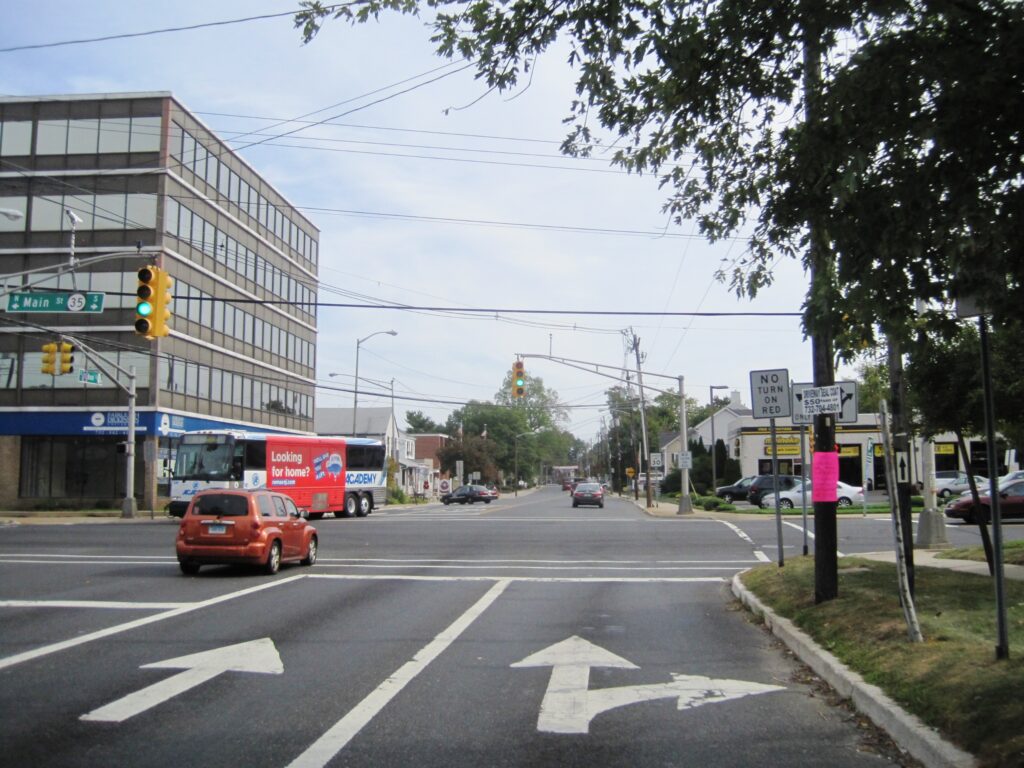
The photograph above shows Route 71 meeting Route 35 in Eatontown, taken in September 2015. A large street tree spreads its branches at the right edge of the frame, and overhead wires cross the road in several directions above the traffic signals, a bus, and the storefronts beyond. We see the same mix across the borough. A mature tree grows in a narrow strip of grass beside a curb, and the wires and the pavement are only a few feet from its limbs.
Water and soil are part of the picture too. Wikipedia lists the South Shrewsbury River and Oceanport Creek among the borough’s waters, and the borough maintains a page for its Wampum Lake Dam Community Flood Mitigation Project with a public notice. We do not describe that project, and we do not claim to know which streets hold water after a storm. We do know that soil which stays soft after heavy rain asks more of roots, which is why our earlier article on tree root problems in Eatontown is worth reading alongside this one.
A Hazard Tree in Eatontown Has a Specific Meaning in the Borough Code
Eatontown handles tree removal through Chapter 307 of the borough code, titled Removal of Trees. The version we read is Ordinance 04-2024, introduced April 10 and adopted May 8, 2024, and the ordinance text says it was amended to meet the borough’s NJDEP Tier A municipal stormwater permit, which requires a community wide ordinance to control tree removal and replacement. That is the reason hazard tree removal in Eatontown comes with rules about replacement as well as permission.
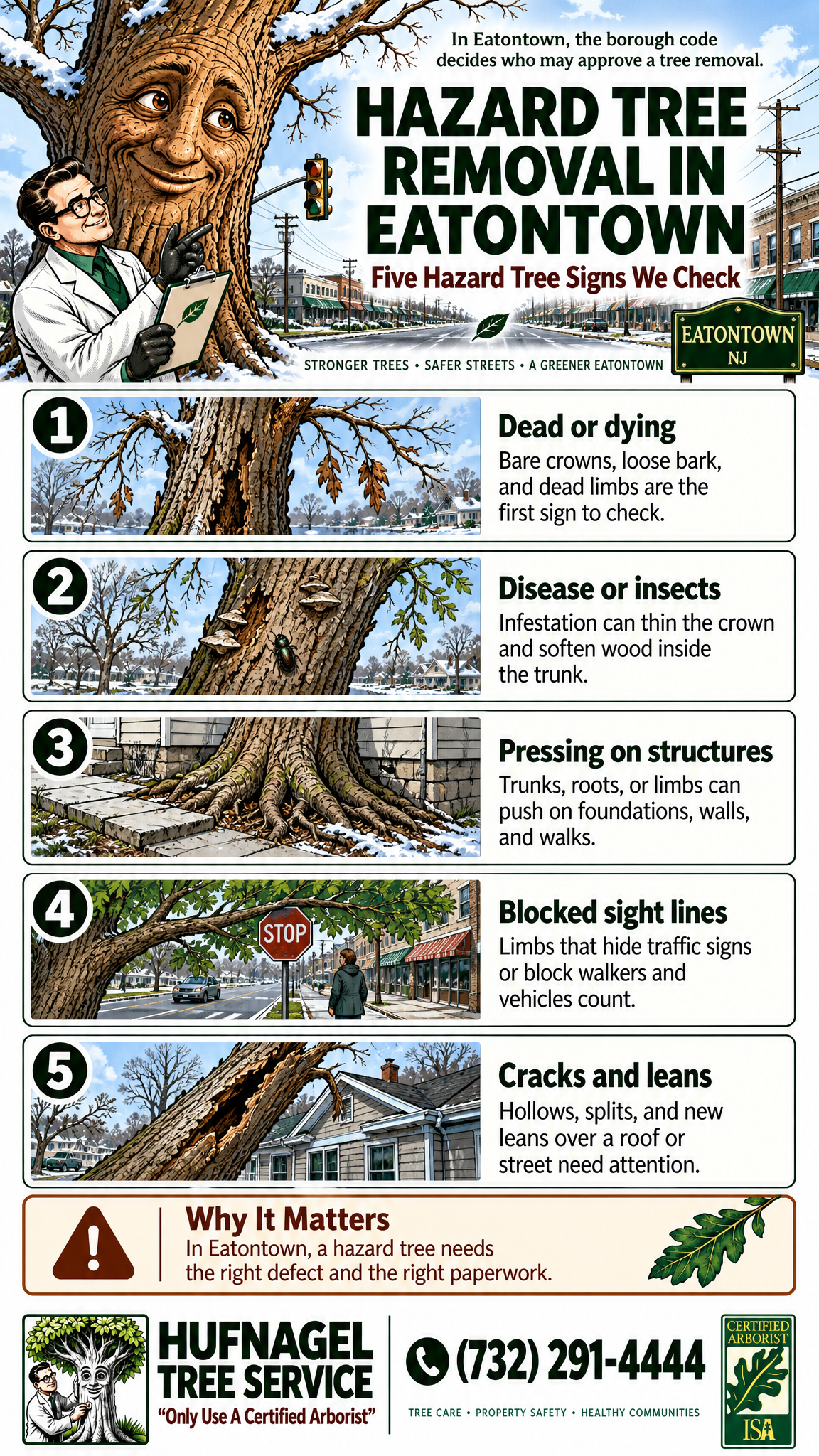
The ordinance defines a hazard tree by condition, not by size. A tree or its limbs qualify if the tree has an infectious disease or insect infestation, is dead or imminently dying, blocks the view of traffic signs or the free passage of pedestrians or vehicles where pruning has not worked, is causing obvious damage to structures such as foundations, or is determined to be a threat to public health, safety, or welfare by a New Jersey licensed tree expert or a licensed arborist. We like that list because it matches how we think. A hazard is a defect with something beneath it that can be hurt.
The same chapter defines which trees it covers. A tree is a deciduous or coniferous tree with a trunk more than six inches across measured one foot above the ground, or an American holly, dogwood, or other broadleaf evergreen more than one inch across. It also defines tree removal broadly. The ordinance says removal means to kill or cause irreparable damage, and it names excessive pruning, toxic substances, over mulching, improper grading, and soil compaction inside the critical root radius. Our tree health management work and our guide to weak tree roots cover the same habits, because a tree that is slowly killed by a mulch volcano is gone just as surely as one that is cut.
Outside the public right of way, the ordinance adds a document requirement. A tree there is only determined to be a hazard in need of removal with a written and signed statement from a New Jersey licensed tree expert, citing N.J.S.A. 45:15C-11, or a licensed arborist. We write down what we see, with photographs, and we explain it plainly. We do not decide what the borough will accept, so we tell owners to ask the zoning office which form it wants before any work is scheduled.
Many hazards are hidden from the street. Our guide to hidden tree rot explains how a crown can look fuller than the trunk deserves, and our article on codominant stems covers unions where bark is trapped between two stems. In the ordinance’s words, a tree that is dead or imminently dying is a hazard, and the word imminently is why we check the base, the trunk, and the crown together. A bare November canopy makes that comparison easier than any other month.
Stay clear of anything that looks cracked, leaning, or hung up, and never climb or cut it yourself. Photograph it from the ground, note the date, and call. Mike Hufnagel puts the rule this way: “A hazard tree is not always the biggest tree on the lot. It is the tree where the defect and the target line up, and where the paperwork has to be right before anyone starts cutting.” That sentence is the whole method. We find the defect, name the target beneath it, and then confirm who has to approve the work.
Five Hazard Tree Signs We Check in Eatontown
- Dead or imminently dying trees with bare crowns, loose bark, or dead limbs.
- Disease or insect infestation that is thinning the crown or softening the wood.
- Trunks, roots, or limbs pressing on foundations, walls, walks, or driveways.
- Limbs that block traffic signs or the clear passage of walkers and vehicles.
- Cracks, hollows, or leaning trunks over a roof, a street, or a play area.
These signs often appear together, and the target decides how urgent they are. A dead limb over an empty corner of a yard is a minor concern, and the same limb over a driveway or a bedroom roof is a serious one. Once the defect is clear, the next question is who has the authority to say yes, and in Eatontown that depends on where the trunk stands. Our guide to storm season risk assessment covers how we rank trees when several need attention.
Right of Way Trees and Private Trees Follow Different Paths in Eatontown
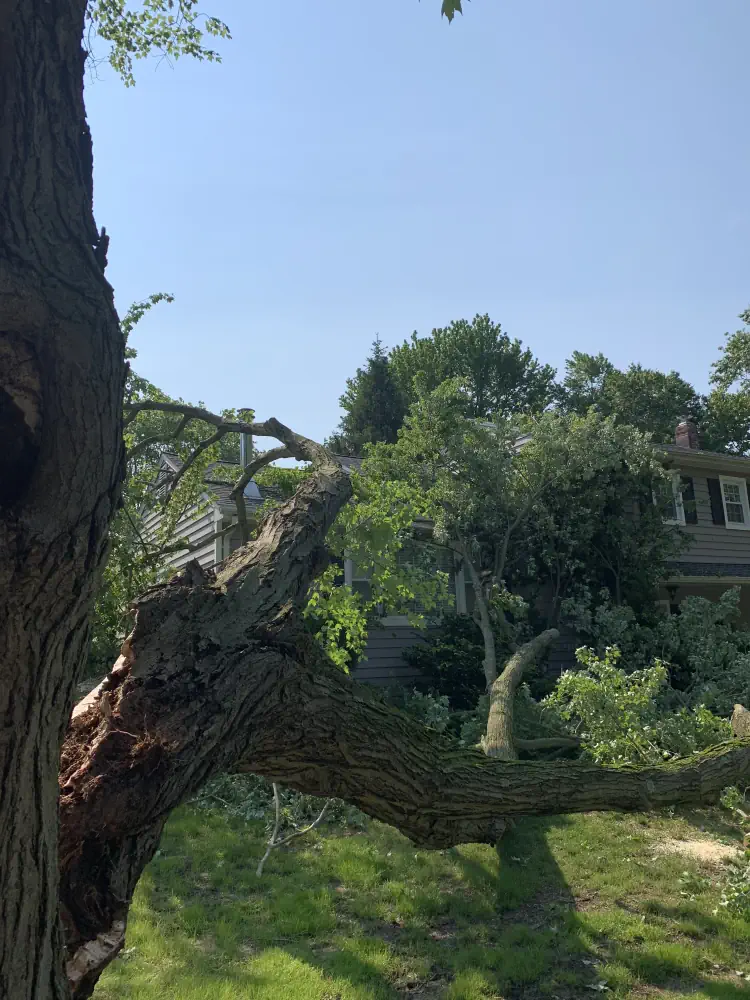
The first thing the ordinance asks is whether the tree is in the public right of way. It defines that term as any street or road shown on a map filed with the Monmouth County Clerk or on the borough’s Official Map, including public easements such as drainage and utility easements. A tree can look like it belongs to the front lawn and still stand in an easement, so the borough, not the owner, makes that call. The ordinance directs the Zoning Officer and Land Use Administrator to decide it.
If the tree is in the right of way, it goes to the Department of Public Works, which decides whether there is an emergent need to prune or remove it. If there is no emergency, the resident is referred to the Shade Tree Commission for a public hearing. If there is an emergency, Public Works may act without the commission. The ordinance also says Public Works alone decides whether a right of way tree is a hazard. That is a reasonable rule, and it means a homeowner should never assume a street tree is theirs to remove.
The Shade Tree Commission is easy to reach. The borough’s Shade Tree Commission page says the commission meets at 7:00 PM on the third Thursday of each month in the second floor conference room at Borough Hall, 47 Broad Street, that meetings are open to the public, and that questions go to shadetree@eatontownnj.com. The borough’s main line is (732) 389-7600. We would rather an owner hear the commission’s answer directly than depend on our summary of it.
For a residential application, the ordinance says the owner applies to the Zoning Officer and Land Use Administrator on a Tree Removal and Pruning request form. It then separates properties by size. On a lot under one acre, a tree that is not in the right of way needs no municipal approval, although removing it is still subject to the replacement table. On a lot of one acre or more, a tree outside the right of way is referred to the Borough Engineer, who reviews it with the Shade Tree Commission and requires the owner to place money in escrow to pay for that review.
The sections of the ordinance do not read identically on every point, and the code has been amended more than once. For that reason we tell owners to call the zoning office before cutting anything, and to confirm the current text on the borough’s code site. Our guide to tree removal permits explains how permit steps usually work across the area. We help describe the problem clearly, with photographs, because a clear description gets a faster answer than a general question.
The penalties are written for owners who skip the process. A resident who cuts a tree in the right of way without permission must meet with the Shade Tree Commission, which decides whether a replacement tree must be planted or a payment made to the tree fund. Failure to do so can lead to a summons from the Code Enforcement Officer. For property of an acre or more, the Borough Engineer and the commission determine the penalty, and the Zoning Officer enforces the ordinance. Our tree trimming and pruning work follows the same cautious path, since the ordinance counts excessive pruning as removal.
Questions to Settle Before Any Eatontown Tree Comes Down
- Whether the trunk stands in the public right of way or a public easement.
- Whether the lot is under one acre or one acre or larger.
- Whether a written statement from a licensed tree expert or arborist is needed.
- Whether Public Works sees an emergency or the Shade Tree Commission hears it.
- Where a replacement tree would be planted, or how the tree fund applies.
Settling these questions in order keeps a good plan from stalling at the curb. A removal that is approved, documented, and scheduled around the weather rarely causes surprises. A removal that starts without answers can end with a hearing, a replacement requirement, or a stalled job. The last pieces of the plan are what the borough asks owners to plant afterward and when the work is done, because replacement and timing shape the whole project. Our storm proofing and restoration services stay in the plan for trees that can be saved.
Replacement Rules and Winter Timing Shape the Removal Plan

Every removal of a covered tree is subject to the Tree Replacement Requirements Table in the ordinance. The number of replacement trees rises with the size of the trunk, measured as diameter at breast height, which the ordinance defines as four and a half feet above the ground. A tree from one to just under 13 inches calls for one replacement, and the count climbs to four replacements for a tree 33 inches or larger. Each replacement must have a minimum caliper of 2.5 to 3 inches. We mention this early because owners often learn about it only after the stump is gone.
The ordinance adds standards for the new trees. They must be planted within twelve months of the removal, monitored by the applicant for two years and replaced if they fail, and they cannot be kept in temporary containers. They also cannot be invasive or on the Do Not Plant List. The Shade Tree Commission promulgates that list and a Planting Guide of permitted trees, and the ordinance says both are posted on the borough webpage. If the lot cannot hold the required trees, the owner pays into the borough tree fund instead.
The ordinance also lists exemptions. A resident who removes fewer than four covered trees outside the right of way within a rolling five year period is exempt from replacement, and invasive trees may be removed without replacement. A hazard tree may be removed without counting toward that total, with neither a replacement nor a tree fund payment, and outside the right of way it needs the signed statement we described earlier. That is why we document a hazard carefully. A clear record can change the outcome for the owner, and it protects the borough’s intent as well.
Winter timing is the other half of the plan. The National Weather Service describes nor’easters as storms with northeast coastal winds that can bring heavy rain or snow, and the season runs through April. A cracked union or a dead limb over a roof does not wait for a convenient date. We do not rush a removal to beat a forecast, and we do not delay one that the target makes urgent. We rank each tree by what stands beneath it, and the highest consequence trees go first.
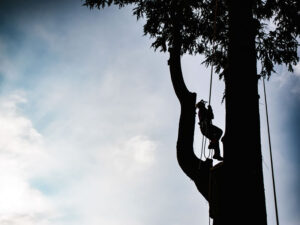
Removal is one outcome among four, along with pruning, restoration, and monitoring. We prefer preservation when a tree still gives us a safe path forward, and we say so plainly when it does not. When a tree has to come down, the work is done in sections, with ropes, cones, and a clear drop zone. The photograph above shows a climber working high in a tall tree beside a narrow lane, with cut brush on the pavement and a truck set well back. That is typical of removals near fences, houses, and wires, where the tree cannot simply be felled in one piece.
Wires change every plan. A limb touching a line, or hung up above one, is not a homeowner project and not something we treat casually either. We keep everyone clear, photograph from a safe distance, and coordinate through the utility, because a line can be live even when nothing looks wrong. If your tree is near a service drop or a pole, tell us when you call so we can plan the work around it.
What an Eatontown Hazard Tree Plan Should Cover
- A written description of the defect, with dated photographs taken from the ground.
- A decision on whether the tree stands in the public right of way.
- A permit path through the zoning office or the Shade Tree Commission.
- A replacement plan that follows the borough table and the Do Not Plant List.
- An order of work that protects roofs, wires, and neighboring property.
A plan like this does not promise that no tree will ever fail. No tree service can honestly say that. What it does is shrink the list of surprises, so each tree on the property is either fixed, watched, or consciously accepted. That is the point of hazard tree removal in Eatontown done early, on a dry day, with the paperwork settled, rather than in the middle of the first winter storm. Our tree risk evaluation comes first, and removal follows only when the findings call for it.
Call Hufnagel Tree Service About Hazard Tree Removal in Eatontown Before the Next Storm
If you have mature trees near your Eatontown home, driveway, sidewalk, or property line, schedule an evaluation before winter storms arrive. We provide storm proofing, tree risk evaluation, tree trimming and pruning, restoration, and removal when a tree cannot be managed safely.
Hufnagel Tree Service is led by a certified arborist with almost 30 years of local experience and more than 280 five star Google Maps reviews. We inspect first, explain what we found in plain terms, and recommend only the work that changes the outcome for your trees and your property.
Call or text (732) 291-4444 to schedule hazard tree removal in Eatontown before the next nor’easter arrives. Our Eatontown tree articles list more local guidance.
Schedule Service Now!
From precision pruning and safe removals to health assessments and preventative care, Hufnagel Tree Service delivers expert solutions backed by decades of experience. We offer certified insight, fair pricing, and a commitment to doing what’s best for your landscape.
Learn More About Our Services

Related Articles
Tree Risk Mitigation Services Near Monmouth Beach NJ