Contents
In Sea Bright, Wind and Salt Spray Shape Every Hedge and Ornamental Tree
Sea Bright is a narrow borough with water on both sides. According to Wikipedia’s entry on Sea Bright, the New Jersey Legislature formed it as a borough on March 21, 1889, from parts of Ocean Township. It sits on a barrier peninsula between the Atlantic Ocean and the Navesink and Shrewsbury rivers, about three feet above sea level, and the same entry says the seawall runs the length of town between the beach and Route 36. The 2020 census counted 1,449 residents.
That setting changes how we approach ornamental pruning in Sea Bright. Hedges, flowering trees, and shaped evergreens here live with wind and salt spray that a yard a few miles inland never sees, and the Rutgers Master Gardener handout on seashore gardening calls salt spray the deal breaker for shore plantings. Our tree trimming and pruning and hedgerow trimming work starts from that fact rather than from a standard schedule.
After almost 30 years working throughout Monmouth County, we have seen that October is the month to look and plan rather than to cut hard. The leaves are still on, so damage on the exposed side of a plant is easy to read, and nothing new has been forced into growth before winter. Iowa State Extension advises against heavy fall pruning of shrubs, and we agree.
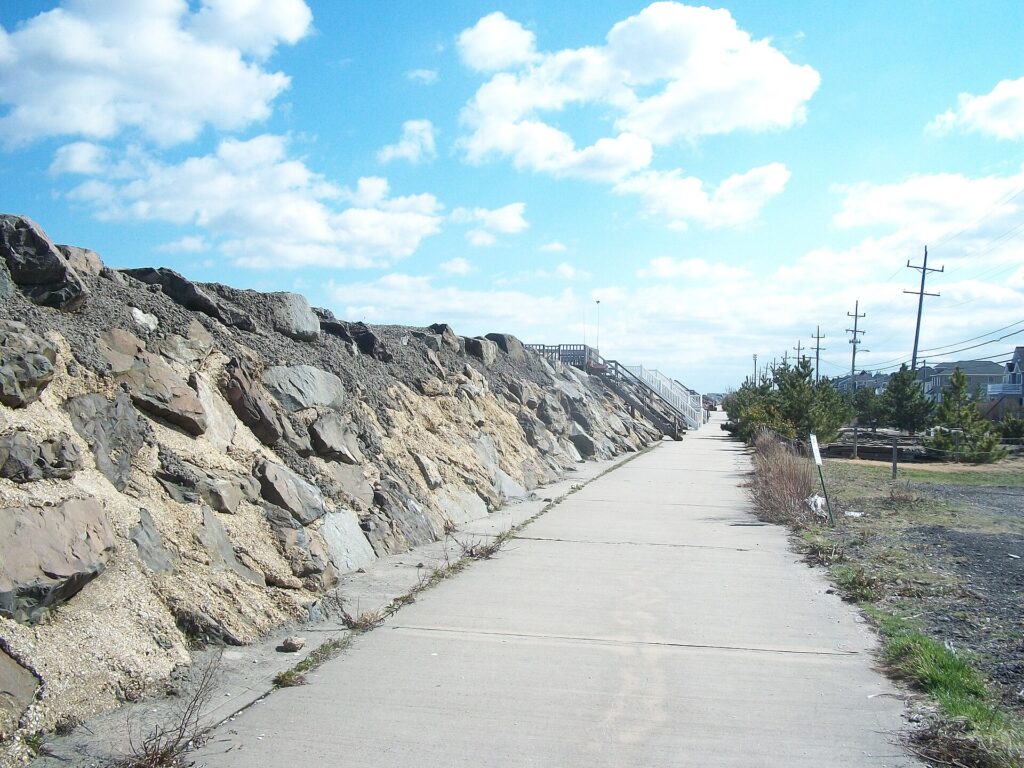
The photo above shows the seawall that stands between the Atlantic and Route 36, with a row of young evergreens planted along the road behind it. The same Wikipedia entry adds that Route 36 crosses the Shrewsbury River to Highlands on a fixed span built between 2008 and 2011, that the borough has a large municipal beach in the center of town, and that seven members only beach clubs operate here. For an owner or a property manager, the lesson is that every planting in Sea Bright is shaped by the exposure around it: the ocean and the beach on one side, the river and its wind on the other, and a state highway in between. We covered the structural side of that exposure in our article on winter storm proofing in Sea Bright. This article looks at the shrubs, hedges, and small ornamental trees that sit closest to it, and the rest of our local writing is collected in the Sea Bright tree care category.
Salt Spray Decides Which Shrubs and Ornamental Trees Hold Up Here
Salt spray is the first thing we ask about on any Sea Bright property. The Rutgers handout lists drying wind, drying sand, baking heat, and salt spray as the adverse conditions at the shore, and it singles out salt spray as the deal breaker. That ranking matches what we see in the field. A hedge can handle a windy summer, but when spray keeps reaching the same side of a plant, the foliage and buds on that side pay for it year after year.
UMass Extension explains how the damage works in a related setting, winter road salt, in its fact sheet on salt injury. Spray lands on stems, buds, and foliage, it can burn tissue and dry out bud scales, and the damage often does not show until late winter or spring. The page names needle or leaf browning, bud death, and branch dieback on the side of the plant facing the road as a common sign. We see the same pattern on the exposed side of shore hedges, so we read that side first whether the salt came from the ocean, the river, or the road.
Rutgers also gives a practical response for the planting itself. The handout suggests a salt tolerant windbreak of plants such as American holly, eastern red cedar, white cedar, cherry laurel, and yew, and it advises planting in masses of the same plant or the same height. Those are planting choices, not pruning choices, but they explain why the shape of a Sea Bright hedge matters. A tight, uniform screen shelters what stands behind it, while a hedge that has been opened up or cut unevenly exposes the plants inside.
Salt tolerant does not mean injury free. UMass makes the same point, and it is worth repeating to every owner who has been told a plant was made for the shore. A tolerant plant still has limits, and a plant that is already browned, thinned, or stressed after a hard winter has less margin than one that is not. Our tree health management work looks at that margin before anyone picks up a pruner.
Water matters as well. The Rutgers handout recommends periodic overhead watering to rinse salt and sand off foliage, and UMass notes that rain can wash salt off leaves and that heavy watering can leach salt from well drained soils but not from poorly drained ones. On a low barrier peninsula, drainage can differ from one lot to the next, so we do not assume the soil will clear on its own. We note where water stands after a storm and where it drains, because that tells us how a plant is likely to handle the next season.
Mike Hufnagel puts it this way: “At the shore, I always start on the side of the plant that faces the wind. That side shows us what the exposure has been doing, and it tells us how much a cut can safely take off.” That is why a Sea Bright pruning visit begins with a walk around the plant, not with a cut. We note the browned tips, the buds that failed, and the branches that have died back, so the pruning plan answers what the exposure has actually done.
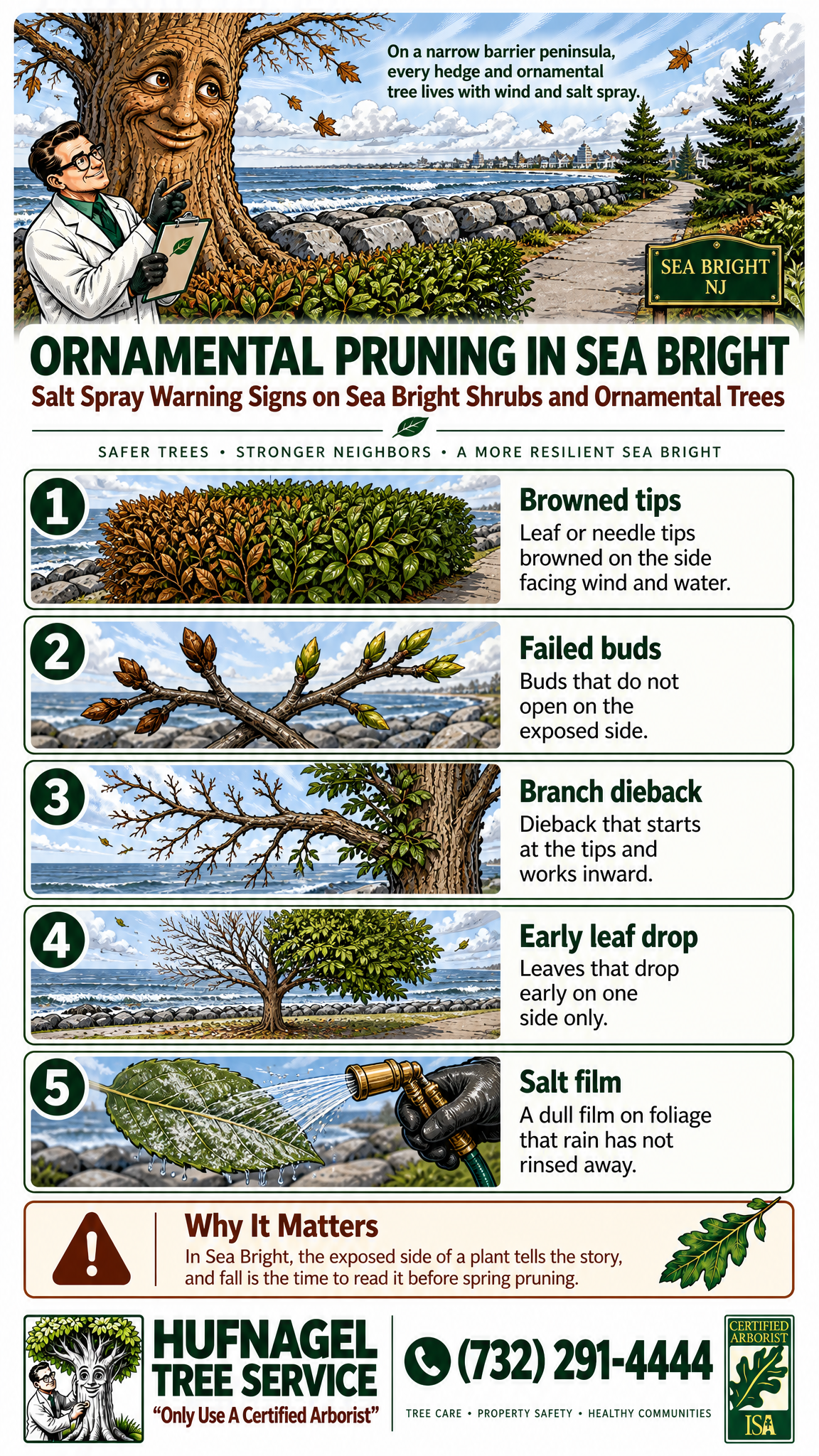
Salt Spray Warning Signs on Sea Bright Shrubs and Ornamental Trees
- Browned leaf or needle tips on the side that faces the wind and water.
- Buds that failed to open, or delayed growth, on the exposed side.
- Branch dieback that starts at the tips and works toward the center.
- Leaves that drop early on one side of the plant but not the other.
- A dull film on foliage after a long onshore wind that rain has not rinsed away.
None of these signs proves that salt is the only problem. We weigh them with the planting, the drainage, and the plant’s own history, and we separate what needs a cut from what needs time. Good ornamental pruning in Sea Bright responds to evidence like this instead of a calendar. Once we know what the exposure has done to a plant, the next question is when to prune and how much to take, and that is where fall advice and spring advice part ways.
Fall Is the Time to Look and Plan, Not to Shear Hard
Many owners assume October is the time to cut everything back before winter. The extension advice says otherwise. Iowa State Extension warns against late summer pruning of deciduous shrubs, because cuts can trigger growth that is not prepared for the cold, and it advises against fall pruning of evergreen shrubs, since fall pruned evergreens are more vulnerable to winter damage.
The reason is hardening off. Late pruning pushes new growth that needs time to toughen before cold weather arrives, and the same page says extensive pruning after mid summer produces growth that may not harden before winter. Boxwood gets its own warning not to be pruned in late summer. On an exposed shore property, where wind and spray already test the foliage, soft new growth is the last thing a hedge needs going into winter.
That does not mean nothing gets done in fall. Iowa State says dead, broken, and diseased branches on evergreen trees can be removed at any time of year, and that on deciduous trees pruning outside the dormant season has little or no negative effect when the job is something like storm cleanup. We read that as permission to deal with real hazards when we find them and to hold back on shaping. A hanging limb over a walk is a safety job. A hedge that is a little taller than last year is a spring job.
Oaks are the exception to that exception. Iowa State advises against pruning oaks from March through October to reduce the risk of oak wilt, so an oak with a hazard limb in October is a case where we weigh the limb against the cut before anything is done. Most shaping of shrubs and hedges waits for spring. The same page gives late March or early April for evergreen shrubs, and it puts the start of shearing for evergreen hedges in late spring or early summer.
How much comes off matters as much as when. Rutgers fact sheet FS019, written for people who are hiring a tree care professional, says proper pruning should never remove more than 25 percent of the branches or limbs in a given year. It also tells owners to avoid topping and to expect cuts that do not leave stubs or rip the bark. We hold our own work to those limits, and we ask any contractor an owner is considering to explain how they will meet them. Ornamental pruning in Sea Bright is better done in small, planned steps than in one heavy visit.
Wikipedia places Sea Bright in USDA hardiness zone 7b, with an average annual extreme minimum air temperature of 5.3 degrees Fahrenheit. A plant that has been cut back hard in fall carries soft growth into that kind of cold, and onshore wind adds to the stress. A conservative fall plan fits those conditions. We document what we see this month, photograph the exposed side of each plant for comparison, and schedule shaping for spring, when the plant can respond and the results are easy to judge.
A Fall Pruning Plan for Sea Bright Hedges and Ornamental Trees
- Remove dead, broken, and hanging wood now, especially over walks and drives.
- Hold heavy shearing of hedges until late spring or early summer.
- Leave shaping of evergreen shrubs for late March or early April.
- Keep the work in any single year within the 25 percent limit.
- Photograph exposed plants this fall to compare with spring growth.
A plan like this can feel too quiet to owners who expect a crew to arrive and tidy everything before winter. We think it is the more responsible approach, because it removes the real hazards, protects the plant while it is most vulnerable, and gives us a clear record to work from in spring. Once the timing is settled, the remaining question is how the plant is actually used on the property, because that decides how hard it can be cut.
Wind Exposure and Targets Set How Far a Hedge or Evergreen Can Be Cut
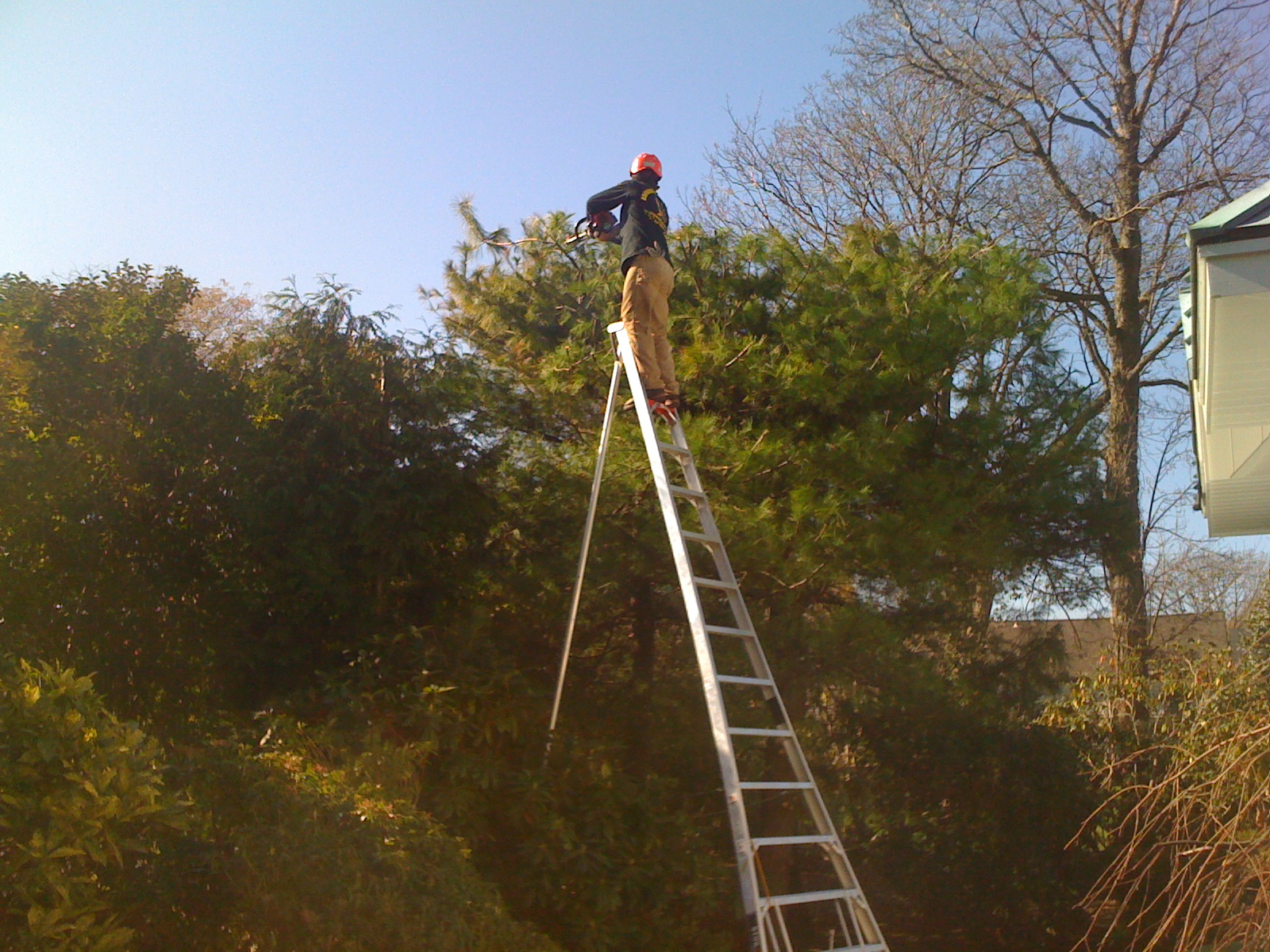
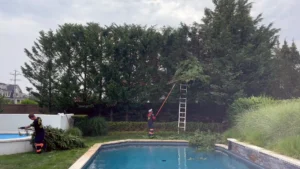
The photo shows one of our crew members working from an orchard ladder at the top of a large evergreen. Tall evergreens and hedges are common on shore properties, and they are often asked to do a job, whether that is screening a view, shielding a patio, or sheltering what grows behind them. We think about that job before we think about the shape. A cut that looks tidy from the street can undo the very thing the plant was put there to do.
Rutgers recommends salt tolerant windbreaks for seashore properties, and an older hedge on a Sea Bright lot may already be serving as one. When a hedge is working as a windbreak, cutting it deeply on the exposed face removes the foliage that was taking the wind and spray. The plants behind it then meet that exposure directly. We usually trim lightly on the windward face and save larger corrections for the sheltered side, where the plant can recover without extra stress.
Targets matter here as they do everywhere. In Sea Bright, a hedge or ornamental tree may stand beside Ocean Avenue, a driveway, a beach club entrance, a pool deck, or a neighbor’s fence on a narrow lot. Wikipedia notes seven members only beach clubs in town, and many club and estate properties are looked after by managers rather than owners. We write our findings so a property manager can hand them to an owner and explain what was done and why, in the same plain terms we use on site.
Structure still counts on small trees. Flowering and ornamental trees can develop narrow unions and crossing branches just as shade trees do, and our guide to codominant stems explains why those unions deserve attention. A tree on the exposed side of a lot may also lean away from the wind, so we check the base for movement. Our article on weak tree roots describes what to look for when the soil around a tree has heaved or settled.
Some plants arrive already damaged. A hedge that has browned and thinned after a hard winter, or a tree that lost a leader in a storm, may need restoration instead of a standard trim. The goal is to rebuild a good shape over more than one season, with cuts that respect the 25 percent limit, rather than forcing the plant back to a clean outline in one visit. When a plant is dead or decayed and cannot be managed safely, we discuss removal plainly and explain what we found.
We do not top ornamental trees to keep them small, and we do not treat every dense hedge as something to thin for wind. FS019 tells owners to avoid topping, and the TreesAreGood tree owner resources include a brochure on why topping hurts trees. Our approach is to make reduction cuts back to a proper branch, keep the natural form of the plant, and leave enough interior foliage that the plant still looks like itself. Our earlier piece on summer ornamental tree pruning describes the same preservation first approach on inland properties.
Questions We Answer Before Ornamental Pruning in Sea Bright
- Which side of the plant faces the wind, the water, or the road.
- What job the hedge does for the house, the patio, or the view.
- What the plant can reach if a limb fails or a leader breaks.
- Whether salt browning, storm damage, or age explains the thinning.
- How much can come off this year without stripping the interior.
Once those questions are answered, the work is usually more modest than an owner expects. Some plants need a light correction, some need monitoring through the winter, and a few need restoration or removal. The point of the inspection is to match the work to the plant instead of the other way around. That leaves only the practical matter of getting the visit on the calendar while the canopy can still be read.
Call Hufnagel Tree Service for Ornamental Pruning in Sea Bright Before Winter
If you have hedges, ornamental trees, or mature evergreens near your Sea Bright home, driveway, beach club, or Ocean Avenue frontage, schedule an inspection and a pruning plan before winter weather arrives. We provide tree trimming and pruning, hedgerow trimming, tree health management, tree risk evaluations, storm proofing, restoration, and removal when a plant cannot be managed safely.
Hufnagel Tree Service is led by a certified arborist with almost 30 years of local experience and more than 280 five star Google Maps reviews. We inspect first, explain what we found in plain terms, and recommend only the work that changes the outcome for your plants and your property.
Call or text (732) 291-4444 to schedule ornamental pruning in Sea Bright before winter arrives.
Schedule Service Now!
From precision pruning and safe removals to health assessments and preventative care, Hufnagel Tree Service delivers expert solutions backed by decades of experience. We offer certified insight, fair pricing, and a commitment to doing what’s best for your landscape.
Learn More About Our Services



Related Articles

Tree Risk Mitigation in Rumson, NJ
Summer Ornamental Tree Pruning in Middletown, NJ

Winter Storm Proofing Trees in Sea Bright NJ: Get Prepared