Contents
In Loch Arbour, Storm Proofing Starts With How Little Room a Tree Has
Loch Arbour is one of the smallest places in the state. According to Wikipedia’s entry on Loch Arbour, the New Jersey Legislature incorporated it as a village on April 23, 1957, from portions of Ocean Township, and the 2020 census counted 224 residents. The same entry ranks it as the third smallest municipality in New Jersey by area, well under a quarter of a square mile, with Allenhurst to the north, Interlaken to the west, and Asbury Park to the south, at an elevation of about 10 feet.
In a village that compact, a tree is never far from a roof, a street, a utility wire, or a neighbor’s fence. That changes how we approach storm proofing in Loch Arbour. Purdue University Extension is plain about the limits in its guide Trees and Storms, which says it is impossible to protect a tree from storms or prevent every injury, but that some actions can reduce the damage. Our tree storm proofing and tree risk evaluation work is built on that honest limit.
After almost 30 years working throughout Monmouth County, we have seen that October is the month to look. The leaves are still on, so a lopsided crown or a dead limb is easy to read, and the fall and winter storms that follow have not yet put those defects under load. We would rather find a weak union or a lifting root plate on a calm day than after the wind has already tested it.
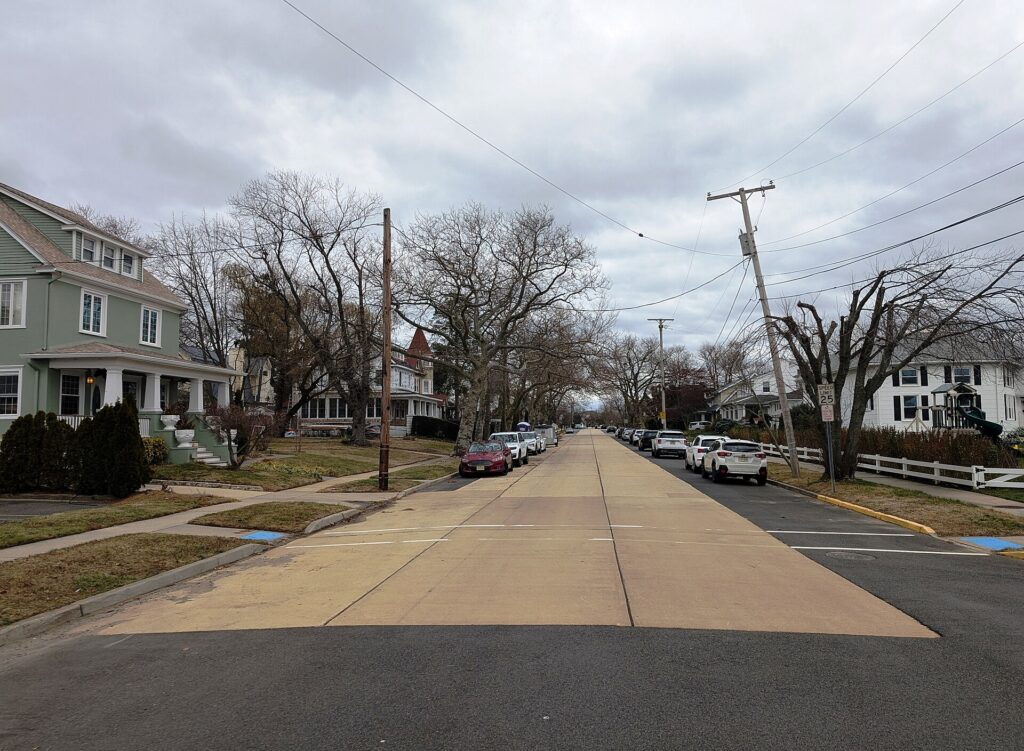
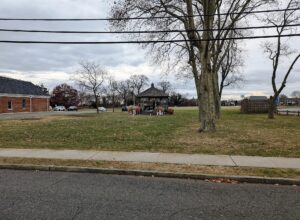
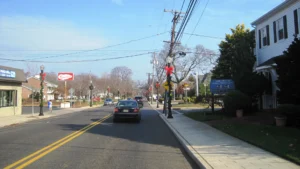
The photo above shows Euclid Avenue in Loch Arbour in December, with large mature trees standing over the street, the houses, and the overhead wires. That is the setting for storm proofing in Loch Arbour in one picture: big trees, small lots, and very little distance between a crown and a target. Water is part of the story too. The Wikipedia entry describes Deal Lake and the Deal Lake Commission, and the Deal Lake Commission says it was chartered in 1974 by the seven shore line towns and works to control lake levels during heavy storms through its flume. Wet ground and high water change how roots hold, which we cover in the sections below. We also wrote about a different season in our article on winter tree risk inspections in Loch Arbour, and the rest of our local writing is collected in the Loch Arbour tree care category.
Storm Damage Usually Starts at a Defect, and the Wind Finds It
Storms do not create most of the problems they expose. Purdue’s Trees and Storms says that trees fail at their weakest points, and that failure is usually caused by the combination of a defect and an outside force. A tree sways in normal wind and builds extra strength to match it. A storm pushes past that strength, and the defect gives way first. That is why we start every storm proofing visit by looking for the defect instead of by looking at the size of the tree.
Purdue describes several ways a tree can fail, and each one has its own warning signs. Stem failure is a trunk that snaps or buckles where it is weakest, often at an old wound, a cavity, or a decayed area. Branch failure is a limb that tears away, often at a poor union. Crown twist happens when a lopsided crown catches uneven wind and puts a twisting load on the main branches and the stem, which can leave splits and cracks that are easy to miss from the ground. We look for each of these on a Loch Arbour property, because the fix is different for every one.
Poor structure is the most common starting point for branch failure. The same guide names codominant stems and included bark at branch junctions as architecture that predisposes branches to fail, and it says those branches are often the first to be damaged. Two stems of about equal size can grow side by side with bark trapped between them, and that union is weaker than it looks. Our guide to codominant stems explains how we read those unions, and why a tree with one is not automatically a tree that needs to come down.
Decay is the other quiet defect. A cavity, a nesting hole, or a mushroom growing out of the trunk can tell us that the wood inside is not as sound as the outside suggests. A crown that is thinning on one side, or branch tips that die back while the rest of the tree looks healthy, can point to the same problem. Our article on hidden tree rot describes why a tree can look fine from the street and still carry a failure waiting for the right wind.
Lopsided crowns deserve attention in a village like this one. Mature trees on tight lots often grow toward the open side, away from a neighbor, a house, or a canopy that crowded them. Over decades the crown becomes heavier on one side than the other, and that uneven weight is exactly what Purdue says produces damaging twist in high wind. We note which way the weight sits, where the unions are, and what the crown would reach if a limb let go, then we decide what to correct and what to leave alone.
Mike Hufnagel puts the village in plain terms: “In a place this small, the tree and the target are almost always close together. The real question is whether the tree has a defect the next storm can find, and we would rather find it first.” That is the reasoning behind our approach in Loch Arbour. We inspect the tree, name the defect, and tie it to what the tree can actually hit.
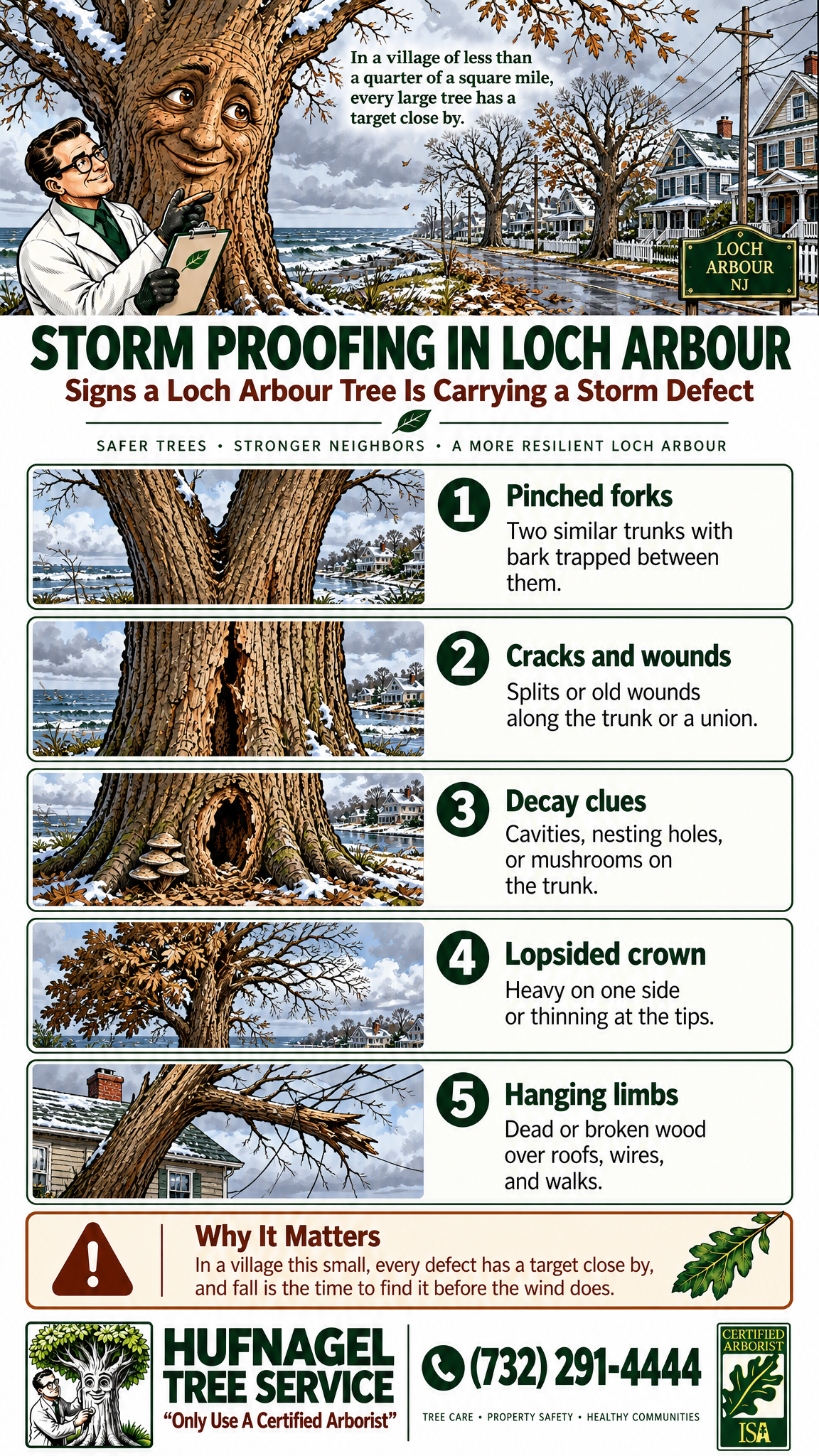
Signs a Loch Arbour Tree Is Carrying a Storm Defect
- Two trunks of similar size forking close together with bark pinched between them.
- Cracks, splits, or old wounds along the trunk or at a branch union.
- Cavities, nesting holes, or mushrooms growing from the trunk or base.
- A crown that is heavy on one side or thinning at the branch tips.
- Dead, broken, or hanging limbs over roofs, wires, cars, and walks.
None of these signs means a tree must be removed. Each one tells us where to look more closely and what the tree might do under load. Some trees need only monitoring. Others need targeted pruning, support, restoration, or removal. Once we understand the structure above ground, the next question sits below it, because a sound crown still depends on the roots and the soil that hold it up.
Roots and Saturated Ground Decide Whether a Tree Stays Upright
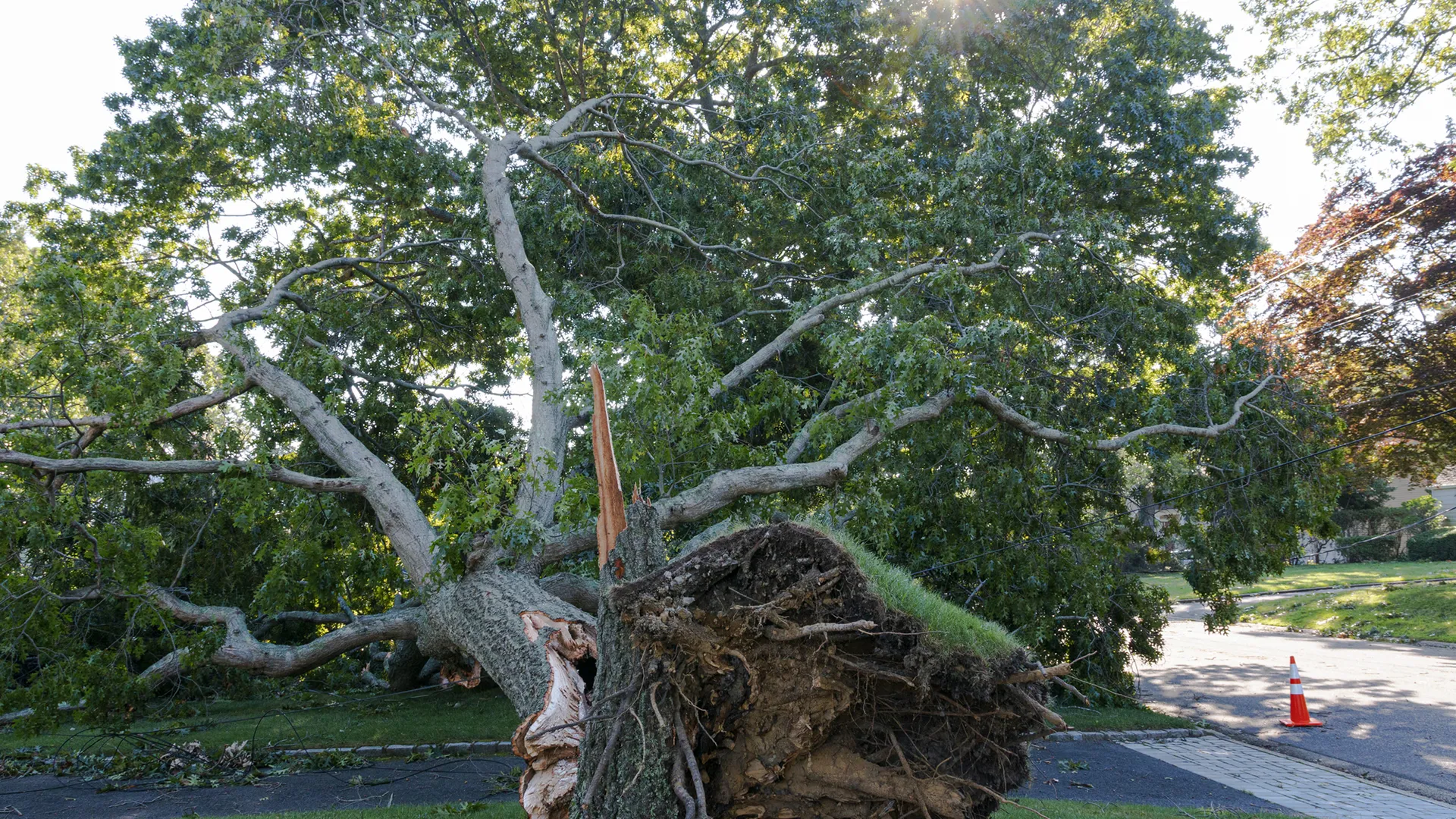
The photo shows a very large tree that failed with its root plate heaved out of the ground beside a street. A tree that goes over whole, instead of breaking in the crown, is a root and soil story. Purdue calls this wind throw, and says the loading forces on the crown become too great for the root system, especially when earlier harm from construction, poor maintenance, or pests has left the tree with poor anchorage. Our guide to weak tree roots lists the signs we look for at the base of a tree.
Purdue gives specific things to check. Look for heaving soil and roots around the trunk, for pulled or broken roots, and for mushrooms growing around the base, since any of them can mean a defect in the roots. It also notes that larger or more mature trees that have been completely uprooted are typically not salvageable. That is a good reason to look at the base of a mature tree before a storm and not after, while there is still a choice about what to do.
Wet ground makes every root problem worse. A Rutgers continuing education article, Storm Devastation Unearths the Hazards of Neglected Trees, describes how waterlogged soil after Hurricane Irene let winds topple seven oaks for one client in Allentown. The same article quotes an arborist instructor who says most trees do not fail because of one problem, and that with most trees that came down, a qualified arborist could have predicted a problem beforehand. We take that as the working rule for this village as well.
Loch Arbour sits at about 10 feet above sea level, and the Deal Lake Commission describes a system built to manage lake levels in heavy storms. We do not manage lake levels, and we are careful not to claim more than the sources say. What we can say is that low, wet ground is a real condition for the trees here. After a heavy rain, we pay attention to where water stands, where it drains, and whether the soil at the base of a tree has softened, heaved, or settled.
The Commission also gives guidance that matters for any tree near the water. Its page says the state environmental agency regulates land within 50 feet of the lake shoreline and of streams draining into it, and that a well vegetated shoreline resists erosion and filters stormwater. It warns that clearing vegetation, grading, or filling along the shore can destabilize the lake and worsen flooding. If a tree you are worried about is near the water, contact NJDEP before anyone starts shoreline work, as the Commission advises. We discuss what is reasonable once the facts are clear.
Roots are also where good intentions cause trouble. Trenching for a new line, grading a lawn, or piling soil against a trunk can cut or smother the roots a tree depends on. A tree may take years to show the damage, and then a storm shows it all at once. We ask about past construction, drainage changes, and any earlier removals nearby, because Purdue notes that trees newly exposed to prevailing winds after development or removal are at greater risk. A tree that lost its neighbors may be taking more wind than it ever has.
Root Zone Warning Signs After Heavy Rain
- Soil heaving or cracking on one side of the trunk, especially after a storm.
- Roots that are exposed, pulled, or broken near the base of the tree.
- Mushrooms growing around the base or along the roots.
- A trunk that leans more than it did last season.
- Standing water or soft ground that stays wet long after the rain stops.
A lean that is new, or a heave that appeared after a storm, is a reason to call. It is not a reason to push on the tree or to dig around it. The best response is to photograph the base, keep people and cars clear, and have a certified arborist look before the next wind. With the structure and the roots understood, the last step is deciding what work will actually reduce the risk, and what will only make the tree look different.
Pruning for Storms Means Reducing Load, Not Topping or Over Thinning
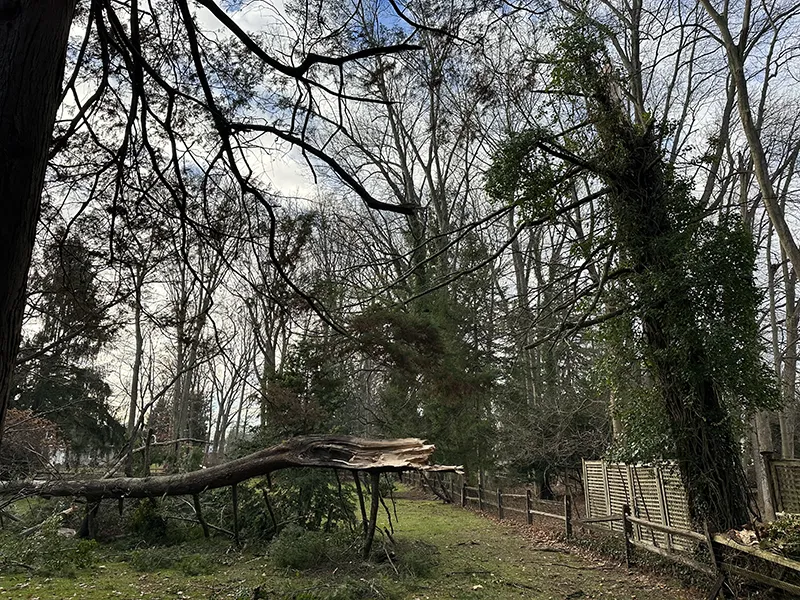
The photo shows a large limb that tore off a tree and lay splintered across a wooded yard. Branch failure like this is common, and Purdue notes it is usually repairable and not lethal to the tree, unless more than half the crown has been destroyed. It can still create a high risk in the wrong place. In Loch Arbour, the wrong place is nearly everywhere, which is why we focus on the limbs that hang over a home, a street, or a wire. Our tree trimming and pruning work removes the dead, broken, and poorly attached wood that storms look for first.
Pruning is where storm preparation goes wrong most often. Purdue says plainly that a tree should never be topped to prevent wind or ice damage, because topped trees produce many small, poorly attached sprouts, and the canopy weight and density actually increase. Topping can make a tree look safer while making it weaker. We do not top trees, and we do not thin a tree out for wind as a blanket treatment. We make reduction cuts back to a proper branch, remove what is clearly unsafe, and leave healthy structure alone.
Functional pruning, in Purdue’s words, helps trees form a healthier crown that handles wind better. It recommends choosing a strong central leader on young trees, eliminating weak forked stems, and favoring branches with a U shaped attachment over tight, narrow unions. It also advises against staking or guying a tree unless it is absolutely necessary, because movement helps a tree build the wood that resists wind. We keep those principles in mind when we plan work on a young street tree, and when we decide how a mature tree should be shaped over time.
Some trees come to us already damaged. A tree that lost a leader, or one with a cracked limb that has not yet fallen, may need restoration instead of a standard trim. The goal is to rebuild a sound structure over more than one season, with cuts that respect the tree, rather than to force it back to a clean outline in one visit. Our tree health management work looks at vigor first, since a stressed tree has less margin than a healthy one when the wind comes.
When a tree cannot be managed safely, we discuss removal plainly and explain what we found. Before any removal in a small village, we also check the local rules. The Deal Lake Commission says the state required each municipality to adopt a tree removal and replacement ordinance by May 1, 2024, and that each of the seven Deal Lake towns now has one. We do not assume what a particular ordinance says. We tell owners to confirm the rules with the village before work begins, and we build the plan around them.
Leave the cleanup to a professional. The New Jersey Department of Health page on post storm tree hazards says that downed lines may not be visible under debris, that electrocution risk is high during cleanup, and that homeowners should not clean up downed trees and branches themselves, since this work should be left to licensed tree care professionals. The TreesAreGood tree owner resources also list brochures on storm related tree damage and on recognizing tree risk, which are useful reading before a storm arrives.
Questions We Answer Before Any Storm Proofing Work
- What the tree can reach if a limb or the whole tree fails.
- Which defect is real, and which is only a cosmetic flaw.
- Whether pruning can reduce the risk without hurting the tree.
- What the roots, soil, and drainage are telling us this season.
- What the village requires before any removal or heavy work.
Once those questions are answered, the work is usually more modest than an owner expects. Some trees need only a light correction and a monitoring plan through the winter. A few need restoration or removal, and we explain why. The point of the inspection is to match the work to the tree, instead of the other way around. That leaves only the practical matter of getting the visit on the calendar while the canopy can still be read.
Call Hufnagel Tree Service for Storm Proofing in Loch Arbour Before Winter
If you have mature trees near your Loch Arbour home, street frontage, or overhead wires, schedule an inspection and a plan before the next fall or winter storm arrives. We provide tree storm proofing, tree risk evaluations, pruning, restoration, and removal when a tree cannot be managed safely.
Hufnagel Tree Service is led by a certified arborist with almost 30 years of local experience and more than 280 five star Google Maps reviews. We inspect first, explain what we found in plain terms, and recommend only the work that changes the outcome for your trees and your property.
Call or text (732) 291-4444 to schedule storm proofing in Loch Arbour before the next storm arrives.
Schedule Service Now!
From precision pruning and safe removals to health assessments and preventative care, Hufnagel Tree Service delivers expert solutions backed by decades of experience. We offer certified insight, fair pricing, and a commitment to doing what’s best for your landscape.
Learn More About Our Services

Related Articles
Tree Risk Inspection and Health Assessment By Certified Pros
Aberdeen Fall Tree Inspection: Find Problems Before Winter
Tree Health Inspection Services Near Fair Haven, NJ