Contents
In Asbury Park, a Weak Fork Has Little Room to Fail
Codominant stems in Asbury Park are easiest to judge in November, when the leaves come off and the fork where two trunks meet can finally be read from the sidewalk. Wikipedia says Asbury Park began as a seaside resort developed by James A. Bradley in 1871 and was incorporated as a borough on March 26, 1874, from portions of Ocean Township. The city covers 1.43 square miles of land, had 15,188 residents in the 2020 census, sits at an elevation of 16 feet, and fronts the Atlantic along a mile and a quarter of Boardwalk.
That is a compact city with an open ocean edge, and it changes how we think about structure. A tree with a weak fork does not have far to fall before it reaches a roof, a car, a sidewalk, or a wire. Our tree risk evaluation and tree health management work begins with how a tree is built, and a union between two stems of similar size is one of the first places we look.
After almost 30 years working throughout Monmouth County, we have seen forks hold for decades and then give way in the first wet snow or hard wind that finds them. This article explains what codominant stems are, what a bare canopy shows, how Asbury Park handles trees on public and private land, and what options exist once a weak union is found.
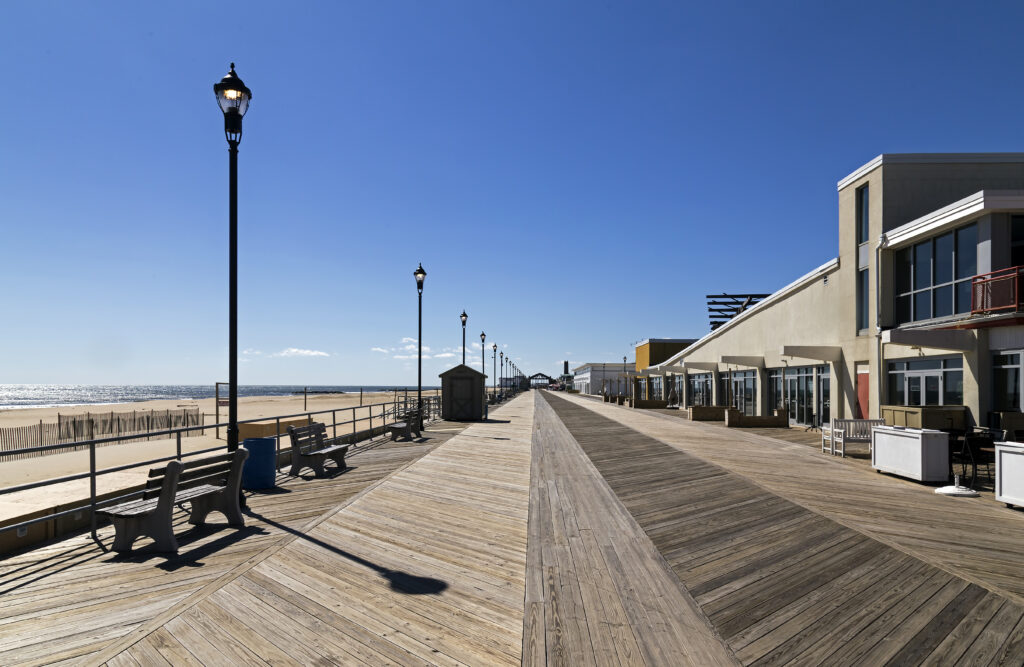
The photograph above shows the Asbury Park Boardwalk looking south toward the Casino, according to the Wikimedia Commons description, and it was taken on March 29, 2016. There is no tree in the frame, and that is the point. Black lamp posts stand in a line along a long plank deck, a bench faces the sand, the ocean fills the left side of the picture, and a building with large windows runs along the right. Nothing in the scene slows a wind that comes off the water. Trees set back among buildings usually get some shelter, but a tree on an open corner or beside a lot line meets that wind with its whole crown, and a fork with included bark takes the load first.
Water shapes the ground as well. Wikipedia says Deal Lake covers 158 acres, is bordered by seven municipalities including Asbury Park, has about 27 miles of shoreline, and has many homes built within the 100 year flood plain. The Asbury Park page puts Sunset Lake in the southwestern part of the city and says it covers more than 16 acres. Saturated soil does not weaken a union in the crown, but it does reduce how well roots hold the whole tree against a load. A forked tree in soft ground has two problems at once, a weak joint above and less anchorage below.
Codominant Stems in Asbury Park Hide Their Weak Point Under Leaves
Codominant stems are two or more stems of about the same size that rise from one point with no single leader. The Florida Urban Forestry Council describes them in its Council Quarterly as forked stems of nearly equal diameter that arise from a common junction without a normal branch to trunk union. Where the fork closes into a sharp V, bark can be pinched between the stems. That is included bark, and it is the detail that turns an ordinary fork into a weak one.
Lindsey Purcell, an urban forestry specialist at Purdue, writes in a publication dated September 2017 that the most common risk of tree failure is the presence of one or more codominant stems. The Purdue Extension guide, Large Tree Cabling and Bracing, says the weakness comes from a lack of connective tissue anchoring a stem to the trunk and from the included bark between the stems. It adds that the longer the codominant stems are, the greater the likelihood of failure, especially on larger trees.
The Florida article adds that soft bark grows between competing stems and gets hidden as the tree thickens, and that a strong attachment looks like a wide U instead of a sharp V. That hiding is the practical problem in Asbury Park. A summer canopy covers the fork, a few more years of growth bury the included bark, and the union can look sound from the street while it is not.
November is a good time to look because leaf drop shows the shape of the fork. A homeowner can stand back from the tree and note whether one stem clearly leads and the others are smaller, or whether two stems of similar size share the load. That takes no ladder and no tools, and it should not. Photograph the fork from two sides, note the date, and compare the pictures next season.
Many of the trees we see in older shore communities have a history we cannot read from the ground. A previous owner may have topped a tree, which we do not recommend, and the regrowth from old cuts can add new weak attachments of its own. We look for that history in the scars, the shape of the crown, and the way the stems have grown around each other. The species matters less than the question of how the stems are joined.
Mike Hufnagel puts it simply: “A fork is not a defect by itself. It becomes one when two stems of the same size are holding each other apart and nobody has looked at the seam in years.” That is why we treat a codominant union as a reason to look closely, not as a reason to remove a tree.
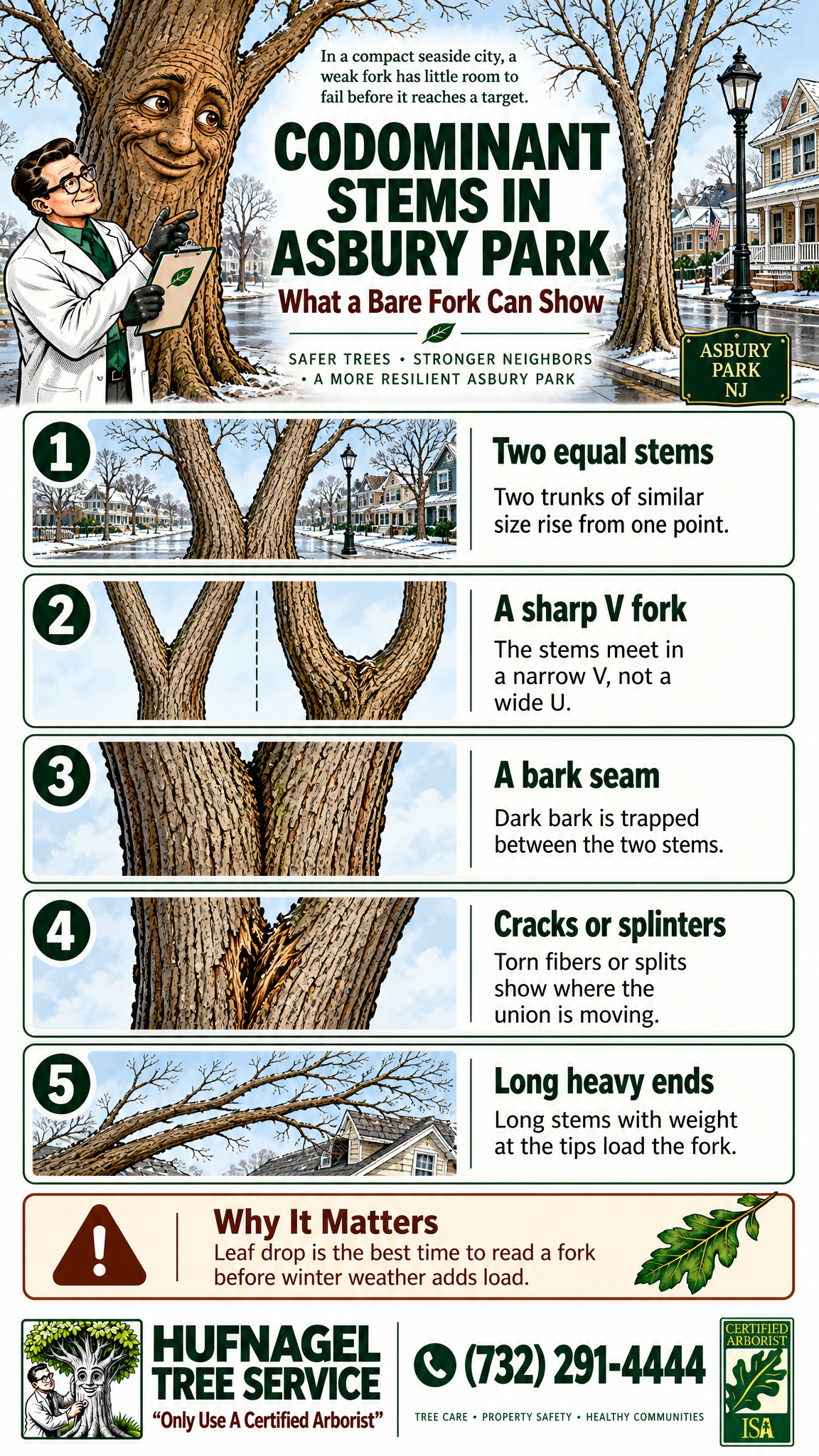
What a Bare Fork Can Show About Codominant Stems in Asbury Park
- Two stems of nearly equal size rising from one point with no clear leader.
- A sharp V shaped fork where the stems meet, not a wide smooth U.
- A dark seam or line of trapped bark running down between the stems.
- Cracks, splits, or splintered wood at the point where the stems attach.
- Long stems that are heavy at the ends and reach over a roof or walkway.
None of these signs means a tree must come down, and most of them can be managed with a plan. The goal is not to remove every forked tree. The goal is to know how the union is built, how much weight it carries, and what stands underneath. Once we know that, the next question is what a failing union actually looks like when a storm tests it.
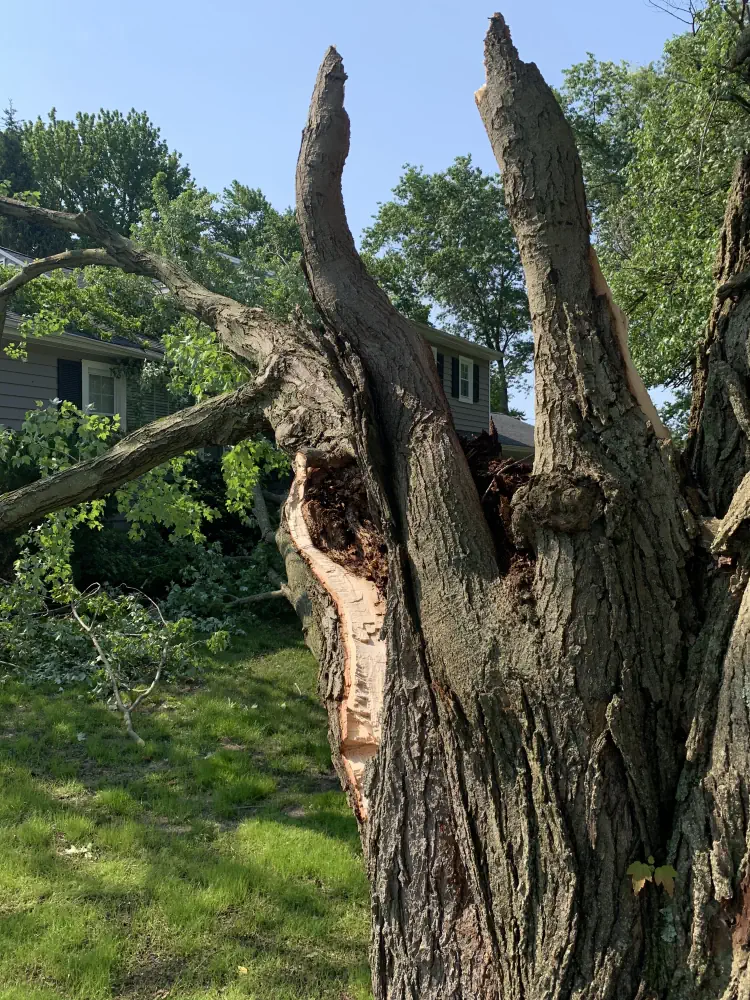
A Split Fork Shows Why We Read the Union Before the Storm
The photograph above shows a trunk that has split into two forks, with torn, splintered bark and pale exposed wood along the break and dark, crumbly material inside the union, while a leafy yard and a house stand behind it. We cannot say from a picture exactly why this tree failed, but we chose it because it shows how a fork can end. A fork that looks full and green from the street can still hide a seam that has been opening for years.
The Florida Urban Forestry Council article tells readers to inspect mature trees with codominant stems for cracks, splits, splintered wood fiber, or signs of internal decay at the point of attachment. That is the same list we work through on a real inspection, and it is why we do not judge a fork from the driveway. Our guide to hidden tree rot explains how decay can sit inside a tree that still looks sound.
Purdue adds a second pattern that often travels with forks. It describes overextended limbs as unusually long, heavy, or far outstretched, with most of the foliage at the end, and says they often break where the branch meets the stem. The guide says these failures usually happen under a heavy load of wind, snow, or ice. We take that as a working rule for November through March, when the Purdue guidance and our own field experience point to the same weather as the test.
In a city of 1.43 square miles of land, a failing fork nearly always has a target. A limb that drops in a rear yard is a cleanup. The same limb over a driveway, a porch roof, a parked car, or a neighbor’s fence is a claim, an injury, or both. This is why codominant stems in Asbury Park deserve a closer look than the same fork in an open field, and why we ask what stands underneath before we ask anything else.
If a fork does fail, the safe response is simple. The New Jersey Department of Health says tree work is hazardous under normal conditions, that contact with electrical power sources is a high risk, and that this work should be left to licensed tree care professionals. Stay clear of a split trunk or a hung limb, keep people and cars away, photograph the damage from a distance for your insurer, and call. Never touch a tree that is near a downed wire.
After a storm the work goes beyond the visible break. We trace the crack to see how far it runs, check the other stem for matching damage, and look at the soil and base for movement, because a union that fails often loads the roots on the way down. Our guide to weak tree roots covers what that ground level check involves.
Warning Signs to Photograph Before You Call About a Forked Tree
- Cracks or seams running down the fork from the crotch toward the trunk.
- Mushrooms, conks, or crumbly dark wood at the union or near the base.
- A limb that has dropped, hangs, or looks different from last season.
- Fresh splinters or torn bark after a wind storm or a wet snow.
- Soil heaving or a new lean on a tree with a forked trunk.
These photographs give us a record of what changed and when, which is often the most useful thing a homeowner can hand us. A single picture rarely settles the question, but two pictures a few months apart often do. Once we know what the fork is doing, the next question is who can work on the tree and what the options are.
Asbury Park Rules and Support Options Come Before Any Cut
Trees in Asbury Park sit under two kinds of ownership, and the rules differ. The Asbury Park Sun reported on July 13, 2018, that the city’s Environmental and Shade Tree Commission is an all volunteer group that looks after the trees lining city roadways and about 11 gardens and open spaces. Its work includes routine trimming, hazardous tree removal, tree replacement, and insect and disease control, and it helps residents with planting, trimming, and public tree removal. For a street tree, the city is the first call, not a contractor.
Private trees now carry their own rules. The Coaster reported on May 7, 2024, that the City Council amended the ordinance governing the commission at its April 24 meeting to add penalties for tree removal, and that residents now have to request a permit to take a tree down. A resident can plant a replacement on the property or pay the city $450 to buy and plant a new tree elsewhere in Asbury Park. The article gives no size thresholds or fees, and rules can change, so confirm the current process with the city before any tree comes down. Our overview of tree removal permits explains what to expect in general, and we do not issue or approve permits.
Once a weak fork is found, removal is not the only answer. Purdue says cables and brace rods are supplemental supports meant to reduce the risk of failure of weak stems, branch unions, and multiple leaders. Cabling may reduce stress damage from high wind or the weight of ice or snow, and braces are threaded rods installed through the union to hold the stems together. Softer systems use synthetic rope without drilling. The guide is clear that not all risk can be mitigated and not all trees can be reinforced.
The photograph above shows a climber in a harness on ropes beside a large trunk and a forked limb, in silhouette against a cloudy sky. It is a fair picture of what support work involves. Purdue calls installation a complicated process best completed by qualified arborists, with pruning often done first, and the Trees Are Good site from the International Society of Arboriculture says pruning or removing trees, especially large ones, can be dangerous and should be done only by people trained and equipped to work safely in trees.
Support is also a commitment. Purdue says owners should expect ground inspections every year for loose hardware, a climbed inspection about every three years, and possibly replacement of the system after seven to ten years. The same guide says some trees cannot be cabled because of poor health or decayed wood, and that not all trees should be saved. That honest limit matches how we work. When we find a weak union we weigh trimming and pruning, tree restoration, support, monitoring, and removal, and we explain why each one is or is not on the table.
Age changes the answer. The Florida article says a young tree can be pruned early so that one stem becomes subordinate to a single leader, while on a mature tree, removing or reducing a stem can be risky and calls for expert recommendations. For a large, long established street tree in Asbury Park, a reduction cut that looks small from the ground can change the load on the whole union, which is why we plan the order of cuts before a crew climbs. Our storm proofing work follows the same logic.
What a Written Plan for a Forked Tree Should Cover
- Which fork and which stems are involved, and what stands underneath them.
- Whether pruning, support, monitoring, or removal fits the condition of the wood.
- How the crew will reach the union and control every piece that comes down.
- Whether a city permit or replacement planting is required before work begins.
- When the union will be checked again, from the ground and from the crown.
A plan like this turns a worry into a sequence. Each item can be answered before a crew arrives, and each one protects the tree as well as the property. It also gives a homeowner something to compare, because a fork that is cabled, pruned, or left alone should come with a reason and a date for the next look.
Call Hufnagel Tree Service About Codominant Stems in Asbury Park
If you have mature trees near your Asbury Park home, driveway, or lot line, and any of them has a fork between two similar stems, schedule an evaluation before winter storms arrive. We provide tree risk evaluations, tree trimming and pruning, storm proofing, tree restoration, and removal when a tree cannot be managed safely. You can also read more local articles in our Asbury Park category.
Hufnagel Tree Service is led by a certified arborist with almost 30 years of local experience and more than 280 five star Google Maps reviews. We inspect first, explain what we found in plain terms, and recommend only the work that changes the outcome for your tree and your property.
Call or text (732) 291-4444 to schedule an inspection of codominant stems in Asbury Park before the next winter storm arrives.
Schedule Service Now!
From precision pruning and safe removals to health assessments and preventative care, Hufnagel Tree Service delivers expert solutions backed by decades of experience. We offer certified insight, fair pricing, and a commitment to doing what’s best for your landscape.
Learn More About Our Services
Related Articles
Old Bridge Fall Tree Inspection: Catch Hidden Hazards Early
Aberdeen Fall Tree Inspection: Find Problems Before Winter