Tree Health in Sea Bright NJ: Salt, Sand, and Flooded Roots

In Sea Bright, salt mist, sandy soil, and ocean flooding all reach a tree at once. Learn what each one does to buds, crowns, and roots before winter storms arrive.
Share This Article

Contents

Tree Health in Sea Bright Starts on a Barrier Peninsula Between Ocean and River

Tree health in Sea Bright starts with the shape of the ground. Wikipedia describes the borough as a barrier peninsula between the Atlantic Ocean and the Navesink and Shrewsbury rivers, formed on March 21, 1889, from parts of Ocean Township. It stands at an elevation of 3 feet, it had 1,449 residents in the 2020 census, and water makes up 0.57 of its 1.29 square miles.

That setting changes how we think about trees. Route 36 is the main highway, the ocean sits behind a seawall on one side, and the Shrewsbury River, an estuary of about 8 miles that empties into Sandy Hook Bay at Highlands, lies on the other. Trees here handle salt, wind, sand, and standing water in a way inland trees never do, which is why our tree health management work starts with the site before it looks at the tree.

After almost 30 years working throughout Monmouth County, we have seen that salt and wet ground leave their marks slowly, and that a tree can look acceptable from the street long after its roots or buds have started to struggle. With the leaves coming down and the dormant season close, November is a practical time to read what the summer and the last storms left behind.

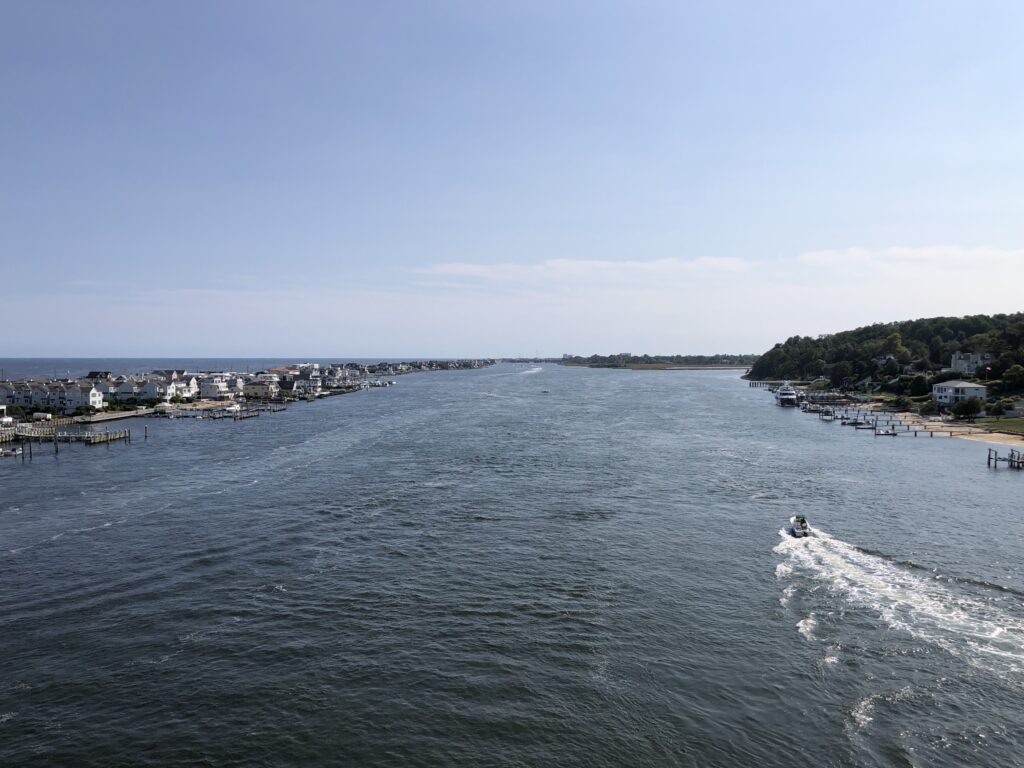
View south from the Route 36 bridge over the Shrewsbury River, with houses and docks on the Sea Bright shore to the left, the Atlantic on the horizon, and the wooded Highlands shoreline to the right under a clear sky
View south from the Route 36 bridge over the Shrewsbury River, September 2024. Photo: Famartin, CC BY-SA 4.0, via Wikimedia Commons.

The photograph above looks south from the Highlands and Sea Bright Bridge on Route 36 over the Shrewsbury River, taken in September 2024. Low houses and docks line the left bank toward the Atlantic on the horizon, while the wooded slope of Highlands rises on the right. Almost everything in the borough stands within sight of water, and the trees that grow here live with that exposure every day of the year.

Exposure is the other half of the setting. The National Weather Service says nor’easters are most frequent and most intense between September and April, with gale force winds and coastal flooding that can be disastrous. A tree that has spent the summer under salt and heat enters that season with less in reserve, so the health of its crown and roots matters well before the first big storm.

Salt Reaches Buds and Twigs Long Before the Trunk Shows It

The University of Massachusetts Extension explains the mechanism in its fact sheet on salt injury to plants. Salt that lands on stems and buds can burn tissue and dry out bud scales, which leaves developing leaves and flowers exposed to winter wind, and the damage usually shows on the side of the plant facing the source and may not appear until spring growth resumes. The fact sheet was written about winter road salt, but the same tissues are exposed to salt mist at the shore, which is why a tree on a barrier peninsula can carry this kind of injury year after year.

The Rutgers Cooperative Extension of Ocean County names the full list in its Seashore Gardening handout. It describes the adverse conditions by the seashore as drying wind, drying sand, baking heat, and salt spray, and it calls salt spray the deal breaker. We agree that salt matters, but we also see it as one of four stresses that arrive together, so a tree that struggles in Sea Bright is rarely suffering from only one of them.

Salt also works through the ground. The UMass fact sheet says dissolved sodium and chloride can displace nutrients such as potassium and phosphorus, and that chloride reaching the leaves can disrupt photosynthesis and cause leaf burn and dieback. It adds that sodium can increase compaction and reduce drainage and aeration. Those effects are slow and quiet, and they produce the kind of thinning crown that homeowners often blame on age or on a dry summer.

Timing makes the diagnosis harder. According to the same fact sheet, soil salt damage can appear late, sometimes in summer or even years afterward, and it often gets worse in hot, dry weather. A maple that scorches in August may be showing the result of a salt event from the previous winter, and a tree that drops leaves early may have been under stress for several seasons. Our guide to hidden damage from seasonal storms explains why we look for slow changes as well as sudden ones.

Species matter, but they do not settle the question. The fact sheet lists northern red oak and thornless honeylocust among the reported tolerant trees, and it lists red maple, sugar maple, pin oak, littleleaf linden, eastern white pine, and eastern hemlock as sensitive. It also notes that tolerance varies within a species and by the type of exposure, and that tolerant does not mean injury free. We use that list to set expectations, not to promise that any tree will stay unharmed in a salt exposed yard.

Reading the exposed side of the crown is the first step in our tree risk evaluation work near the water. Mike Hufnagel puts it simply: “On the barrier island, the story is usually on the side of the tree that faces the wind and the water. We read that side first, because it tells us what the tree has been through.” That is why we walk a property in the direction the weather comes from before we look at anything else.

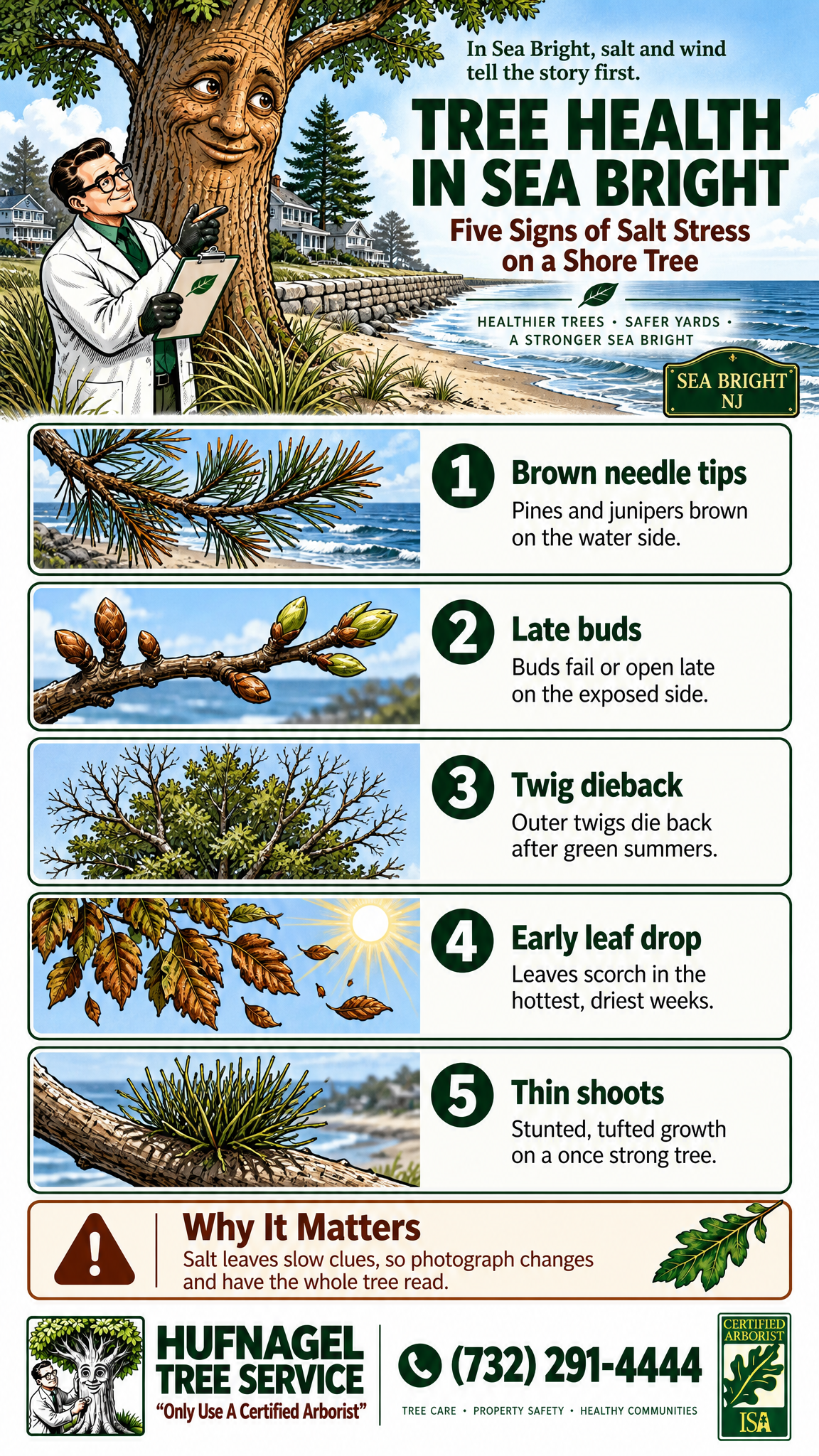
Signs of Salt Stress That Matter for Tree Health in Sea Bright Yards

  • Browning or dead needle tips on pines and junipers, mostly on the side facing the water.
  • Buds that fail to open, or open late, on the exposed side of the crown.
  • Twig and small branch dieback in the outer crown that was green last summer.
  • Leaves that scorch or drop early during the hottest, driest weeks of the summer.
  • Thin, stunted, or tufted shoots on a tree that was vigorous a few seasons ago.

None of these signs proves that salt is the cause, because each one can also point to root trouble, drought, or an old wound. The goal is not to diagnose a tree from the driveway. The goal is to notice what changed, photograph it, and have the whole tree read in context. Once the symptoms are noted, the next question is what the canopy shows after the leaves are gone, because the dormant season gives a clearer view of the crown than any summer visit can.

A Bare Crown Shows What Summer Foliage Covered

Once the leaves are down, the thin and dead parts of a crown are much easier to see. A bare crown shows which limbs have no buds, which twigs are brittle, and which unions are crowded or crossed, and that view is the reason we favor the dormant season for a careful first look. A tree that was full in July can look very different in November, and the difference is information.

The photograph above shows a tall tree with bare, thinning upper branches against a deep blue sky, with a few small leaves left on one side and reddish shrubs below. A crown like this can have many causes, including salt, root trouble, an old injury, or simple age, and a photograph cannot settle which one. That is why we look at the trunk, the base, and the roots before we recommend anything.

Dieback and weak structure are different problems, and they call for different answers. Dieback points to a tree that is losing the ability to feed its crown, while a weak union or a cracked limb is a mechanical problem that wind can turn into a failure. Our guide to codominant stems explains how a split fork forms, and our guide to hidden tree rot explains why a tree can look sound outside while the wood inside has been lost.

Wind is the tester on a barrier peninsula. With nor’easter season running through April, a dead limb or a split union over a roof, a parked car, or a walkway has months of chances to fail. We ask where each defect would land and how often people are underneath it, because a defect that is low concern over an open lawn can be much more important over a driveway.

Pruning, restoration, monitoring, and removal are the four outcomes, and most trees land in the first three. Deadwood over targets can come out now through our tree trimming and pruning work, and a tree harmed by past storms or poor cuts may be a candidate for tree restoration done over several seasons. Topping is never the answer, and neither is thinning a tree out for wind as a blanket prescription.

Monitoring works when it has a record. We recommend photographing the same tree from the same spot each season, so a change in density, color, or lean shows up against something real. Our earlier article on ornamental pruning in Sea Bright covers salt, wind, and timing for smaller trees and shrubs, and our winter storm proofing article for Sea Bright covers wind loading on larger ones.

Canopy Clues We Record During a Sea Bright Inspection

  • Dead, brittle, or hanging branches over roofs, driveways, walkways, and neighboring property.
  • Thin tops or bare outer twigs on a tree that was full last year.
  • Tight forks and crossed branches where two stems press against each other.
  • Cracks, cavities, or fungus on the trunk, the limbs, or the exposed root flare.
  • A lean that looks new, with soil lifted or cracked on one side of the base.

A crown tells only part of the story, and the roots decide how much of that story ends well. A tree can hold a thin canopy for years if its roots are sound, and it can fail with a full canopy if they are not. For that reason the last part of a good health review happens at ground level, where sand, fill, water, and equipment all leave their marks.
Roots in Sea Bright Face Sand, Fill, and Standing Water

The Rutgers handout lists drying sand as one of the four seashore stresses and recommends organic amendments to improve moisture retention, along with organic mulch to hold moisture and control erosion. It also suggests overhead watering from time to time to rinse salt and sand off foliage. That advice is written for gardens, but the principle carries over to trees: sandy ground drains fast, holds little, and rewards a steady layer of mulch.

Purdue Extension’s guide to construction and trees says roots are the leading cause of decline and death of injured trees, and that damage to them may take years to show. That slow clock is the reason a tree can seem fine for a season after a patio, a trench, or a new grade is added and then begin to thin. We treat any yard project inside the root zone as a possible start date for a decline that has not yet appeared.

The guide gives a simple way to find the zone that needs protection. Measure the trunk diameter in inches at 4.5 feet above the ground and multiply by 1.5 to get the distance in feet from the trunk, so a tree 16 inches across gets 24 feet. It also says not to allow more than 25 percent of the roots in the protected zone to be damaged. On a compact lot that zone often crosses a driveway, a property line, and a neighbor’s patio, which is why plans have to be made with the tree in mind.

Fill is a particular concern near the water. The Purdue guide warns that as little as 2 inches of fill soil over a root zone can cause a tree’s death, and that lowering the grade can destroy major parts of the root system. It says an ISA Certified Arborist or other qualified expert should approve any grade change before work begins. A flood that reaches a yard from the ocean or the river carries salt with it, and the sodium and chloride problems described earlier apply to the soil as well as to the leaves.

Shore communities rebuild often. Wikipedia says the Sea Bright and Monmouth Beach seawall, about 4.7 miles long, was built in phases from 1914 to 1962 and that reconstruction began in 2017 to add 3,188 feet of new wall where none existed. The same page says Hurricane Sandy in 2012 washed away roughly 5 million cubic yards of beach sand. Ground on the peninsula moves, and every yard that is regraded or filled deserves the same question about roots.

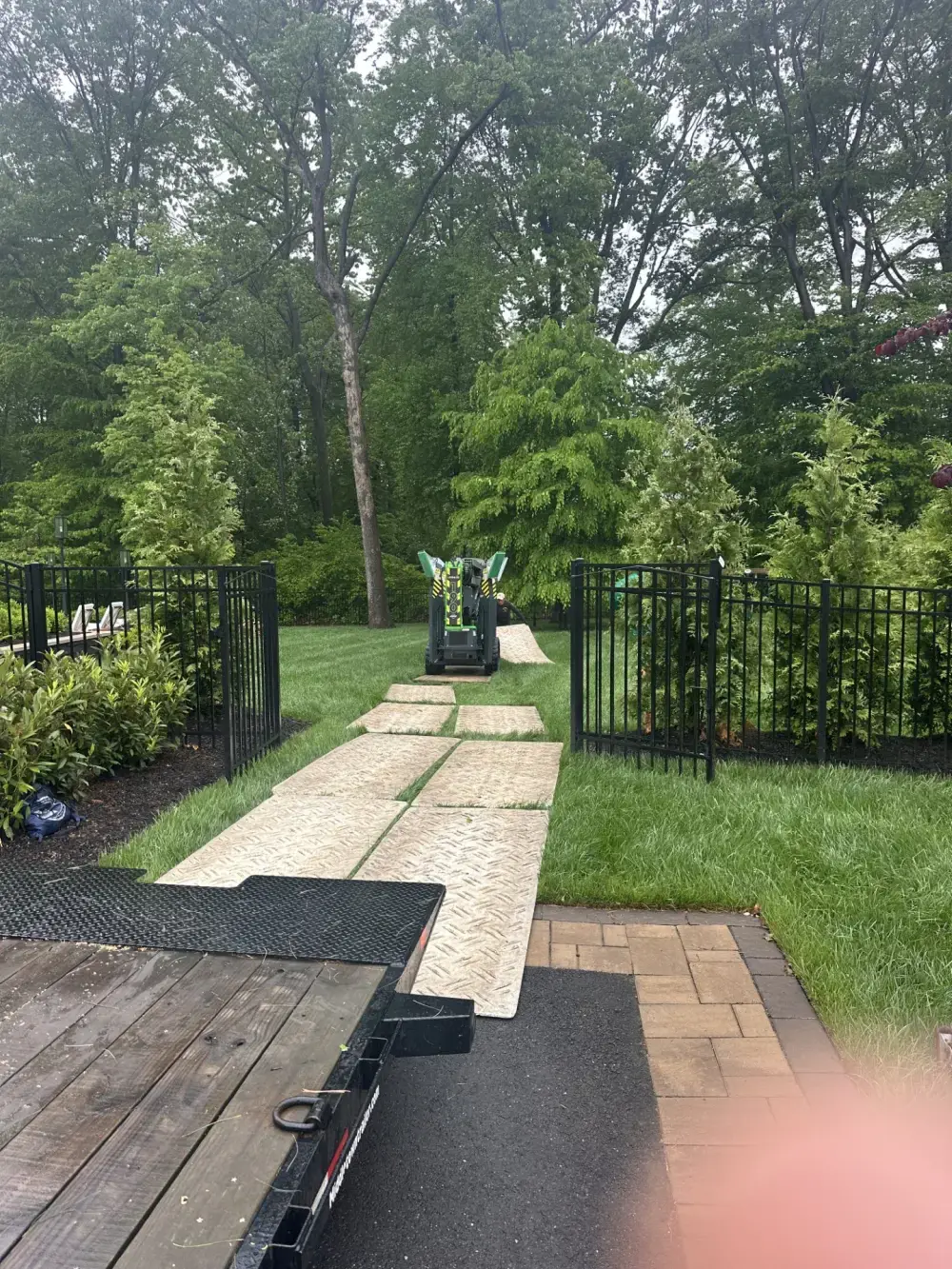
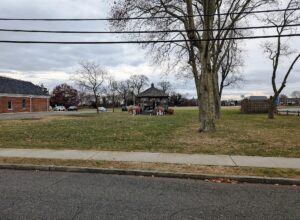
Equipment is the other source of root injury. The Purdue guide recommends limiting vehicles to marked paths and preparing access ways with at least 6 inches of hardwood mulch to reduce compaction, and it says compaction can destroy the fine absorbing roots. The photograph above shows the same idea on a lawn, with ground protection mats laid across the grass so a small tracked machine can reach the work without crushing the soil beneath it.

Care after the work is mostly about restraint. The guide advises mulching the protected root zone to insulate soil from swings in exposure and water loss, watering during dry periods, and monitoring for stress, and it says fertilization is not necessary or advised on mature trees. We agree, and we add one caution of our own: mulch belongs in a flat layer across the root zone, never piled against the trunk. Our guide to weak tree roots shows what a root problem looks like when it finally reaches the surface.

Root Zone Questions We Ask Before We Recommend Care

  • How much sand or fill has been added over the root zone since planting.
  • Whether trucks, mowers, or stored materials have packed the soil under the crown.
  • Whether mulch sits in a flat layer rather than piled against the trunk.
  • Whether the soil stays soggy after rain or turns hard and dry in summer.
  • Whether the root flare is visible where the trunk meets the ground.

These questions are practical, not technical, and a homeowner can answer most of them from memory. The answers tell us whether to leave a tree alone, change the ground around it, reduce load in the crown, or plan a removal through our tree removal service when the structure leaves no safe path. Preservation comes first whenever the tree allows it, and written findings with dated photographs make each choice easier to explain.

Call Hufnagel Tree Service About Tree Health in Sea Bright

If you have mature trees near your Sea Bright home, driveway, or the Route 36 side of the borough, schedule an evaluation of tree health in Sea Bright before winter storms arrive. We provide tree risk evaluations, tree trimming and pruning, storm proofing, restoration, and removal when a tree cannot be managed safely. You can also read more local articles in our Sea Bright category.

Hufnagel Tree Service is led by a certified arborist with almost 30 years of local experience and more than 280 five star Google Maps reviews. We inspect first, explain what we found in plain terms, and recommend only the work that changes the outcome for your trees and your property.

Call or text (732) 291-4444 to schedule a tree health inspection in Sea Bright before the next coastal storm arrives.

Schedule Service Now!

From precision pruning and safe removals to health assessments and preventative care, Hufnagel Tree Service delivers expert solutions backed by decades of experience. We offer certified insight, fair pricing, and a commitment to doing what’s best for your landscape.

Where Do You Need Service?
Please Enter Your Contact Information
Are You A New or Existing Customer?
How Can We Help You?

Thank You!

Your Message Has Been Sent

We Will Contact You About Your Inquiry Shortly.

We Could Not Find A Direct Link To A Tree Removal Permit Application For The Town You Selected.

Please contact your local municipality to determine if a permit is required for your tree removal project. They will provide you with the most accurate and up-to-date information.