Contents
In Neptune City, Every Tree Has a Close Target
Neptune City covers 0.90 square miles, all of it land, and the 2020 census counted 4,626 residents there, according to Wikipedia. Voters approved the borough in a referendum on March 19, 1881, and it was incorporated on October 4, 1881, with boundaries that then took in what is now Avon-by-the-Sea and the southern part of Bradley Beach. Today it sits between Avon-by-the-Sea, Bradley Beach, and Neptune Township, with Route 35 running through it and Route 33 along Corlies Avenue on its northern edge.
That compact layout shapes how we think about tree risk evaluation, and it is why tree risk evaluation in Neptune City starts with what a tree can reach rather than how large it is. In a borough this small, a mature oak or maple usually has a roof, a fence, a driveway, or a neighbor’s yard within reach of its limbs. A defect that is low concern over an open field can matter a great deal over a bedroom or a parked car.
After almost 30 years working throughout Monmouth County, we have seen that the trees that cause trouble in a small town rarely fail without notice. A crack that opened after a summer storm, a lean that was not there in June, or deadwood that shows once the leaves drop are the changes a late fall evaluation is meant to catch, while the ground is still workable and winter has not yet added its load.
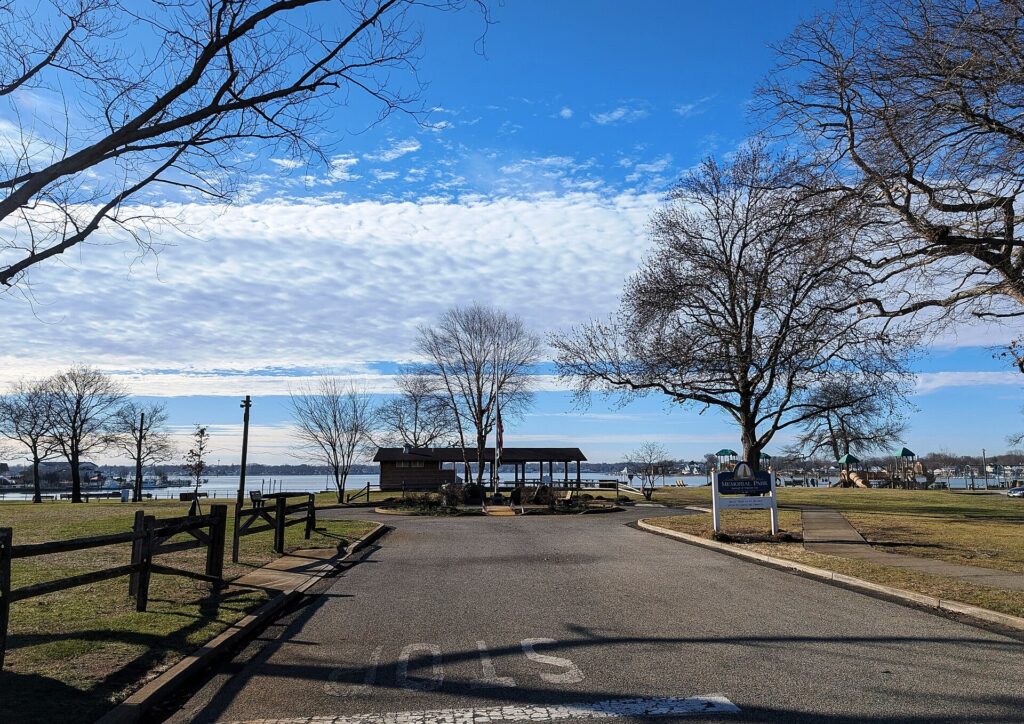
The photograph above shows Memorial Park, which Wikipedia places along the Shark River, on a clear December day. Bare trees stand between a roofed pavilion and the water, and a playground sits at the right edge of the frame. A bare canopy is the best time to read a tree, because the forks, the long limbs, and the weight at the ends of the branches are all visible, and so is anything hanging in the crown.
Exposure is part of the picture. The same page gives the borough an elevation of 23 feet, and the water at the park edge means northeast wind reaches some trees with fewer buildings in the way. The National Weather Service describes nor’easters as the storms that are most frequent and violent from September through April, and that window is open now. Our article on weak tree roots in Avon-by-the-Sea looked at the same river and the same wind from the next borough east.
Tree Risk Evaluation in Neptune City Ranks Defects by What a Tree Can Reach
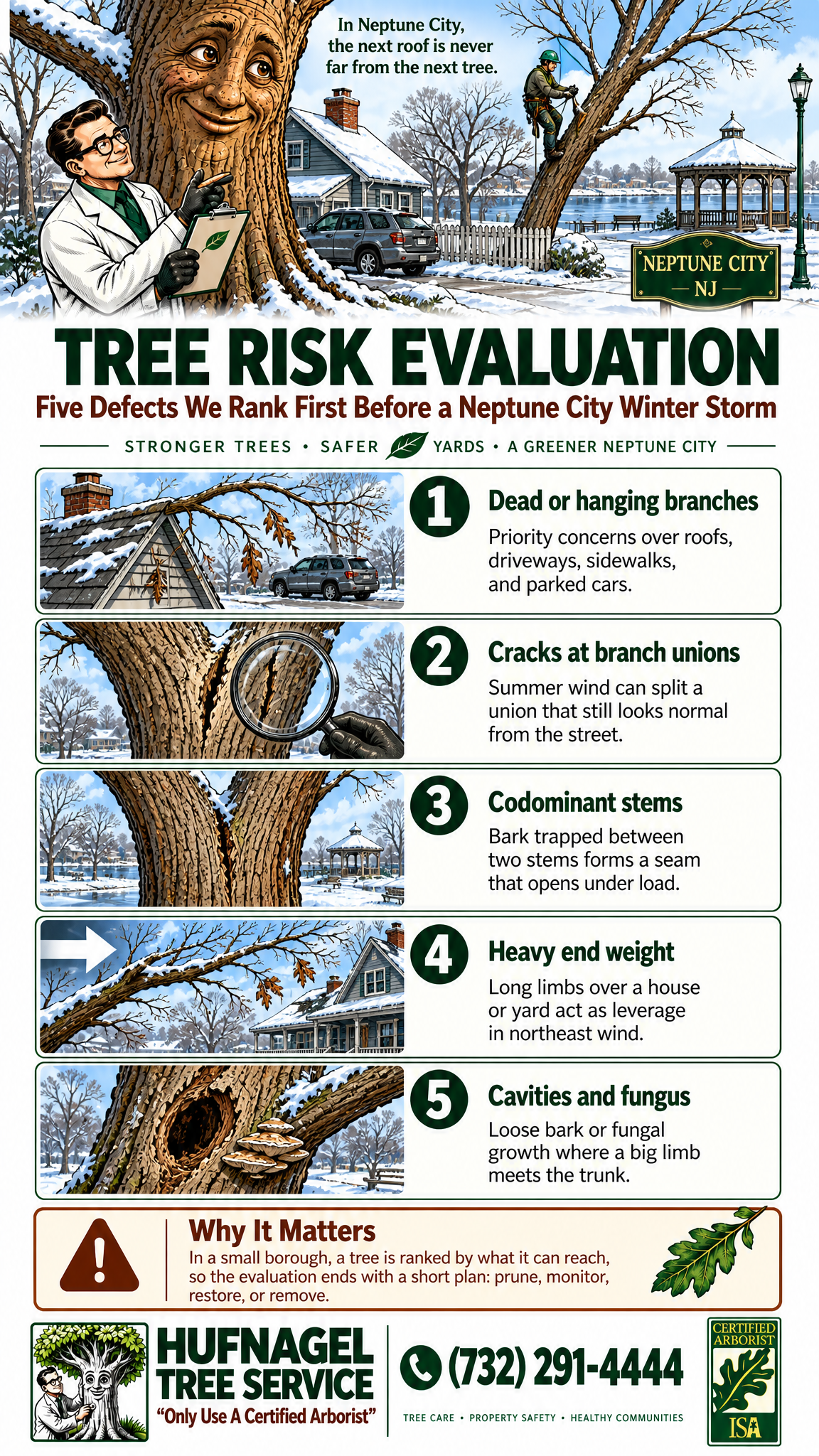
A tree risk evaluation starts with a question that has nothing to do with how big the tree is. What could this tree hit, and which part of it is most likely to fail? The International Society of Arboriculture describes a target as anything a falling tree could strike, such as a home, a vehicle, a picnic table, or a power line, and it notes that the failure of one mature tree can do significant damage to personal property or utility lines. Tree risk evaluation in Neptune City follows that logic, because the answer to the first question is almost always close by.
We begin in the crown, where the defects that matter most are also the easiest to find once the leaves are down. Deadwood over a roof or a driveway is the simplest problem and the one most likely to come down in the first strong northeast wind. Branches that cracked in a summer storm often stay in the tree and look normal from the street until wet snow adds weight. Our guide to storm season risk for homeowners covers what to watch for from the ground.
Branch unions come next. Two stems of similar size growing from one point can trap bark between them, and that seam opens under load. Our article on codominant stems explains why these unions fail. Long limbs that reach well past the rest of the crown carry end weight that acts as leverage in wind, and that matters most when the limb extends over a house, a garage, or a neighbor’s fence.
Neptune City trees are rarely the only thing a defect can reach. Streets such as Sylvania Avenue, Evergreen Avenue, Steiner Avenue, and Laird Avenue run through a borough where the next lot is never far away, so a tree on one property often has a roof, a fence, or a parked car on the next property within reach. That is why we walk the whole drip line and not just the owner’s side, and why we photograph what sits under every limb we are concerned about.
Rutgers describes the pattern well. In an article on the hazards of neglected trees that its Office of Continuing Professional Education reposted in 2023, arborists who teach a hazardous tree course explain that failures usually come from several factors working together, among them improper pruning, structural defects, pests, disease, and poor maintenance, and that planting too close to buildings, roads, or lines adds to the risk. The article notes that weak wooded species such as willows, poplars, sassafras, and silver maples are poorly suited near buildings, while oaks and hickories are sturdier. It also warns against removing every tree after a storm, since pruning or support cables often solve the problem and a removed tree can leave a house exposed that it was sheltering.
The ISA page lists the choices an evaluation leads to: move the target, prune defective branches, add cables or braces where a limb can be supported, keep up routine care, or remove a tree whose risk is unacceptable and plant a replacement in a better place. It adds that cables and braces are not guarantees against failure. That matches our view. No tree service can honestly promise that a tree will never fail in severe weather, and an evaluation is a way to make the likely failures less likely.
Mike Hufnagel puts it this way: “A small borough does not make a tree smaller. It makes the list of things it can hit longer, so I start with the roof, the driveway, and the neighbor’s fence and work back to the crown.” That order keeps the work honest. It points pruning at the defect over the house, rather than at a general reduction that wounds the tree and solves nothing.
Defects We Rank First Before a Neptune City Winter Storm
- Dead, broken, or hanging branches over roofs, driveways, sidewalks, and parked cars.
- Cracks or splits at branch unions left behind by summer wind.
- Codominant stems with bark trapped in the seam between them.
- Long limbs with heavy end weight reaching over a house or a neighboring yard.
- Cavities, loose bark, or fungal growth where a large branch meets the trunk.
Finding these defects is the point of the evaluation, and fixing them is usually modest. Selective pruning removes the deadwood, shortens an overextended limb, or reduces the weight on a weak union. What we do not do is thin a tree out “for wind” as a blanket prescription or top it to make it shorter, because both practices weaken the tree and produce dense regrowth that fails in the next storm. Once the crown is understood, the next question in Neptune City is what winter itself will ask of the tree.
Winter Wind, Wet Snow, and Soft Ground Test Neptune City Trees
The National Weather Service says nor’easters bring gale force winds and nearly always bring heavy rain or snow, with coastal flooding possible, and that they are most frequent and violent from September through April. The Illinois Extension adds the part that matters for trees: heavy snow and ice can overwhelm a tree, breaking limbs or toppling it. Neptune City sits well inside that season, so a plan for winter belongs in late November and not in the middle of the first storm.
The same extension article names the trees that suffer most. Those with more than one central leader, multi stem or clump forms, poor form with narrow branch attachments and included bark, and upright evergreens are the most susceptible. That list is close to our own checklist, which is why a tree risk evaluation in Neptune City looks hard at every fork and every upright evergreen near a house.
What a homeowner does after a storm matters as much as what a crew does before it. The extension advice is to be patient. Bent branches that are not broken usually recover on their own, and ice that will not come off easily should be left to melt, since forceful removal can cause more damage. It also says never to approach a limb that touches a line and to call an arborist and the utility company instead. We agree with all of it. A homeowner can look, photograph, and stay clear, and our article on protecting your trees from snow and ice goes through what to expect.
Saturated ground changes the equation. The Rutgers article on neglected trees describes a client in Allentown who lost seven oaks after Hurricane Irene when saturated ground let the wind topple them, and the one tree that had been marked for removal survived. Weather does not follow a list, and it tests roots as hard as it tests crowns. A root plate that has moved once has less anchorage than it had before, even if the tree looks upright again after the ground dries. Our guide to weak tree roots covers what we check at the base of a leaning tree.
Trees at the edge of open water, such as those at Memorial Park on the Shark River, meet wind with fewer buildings to slow it than trees on the interior streets, so we give the side that faces the water extra attention. Inland, the signs are quieter. A crack in the soil, a small mound of lifted turf, or a shelf of fungus at the base of the trunk tells us the roots have been working harder than the crown suggests.
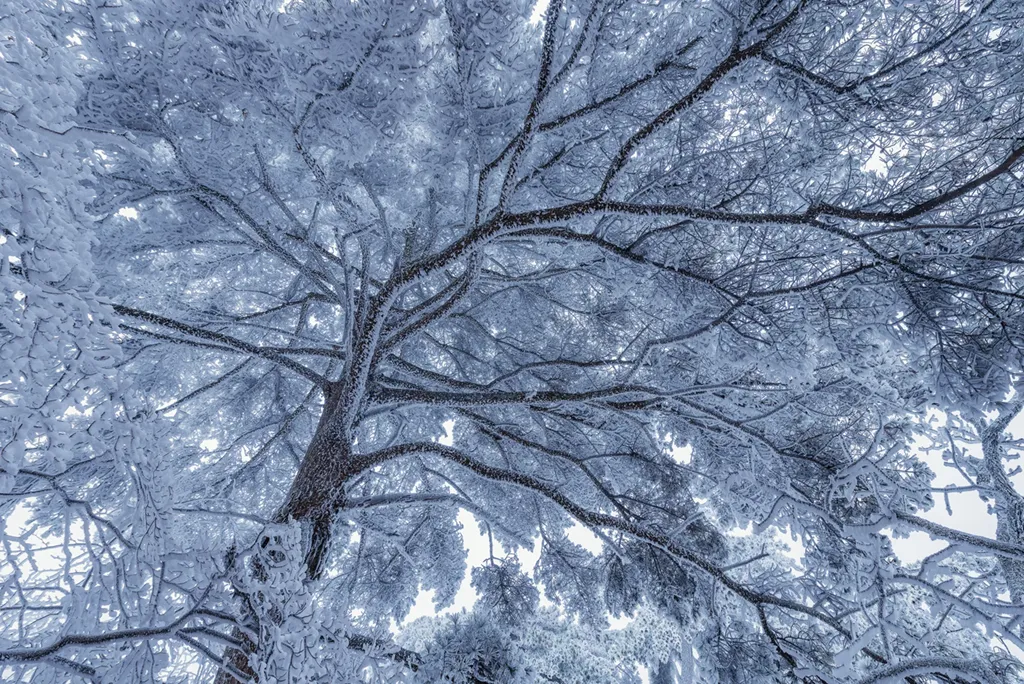
The photograph in this section looks up into a crown thickly coated in frost and snow. Every limb in the frame is carrying weight it did not carry in October, and the long, widely spread branches show where that weight collects. That is the load a tree storm proofing plan is built around, and it is why we look at end weight and branch unions before the first snowfall and not after it.
Root and Crown Signs to Check After a Winter Storm
- A new lean, or an old lean that looks more pronounced than it did in fall.
- Lifted or cracked soil on the side of the trunk away from the lean.
- Fresh splits or hanging limbs at unions that looked sound before the storm.
- Upright evergreens bent over or pulled open by snow and ice.
- Limbs resting on service lines, which call for the utility and an arborist.
None of these signs means a tree is coming down tomorrow. Each one means the tree’s margin has changed and deserves a closer look before the ground is soaked and the wind is up at the same time. Where the roots are sound, pruning to reduce the load on a weak union can lower the stress the tree has to carry. Where the roots are not sound, no amount of pruning fixes the problem, and we say so. The next question is who owns the tree and what the borough expects.
Borough Rules and Private Trees Share the Same Neptune City Streets
Neptune City treats shade trees as a public program. Chapter 32 of the borough code creates a Shade Tree Advisory Board of three residents appointed by the Mayor, who serve without compensation. The board prepares programs and plans for the purchase, planting, care, trimming, preserving, and control of the shade and ornamental trees of the borough, and it consults regularly with the governing body about them.
The same chapter gives the Borough Council the power to regulate the use of the grounds around shade and ornamental trees on public land and to move or require the removal of any tree or part of a tree that is dangerous to public safety. It also lets the council treat or remove a tree on private property that is believed to harbor a disease or insects readily communicable to neighboring healthy trees in the borough’s care, with the owner’s consent and only after the condition is confirmed by a certificate of the Department of Agriculture.
Section 32-7 adds a point that owners should know. If the governing body so determines, the cost of removing a tree that is dangerous to public safety can be charged to the real estate in front of which the tree stood, and an unpaid charge is certified to the Tax Collector and becomes a lien that is included in the next tax bill. A homeowner who knows a tree is a problem is better off acting before any of that is in play. Questions about a specific tree belong with the borough, and our article on tree removal in Neptune City covers the application side.
Where a tree stands in one of the borough parks, which Wikipedia lists as Memorial Park, Laird Avenue Park, Joe Freda Park on Third Avenue, and Adams Field on West Sylvania Avenue, ownership is a question for the borough. On a private lot, the decision belongs to the owner, and the evaluation gives the owner something concrete to decide with: the defect, the target, and the recommended action, in order. Our article on tree trimming in Neptune City covers fall pruning on the same streets.
Most Neptune City trees we evaluate end up in one of four outcomes: monitoring, pruning, restoration, or removal. Monitoring is a legitimate result. A tree with a minor defect and no meaningful target can wait and be checked again in spring. Pruning handles most of the rest, and it is done selectively, with a reason behind every cut. Restoration pruning applies to trees that were damaged in a past storm or cut badly by someone else, and it works regrowth back toward sound structure over more than one season.
Tree removal is the outcome we reach when the structure or the roots no longer give us a dependable way to manage the risk over a house, a driveway, or a neighbor’s property. We do not recommend it because a tree is large or because winter is coming. We recommend it when the alternatives do not reduce the risk to a reasonable level. Our guide to tree removal permits explains the paperwork when a removal is needed.
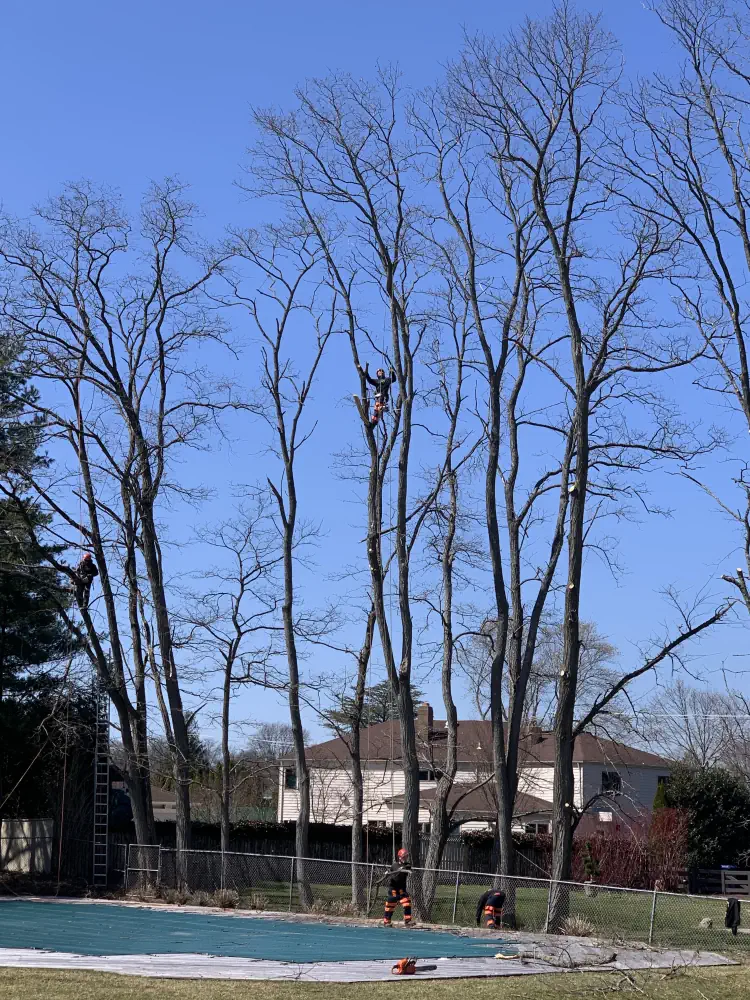
The photograph in this section shows tall bare trees standing behind a backyard pool cover, with a climber high in one and crew members at the base. A pool, a fence, and a neighboring house sit within reach of that row, which is the kind of scene an evaluation is built for. The defect is found first, the target is named second, and the plan follows from both.
What a Neptune City Homeowner Should Have Ready Before Winter
- A late fall evaluation of any mature tree within reach of the house, garage, or driveway.
- Deadwood and cracked branches removed from above roofs, walks, and parking areas.
- Overextended limbs shortened to reduce end weight over targets.
- Dated photographs of leans, cracks, or soil movement to compare after each storm.
- A clear answer from the borough on whether the tree is public or private.
A plan built this way is specific to the property. It is not a list of every service we offer. It is the handful of actions that change the outcome for this house when the next winter storm arrives, in the order that matters. When the work is done, the homeowner knows what was found, what was fixed, what is being watched, and why.
Schedule Tree Risk Evaluation in Neptune City Before the Next Winter Storm
If you have mature trees near your Neptune City home, driveway, fence line, or a street frontage the borough may share, schedule an evaluation before winter storms arrive. We provide tree risk evaluations, tree storm proofing, tree trimming and pruning, restoration, and tree removal when a tree cannot be managed safely.
Hufnagel Tree Service is led by a certified arborist with almost 30 years of local experience and more than 280 five star Google Maps reviews. We inspect first, explain what we found in plain terms, and recommend only the work that changes the outcome for your trees and your property.
Call or text (732) 291-4444 to schedule tree risk evaluation in Neptune City before the next winter storm. Our Neptune City tree articles list more local guidance.
Schedule Service Now!
From precision pruning and safe removals to health assessments and preventative care, Hufnagel Tree Service delivers expert solutions backed by decades of experience. We offer certified insight, fair pricing, and a commitment to doing what’s best for your landscape.
Learn More About Our Services

Related Articles
Tree Health in Sea Bright NJ: Salt, Sand, and Flooded Roots