Contents
In Interlaken, Tree Removal Starts With Small Lots and a Planted Street
Interlaken is small, quiet, and entirely residential. According to Wikipedia’s entry on Interlaken, the New Jersey Legislature authorized the borough on March 11, 1922, from part of Ocean Township, and voters approved it in a referendum on May 3, 1922. Today it covers 0.39 square miles and counted 828 residents in the 2020 census. County Route 15 runs through the middle of it, and Deal Lake, which the Deal Lake Commission describes as about 158 acres, lies along its edge.
That small footprint shapes how we think about tree removal. Tree removal in Interlaken is rarely about clearing a lot. It is about deciding whether one particular tree can still be managed, and if it cannot, taking it down in a way that protects the house, the street, the neighbors, and the trees that remain. Many homeowners are surprised to learn that the borough also asks for notice before a tree comes down, which is a good reason to understand the decision before the first cut is made.
After almost 30 years working throughout Monmouth County, we have seen that October is a practical time to ask the question. The leaves are thinning, the summer record is behind us, and a tree risk evaluation can sort the trees that deserve another decade from the few that have run out of safe options.
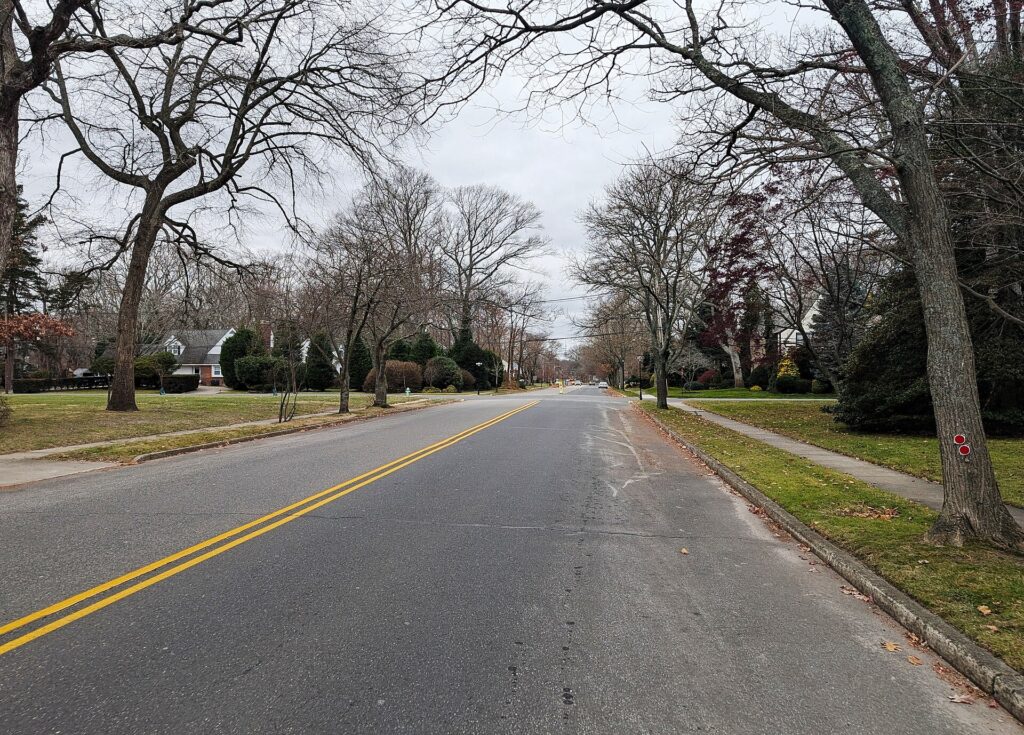
Exposure matters in a borough this low and this close to the water. The same Wikipedia entry gives Interlaken’s elevation as 16 feet, and the Deal Lake Commission’s facts page notes that strict compliance with NJDEP regulations applies to any land within 50 feet of the lake shoreline, and that property owners should contact the NJDEP before shoreline maintenance or construction. For a homeowner with a large tree near the water, that rule is worth checking before any crew is booked. Trees here also live with soil that stays wet after heavy rain and with wind that finds the gaps between houses. We cover how storms leave hidden damage in our article on hidden damage from seasonal storms, and the same signs apply on Grassmere Avenue and the streets around it.
Tree Removal in Interlaken Begins With the Defect, Not the Size
Removal should come at the end of a decision, not the start of one. The Purdue Landscape Report puts it plainly: the last option should be removal and it should be an informed decision, after pruning, support, and plant health care have been considered. We work the same way. Our first question is never how big the tree is. It is what is wrong with it, how far that defect has progressed, and what the tree could hit if it fails.
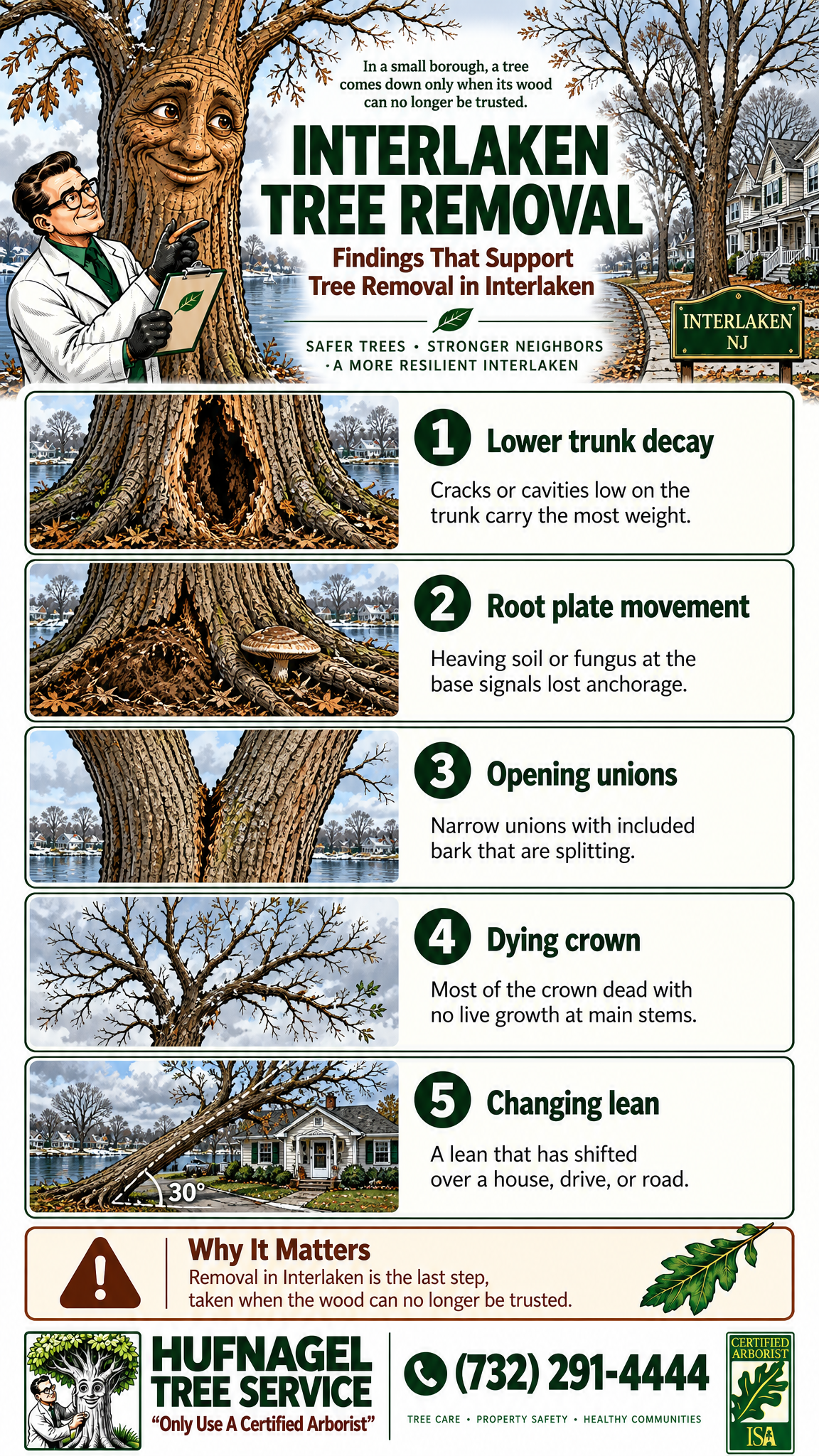
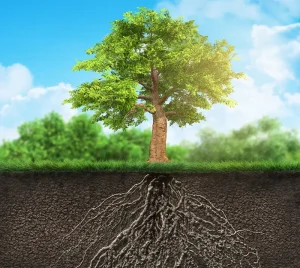
We read the tree from the ground up. At the base we look for exposed or decayed roots, heaving soil, fungus, and cracks in the ground around the root plate, which is the same list the Purdue article gives for root problems. Our guide to weak tree roots explains why movement at the base matters more than almost anything seen in the crown. A tree that has shifted even slightly in wet soil has told us something about its anchorage.
Next comes the trunk. Cracks, cavities, and decayed areas in the main stem carry real weight in a removal decision, especially when they sit in the lower trunk where the load is highest. Conks and mushrooms on the bark suggest that decay has been working for some time, and our guide to hidden tree rot describes how a sound looking tree can be hollow inside. A hollow tree is not always an emergency, but it changes the question from how much to prune to how much wood is left.
Then we look at the unions where large stems meet. Narrow unions with included bark are common in older shade trees, and they are where summer storms and winter loads do their worst work, as our guide to codominant stems explains. Some of these trees can be reduced and monitored. Others have a union that is already opening, and no cut will make that dependable.
The crown tells us about recent history. Dead, diseased, or broken branches, thinning tips, and early browning all matter, but they matter most when they agree with what we found lower down. A tree with a poor crown and a sound base is a very different case from a tree with a handsome crown and a decayed base. We write down both, and we photograph what we see so that later visits can compare it.
Targets finish the picture. In Interlaken the distance between a tree and a roof, a car, a fence, a wire, or a neighbor’s yard is often only a few steps. The same defect over an open corner of a lot is a monitoring item. Over a bedroom wall or the County Route 15 corridor, it is a different conversation. That is why we ask homeowners where people sit, park, and walk before we say anything about the tree.
Mike Hufnagel puts it simply: “A tree is not condemned because it is big or old. We take it down when the wood can no longer be trusted and the work to save it would only leave a smaller version of the same problem.” That rule keeps us from removing a good tree out of caution and from keeping a failing one out of sentiment.
Findings That Support Tree Removal in Interlaken
- Large cracks or cavities in the lower trunk, with decay showing in the exposed wood.
- Heaving soil, fungus, or cracks around the root plate after wet weather.
- Narrow unions with included bark that have already begun to open or split.
- Most of the crown dead or dying, with no live growth at the main stems.
- A lean that has changed over time, over a house, driveway, or road.
No single item on that list decides the outcome. We weigh them together, and the answer is often pruning, restoration, monitoring, or removal, in that order of preference. Once a removal is the responsible answer, the next questions are practical ones: how a tree can be taken down on a lot this small, and what the borough expects first.
On Small Lots Near Deal Lake, the Method Matters as Much as the Decision
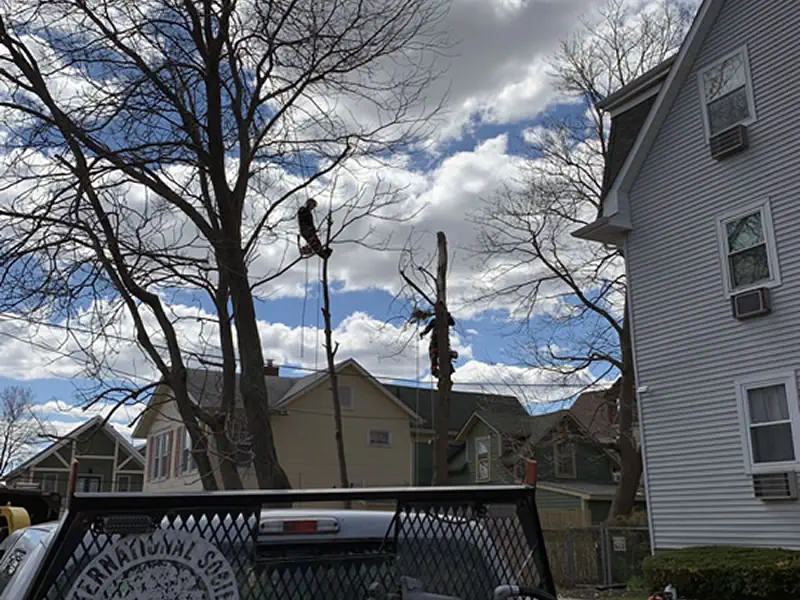
Most Interlaken lots do not allow a tree to be felled in one piece. Houses sit close together, streets are lined with mature trees, and overhead wires follow the roads. That usually means a climber works the tree from the top down, lowering branches and then trunk sections on ropes, while ground crew keep the drop zone clear. The method is slower than people expect, and that is what keeps the work controlled.
The plan comes first. Before anyone climbs, we walk the site and look at the tree, the lot, and what is below and beside it. We identify the wires, the fences, the plantings, the irrigation, and the driveway. We decide where the crew will stage, where cut sections will land, and how the chipper and trucks will fit on a narrow street. A removal done well is mostly decided before the saw starts.
Shoreline lots add a layer. If a tree stands near the lake, the NJDEP rule described on the Deal Lake Commission’s facts page applies to land within 50 feet of the shoreline, and the owner should contact the state before work begins. We would rather an owner make that call early than discover the requirement after a crew is booked. Even away from the water, wet ground matters, because heavy equipment on saturated lawn leaves ruts that last long after the tree is gone.
Tension is the hidden hazard. A limb that looks as if it is simply leaning on another limb may be holding a great deal of stored force, and a hung up branch can shift without warning when anything around it is cut. That is one reason we ask homeowners to stay clear, photograph the damage, and call. Cutting a leaning or damaged tree without training and the right equipment is how people get hurt, and trees near wires are a job for the utility first.
Cleanup is part of the work, not an extra. Wood is cut to manageable sections, brush is chipped, and the ground is raked so that the lot looks like a yard again. Where a stump remains, the owner can decide whether to grind it now or leave it for a planned replacement. We say plainly what each choice means for roots, sidewalks, and any new tree that will go in nearby.
Some trees are better lowered by crane. When a tree stands behind a house with no clear path, or when the trunk is too decayed to climb safely, a crane can lift sections over the roof rather than lowering them through the yard. It is not needed often, and it is not the default. We would rather use the simplest method that keeps people and property safe, and we explain the choice before the day of the job.
Neighbors deserve a word beforehand. On a street as compact as these, a crew in the next yard, a closed lane, or the sound of a chipper is noticed by every house nearby. We encourage owners to tell the people next door when the work is planned, to move cars from the curb, and to keep children and pets indoors on the day. A short conversation over a fence prevents most of the complaints that a removal can otherwise attract.
Timing is flexible, and it should be. A tree that is cracked over a bedroom should not wait for a convenient week, while a tree with a slow decline can be scheduled for the dormant season, when the ground is firmer and the crown is easier to read. We tell owners which category their tree falls into, and we do not use urgency to sell work. Weather decides some of it, because saturated ground and strong wind are poor partners for rigging.
How a Careful Removal in Interlaken Is Organized
- A site walk that marks wires, fences, plantings, and the planned drop zone.
- Climbing and rigging from the top, with sections lowered on ropes.
- Protection for lawns, walks, and driveways under heavy equipment.
- A decision on crane access when the trunk cannot be climbed safely.
- Chipping, raking, and a clear plan for the stump and any replacement.
When the method is chosen in advance, the day itself is quiet and predictable. Neighbors know what to expect, the street stays open as much as possible, and the tree comes down in a sequence rather than a single event. The last piece is the paperwork, because in Interlaken the borough wants to hear about a removal before it happens.
An Interlaken Removal Plan Follows the Findings and the Borough Rules
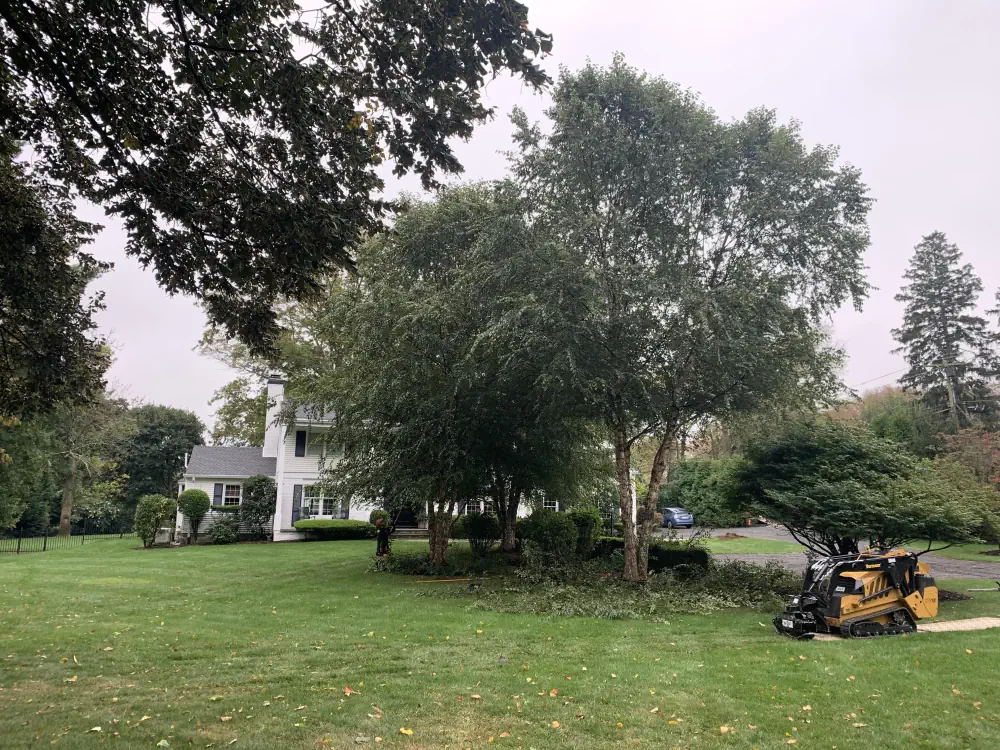
The borough states its rule on its notice page. A tree removal permit is required for the removal of four or more trees of nine inches or greater caliper. For fewer than that, no application is needed, but the person removing each tree must first notify the borough and pay a small fee covering up to four trees. The page says the purpose is to keep a record of removals, and it lists a fine of up to $200 per tree for not following the provisions. The page is undated, so we always tell owners to confirm the current wording with the borough clerk before work begins.
Those rules sit inside a borough that takes its trees seriously. The Shade Tree Commission’s page says the first commission planted 291 trees in 1927, that Interlaken earned Tree City USA recognition in 1988 and has kept it every year since, and that the commission created the Interlaken Arboretum in 1992 near the easterly entrance gates. Residents can also buy a tree through the Honor Me Tree Program to mark a milestone, and the commission cares for it as part of the borough’s long term landscape plan.
That history explains why notice matters here. A removal is not only a private decision. It changes a street that was planted with intent almost a century ago. Where a tree can be saved, we say so. Where it cannot, a written inspection that names the defect makes it easier for the owner to talk with the borough, an insurer, or a neighbor about why the tree is coming down. Our guide to tree removal permits explains how these requirements work across the area.
Ownership is the next question. A tree that stands on a borough or county right of way is a different matter from one in a private yard, and County Route 15 is a county road. If a tree is near the line, we ask the owner to confirm who is responsible before anyone cuts. A removal that starts on the wrong side of a property line can become a dispute that lasts longer than the tree did.
Replacement belongs in the plan from the start. We suggest thinking about the next tree while the old one is still standing: where its roots will have room, what it will reach in thirty years, and how close it will be to wires and walls. A smaller, well placed tree that fits the lot is usually a better replacement than a large one in the same cramped spot. Our tree health management work can follow a new tree through its first seasons.
Finally, choose who does the work with care. The International Society of Arboriculture’s Find an Arborist directory lets owners search for certified arborists in their area, and the Purdue article recommends an inspection by a qualified arborist, preferably an ISA Certified Arborist, at least every three to five years and after major weather events. You can also read our other Interlaken articles for how we have handled trees in the borough.
Questions to Settle Before an Interlaken Tree Comes Down
- Whether the borough must be notified or a permit is needed for the number of trees.
- Whether the tree stands on private land, the street edge, or a county right of way.
- Whether the tree is close enough to Deal Lake to involve the NJDEP shoreline rule.
- What the written inspection says about the defect and what it could reach.
- Which replacement tree will fit the site once the work is finished.
When those questions are answered in order, the plan usually becomes clear. Some trees need only monitoring. Others need pruning, support, or removal, and a written inspection gives the owner something concrete to bring to the borough or to a neighbor when a tree line is shared.
Schedule Tree Removal in Interlaken Before Winter Weather Arrives
If you have mature trees near your Interlaken home, driveway, or sidewalk, or along Grassmere Avenue, schedule an evaluation before winter weather adds load. We provide tree removal, tree risk evaluations, tree trimming and pruning, storm proofing, and restoration when a tree can be saved.
Hufnagel Tree Service is led by a certified arborist with almost 30 years of local experience and more than 280 five star Google Maps reviews. We inspect first, explain what we found in plain terms, and recommend only the work that changes the outcome for your trees and your property.
Call or text (732) 291-4444 to schedule tree removal in Interlaken, or an inspection to find out whether it is needed, before the next coastal storm arrives.
Schedule Service Now!
From precision pruning and safe removals to health assessments and preventative care, Hufnagel Tree Service delivers expert solutions backed by decades of experience. We offer certified insight, fair pricing, and a commitment to doing what’s best for your landscape.
Learn More About Our Services
Related Articles
Summer Ornamental Tree Pruning in Middletown, NJ
Schedule Your End-of-Summer Tree Inspection
Vines and Tree Health: Hidden Risks to Mature Trees
Lightning Strike Tree Damage in Interlaken NJ
Winter Tree Prep in Old Bridge: Schedule An Inspection