Contents
Red Bank Packs Brick Streets, River Edge, and Red Soil Into Barely Two Square Miles
Red Bank sits on the south bank of the Navesink River, and Wikipedia says the borough takes its name from the red soil along that shore. It became a town on March 17, 1870, and was reincorporated as a borough on March 10, 1908. The borough covers 2.16 square miles, and 0.41 of them are water, which gives a small place a great deal of river edge and a great deal of ground that stays wet. Root zones in Red Bank start with that soil, because every street tree here grows in it.
The same page describes Broad Street as the central commercial street, with the Broad Street Historic District running along Monmouth, Front, and White Streets, and it notes about 4 miles of waterfront, only a small part of it open to the public. The borough also keeps eight parks, led by Count Basie Park, with Marine Park and Riverside Gardens Park on the Navesink. Our tree health management work in Red Bank spends most of its time below the trunk, because brick sidewalks, curbs, and utility trenches squeeze the roots of trees that look healthy from the street.
After almost 30 years working throughout Monmouth County, we have seen how often the trouble in a mature tree began years earlier, when soil was piled against it, a trench crossed its roots, or mulch grew into a cone. Late November is a useful time to look, because the leaves are down, the ground is still workable, and the winter ahead will test every root plate in town.
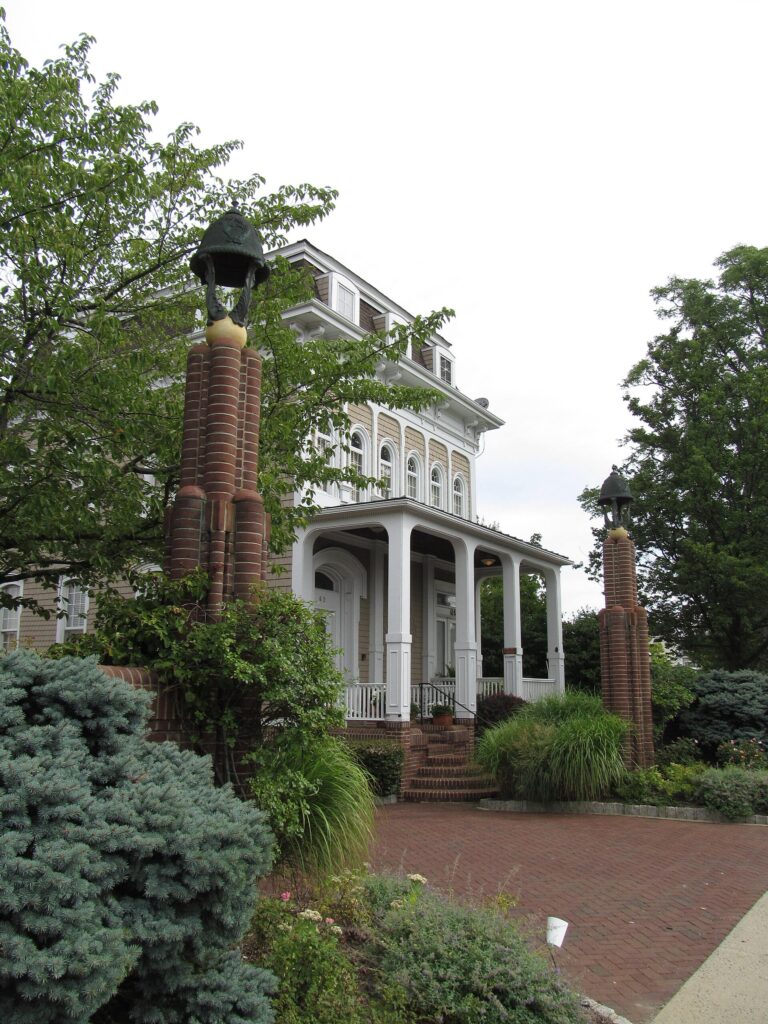
The photograph above, taken in Red Bank in August 2012, shows a brick paved frontage with a blue spruce, a bed of shrubs and grasses, and leafy trees rising behind brick lamp posts in front of a large house. That is a fair picture of what the borough asks of its trees. They share very little ground with paving, utilities, and people, and the root zone under them was shaped long ago. Any change to it, whether a new patio, a trench, or a pile of fill, can matter for years.
Water is the other fact of life here. With the Navesink running along the borough and 0.41 square miles of it under water, low ground near the river holds moisture, and wet soil holds roots less firmly when a nor’easter pushes against the crown. Our article on storm proofing in Red Bank looked at tides and soft soil in detail. This article looks at what owners and contractors do to the ground itself, and at the borough rules that now treat that work as part of the tree.
Red Bank Chapter 665 Counts Mulch, Grade, and Compaction as Tree Removal
Red Bank replaced its tree chapter in 2024. Ordinance 2024-14 was introduced on May 9, 2024, and adopted on May 23, 2024. It states that the purpose of Chapter 665 is to reduce soil erosion and pollutant runoff, promote infiltration of rainwater into the soil, and protect the environment, public health, safety, and welfare. The ordinance ties itself to the borough’s stormwater permit, so a tree is treated as part of how the ground handles water and not only as scenery.
The definition that matters most for root zones in Red Bank is the one for tree removal. It means to kill a tree or cause irreparable damage that leads to its decline or death, and it names excessive pruning, toxic substances, over mulching or improper mulching, and improper grading or soil compaction within the critical root radius. Responsible pruning and maintenance are excluded. A tree can therefore be removed on paper without a saw, simply by what is done to the ground around it.
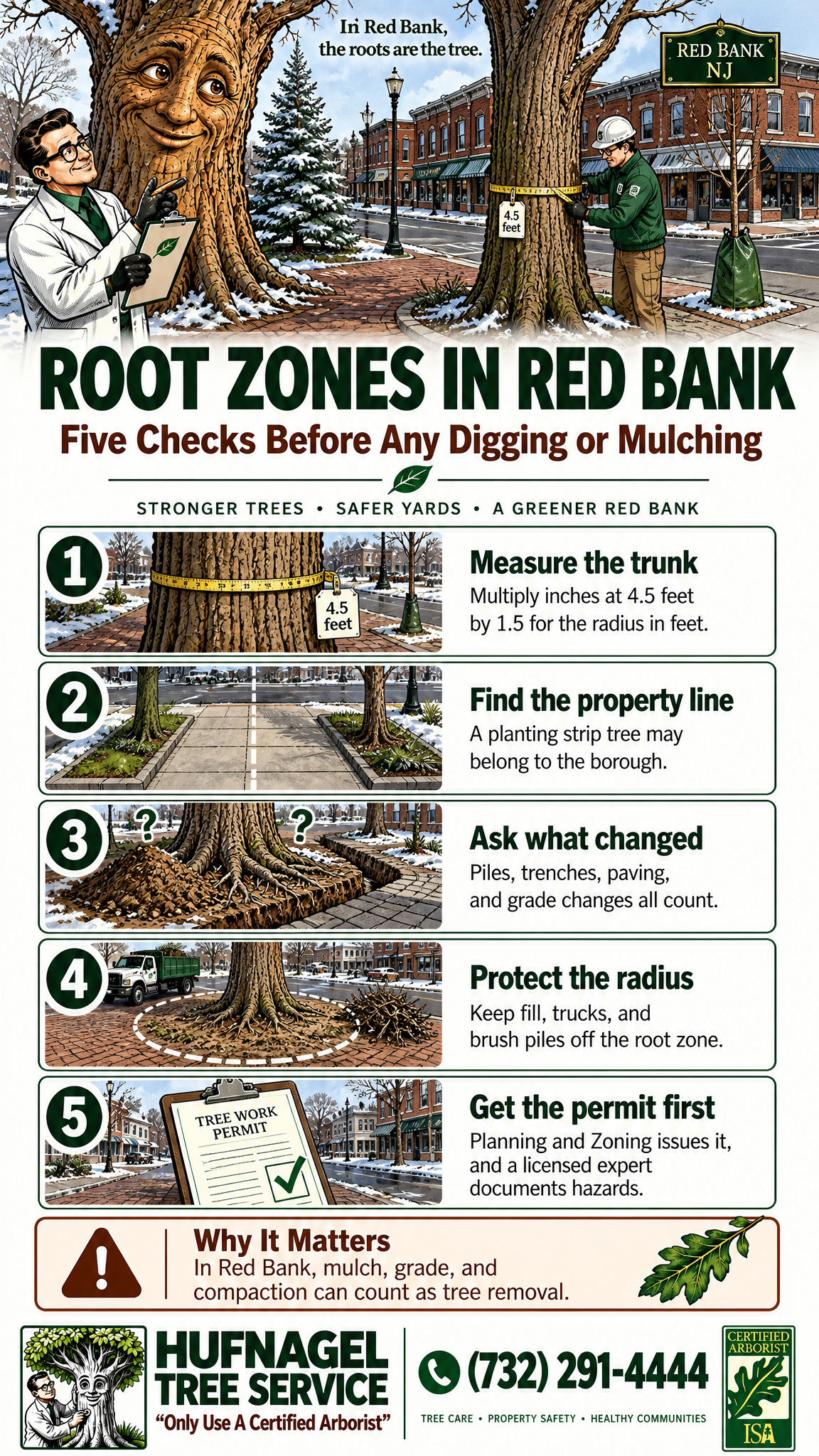
The critical root radius is the trunk diameter at breast height, in inches, multiplied by 1.5 feet. The ordinance gives the example of a tree 6 inches across, which has a radius of 9 feet. By the same arithmetic, a mature maple 24 inches across has a protected radius of 36 feet, and on a small Red Bank lot that can reach the neighboring yard, the sidewalk, and the curb. The breast height point is 54 inches above ground on the uphill side of the tree.
A permit is required to remove a deciduous tree 6 inches or more across, or a coniferous tree 10 feet or more tall, with exceptions for approved development, orders from public authorities, and permitted removals. Section 665-3 also says no one may remove, trim, or cause harm to any tree growing on or over a public right of way or public land without complying with the chapter. Applications go to the Planning and Zoning Department with a $50 application fee, plus a $25 inspection fee when the borough must verify the site on location. The borough permit form asks the owner to mark each tree with colored tape and not to remove anything until the inspection is complete and a permit is issued.
Replacement follows trunk size. A street tree 2.5 inches across or more, or any other tree 6 inches or more, falls under the replacement table, and the first category calls for one new tree with a caliper of at least 3 inches for each tree removed, or a mitigation fee of $300 for each tree not replaced. Hazard trees may be removed with no fee or replacement, but the ordinance says a Licensed Tree Expert makes that determination at the applicant’s expense. The New Jersey Board of Tree Experts explains that Licensed Tree Experts, unlike Licensed Tree Care Operators, may diagnose tree problems, manage trees during site planning and development, and assess tree risk. A violation carries a fine of up to $2,000, and each tree counts as a separate violation.
Mike Hufnagel puts the working rule this way: “Roots do not complain until the damage is done. When a tree starts to fail, we ask what was dug, piled, or paved around it in the last few years, because the answer is usually in the ground and not in the crown.” That question guides every visit we make in the borough, and it is the reason we photograph the base of a tree before we look up.
Root Zones in Red Bank: Five Checks Before Any Digging or Mulching
- Measure the trunk at four and a half feet and multiply the inches by 1.5 to find the radius in feet.
- Find the property line, since a planting strip tree may belong to the borough and not the owner.
- Ask what has been piled, trenched, paved, or regraded around the base since the tree was planted.
- Keep fill, equipment, and brush piles outside the critical root radius, or ask for a different access route.
- Call Planning and Zoning before any removal, and have a licensed expert document a hazard in writing.
These five checks cost little and they leave a record. If a neighbor, a contractor, or the borough asks later why a tree declined, a dated photograph and a measured radius are the easiest way to show what the ground looked like before any work began. Once the rule is clear, the next question is who owns the tree and the strip of ground it grows in.
Planting Strips and Young Street Trees Need Good Soil and Weekly Water

The ordinance defines the planting strip as the land between the curb and the sidewalk and states that it is part of the borough right of way. The Shade Tree Committee FAQ goes further. Borough trees are the trees on the right of way, which typically includes the road, the planting strip, the sidewalk, and often a few feet of the front lawn, along with trees in public parks. A homeowner who is unsure whose tree it is can contact the committee before touching the roots or the soil.
New street trees in Red Bank follow a set routine. The FAQ asks for a trunk that measures 3 to 3.5 inches in caliper, planted by a known landscape company or nursery, staked, and guaranteed by the installer for two years. Planting happens in spring or fall depending on the species. After an inspection the committee installs a gator bag, which the resident fills once a week until the tree is established, about a year. That weekly routine matters as much as the stake, because a young tree has a small root system and depends on the water it is given.
The photograph in this section shows a child watering the base of a thin young tree with a garden hose, which is the same job the gator bag does on a borough street. Water goes where the young roots are, at the base of the tree, and not onto the pavement beside it. A new tree in a strip of brick and concrete has little else to draw on, so a missed week in a dry spell is a real loss.
The committee’s August 20, 2024 meeting minutes show the borough working through the same problems. For the Broad Street project, the long term plan is to change the planting strip, put in better soil, root prune, and plant smaller trees, and the minutes say it will take about two years to root prune the new trees before they are planted. That tells homeowners something useful. When a strip of poor soil is hard on a tree, the fix starts in the ground, and the borough is willing to wait two years to get it right.
The same minutes record a Willow Oak on Harrison Avenue where the homeowner wanted to keep the tree and the Department of Public Utilities agreed to bridge the sidewalk. A slab pushed up by a root is a common sight on older streets, and the choice between bridging the walk and cutting the root decides how much anchorage a tree keeps. Cutting a large root near a trunk is a decision for a licensed expert, and on a borough tree it is also a decision for the borough.
The minutes also describe a problem in Marine Park, where a contractor had piled dirt against trees in a future parking lot. The committee wrote that this will kill the trees, the pile stayed for more than three weeks, and some of the tree roots had been cut. It is a public example of what Chapter 665 means by improper grading, and it happened on land the borough itself manages.
Our tree risk evaluation service looks at the roots, the base of the trunk, and what the tree can reach, and our guide to weak tree roots explains the warning signs that appear at the base of a leaning or lifting tree. For a street tree, those signs are worth reporting early, because the borough can only act on what it hears about.
Five Things to Watch on a Young Street Tree This Winter
- Fill the gator bag once a week until the tree is established, about a year, as the borough asks.
- Check that stakes and ties are not rubbing or cutting into the bark of the young trunk.
- Keep mulch a few inches away from the trunk and never shaped into a cone.
- Report a dead, leaning, or damaged borough tree to the Department of Public Utilities.
- Never pile soil, fill, or building debris against the trunk or over the planting strip.
A young street tree has no reserves, so small mistakes show up quickly. A year of weekly watering and clear ground around the base is an inexpensive way to protect the borough’s investment and the shade the tree will give in future summers. Older trees deserve the same attention, especially where mulch, grade, and salt have built up over the years, and that is where we turn next.
Mulch, Fill, and Winter Salt Change the Ground Under Older Red Bank Trees

UNH Extension recommends mulch 2 to 4 inches thick under a tree with none touching the trunk. For an established tree it describes a rule of three: a 3 inch layer in a ring 3 feet across, with at least 3 inches left clear beside the stem. It warns that mulch piled against the trunk keeps the bark almost always wet, which encourages disease and decay, and that volcano mulch buries the root flare, which leaves trees less stable and more prone to windthrow.
Red Bank says much the same thing in its own words. The Shade Tree Committee FAQ asks residents not to pile mulch into a cone around the trunk, because it encourages decaying fungi, damages the inner bark, and attracts animals that gnaw on bark. Chapter 665 goes a step further and lists over mulching or improper mulching in its definition of tree removal. In November many yards get one more layer before winter, and a look at the base will tell whether the tree needs mulch pulled back and not another bag. Our root flare care article for Allenhurst shows what a correct base looks like.
Digging and driving do more damage than mulch. The Trees Are Good guide to avoiding damage during construction says that grading, trenching, paving, altering drainage patterns, and adding or removing soil within a tree’s critical root zone damages roots. Heavy equipment increases soil density, which slows root growth, limits water penetration, and decreases the oxygen roots need. The guide adds that construction damage to trees may take many years to show and can be deadly, and that small injuries add up into a decline that is hard to reverse.
That matters in a borough where driveways are repaved, utilities are trenched, and houses get additions. On a private lot, a pile of excavated soil beside a trunk or a skid steer working inside the critical root radius does the same harm that the Marine Park pile did, only more quietly. The guide suggests involving an arborist before work begins, and an arborist can set protection fences, prune roots cleanly ahead of excavation, and plan temporary watering if many roots are lost.
Winter adds salt. A Rutgers advisory on road salt puts the spray zone at about 15 feet from treated pavement, and more if downwind, and says salt in the soil acts like drought because roots struggle to absorb water. It also says sodium binds to soil particles, which increases compaction and reduces drainage and aeration. Wherever salt is used on a Red Bank street, trees inside that distance are in the zone, and spring is the time to check them for scorched foliage and dieback.
The advisory’s remedies are practical. Clear snow before applying deicer and use less of it, screen salt sensitive evergreens during winter, rinse salt coated foliage with salt free water, and leach the soil with fresh water as soon as possible after exposure. None of these steps needs special equipment, and all of them are easier before a tree shows symptoms than after.
The photograph in this section shows a churned patch of bare ground with shallow muddy puddles, the kind of surface left where equipment crosses a lawn in wet weather or where water cannot drain. The Trees Are Good guide ties compaction to less oxygen and less water reaching the roots, which is why a surface like this at the base of a tree is a warning sign. Our restoration work and our tree storm proofing service both begin with how the ground looks before we recommend any cut.
If a tree has to come out after the ground has failed it, our guide to tree removal permits and our tree removal service walk through the process. For a look at root zones on larger properties, our article on tree protection in Rumson covers a nearby borough with a similar rule.
Five Root Zone Habits That Protect an Older Tree Through Winter
- Pull mulch back until the root flare is visible, and keep the layer between 2 and 4 inches.
- Keep soil piles, fill, and building materials off the ground beneath the canopy.
- Park trucks, trailers, and equipment outside the critical root radius whenever possible.
- Clear snow before spreading deicer, and use only as much as the walkway needs.
- Leach salty ground with fresh water soon after exposure, and photograph any change at the base.
These habits take an afternoon and they carry a tree through the season with its roots intact. They also make the next inspection easier, since a clear base shows the flare, the first roots, and any new cracks or heaving. With the rules, the owners, and the ground understood, the last step is to schedule the visit.
Call Hufnagel Tree Service About Root Zones in Red Bank Before the Next Storm
If you have mature trees near your Red Bank home, driveway, sidewalk, or riverfront lot, schedule an evaluation before winter storms arrive and before any digging, paving, or regrading begins. We provide tree health management, tree risk evaluations, tree trimming and pruning, restoration, and tree removal when a tree cannot be managed safely.
Hufnagel Tree Service is led by a certified arborist with almost 30 years of local experience and more than 280 five star Google Maps reviews. We inspect first, explain what we found in plain terms, and recommend only the work that changes the outcome for your tree and your property.
Call or text (732) 291-4444 to schedule an inspection of the root zones in Red Bank trees before the next winter storm. Our Red Bank tree articles list more local guidance.
Schedule Service Now!
From precision pruning and safe removals to health assessments and preventative care, Hufnagel Tree Service delivers expert solutions backed by decades of experience. We offer certified insight, fair pricing, and a commitment to doing what’s best for your landscape.
Learn More About Our Services

Related Articles
Tree Risk Mitigation Services Near Monmouth Beach NJ
Tree Restoration in Aberdeen NJ: Bay Winds, Old Wounds, and Wires

Winter Storm Proofing Trees in Sea Bright NJ: Get Prepared