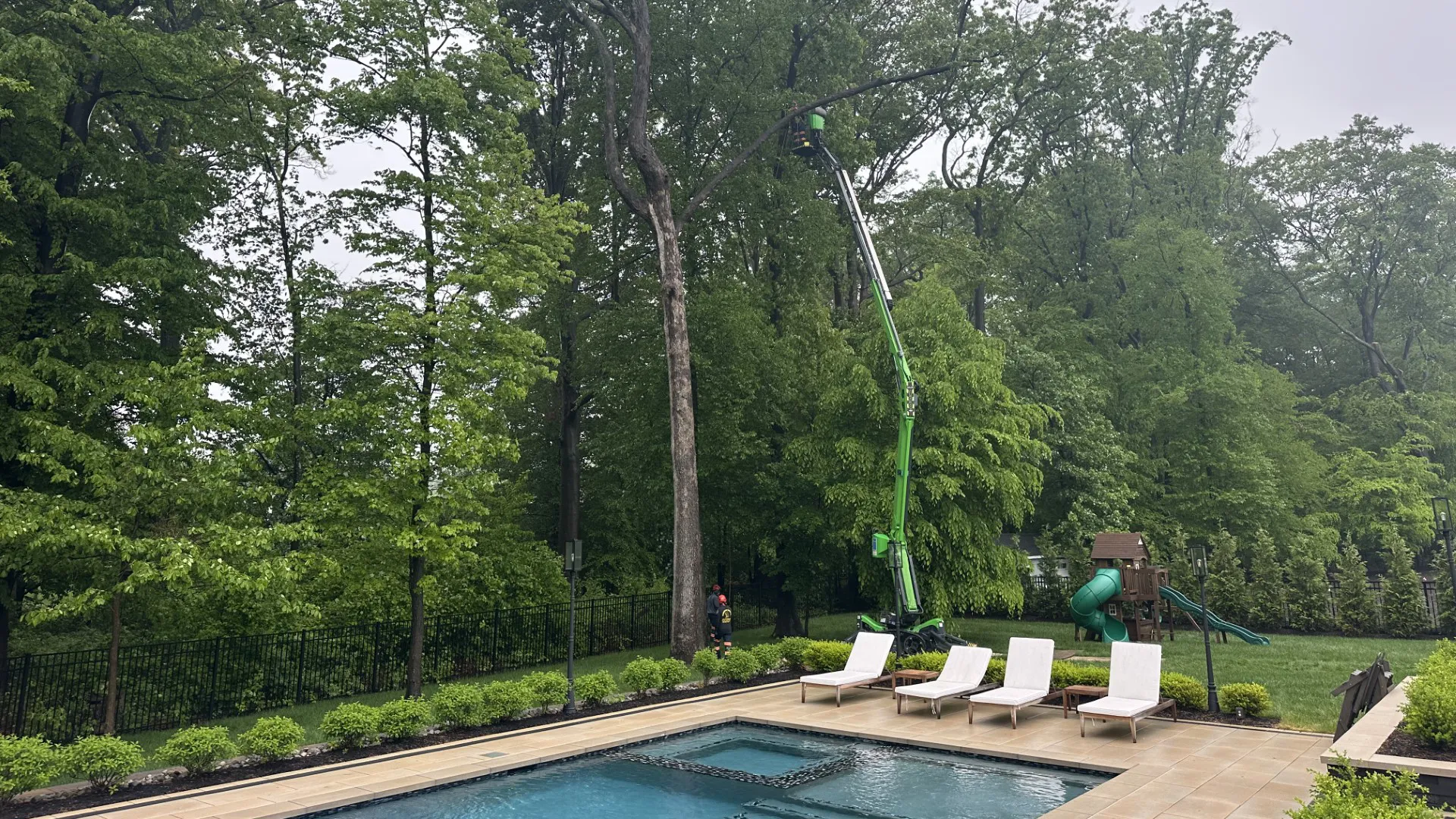
Old Bridge Fall Tree Inspection: Catch Hidden Hazards Early
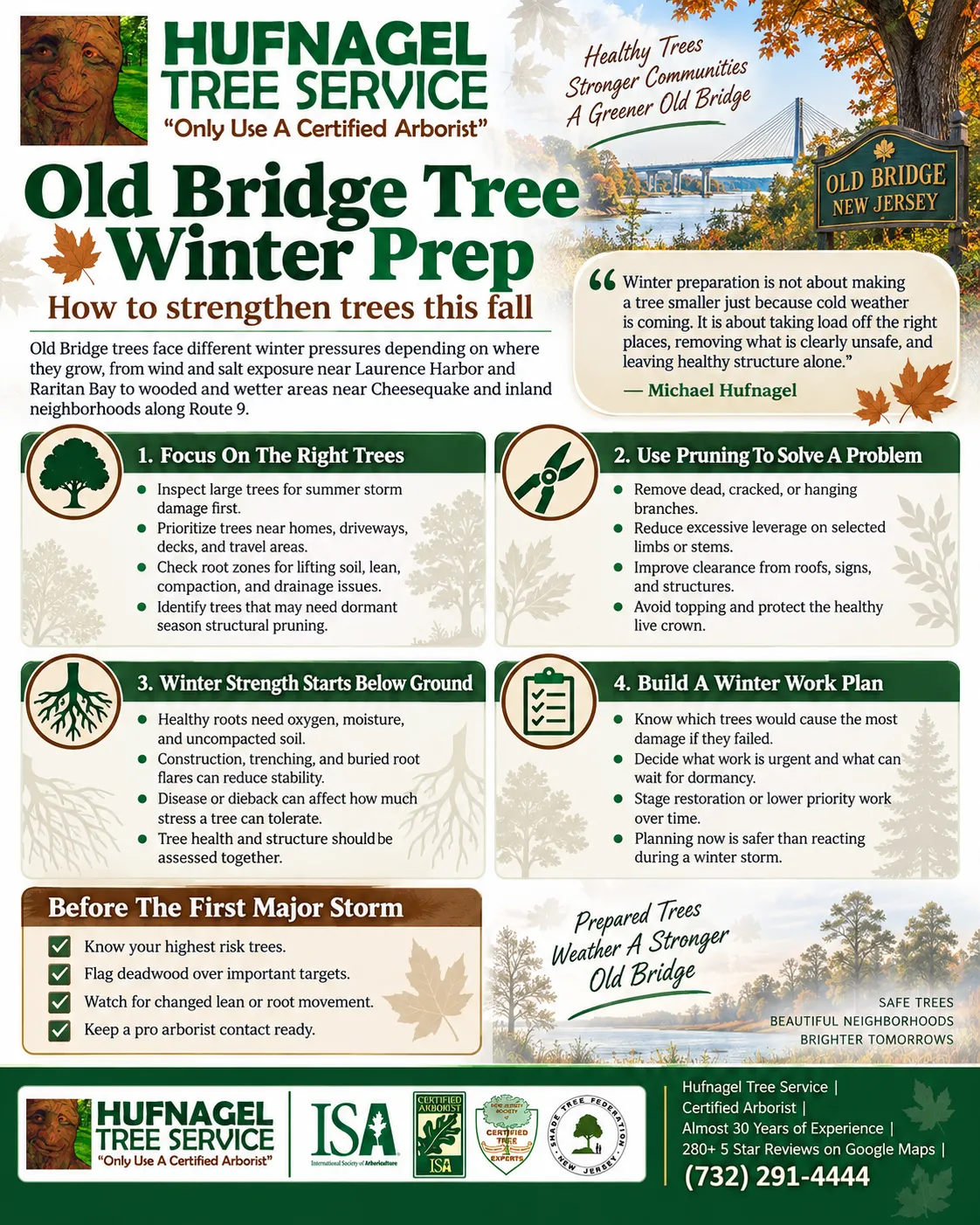
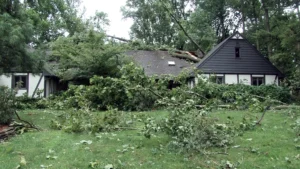
Old Bridge has everything from bayfront exposure to wooded inland neighborhoods, which means tree risks vary widely by property. A fall tree inspection can identify storm damage, root movement, decay, deadwood, and health problems before winter weather increases the load.
Share This Article
Contents
Old Bridge Is Too Large for One Size Fits All Tree Advice
Old Bridge covers a broad mix of landscapes, from Laurence Harbor and the Raritan Bay edge to wooded sections near Cheesequake and established inland neighborhoods crossed by Routes 9, 18, 34, and 516. The township maintains more than 300 acres of developed parkland according to its Parks and Recreation department, and many residential properties also border mature wooded areas. That variety is exactly why a fall tree inspection should focus on the individual site instead of a generic seasonal checklist.
Cheesequake State Park is a useful picture of the local ecological transition. The New Jersey DEP park description notes a mix of saltwater and freshwater marshes, Atlantic white cedar swamp, pine barrens habitat, and northeastern hardwood forest. Residential Old Bridge is obviously more developed, but the same regional diversity shows up in the types of trees, soils, drainage patterns, and exposure we encounter from one neighborhood to another.
Our prior Old Bridge tree care article discusses the mature oaks, maples, sweetgums, and other trees that shape local neighborhoods. By fall, those trees have carried a full season of foliage through heat, thunderstorms, and heavy rain. An inspection helps determine whether that season left behind structural changes or health stress that could become more serious under winter wind, ice, or wet snow.
Michael Hufnagel often says, “Old Bridge can change completely in a few miles. The tree beside the bay is dealing with a different environment than the tree backed up to woods near Cheesequake, so the inspection has to start with the site.” That local context helps us interpret what a defect actually means.
Why fall earns a place on the Old Bridge tree care calendar
Summer storm damage has had time to reveal cracks, deadwood, and canopy changes.
Leaf symptoms can still provide clues about tree health before dormancy.
Winter wind, ice, and wet snow can add new load to existing weaknesses.
Large properties and wooded edges can hide hazards that are easy to miss from the house.
Fall gives homeowners time to plan work instead of reacting during an emergency.
A Good Inspection Connects Defects to Real Targets
Our tree risk evaluation service looks for defects, but defects alone do not define risk. We also consider what a branch or tree could hit. A cavity in a tree beside an unused wooded edge may be monitored differently than the same cavity in a tree over a bedroom, driveway, deck, playground, sidewalk, or utility line.
The International Society of Arboriculture risk guidance makes the same distinction by connecting tree condition with targets and consequences. This is particularly important in Old Bridge because lot sizes and land uses vary so widely. Some properties have mature trees close to homes. Others have long driveways, rear woods, outbuildings, fences, or multiple gathering areas that all need to be considered.
During the inspection we look for dead and hanging branches, cracks, cavities, codominant stems, weak attachments, decay indicators, root movement, soil lifting, new lean, canopy imbalance, and evidence of previous storm damage. We also evaluate past pruning. Old topping cuts, flush cuts, and large wounds can create weak regrowth or internal decay that becomes more important as the tree gains size.
When pruning can reduce the problem, our tree trimming and pruning service focuses on a defined objective such as deadwood removal, structural improvement, clearance, or reduction of leverage. Penn State Extension pruning guidance stresses that risk mitigation and restoration are specific pruning objectives and that topping damages long term structure. Good pruning solves a problem without creating a new one.
The inspection should answer practical questions, not just identify flaws
What is the likelihood that the branch or tree could fail?
What people, structures, vehicles, or utilities are within reach?
Can targeted pruning or restoration reasonably lower the risk?
Does the tree need monitoring, prompt work, or removal?
What maintenance should be planned for the next dormant season?
Fall Health Clues Can Change the Recommendation
A tree can be structurally sound but declining in health, or structurally weak while still producing a full green canopy. We look at both. Our tree health management service considers foliage density, dieback, leaf size, discoloration, pests, disease indicators, root zone stress, and changes around the site. Those observations can explain why one tree recovered from summer stress while another did not.
The New Jersey Forest Service forest health program tracks statewide tree health problems, including bacterial leaf scorch that affects red oaks and can also occur in other landscape species. Late summer and early fall symptoms can be especially useful because the pattern of scorch or dieback may still be visible before leaves drop.
In Old Bridge, tree health can also be influenced by drainage and land disturbance. Trees near older development may have compacted roots. Trees along wooded property edges may have roots altered by grading, fences, additions, or utility work. Bayfront and low lying sections can experience different moisture and wind conditions than inland neighborhoods. We want the recommendation to reflect those realities.
When a valuable tree is damaged but retainable, tree restoration may allow us to correct structure gradually instead of removing the tree. When defects are severe, roots have lost anchorage, or the target consequences are too high, removal may be the responsible recommendation. A fall inspection provides the evidence for that decision.
Trees that deserve priority on a large Old Bridge property
Large trees within striking distance of the house or driveway.
Trees along wooded edges that lean toward maintained areas.
Mature trees near decks, pools, play areas, sheds, or detached garages.
Trees with recent construction, trenching, or grading inside the root zone.
Trees that changed noticeably after summer thunderstorms.
Wooded Property Edges Need a Different Inspection Strategy
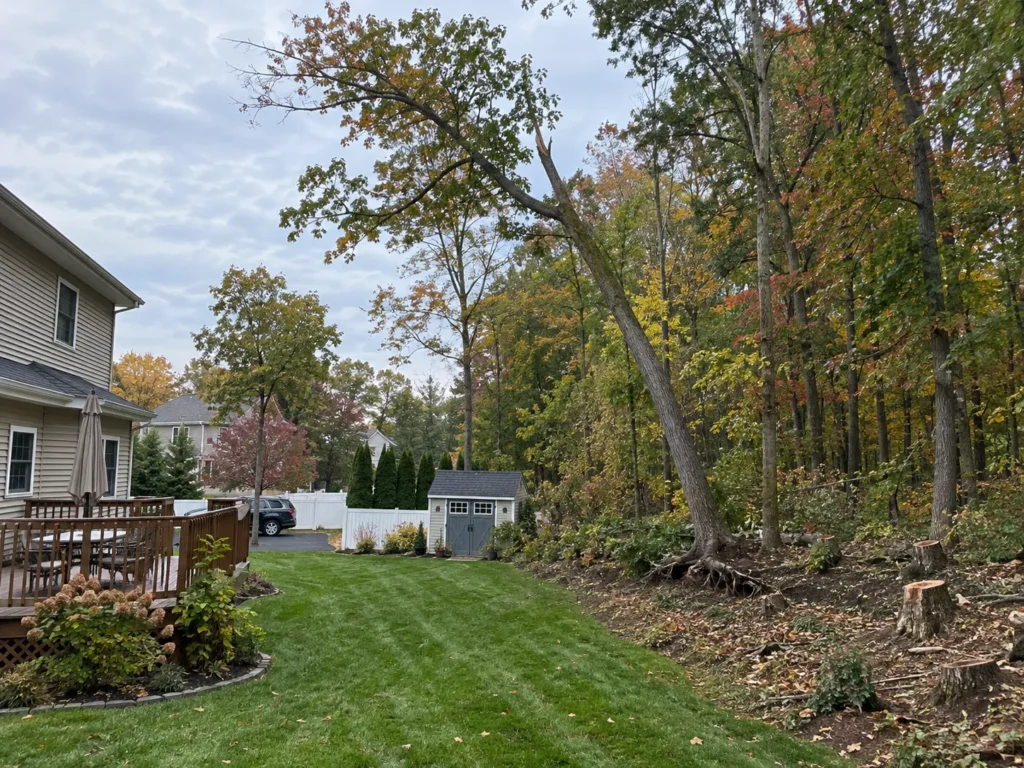
Old Bridge has many properties where maintained lawn meets a wooded edge. Those boundaries can hide risk because homeowners naturally focus on the trees standing in the yard and overlook trees just beyond the mowing line. A tree leaning out of the woods toward a deck, shed, driveway, or fence can still be a meaningful target risk even if most of its trunk stands in an unmanaged area.
We look closely at newly exposed edge trees after neighboring removals or clearing. Trees that developed inside a group may have tall narrow crowns and smaller root systems relative to height. When the trees around them disappear, wind loading changes. Fall is a good time to review these transitions because storm damage from summer is visible and winter has not yet added ice or snow.
The township’s large park and open space system, described by Old Bridge Parks and Recreation, reflects how much green space remains woven into developed neighborhoods. Residential wooded edges deserve the same kind of respect for tree biology, even when the goal is simply keeping a home and yard safe. Not every leaning woodland tree needs work, but trees that can reach occupied areas deserve a closer look.
Have Your Trees Inspected The Stress of Winter Weather Comes Rolling In!
The New Jersey Office of Emergency Management warns that dead or rotting trees and branches can fall during severe thunderstorms. The same structural weaknesses can matter in winter when wind, saturated soil, ice, or wet snow add load. Our tree storm proofing service uses inspection findings to reduce avoidable weaknesses before weather turns them into emergencies.
Hufnagel Tree Service has almost 30 years of tree care experience in the region, certified arborist leadership, and more than 280+ 5-Star Reviews on Google Maps. If you want a fall tree inspection in Old Bridge before winter, call (732) 291-4444 for a clear assessment of your highest priority trees and practical next steps.
Schedule Service Now!
From precision pruning and safe removals to health assessments and preventative care, Hufnagel Tree Service delivers expert solutions backed by decades of experience. We offer certified insight, fair pricing, and a commitment to doing what’s best for your landscape.
We Could Not Find A Direct Link To A Tree Removal Permit Application For The Town You Selected.
Please contact your local municipality to determine if a permit is required for your tree removal project. They will provide you with the most accurate and up-to-date information.