Contents
Holmdel Trees After the Thanksgiving Storm
Holmdel is an inland township with working farm landscapes, wooded stream corridors, and homes set near mature shade. It was formed on February 23, 1857, covers about 18 square miles, and counted 17,400 residents in 2020, according to Wikipedia. The same source places Crawford Hill, the highest point in Monmouth County at 391 feet, inside the township. Planning tree removal in Holmdel means reading that setting first, because high ground, wooded edges, and sheltered house lots do not take wind the same way.
The Thanksgiving storm made the point. Friday reporting by TAPinto Holmdel and Colts Neck described downed trees, utility wire problems, and widespread power outages among the challenges facing both towns. A tree on the ground is only part of that picture. Standing trees may now carry a split fork, a lifted root plate, or a broken limb that never reached the lawn. Our tree risk evaluation service sorts the trees that can be kept from the ones that cannot be managed safely.
After almost 30 years working throughout Monmouth County, we have seen that the days after a storm are when rushed decisions happen. This article covers what was reported, how to judge a damaged tree from a safe distance, how township rules apply, and when removal is the responsible answer.
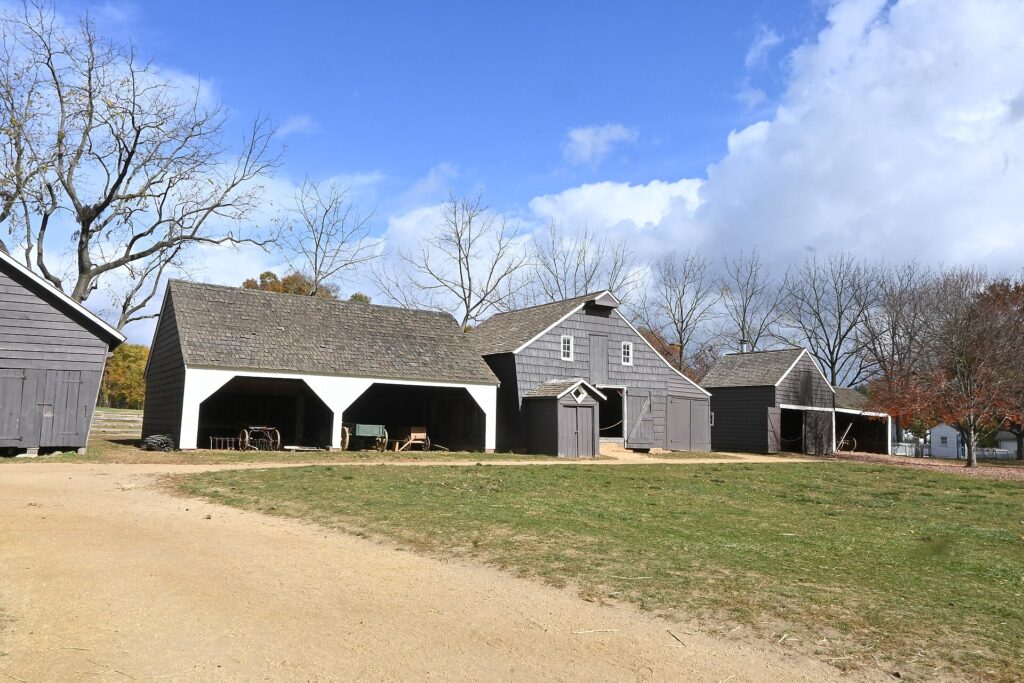
The photograph above shows the barns at Historic Longstreet Farm in October 2024, with bare crowns standing behind the rooflines. It is not a picture of this storm. In its Friday statement, Monmouth County named Stagecoach Drive in Holmdel among county road closures where trees and utility wires had created hazardous conditions. An Asbury Park Press outage list showed 100 Holmdel customers still without power as of 2:30 p.m. Friday. Those figures change quickly, so check current utility and county information. The National Weather Service in Mount Holly forecast read this morning calls for rain Sunday night into Monday, with Monday gusts as high as 30 miles per hour. A limb that is already cracked may not need much more load to finish breaking.
When Storm Damage Points to Tree Removal in Holmdel
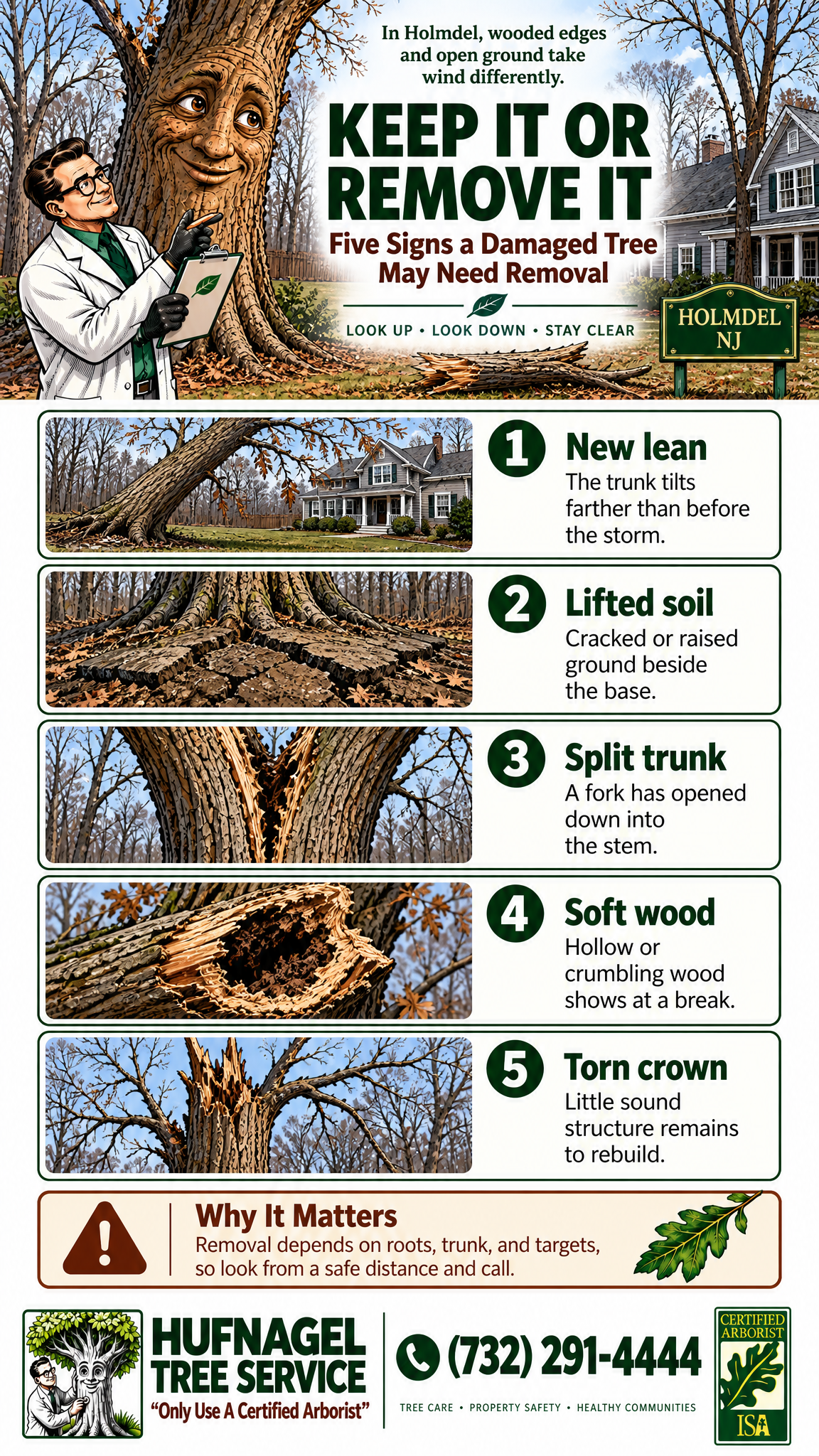
Tree removal in Holmdel should start with a question rather than a saw: what changed, and can the tree still be relied on. A broken limb is easy to see and often easy to correct. A trunk that moved is quieter and far more serious. We compare the tree with the house, a fence line, or an older photograph, because a small new lean can matter more than a large pile of brush. The size of the debris on the lawn tells very little about the strength of what is still standing.
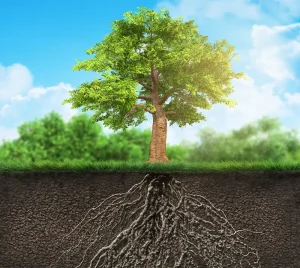
The base comes first. Soil that cracked, heaved, or opened beside a trunk can mean the root plate shifted while the ground was wet. The ISA guide to recognizing tree risk notes that cracks or separations in the soil may indicate excessive root movement, particularly where a tree leans. Roots that snapped near the surface, a fresh gap between trunk and soil, or turf lifted like a hinge deserve an inspection before anyone walks or parks under that side. Our guide to weak tree roots explains why an upright tree can still be a failing one.
Then look at the trunk and the major unions. A new vertical crack, pale wood torn open at a fork, or two large stems that moved apart can remove the strength that holds a heavy crown together. Bark folded inward at a narrow fork is an older warning that a storm may have tested hard. Our article on codominant stems shows how that union becomes the weak place. A split that runs from the fork into the main trunk is much harder to manage than a single torn branch.
Decay changes the answer again. A break that exposes soft, dark, or crumbling wood shows that the tree was weaker at that point before the wind arrived. Mushrooms at the base, open cavities, and old seams that reopened belong in the same conversation. None of them can be judged well from a window. We connect the signs described in our guide to hidden tree rot with the lean, the soil, and the load above before we recommend anything.
Targets set the urgency. The same defect is a smaller concern deep in a wooded lot than over a bedroom, a driveway, a play area, or a road. A single property can hold both conditions at once, with maintained lawn near the house and unmanaged woods beyond it. We rank trees by what they can reach, so the one leaning toward a garage is handled before the one leaning into the woods. Some trees need only watching. Others need pruning, tree restoration, support, or removal.
Wires come before everything else. Treat each downed or sagging line as live, including one that looks dead or lies in wet leaves. A limb touching a service line is not a homeowner task and not a job to start from a ladder. Report it to the utility, call 911 where there is immediate danger, and keep family, pets, and vehicles well away until the line has been made safe. Tree work near that span waits until the utility says it can proceed.
Signs a Storm Damaged Holmdel Tree May Need Removal
- A trunk that leans farther than it did before the Thanksgiving storm.
- Soil that cracked, lifted, or opened around one side of the base.
- A split running from a major fork down into the main trunk.
- Soft, hollow, or crumbling wood exposed where a large limb broke.
- A crown so badly torn that little sound structure remains to rebuild.
Any one of these is a reason to keep people away from that side of the tree until it has been examined. None of them decides the outcome alone. Mike Hufnagel describes the judgment this way: “A tree does not earn removal just because it dropped a big limb. We take it down when the roots, the trunk, or the main structure can no longer be trusted over what sits underneath.” That distinction protects good trees, and it keeps attention on the ones that can still cause harm. The next question is what the township asks before a tree comes down.
Holmdel Permit Rules Still Matter After a Storm
Holmdel regulates tree removal and replacement through Ordinance 2025-10, which reaches private yards as well as street frontage. The township tree ordinance FAQ says a permit is needed to remove a tree on private property when it measures 6 inches or more in diameter at 4.5 feet above the ground. For a street tree, meaning one near the sidewalk or the road, the threshold is 2.5 inches. Applications are filed online through the Zoning Office page of the township website. Listed exceptions exist, including certain construction and driveway areas, so read the current text for your situation.
Many owners assume that a damaged or dead tree needs no paperwork. Read the current wording before acting on that idea. The FAQ states that a permit and application fee are still required for dead or diseased trees, although no replacement fee or replacement tree applies. It asks for written justification from a New Jersey Licensed Tree Expert or Licensed Tree Care Operator. The ordinance says hazard trees may be removed with no fee or replacement requirement. Readers could take those two statements differently on the application fee, so confirm that point with the Zoning Officer.
The ordinance defines a hazard tree with specific conditions. They include a tree with an infectious disease or insect infestation, a tree that is dead or dying, and a tree causing obvious damage to structures. Obstruction of traffic signs or passage can qualify where pruning has not worked. A tree found to threaten public health, safety, or welfare by a certified arborist or Licensed Tree Expert is also listed. The township may require a Licensed Tree Expert to make the determination. Do not assume a storm broken tree qualifies until the facts meet that definition.
Replacement is part of the plan when a regulated tree comes out without an exemption. The FAQ sets one replacement tree for a trunk from 6 to 12.99 inches, two from 13 to 22.99 inches, three from 23 to 32.99 inches, and four at 33 inches or more. Owners who cannot plant them on site may plant in another approved area or pay 100 dollars per tree into the township tree fund. The FAQ also warns of a 500 dollar fine per tree for removal without a permit. Our guide to tree removal permits is only a general starting point.
The definition of removal is also broader than cutting a trunk. The ordinance counts killing a tree or causing irreparable damage that leads to decline, including excessive pruning, improper mulching, and grading or soil compaction within the critical root area. That matters during storm cleanup. Severe cutting to make a damaged crown look even, or heavy equipment run repeatedly over roots, can create a second problem. The text separates responsible pruning from removal, which is one more reason every cut should have a clear purpose.
Documentation makes the process easier. Photograph the whole tree from two sides, then the base, the break, and whatever the tree threatens. Measure or estimate the trunk diameter at chest height only if it is safe to stand there. Save the date of each picture and note when the damage appeared. Take these records before cleanup changes the scene. They help the township, an insurer, and the arborist understand the same tree, and they remain useful if the condition changes after the next round of rain and wind.
Questions to Settle Before Holmdel Tree Work Starts
- Does the trunk meet the private or street tree permit diameter.
- Is the tree on your lot, along the road, or shared with neighbors.
- Can a licensed professional document why the tree qualifies as hazardous.
- Is any limb or trunk resting on, touching, or near a utility line.
- Have dated photographs recorded the damage before anything is cut or moved.
Answering these questions in order prevents common mistakes, such as removing a road tree that needed approval or clearing away the evidence an insurer later requests. Immediate danger still comes first. When a tree threatens a person, call 911 or the utility and stay clear while the approval question is settled with the township. Rules can be amended, and this summary is not a ruling on any single property. A clear plan names what is urgent, what needs approval, and what can wait for calmer weather. The land around the tree shapes that plan as well.
Wooded Edges and Open Ground Change the Removal Plan
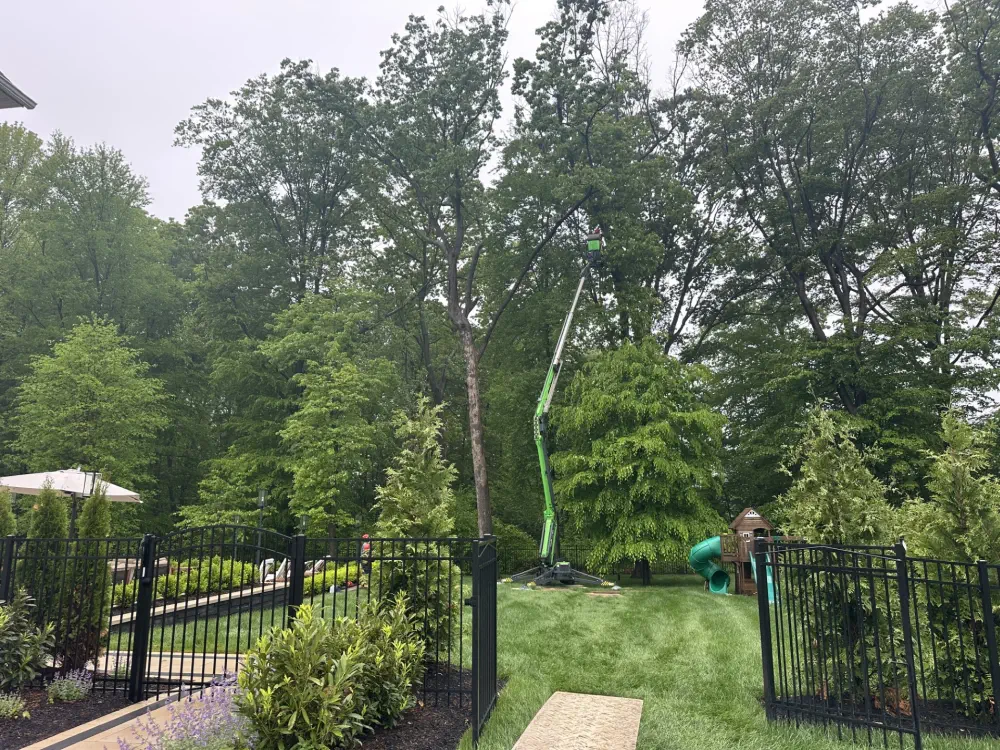
Holmdel keeps a good deal of preserved woodland. Holmdel Park was acquired by the county park system in 1962 and grew in 2001 with the addition of the 227 acre Ramanessin Section. The county brochure describes the park as 673 acres. The township adds Bayonet Farm, 135 acres of woodlands and open fields with access to the Ramanessin Brook Conservation Area. Yards that border woods of any size often end in tall trees that grew up competing for light.
Trees grown close together behave differently once a neighbor falls. Their trunks are often tall and slender, with most of the crown near the top. When a storm opens a gap, the trees left on the edge meet wind that the group once shared. A trunk that stood quietly for decades can start to move in a new way. After this storm, we would look closely at the trees beside every fresh opening, especially where a crown now faces a house, a barn, a pool, or a parking area.
Open ground creates the opposite pattern. A broad field tree or a tree on a rise may carry wide, heavy limbs that collect the full force of the wind. Long horizontal branches can crack at the attachment and stay in place, held by the remaining wood. From the porch an owner may see a normal canopy. From a second angle, a fresh seam or a sagging limb becomes plain. Binoculars used from a safe position help, and a dated photograph helps even more.
Wet soil adds to each of these. Saturated ground can loosen the hold that roots have, and compaction from vehicles makes recovery harder. Keep trucks, trailers, stacked logs, and chip piles away from the root area of trees that will stay. A paved driveway or a firm gravel area is a better place for cleanup equipment. Do not bury a trunk with mud or mulch while tidying the yard, and do not cut exposed roots simply because they now look untidy.
Access shapes the removal itself. A damaged tree behind a house, over a fence, or inside a wooded edge may need ropes, a compact lift, or a planned sequence of small sections. Stored tension in a bent or hung limb can release suddenly, which is why a partly fallen tree can be more dangerous to cut than a standing one. We decide where each piece will go before the first cut. Our tree removal service is planned around the targets, the footing, and the condition of the wood.
Removing one tree should not weaken the next. Dropping a stem through a neighboring crown can tear limbs and bark, leaving wounds where decay can start. We protect the trees that remain and look at them again once the failed tree is gone, because new exposure may call for selective pruning to reduce end weight. We do not top trees, and we do not thin a crown just to make it look lighter in the wind. Every cut needs a reason the owner can understand.
Wooded Lot Checks Worth Making After This Storm
- Walk the lawn edge and note fresh gaps where trees or limbs fell.
- Watch exposed edge trunks for new lean, cracks, or lifted soil.
- Look for hanging limbs caught over trails, sheds, fences, and driveways.
- Keep children and pets away from partly fallen or hung up trees.
- Keep vehicles and brush piles off soft ground above living roots.
These checks take little time and give a later visit a useful record. They also separate ordinary mess from real structural change. A yard covered in twigs can look alarming while the trees remain sound, and a tidy corner can hide one shifted root plate. Winter will keep testing whatever this storm weakened. Bare crowns make forks, cavities, and deadwood easier to read, so the weeks ahead are a sensible time for a closer look. Our tree storm proofing page and our article on storm season risk assessment describe how preparation lowers risk without any promise that a tree will never fail. Our tree health management work then follows the slower effects through the growing season.
Call Hufnagel Tree Service for a Holmdel Tree Evaluation
If you have mature trees near your Holmdel home, driveway, wooded edge, or road frontage, schedule an evaluation before the next round of wind and rain. We provide tree risk evaluations, pruning, restoration, storm proofing, health management, and removal when a tree cannot be managed safely. Bring your photographs and your questions about what changed.
Hufnagel Tree Service is led by a certified arborist with almost 30 years of local experience and more than 280 five star Google Maps reviews. We look at the tree, the roots, the surroundings, and the target, then explain what we found in plain terms.
Call or text (732) 291-4444 to schedule an evaluation for tree removal in Holmdel after the Thanksgiving storm. Our Holmdel tree articles offer more local guidance.
Schedule Service Now!
From precision pruning and safe removals to health assessments and preventative care, Hufnagel Tree Service delivers expert solutions backed by decades of experience. We offer certified insight, fair pricing, and a commitment to doing what’s best for your landscape.
Learn More About Our Services
Related Articles
Storm Damaged Trees in Aberdeen: We Can Help
Matawan Fall Tree Care: Prepare Trees Before Winter