Contents
In Shrewsbury Township, Every Tree Stands Close to Something
Tree risk evaluation in Shrewsbury Township begins with a fact that is easy to check. Wikipedia lists the township at 0.1 square miles, the smallest municipality in New Jersey by area, with 1,076 residents in the 2020 census. It was formed on October 31, 1693, as a much larger area and became a township on February 21, 1798, before 74 municipalities split away from it. The township website says it now consists of three streets, Crawford, Barker, and Belshaw.
That is as compact as a New Jersey community gets, and it changes how we think about tree risk. A tree with a weak union or a decayed base has almost no empty ground to fall on, so nearly every defect has a roof, a car, a wire, or a neighbor beside it. Our tree risk evaluation and tree health management work starts with the tree and then with whatever stands within reach of it.
After almost 30 years working throughout Monmouth County, we have learned that small places are not low risk places. They are places where the answer to what a tree can hit is almost always yes. This article explains how we weigh defects against targets, what a bare November canopy shows, how a nor’easter tests the same tree, and what to confirm before anyone cuts.
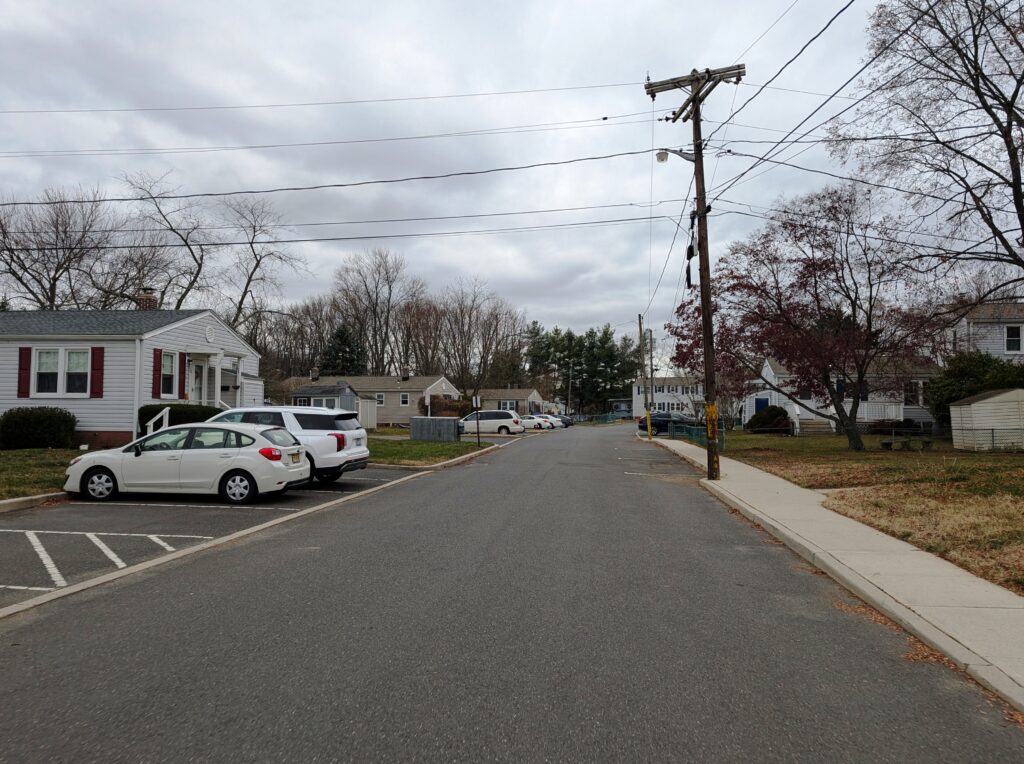
The photograph above shows Belshaw Avenue in Shrewsbury Township in December 2024, according to the Wikimedia Commons description. A paved street runs away from the camera with a sidewalk on the right and white cars parked on the left. Small houses stand close to the pavement on both sides, a wooden utility pole carries a street light and several lines of overhead wire, and the trees along the way include bare deciduous trees, a dark red leaved ornamental, and a stand of evergreens at the far end under a grey sky. Nothing in the frame is more than a short walk from a house, which is exactly how the township is built. A limb that drops from any of those trees has a roof, a wire, or a parked car close by.
Access matters here as well. Wikipedia says the township sits at an elevation of 39 feet and that its only vehicle access is Shrewsbury Avenue, County Route 13. The township website sends questions about Shrewsbury Avenue and other streets outside its three to the Borough of Shrewsbury. For a tree owner, that has a practical meaning. A tree that comes down across one of three short streets can close the way out to the only road, so we weigh blocked access as a consequence along with damage to a house.
A Tree Risk Evaluation Weighs the Defect Against the Target
A tree risk evaluation answers two questions. How likely is it that part of the tree fails, and what happens if it does? The UF/IFAS Extension publication Is My Tree Safe?, by Drew McLean, Andrew Koeser, Robert Northrop, and Gitta Hasing, describes a professional evaluation as one that specifies the likelihood of whole or partial tree failure and the consequences of that failure if nearby targets are struck. The authors add that rating the likelihood of failure is one of the most difficult parts of the work, because there are no definitive rules that cleanly separate sound trees from unsound ones.
The second question, what gets struck, is where Shrewsbury Township differs from a large lot suburb. On a half acre, a dead limb may land on lawn. On Belshaw, Barker, or Crawford, the same limb lands near a sidewalk, a parked car, a service wire, or a neighbor’s shed within a few feet. The defect is the same. The consequence is not. That is why we do not rank a tree by size alone, and why a modest tree with a bad union can rank above a large sound one.
Targets also move. A car parked under a limb in the morning is gone by noon, and a sidewalk is busy at some hours and empty at others. We note what is fixed, such as a roof or a wire, and what is occasional, such as a vehicle or a person walking by, because both belong in the plan and each one changes how soon we recommend work. A fixed target under a defect is a reason to act. An occasional target under a defect is a reason to act before the occasion arrives.
Ownership belongs in the evaluation too. Wikipedia says Camp Vail, a complex of 265 homes built for Fort Monmouth employees, was later bought by residents and became the Alfred Vail Mutual Association, a cooperative housing entity. We cannot tell from the public record which trees belong to the association, which to the township, and which to an individual owner. Before we schedule work, we ask who owns the tree and who has to agree, because a crew should never start a job that someone else has the right to stop.
A written evaluation keeps these questions straight. We record the tree, the defects we can see, the targets under it, our rating, and the work that would change the rating. If the answer is to monitor, we say when to look again. If the answer is pruning, restoration, or removal, we say which one and why. Our guide to hidden tree rot explains why we sometimes recommend further testing before any decision is made about a tree that looks sound from the street.
Mike Hufnagel puts it simply: “The tree is only half the question. The other half is what is standing, parked, or walking under it.” That is why a small township with close lots gets the same careful look as a large estate, and often a more urgent one.
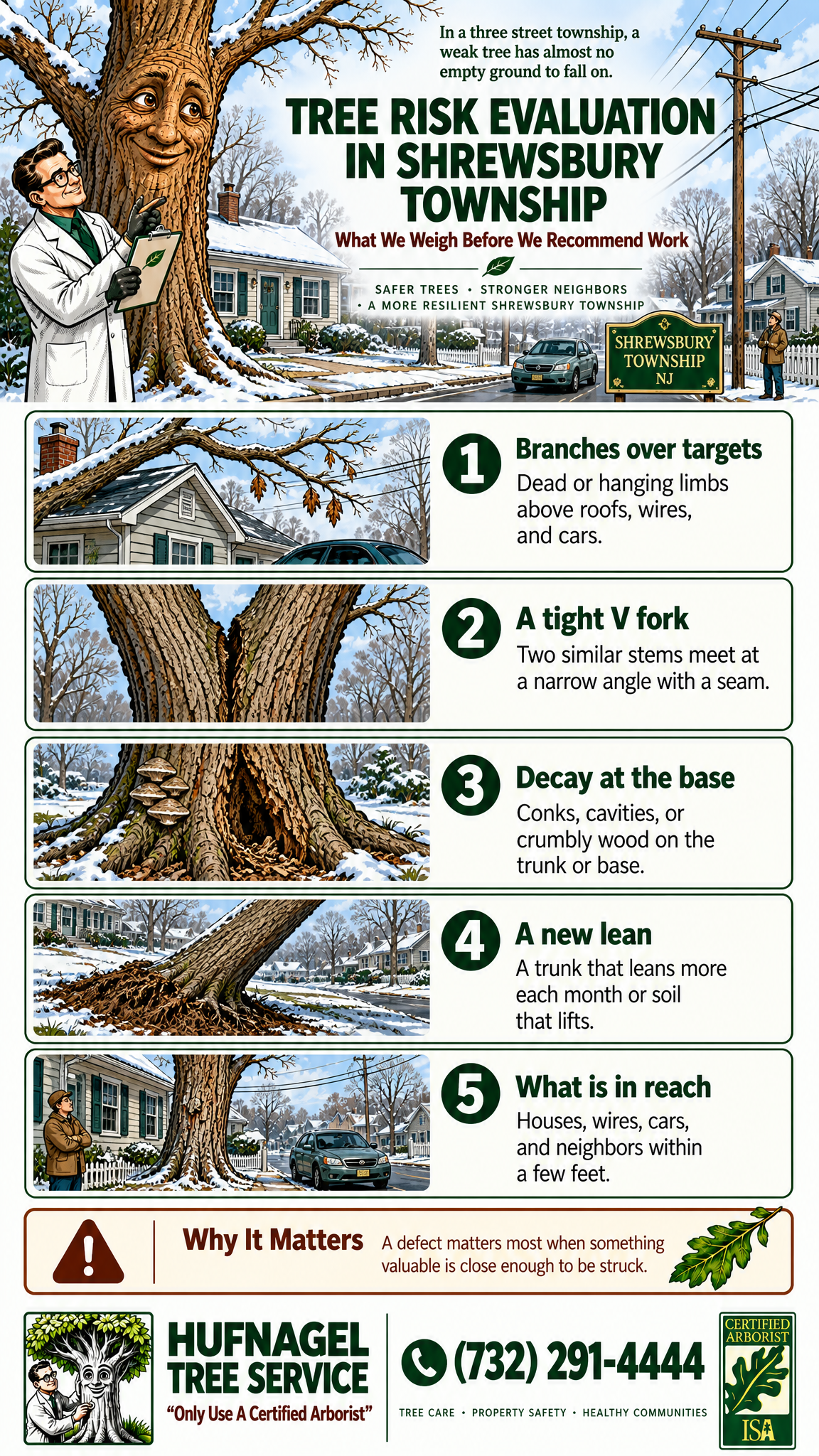
What We Weigh in a Tree Risk Evaluation in Shrewsbury Township
- Dead, cracked, or hanging branches over roofs, wires, sidewalks, and parked cars.
- Forks between two stems of similar size that meet in a tight V with a seam.
- Fungal conks, cavities, or crumbly wood on the trunk or at the base.
- A lean that is new or growing, or soil lifting on one side of the tree.
- Every target within reach, from the house and wires to the neighbor next door.
None of these signs settles a tree’s fate on its own. The point of the list is to connect each defect to a real target and then choose the smallest action that changes the outcome. Some trees need only monitoring. Others need targeted pruning, support, restoration, or removal. Once the defects are named, the next job is learning how to see them, and November is a good month for it.
Bare Branches in November Make Weak Points Easier to Read
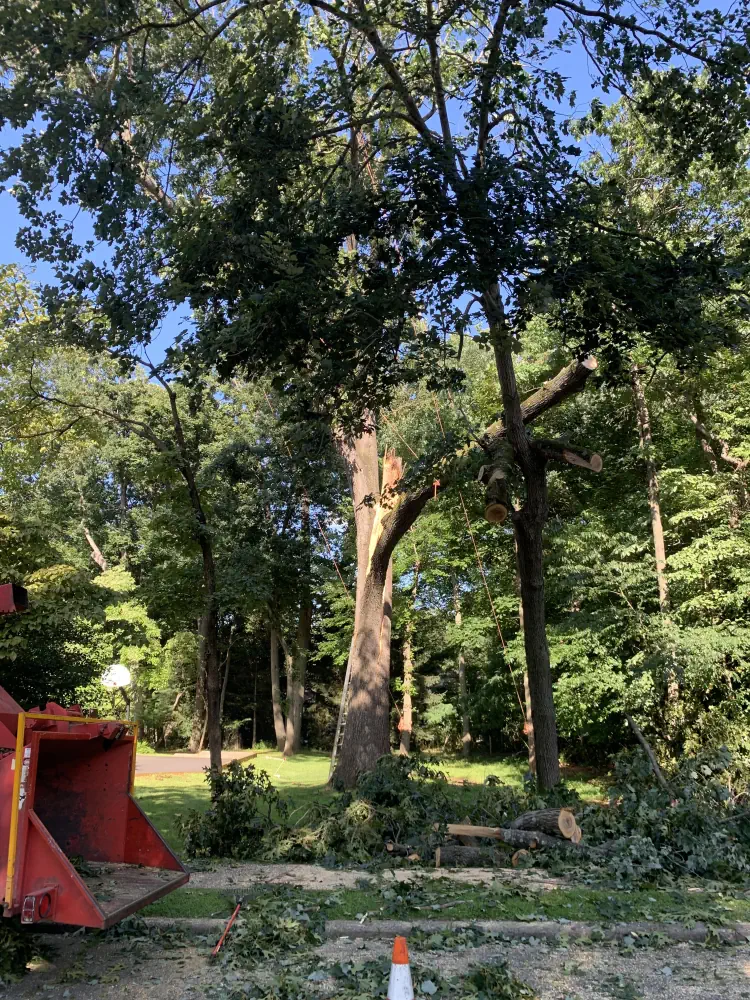
Leaf drop is the best time to look because the crown shows its structure. The UF/IFAS publication lists seven defects that a homeowner can recognize, and the first two are the simplest. Dead branches may have loose or missing bark and dead or absent buds, and the authors note that the presence or absence of leaves alone should not decide whether a limb is dead, since deciduous trees lose their leaves naturally. Broken or partly attached branches are already in a state of failure, and the publication says that dropping is a matter of time and can happen in calm weather.
The third defect is a branch union. The publication describes codominant stems as limbs of similar size that begin at the same point, says they raise the likelihood of failure in strong storms, and explains that a narrow, sharp V often holds included bark, meaning bark pressed between the two stems, while a smooth U is a stronger attachment. In November a fork is easy to read from the sidewalk, and a dark seam running down between two stems is worth a photograph.
Decay and cavities are harder to judge. The publication says decay is the breakdown of wood by micro organisms, most often fungi, and lists conks, cavities, carpenter ants, and animal nesting holes as visible signs. A cavity is often the site of an old injury or pruning cut and a point of entry for decay fungi, and the authors advise checking first whether wildlife or insects occupy it. A hollow does not automatically mean a tree is unsafe, because the wood around it may still be sound, and measuring that is the work of a trained evaluation.
The photograph above shows a job site, not a township street, and we chose it because it shows what a split union can look like. A tall leafy tree has a long vertical tear down its trunk, a neighboring trunk carries the cut stub of a limb, a red chipper stands at the left, and an orange cone sits on the pavement at the bottom of the frame. We cannot say from the picture exactly what opened the split, but it shows how a fork can fail while the crown above still looks full and green. Our guide to weak tree roots covers the ground level half of the same question.
Leans and roots matter more in tight spaces. The publication says a lean that forms slowly is often a tree growing toward light and may be offset by extra wood, but a lean that develops quickly, for example after a severe storm, indicates partial root failure and needs immediate attention. Warning signs below ground include a thinning crown, swelling at the root collar, fungal conks near the base, and broken root stubs at the soil line. The authors also say a buried root system, caused by deep planting or added soil, can lead to dieback, which is why we look for a visible root flare.
None of this requires a ladder, and none of it should. The New Jersey Department of Health says tree work is hazardous, that contact with electrical lines is a high risk, and that this work should be left to licensed tree care professionals. In a township where overhead wires run along the streets, we ask owners to look, photograph, stay clear, and call.
Warning Signs to Photograph From the Ground Before You Call
- The whole tree from two sides, then the fork, then the base.
- Any crack, seam, or splinter where two stems of similar size meet.
- Mushrooms, conks, or crumbly dark wood on the trunk or at the base.
- The lean of the trunk and the soil at the base, compared with an earlier photo.
- The date, and what sits under each limb of concern, such as a roof or wire.
Dated photographs are among the most useful things a homeowner can hand us, because they show change, and change is what separates a tree that is stable from a tree that is moving. A single picture rarely settles a question, but two pictures a few months apart often do. Once we know what the tree is doing, the next question is what winter weather will ask of it.
Nor’easter Season Is the Reason to Plan Before Any Cut

The National Weather Service says nor’easters can occur at any time of year but are most frequent and most violent between September and April, that they are named for the typically northeast winds over the coastal area, and that they often bring gale force winds and nearly always bring heavy rain or snow. The same page warns of coastal flooding. Shrewsbury Township is not a shoreline problem, but the wind and the rain apply anywhere in Monmouth County, and they test a tree from two directions at once.
Wind loads the crown. A long limb with its foliage at the end, a fork with included bark, or a dead branch hung in the canopy takes the force first. Rain loads the soil. Ground that stays wet holds roots less firmly, so a tree that stood through a dry summer can lean or lift when wind arrives on saturated ground. A tree with a defect above and soft soil below has two problems at once, and the combination is what we look for in November, before the first heavy storm and not after it.
The photograph above shows a large tree that has gone over with its root ball torn out of the ground, a stump grinder and crew working beside it, and a green Hufnagel truck and chipper in the road on a clear spring day. We cannot say from the picture what brought this tree down, but it shows the end of a tree whose anchorage failed, and it is why we look at roots and soil as carefully as we look at limbs.
After a storm, the first job is to decide which trees need attention now. The UF/IFAS publication Assessing Hurricane Damaged Trees and Deciding What to Do, by Eliana Kampf and five coauthors, says evaluation should happen as soon as possible, that a tree becomes a risk when a structure, vehicle, or person could be struck by it or any part of it, and that trees or parts blocking driveways or roads need quick attention. It also says not every damaged tree needs to be cut down, and that what looks awful at first may be judged much less serious by an experienced professional. Only qualified line clearance arborists should work near electrical utilities, and limbs on or over a power line should be reported to the electric company.
Rules come before any cut. The township website lists its office at 1979 Crawford Street, open Monday through Thursday, and says the Township Committee meets on the second Tuesday of each month at 6:00 p.m. We did not find a tree ordinance on that page, so we recommend that owners ask the township office before removing any tree near a street, a wire, or a lot line, and ask the Borough of Shrewsbury about anything on Shrewsbury Avenue. Our overview of tree removal permits explains what to expect in general, and we do not issue or approve permits.
Removal is not the only answer when a risk is found. The first UF/IFAS publication says the risk from a poorly attached branch can often be partly mitigated through corrective pruning or a cable system installed by an experienced arborist, and that reducing risk can be as simple as moving a target or removing the defective part. We weigh trimming and pruning, tree restoration, support, monitoring, and removal, and we explain why each one is or is not on the table.
Ways to Reduce Risk Without Losing a Good Tree
- Corrective pruning that removes deadwood and reduces end weight on a long limb.
- Cable support for a weak fork when the wood around the union is sound.
- Moving a target, such as a parked car or a bench, out from under the tree.
- Monitoring with dated photographs and a set time for the next inspection.
- Removal when decay or root loss leaves no dependable way to hold the tree.
The goal is not to remove every tree that has a flaw. The goal is to give each tree the work it needs and nothing more. A written plan with a reason and a date for the next look turns a worry into a sequence, and that sequence is also how we prepare a property for the kind of storm proofing that actually helps.
Call Hufnagel Tree Service for Tree Risk Evaluation in Shrewsbury Township
If you have mature trees near your Shrewsbury Township home, driveway, or lot line, and any of them has a fork, a dead limb, or a lean you cannot explain, schedule an evaluation before winter storms arrive. We provide tree risk evaluations, tree trimming and pruning, storm proofing, tree restoration, and removal when a tree cannot be managed safely. You can also read more local articles in our Shrewsbury Township category.
Hufnagel Tree Service is led by a certified arborist with almost 30 years of local experience and more than 280 five star Google Maps reviews. We inspect first, explain what we found in plain terms, and recommend only the work that changes the outcome for your tree and your property.
Call or text (732) 291-4444 to schedule a tree risk evaluation in Shrewsbury Township before the next nor’easter arrives.
Schedule Service Now!
From precision pruning and safe removals to health assessments and preventative care, Hufnagel Tree Service delivers expert solutions backed by decades of experience. We offer certified insight, fair pricing, and a commitment to doing what’s best for your landscape.
Learn More About Our Services

Related Articles
Tree Risk Mitigation Services Near Monmouth Beach NJ
Tree Risk Evaluation Services Near Marlboro NJ