Late Summer Tree Service in Holmdel, NJ

Late summer tree service in Holmdel, NJ focuses on storm hazards, tree health inspections, selective trimming, and knowing which pruning should wait for winter.
Share This Article

Contents

Late August Is a Decision Point for Holmdel Trees

By the final weeks of August, Holmdel trees have been through nearly a full growing season. Mature oaks, maples, tulip poplars, pines, and ornamentals are carrying full canopies, making this a useful time to see what summer growth, heat, rain, wind, and storms may have changed.

At Hufnagel Tree Service, we approach late summer tree care differently from winter pruning. This is not the time to automatically make large structural cuts. We focus first on safety, tree health, and targeted maintenance, then schedule elective pruning for the season that best fits the tree.

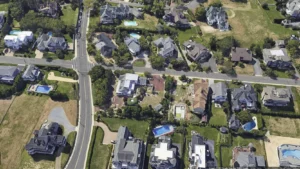
That distinction matters in Holmdel, where wooded lots often place mature trees near homes, pools, garages, driveways, fences, and patios. From Crawfords Corner and Telegraph Hill to properties near Holmdel Park, Bayonet Farm, Bell Works, and Longstreet Farm, large canopies are part of the landscape and part of the responsibility.

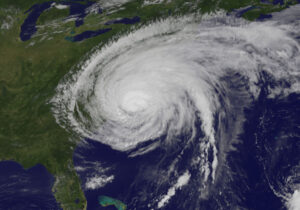
Late August also arrives just before the climatological peak of Atlantic hurricane season. NOAA identifies September 10 as the historical peak, with most activity occurring from mid August through mid October. Strong wind and heavy rain can reach New Jersey even when a tropical system does not make a direct local landfall.

“Late summer is when I want homeowners to look at what changed, not just what grew,” says Michael Hufnagel. “A dead limb, a new lean, or a branch suddenly over the roof tells us more than simply saying the tree needs a trim.”

Storm Prep and Hazard Mitigation Before September

Trees In Holmdel: Seasonal Service Recommended

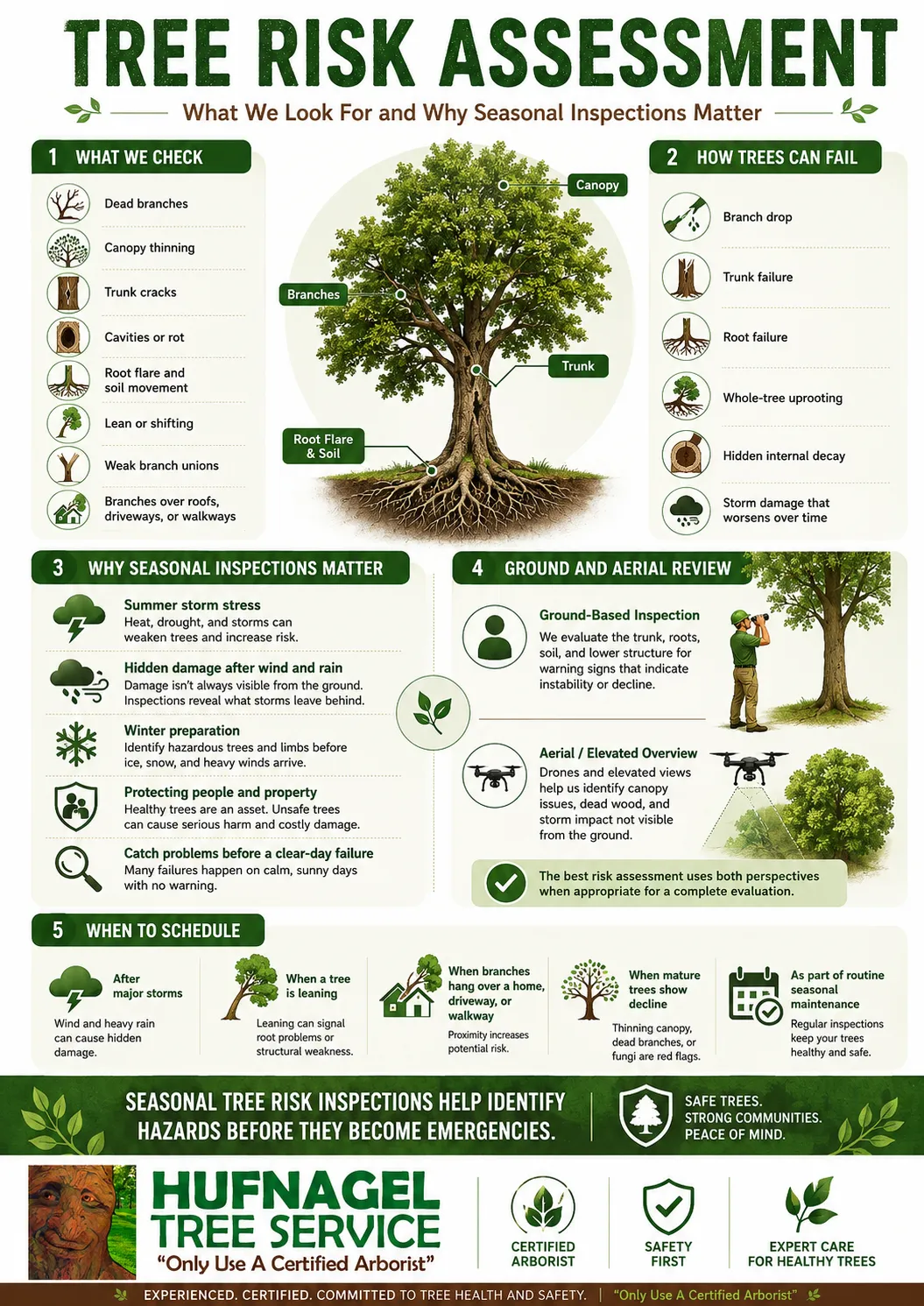
The first priority at the end of August is reducing obvious hazards before severe weather. Our tree storm proofing work starts with the parts most likely to fail or cause damage. Dead branches, cracked limbs, hanging wood, poor attachments, and heavy branches over occupied areas deserve attention before cosmetic shaping.

Deadwood matters because it no longer has living tissue helping it respond to wind. A dead branch may remain overhead for months until wind, rain, or contact from another limb causes it to fail. The International Society of Arboriculture recognizes dead branch removal as a routine pruning objective that can improve safety.

We also evaluate excessive end weight. A long branch carrying most of its foliage near the tip creates leverage at its attachment. Where appropriate, selective reduction can shorten that lever without stripping the canopy. Penn State Extension describes reduction pruning as a method for reducing branch length and weight while preserving natural form.

Clearance is another late summer concern. A season of growth may bring branches closer to shingles, gutters, siding, driveways, walkways, or service lines. We can make targeted clearance cuts where appropriate. Homeowners should never attempt overhead pruning near energized conductors, and utility conflicts may require coordination with the electric provider.

A good hazard mitigation visit does not mean thinning a tree until it looks sparse. Over thinning can concentrate foliage near branch ends and change how the crown reacts to wind. We correct identifiable problems while preserving enough healthy foliage for the tree to enter fall in good condition.

Where We Focus First Before the Next Storm

  • Dead, broken, cracked, or hanging branches over homes and active areas.
  • Heavy limbs with excessive end weight or questionable attachments.
  • Branches rubbing roofs, siding, gutters, fences, or other structures.
  • Recent changes in lean, soil elevation, root movement, or trunk cracking.
  • Trees that have already lost limbs during summer thunderstorms.

No arborist can make a tree storm proof. The goal is to reduce avoidable risk and identify defects that should not be ignored. Sometimes a few precise cuts are more valuable than broad pruning. Once immediate hazards are addressed, we look at the health of the tree itself. Late August foliage can reveal problems that are harder to see later.

Tree Health Assessments While the Canopy Is Still Full

A full late summer canopy tells a story. We compare leaf density, color, twig growth, dead tips, and branch distribution. A tree thinning on one side, browning earlier than neighboring trees, or dropping leaves unusually early may be responding to root stress, drought, disease, insect pressure, or structural damage.

This is useful with mature oaks and maples common in Holmdel. The New Jersey Forest Service notes that bacterial leaf scorch can produce browning along leaf margins in August and September, particularly in red oak family species, maples, sycamores, and elms. Similar symptoms can have different causes, so proper diagnosis matters.

We also inspect the trunk and root flare. Mushrooms near the base, cavities, seams, loose bark, old wounds, and soil changes can matter even when the canopy still looks green. A tree risk evaluation considers both the likelihood of failure and what the tree could strike if failure occurs.

Summer storms can expose stability issues that were less obvious in spring. Saturated soil can reduce anchorage, while repeated wind can enlarge cracks or shift a root plate. We look for fresh soil lifting, newly exposed roots, trunk buckling, or a lean that has changed, especially where a large tree can reach a structure.

“Leaves are still on the tree in August, and that helps us read the canopy,” Mike says. “If one section is thinning, the top is dying back, or an oak is browning early, I want to know why before somebody starts cutting branches off.” Our tree health management service starts with that inspection.

Late Summer Warning Signs Worth a Closer Look

  • Early browning, thinning foliage, or unusual leaf drop.
  • Dead branch tips or canopy sections that are no longer filling in.
  • Fungal growth, cavities, seams, or loose bark around the trunk and base.
  • New lean, lifted soil, exposed roots, or movement after heavy rain.
  • Repeated limb loss, weak unions, or old storm wounds that have worsened.

A health assessment may lead to pruning, monitoring, restoration, treatment recommendations, or removal, but the inspection should come first. That can prevent unnecessary cutting when the real problem is below ground or related to disease. Once we understand the tree’s condition, we can decide whether late summer maintenance is appropriate. For many trees, lighter work is the better choice until dormancy.
Light Tree Trimming and Maintenance That Makes Sense in August

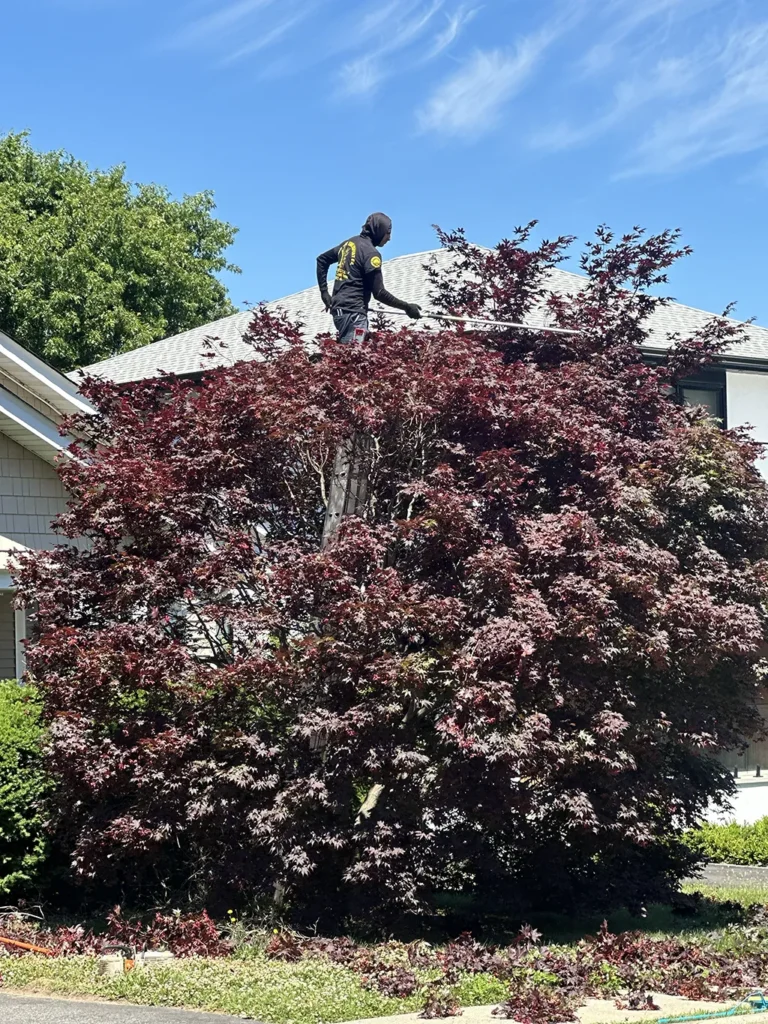
Tree Pruning Highlands, NJ

Late summer does not mean all pruning is off limits. The New Jersey Forest Service states that dead branches can be removed at any time, and the ISA notes that light routine pruning of weak, dead, or diseased limbs can generally be performed throughout the year. The key is keeping the work targeted.

For some properties, the most useful work is cleanup. We may remove selected suckers or water sprouts, correct a rubbing branch, restore walkway clearance, or address a small broken limb left from a storm. These are objective driven cuts. We are not making every tree smaller simply because August is ending.

Ornamental trees need species specific judgment. Dogwoods, flowering cherries, crabapples, pears, and other flowering trees do not share one pruning schedule. Some set flower buds well before winter, while others are vulnerable to diseases spread through pruning wounds. We identify the tree and the objective before choosing the timing.

Hedges and screening plants may also need light shaping around entrances, pools, patios, and property lines. That work should be measured. Severe shearing can remove too much productive foliage and may stimulate unwanted growth depending on the species and conditions. A clean correction is different from repeatedly cutting a plant back hard.

For larger shade trees, we favor natural pruning rather than topping or indiscriminate thinning. Topping creates large wounds and can trigger weakly attached sprouts. Excessive interior thinning can leave foliage concentrated at branch ends. Our tree trimming and pruning service is built around specific goals such as safety, clearance, health, and appearance.

Small Corrections That Can Make a Real Difference

  • Remove deadwood and small storm damaged branches that present a clear hazard.
  • Correct rubbing, broken, or poorly positioned branches where timing is appropriate.
  • Restore needed clearance over walkways, driveways, roofs, and outdoor spaces.
  • Remove selected suckers or sprouts that interfere with structure or appearance.
  • Lightly shape suitable hedges and ornamentals without aggressive cutting.

Late August maintenance should leave a tree better prepared, not noticeably depleted. The best work often looks subtle because the canopy keeps its natural form. When extensive pruning is needed, we can address the hazard now and schedule structural work for the proper season. Knowing what not to cut yet is an important part of professional tree care.

Tree Work Better Saved for Late Fall and Winter

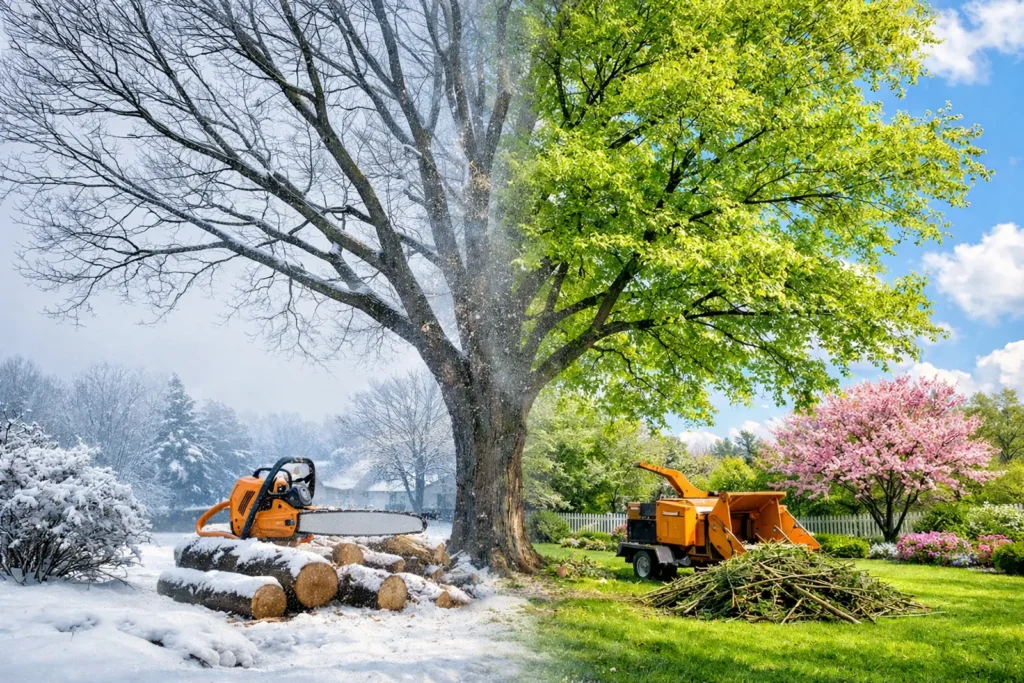
Late Winter Tree Service

For many mature hardwoods in New Jersey, substantial structural pruning is better during dormancy. The New Jersey Forest Service recommends dormant season pruning for hardwoods without showy flowers because branch structure is easier to see, disease transmission risk can be lower, and wound closure can begin with the next growing season.

Oaks deserve particular caution. Rutgers NJAES recommends that oaks in New Jersey not be pruned, trimmed, or felled during the growing season, with December through February identified as the safest period for disease prevention. Oak wilt has not been detected in New Jersey, according to the New Jersey Forest Service, but it is present in neighboring states.

Elms and certain flowering trees also have timing considerations related to pests and disease. A blanket rule such as pruning everything in August is not good arboriculture. Species, age, condition, pruning objective, and current stress all matter. Removing a large percentage of healthy foliage from an already stressed tree can add unnecessary strain.

Major crown reduction should also be planned rather than improvised. When a large limb needs reduction, cuts should return to suitable laterals so the remaining branch can continue growing appropriately. Random heading cuts and topping may reduce size temporarily, but they can create decay and vigorous sprouts that become future failure points.

There is one important exception to waiting. A dangerous condition should not remain simply because winter is a better pruning season. Dead limbs over a house, broken branches, storm damage, or a newly unstable tree should be evaluated promptly. We separate urgent mitigation from elective pruning so each tree gets the right work at the right time.

Jobs We Usually Prefer to Schedule for Dormancy

  • Major structural pruning on many mature hardwood trees.
  • Significant crown reduction that is not immediately required for safety.
  • Routine oak pruning, which Rutgers recommends for December through February.
  • Larger corrective pruning where bare branches improve structural visibility.
  • Elective work on stressed trees when delaying can reduce unnecessary strain.

Waiting can be part of good tree care when a condition is stable and the work is elective. It lets us choose a season that better supports the pruning objective. Waiting should never become an excuse to ignore a known hazard. A certified arborist can make that distinction after seeing the tree and the property. The best late August visit often produces both a short term safety plan and a longer term pruning schedule.

Schedule a Late Summer Tree Inspection in Holmdel

If you need late summer tree service in Holmdel, NJ, start with trees that can reach your home, driveway, pool, patio, garage, or utility area. Look for deadwood, unusual browning, new lean, cracked limbs, storm damage, and branches that have grown into places they were not in spring. Then let a certified arborist determine what needs action now and what should wait.

Hufnagel Tree Service has more than 25 years of local experience caring for trees across Holmdel and Monmouth County. We provide certified arborist knowledge for tree risk evaluation, storm preparation, tree health assessments, selective pruning, restoration, and removal when a tree can no longer be safely retained.

With more than 275 five star Google reviews and deep local roots, we have built our reputation by giving homeowners clear recommendations rather than selling unnecessary cutting. Call or text Hufnagel Tree

Schedule Service Now!

From precision pruning and safe removals to health assessments and preventative care, Hufnagel Tree Service delivers expert solutions backed by decades of experience. We offer certified insight, fair pricing, and a commitment to doing what’s best for your landscape.

Where Do You Need Service?
Please Enter Your Contact Information
Are You A New or Existing Customer?
How Can We Help You?

Thank You!

Your Message Has Been Sent

We Will Contact You About Your Inquiry Shortly.

We Could Not Find A Direct Link To A Tree Removal Permit Application For The Town You Selected.

Please contact your local municipality to determine if a permit is required for your tree removal project. They will provide you with the most accurate and up-to-date information.