Avoid Late Summer Tree Problems: Schedule An Inspection

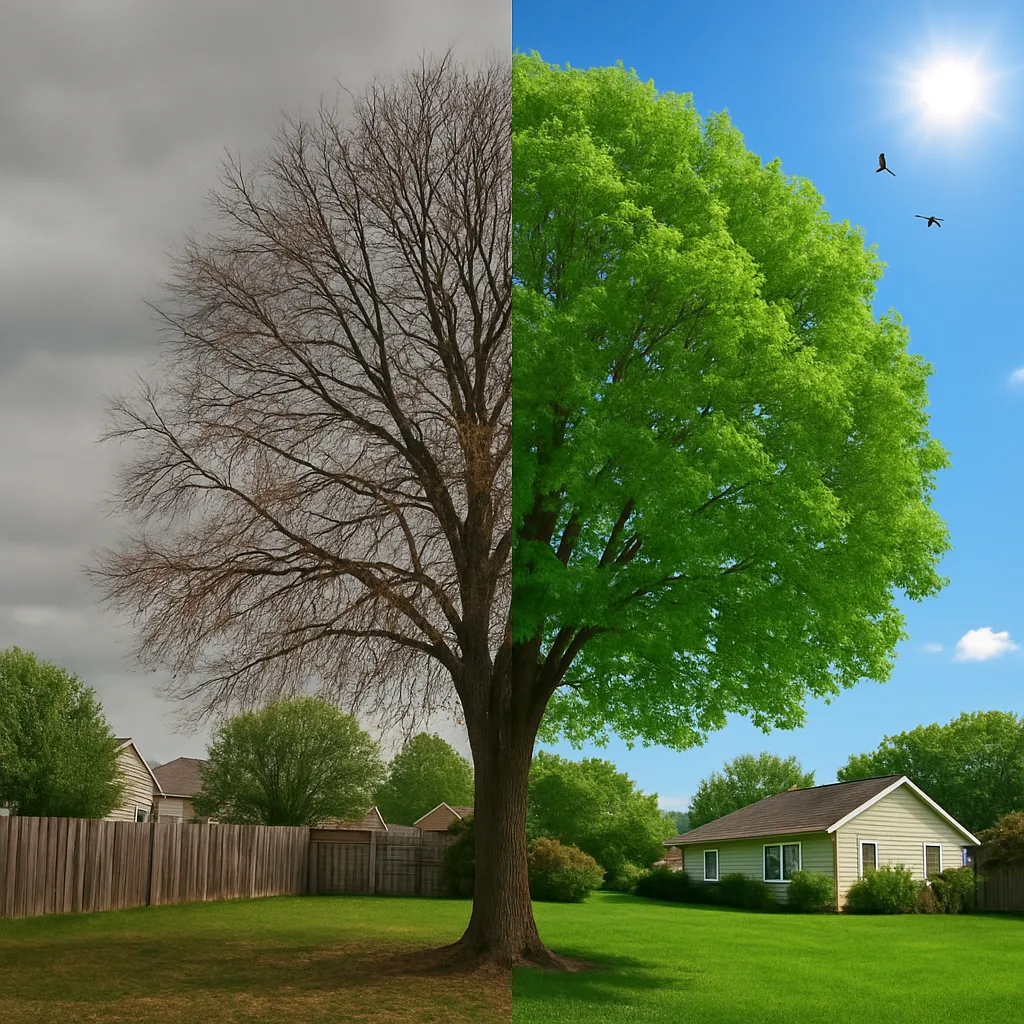
Is a tree suddenly turning brown, thinning out, dropping leaves early, or showing dead branches this summer? Hufnagel Tree Service provides certified arborist tree health inspections throughout Monmouth County, identifying drought stress, root problems, structural defects, decay, and other causes of decline before recommending pruning, restoration, monitoring, or removal.
Share This Article

Contents

Tree Health Inspections in Monmouth County, NJ

By August, we hear from homeowners whose trees looked fine in spring but suddenly appear thin, brown, or uneven. Around Middletown, Lincroft, Rumson, Red Bank, Holmdel, Long Branch, and other Monmouth County communities, late summer can expose problems that were easy to miss earlier. At Hufnagel Tree Service, we approach those changes as certified arborists with more than 25 years of local experience. We want to know what is happening before anyone starts cutting.

There is an added reason to pay attention this summer. As of August 5, 2026, the New Jersey Department of Environmental Protection lists the state under a Drought Warning. Dry soil, heat, compacted roots, pavement, and shore exposure can all stress trees. Stress does not always mean a tree is dying, but it can make existing root, disease, decay, and structural problems easier to see.

A proper tree health inspection separates temporary stress from a problem that needs action. The answer may be selective pruning, restoration, better root zone care, risk evaluation, or removal. The important part is making that decision from the condition of the whole tree, not one brown branch or one patch of thin leaves.

Why Monmouth County Trees Look Stressed in Late Summer

Late summer can be demanding on mature trees. After months of growth and heat, limited rainfall means roots have less moisture available to replace what the canopy loses. Rutgers guidance on using water wisely explains that established shade trees can suffer during drought. Visible clues may include leaf scorch, early leaf drop, a thinner canopy, or small dead twigs near the outer crown.

Conditions also vary across Monmouth County. In Lincroft, Navesink, Locust, and wooded Middletown, large oaks, maples, tulip poplars, and pines compete for water. In Holmdel and Colts Neck, broad root systems may cross lawns, driveways, and beds where construction, vehicles, patios, or foot traffic compact soil and reduce available air and moisture.

Near the water, properties in Monmouth Beach, Sea Bright, Long Branch, Oceanport, Leonardo, Belford, and Port Monmouth also deal with wind, salt, and faster drying in some soils. Trees already weakened by storm damage, root disturbance, or poor pruning may show symptoms sooner than protected inland trees.

Drought is not the only explanation for brown leaves. Rutgers plant health guidance notes that drought stressed trees can grow slowly and lose foliage, while insects, fungal problems, root injury, and other disorders can create similar symptoms. We look at the pattern, which branches are affected, where symptoms began, and what is happening at the trunk and roots.

Homeowners usually call because something changed. One side may look thin, leaves may brown early, or a limb that had foliage in June may be bare in August. Those observations help us start, but we still inspect the entire tree and its growing environment.

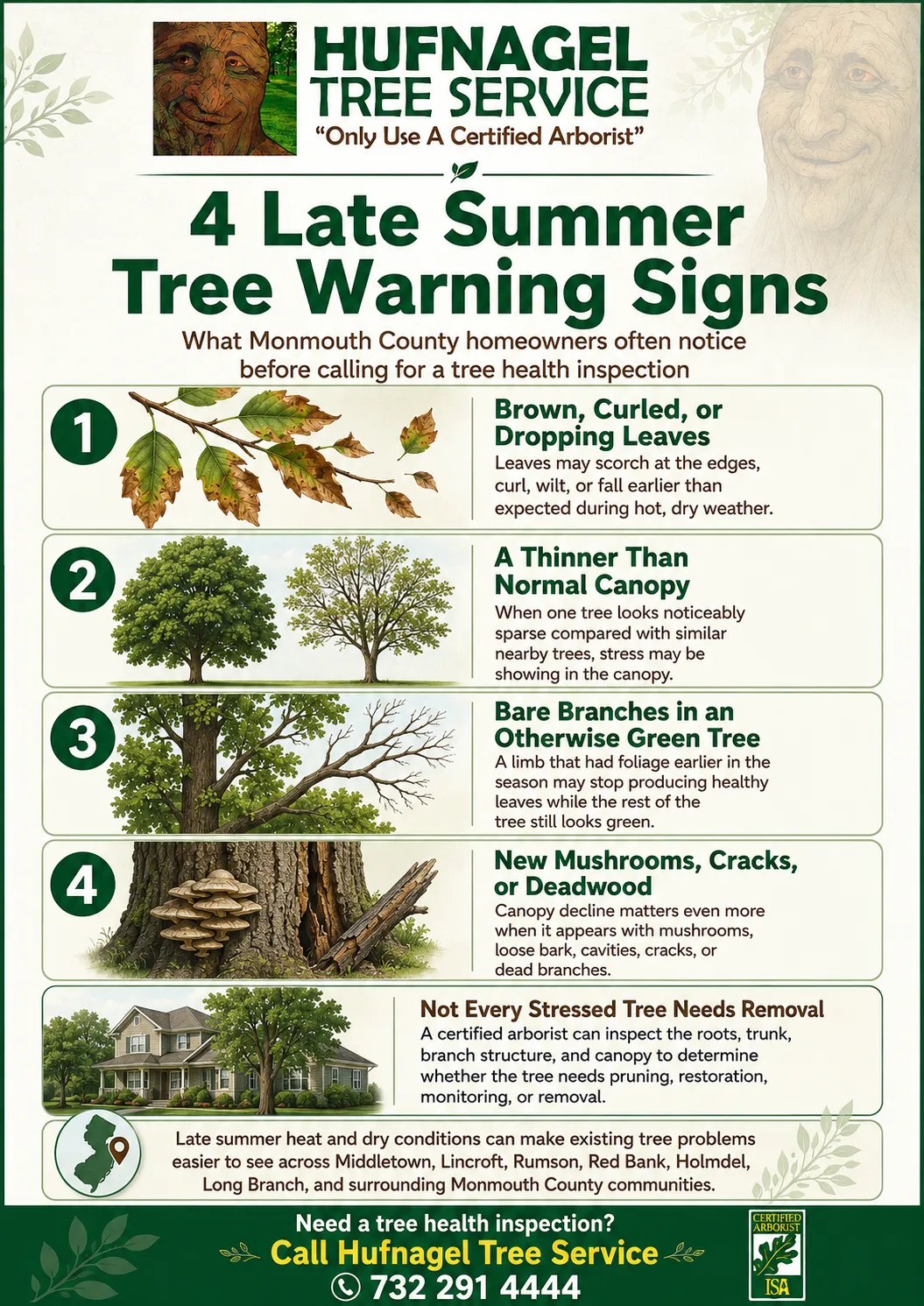
What homeowners often notice first in August

Late summer stress tends to show itself through a handful of visible changes that are worth watching.

  • Leaves browning at the edges, curling, wilting, or dropping earlier than expected.
  • A canopy that looks noticeably thinner than nearby trees of the same type.
  • Individual branches that stop producing healthy foliage while the rest of the tree remains green.
  • New mushrooms, loose bark, cracks, cavities, or deadwood appearing along with canopy decline.

Those signs are reasons for a closer look. A certified arborist inspection is more useful than guessing at the cause from the ground.

Tree Health Inspection Finds the Cause Before We Cut

Late Summer Tree Inspections

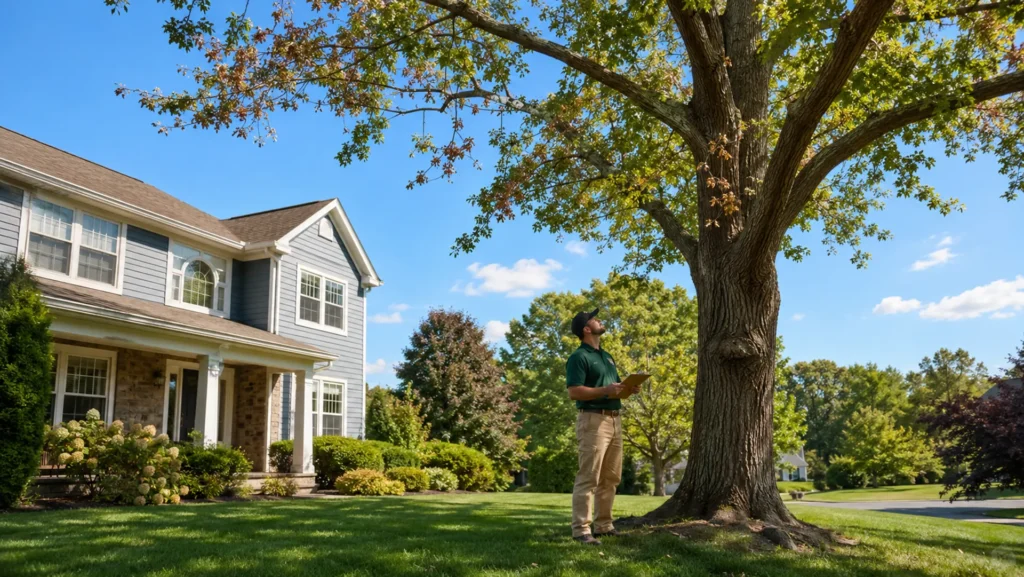
When we inspect a declining tree, we start with context: species, age, location, hardscape, construction, drainage, exposure, and the affected canopy. A red oak on a wooded property in Locust or Middletown has different pressures than an ornamental cherry near a Red Bank driveway or a wind exposed shade tree near the ocean. The tree must be evaluated where it grows.

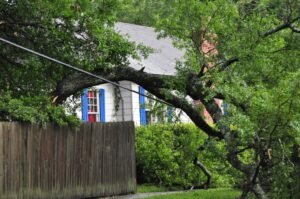
Then we work from the ground up. The root flare and lower trunk can reveal buried bark, girdling roots, wounds, cavities, fungi, or grade changes. We check the trunk for cracks, decay openings, old wounds, and weak unions, then look higher for deadwood, broken limbs, poor attachments, and uneven vigor. Our tree risk evaluation service uses those findings when safety is part of the concern.

We also separate health problems from structural problems. A tree can have scorched leaves and still be structurally sound, while a green tree can hide a serious cavity or weak union. Homeowners naturally focus on leaves, but important defects may be at the trunk, branch attachments, or root zone.

Michael puts it simply: “We do not rush jobs. We do not cut corners. Precision takes time.” That applies to diagnosis as much as pruning. We want to understand why a tree is declining before removing healthy wood. When pruning is appropriate, our tree trimming work focuses on deadwood, damaged growth, balance, clearance, and specific structural needs rather than treating every stressed tree the same way.

That approach matters on established properties in Rumson, Little Silver, Red Bank, and older Middletown neighborhoods where mature trees add character and value. A good inspection should explain what we see, what matters now, what can be monitored, and what service is justified.

What we look for before recommending tree work

The visible symptom is only the starting point. Our recommendation comes from the condition of the full tree.

  • Root flare condition, soil level, drainage, compaction, and signs of root injury.
  • Trunk wounds, cavities, cracks, decay indicators, bark changes, and fungal growth.
  • Branch attachments, deadwood, storm damage, canopy balance, and patterns of foliage loss.
  • Nearby targets such as the home, driveway, pool, play area, road, or neighboring property.

Once we know whether the problem is stress, health, structure, or a combination, we can decide whether the tree has a realistic path toward recovery.
When Tree Restoration Can Save a Declining Tree

Tree Restoration

A stressed tree should not automatically become a removal job. Some trees still have strong structure and enough living canopy to recover with better conditions and thoughtful maintenance. Our tree restoration service is built around that idea. We preserve what is viable, remove what is clearly dead or harmful, and reduce avoidable stress.

Selective pruning can help when dead, damaged, rubbing, or poorly positioned branches are present. We do not aggressively thin a drought stressed tree. Excessive cutting can add stress, so pruning decisions are based on structure, safety, and the amount of healthy canopy the tree can support.

Root zone care matters too. Proper mulch can moderate soil temperature and conserve moisture, while mulch piled against the trunk can create problems. The New Jersey Tree Owners Manual emphasizes proper watering and care as important to tree survival. Homeowners should also avoid grade changes, heavy equipment over roots, trenching through the root zone, or repeatedly saturating soil to compensate for drought.

Michael says, “We do everything we can to save a tree first.” We use that principle from Holmdel and Colts Neck to Rumson, Little Silver, and the Bayshore. Mature trees take decades to replace. When structure is sound and enough healthy canopy remains, preservation can protect shade, privacy, and landscape character.

Restoration also requires realistic expectations. A tree stressed for several seasons may not look perfect after one visit. We may recommend monitoring, future pruning, or root zone changes rather than a dramatic correction. The goal is to improve what we can control and watch how the tree responds.

Signs a tree may still have a good path forward

Every tree is different, but several findings can support a preservation focused plan.

  • Most of the canopy is still alive and producing normal foliage for the species.
  • The trunk and major branch unions do not show defects that outweigh the value of preservation.
  • The decline appears connected to correctable stress such as drought, compaction, minor deadwood, or poor past maintenance.
  • The root zone and surrounding property can be managed without continuing the same damage.

When those advantages remain, restoration can make sense. When they do not, the conversation shifts from recovery to risk.

Call Hufnagel for Tree Health Inspection in Monmouth County

If a tree suddenly looks thin, brown, uneven, or unhealthy, call Hufnagel Tree Service at (732) 291-4444We are certified arborists with more than 25 years of Monmouth County experience and more than 275 five star Google reviews. We provide trimming, pruning, restoration, risk evaluation, and removal based on what the tree actually needs.

From Middletown, Lincroft, Leonardo, and the Bayshore to Rumson, Fair Haven, Little Silver, Red Bank, Monmouth Beach, Long Branch, Oceanport, Holmdel, and surrounding communities, we know the trees and the tight residential settings that define this part of New Jersey. Bring us the insurance notice and let us help create the clearance your home needs while treating the tree like the valuable living asset it is.

Schedule Service Now!

From precision pruning and safe removals to health assessments and preventative care, Hufnagel Tree Service delivers expert solutions backed by decades of experience. We offer certified insight, fair pricing, and a commitment to doing what’s best for your landscape.

Where Do You Need Service?
Please Enter Your Contact Information
Are You A New or Existing Customer?
How Can We Help You?

Thank You!

Your Message Has Been Sent

We Will Contact You About Your Inquiry Shortly.

We Could Not Find A Direct Link To A Tree Removal Permit Application For The Town You Selected.

Please contact your local municipality to determine if a permit is required for your tree removal project. They will provide you with the most accurate and up-to-date information.