
Contents
Storm Proofing in Red Bank Starts With the Navesink and the Street Trees
Red Bank sits on the southern bank of the Navesink River, and its map shows how much water surrounds the borough. Wikipedia lists a total area of 2.15 square miles, of which 0.41 square miles, about 19 percent, is water, and it counts about four miles of waterfront. The same page gives the borough an elevation of 43 feet and a 2020 population of 12,936, which makes Red Bank a dense, closely built place with a large river on its northern edge.
That geography shapes how we approach storm proofing in Red Bank. Trees here grow in planting strips beside busy streets, in tight yards, and on soil that sits close to tidal water, and each of those settings loads a tree differently when a nor’easter arrives. Our tree storm proofing service starts with the tree, its roots, and everything it could reach, rather than with a calendar date or a single forecast.
After almost 30 years working throughout Monmouth County, we have seen how late fall shows what summer leaves hide. With the leaves coming down and the first hard coastal storms still ahead, this is a practical time to find weak unions, wet roots, and heavy limbs over roofs and cars before winter weather adds load.
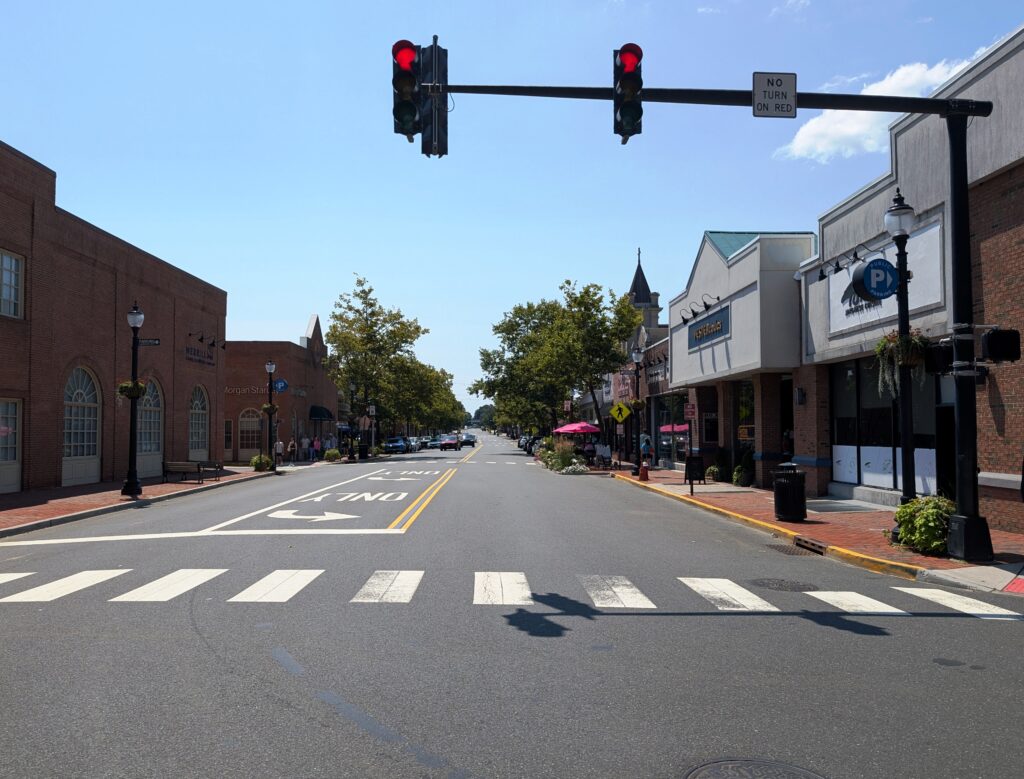
The photograph above shows downtown Red Bank at Monmouth Street in August 2025. A row of leafy street trees runs down the right side of the road in front of brick storefronts, with lamp posts carrying hanging planters, traffic signals overhead, and a crosswalk in the foreground. Wikipedia describes Broad Street as the main commercial street of downtown and places Front, Monmouth, and White Streets in the Broad Street Historic District. A tree in a setting like this one has little room to spread, and a limb that fails here lands on pavement, parked cars, or people, not on open lawn.
Water and wind are the other part of the setting. The same page puts Red Bank’s average annual precipitation at 48.13 inches, and the National Weather Service says nor’easters are most common and most intense from September through April, nearly always bringing gale force winds along with heavy rain or snow. It adds that coastal flooding is an occasional effect that has sometimes been disastrous. A tree that has taken in a wet year can meet that wind with soil that has had little time to firm up, and that is the pairing our storm work is built around.
Storm Proofing Is a Question of Load, Weak Unions, and Wet Roots
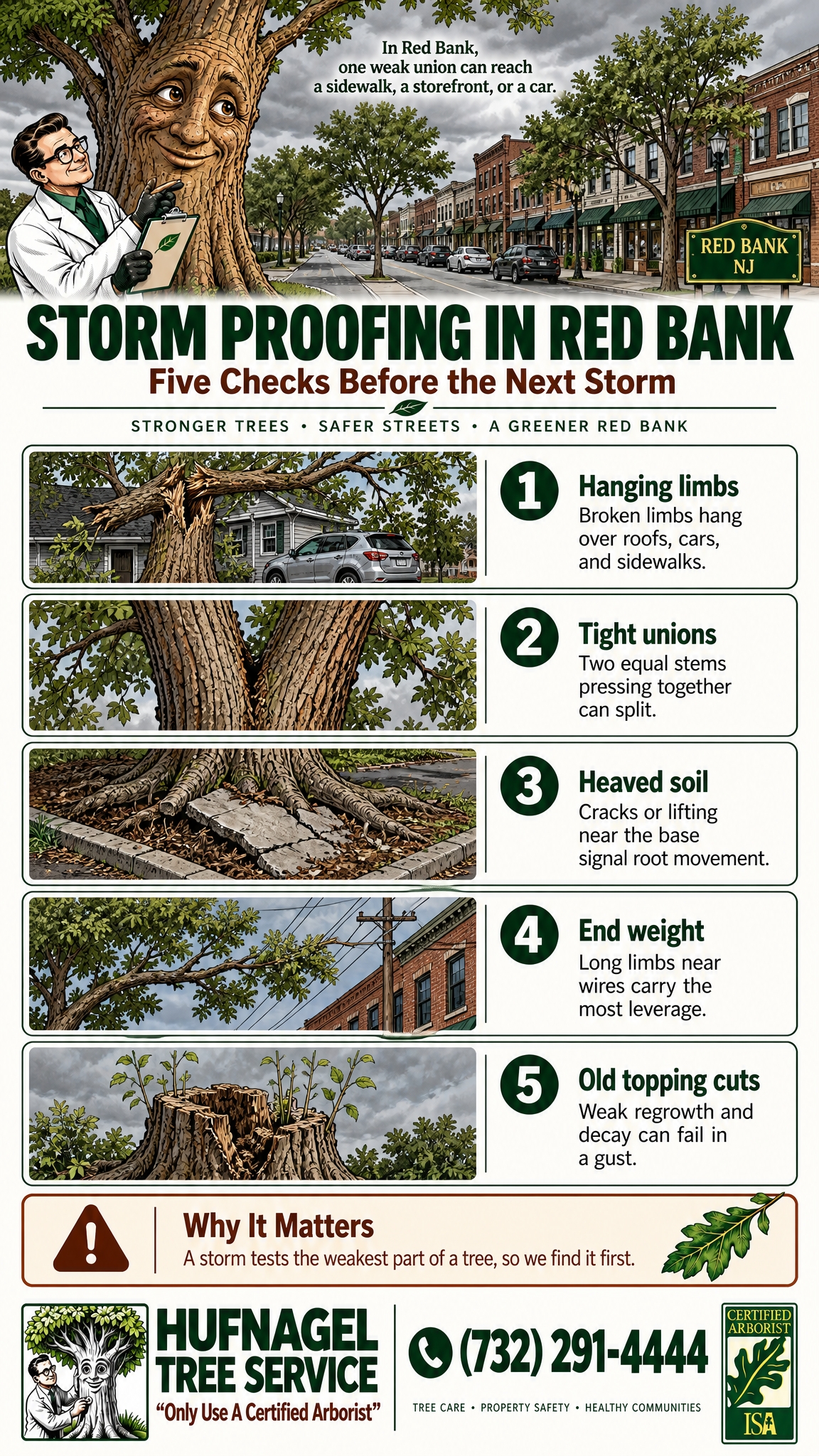
The International Society of Arboriculture says in its brochure on storm related tree damage that it is impossible to prevent all storm damage to trees, but that preventive care helps. The brochure lists training trees to improve their form, identifying branch, trunk, and root defects that may weaken a tree, removing dead or defective branches, and correcting problems left by improper care such as topping. That list is close to how we write a plan, because each item answers a specific way a tree can fail.
ISA also explains how storms hurt trees. Strong winds can break branches and even uproot trees, particularly when soils are soft from heavy rain or snow, and heavy snow or ice can break branches under the added weight. In plain terms, a storm adds load and leverage to a tree that was already carrying its own. A long limb with heavy foliage or end weight multiplies the force at its union, and a tall trunk multiplies the force at its base, so the question is always where that force will end up and what the tree is holding it with.
That is why we look at structure before we look at size. Large codominant stems can develop included bark and narrow unions that become more vulnerable as the stems grow, and our guide to codominant stems explains what we look for in a fork. A tree with a sound structure can ride out a hard wind with some broken twigs, while the same species with a split union may lose half its crown. Neither tree looks different from a car window in October.
Topping does not solve any of this. The ISA page on pruning your trees calls topping perhaps the most harmful tree pruning practice known and says it can create unacceptable risk, stress the tree, and promote decay. We name topping only to reject it, and we do not try to thin a tree out for wind as a blanket prescription. When a tree needs to carry less load, ISA describes reduction, which cuts leaders and branch ends back to secondary branches at least one third the diameter of the cut stem, so the tree keeps its form and structure.
Storm proofing has limits, and we state them to every homeowner. No tree service can honestly guarantee that a tree will never fail in severe weather. What the work can do is remove deadwood, relieve end weight, address a defect that can be corrected, and tell the owner plainly when a tree is past that point. In Red Bank the stakes are practical, because a tree beside a sidewalk, a storefront, or a parked car has more people and property under it than a tree at the back of a large lot.
Mike Hufnagel describes our goal this way: “A tree does not have to fall to cost a homeowner something. If we find the weak union or the shifted root before the wind and the high water arrive together, we usually still have choices.” That is the reason we inspect first. The earlier a defect is found, the more options a homeowner has, and the less likely the first look at it happens during a storm.
Storm Proofing Checks We Make on a Red Bank Tree
- Broken or hanging limbs over roofs, cars, sidewalks, and shared drives.
- Two stems of equal size pressing together at a narrow, tight union.
- Soil that has heaved, cracked, or sunk near the base of the trunk.
- Long limbs with heavy end weight reaching toward wires or buildings.
- Old topping cuts and wounds that left weak regrowth or decay behind.
Answering those five questions before winter turns a vague worry about storms into a short list of defects with locations. Some trees need only monitoring. Others need targeted pruning, restoration, support, or removal. Once we know which group a tree belongs to, the next part of the plan happens at ground level, where wet soil decides whether a sound trunk stays upright.
Soft Soil and High Water Decide Whether a Red Bank Trunk Holds

Red Bank’s water is close to every neighborhood. Wikipedia places the borough on the southern bank of the Navesink River, names Marine Park, Riverside Gardens Park, and Maple Cove Park along that shore, and lists Bellhaven Nature Area on the Swimming River. Trees on ground near water often grow with moist soil for much of the year, and that can mean shallow or uneven rooting that looks perfectly fine until a storm pushes on the crown.
ISA points to the same pairing when it explains how storms hurt trees: strong winds can uproot trees, particularly when heavy rain softens the soil. The photograph in this section shows what that failure can look like. A large tree has come down across a lawn with its root ball lifted at the base, water is standing in a low spot beside the drive, and one of our trucks is parked nearby. It is a job photograph from our files, not a Red Bank address, and it shows the pattern we want to prevent.
The signs usually show first at the base, and homeowners can see them without leaving the ground. ISA advises that trees which look undamaged after a storm, especially larger trees near people or property, should be checked for cracks in trunks or limbs, hanging branches, and soil heaving. Our guide to weak tree roots describes the same signs in more detail, including a trunk that leans more than it did last season and soil that has lifted on one side.
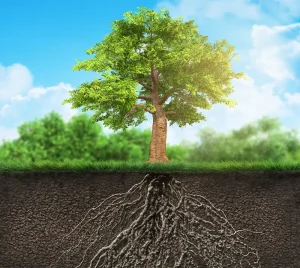
The roots also need protection from us and from the people who work around them. Red Bank’s tree ordinance defines a critical root radius by multiplying the trunk diameter at breast height, in inches, by 1.5 feet, so a tree with a 12 inch trunk has a critical root radius of 18 feet. The same ordinance counts excessive pruning, over mulching or improper mulching, and improper grading or soil compaction within that radius as tree removal when the result is decline or death. Piling soil, parking equipment, or trenching inside that circle weakens the anchorage a storm will test.
The ordinance gives a reason for all of this that fits our work. It says trees play a critical role in the water cycle and in reducing stormwater problems such as soil erosion, pollutant runoff, and infiltration, and it ties the rules to the state’s stormwater requirements. Wikipedia adds that the 2019 Marine Park redesign includes storm water management and pump stations. A borough that spends effort managing water has good reason to keep healthy trees in the ground, and we prefer to preserve a sound tree whenever the structure allows it.
When saturated ground or high water has been part of a storm, we also look for decay that wet conditions can hide. A tree can stand through the weather and still carry a hollow trunk or a rotted base, and our guide to hidden tree rot explains why a green crown is not proof of sound wood. Our tree health management work covers the roots, soil, and mulch side of the same trees, and it belongs in a storm plan as much as pruning does.
Root Zone Warning Signs After Heavy Rain or High Water
- Soil that has lifted or cracked on one side of the trunk.
- A trunk that leans more than it did before the storm.
- Mushrooms or conks growing at the base or on exposed roots.
- Roots uncovered by washed away soil or a sunken grade near the trunk.
- Standing water that stays around the root zone for several days.
None of these signs means a tree must come down. Each one means the tree deserves a closer look from the ground, and often a look from above as well. A homeowner who photographs the base today and again after the next storm gives us a record of change, which is more useful than any single glance. Once the roots are understood, the plan moves to the question of who is allowed to cut what, because in Red Bank that answer depends on where the tree stands.
Borough Rules Decide Who Can Prune a Red Bank Tree Before a Storm
Not every tree in front of a Red Bank house belongs to the owner of the house. The borough’s tree FAQ explains that borough trees are those planted on the borough right of way, which typically includes the road, the planting strip between the curb and the sidewalk, the sidewalk, and often a few feet into the front lawn. Trees in public parks are borough trees too. The page directs ownership questions to the Shade Tree Committee and tells residents to report tree problems to the Department of Public Utilities.
That matters for storm work because the ordinance is direct. Section 665-3 of the borough tree ordinance says no person shall remove, trim, or cause harm to any tree growing on or over a public right of way or public land without complying with the chapter. A homeowner who sees a storm damaged limb on a street tree should photograph it from a safe distance, keep clear, and report it, not cut it. Our earlier article on tree risk evaluation in Red Bank walks through the ownership question in more detail.
For a tree on private property, the same ordinance requires a permit to remove a deciduous tree with a trunk diameter of six inches or more, or a conifer ten feet tall or more, unless an exception applies. The criteria for approval include a tree that is dead, diseased, injured, or in danger of falling. Our guide to tree removal permits helps homeowners find out what applies before anything comes down, and we recommend removal only when the structure leaves no responsible alternative.
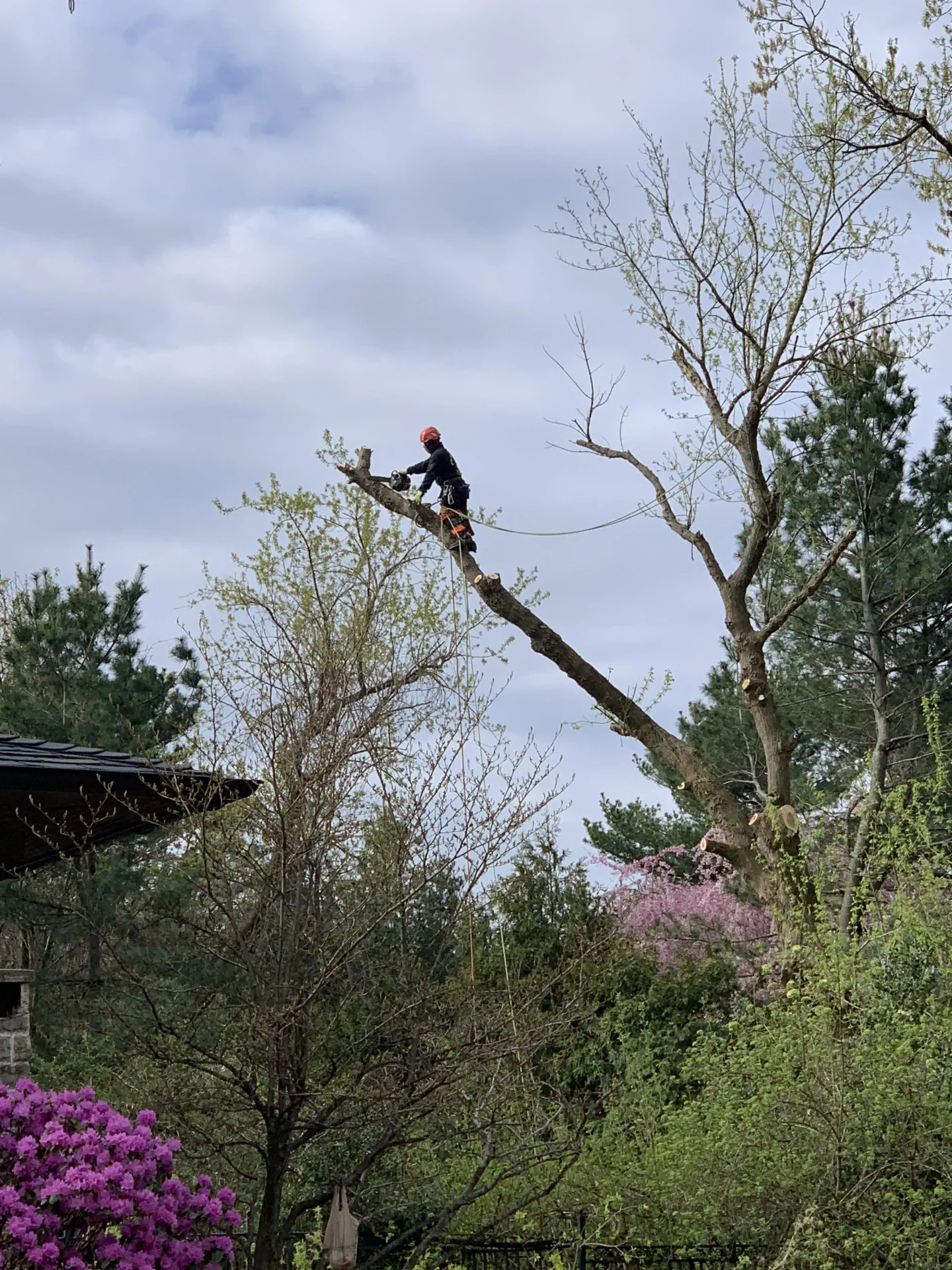
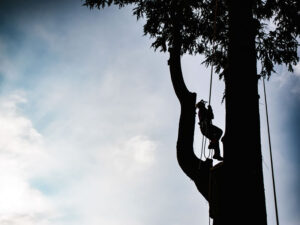
The photograph in this section shows a climber high in a tall tree cutting a long limb that angles away from the trunk, with a rope line running down to the crew below. It is the kind of work that relieves end weight without removing the tree. ISA says growth and wound closure are greatest when pruning happens before the spring growth flush, that light removal of dead, dying, or weak limbs can usually be done at any time of year, and that every cut should have a purpose. We apply that to our tree trimming and pruning plans by sorting hazards first and shaping last.
After a storm, the safety rules from the ISA brochure apply to every homeowner. Broken limbs hanging overhead and fallen trees resting in other trees or on buildings may keep moving, trees and limbs under tension can react unexpectedly when cut, and damaged trees may be in contact with electrical wires. ISA says to stay clear of damaged trees when possible and to call emergency services, the utility, or an arborist, and it warns against doing cleanup before consulting a professional. We handle the aftermath through our tree restoration work when a tree can be repaired, and we explain the choices before any cut is made.
Downtown streets add their own planning. Crews working near traffic signals, parked cars, and storefronts need clear access, a plan for where cut limbs will go, and attention to overhead wires. We also keep debris out of the road and away from storm drains as a matter of routine, since the borough is already working to manage water. A storm proofing visit that leaves a clean site and a written list of what we found is part of the job, not a bonus.
Questions to Settle Before Any Storm Work on a Red Bank Tree
- Whether the tree stands on private land or on the borough right of way.
- Whether the tree is large enough to need a borough removal permit.
- Which limbs reach wires, roofs, signals, or shared parking areas.
- What the tree looked like last season, using dated photographs.
- Who will clear debris so it stays out of the street and storm drains.
These questions keep storm proofing in Red Bank orderly. A homeowner who knows who owns the tree, what the ordinance requires, and what has changed in the crown can make a good decision quickly and avoid the mistakes that cost a tree its health. The last step is simple, and it is the one most people postpone until the weather forces it.
Call Hufnagel Tree Service About Storm Proofing in Red Bank
If you have mature trees near your Red Bank home, storefront, driveway, or shared parking, schedule an evaluation before winter storms arrive. We provide tree risk evaluations, tree health management, pruning, restoration, and removal when a tree cannot be managed safely. You can also read more local articles in our Red Bank category.
Hufnagel Tree Service is led by a certified arborist with almost 30 years of local experience and more than 280 five star Google Maps reviews. We inspect first, explain what we found in plain terms, and recommend only the work that changes the outcome for your trees and your property.
Call or text (732) 291-4444 to schedule storm proofing in Red Bank before the next coastal storm arrives.
Schedule Service Now!
From precision pruning and safe removals to health assessments and preventative care, Hufnagel Tree Service delivers expert solutions backed by decades of experience. We offer certified insight, fair pricing, and a commitment to doing what’s best for your landscape.
Learn More About Our Services
Related Articles

Matawan Tree Storm Damage: What Summer Wind Leaves Behind