Contents
Keyport Trees Face Bay Wind and a High Tide on the Same Day
Keyport was formed as a town in 1870 from part of Raritan Township, and the Borough of Keyport replaced it on April 2, 1908, according to Wikipedia. It covers 1.46 square miles on the Raritan Bay, the 2020 census counted 7,204 residents, and Route 35 and Route 36 cross its southern end. Storm proofing in Keyport is under test this week, because the National Weather Service in Mount Holly has a High Wind Watch and a Coastal Flood Watch in place for Monmouth County through the early hours of Friday.
Those watches matter for trees. The wind watch describes east winds of 35 to 45 mph with gusts up to 70 mph possible, from late Wednesday night through late Thursday night, and says damaging winds could blow down trees and power lines. The coastal flood watch begins Thursday morning and allows for one to two feet of water above ground in low lying areas near shorelines and tidal waterways. A watch is not a warning and the forecast can change, so please check the latest statement before Thursday. This is the kind of day our tree storm proofing work is meant to prepare for.
After almost 30 years working throughout Monmouth County, we have seen that wind alone rarely does the damage. It is wind on a tree that already carried a crack, a lean, or deadwood, standing in ground that cannot hold its roots. That leaves today and tomorrow to look, photograph, and call.
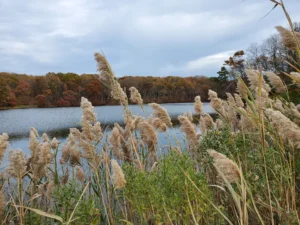
The photograph above shows a weathered wooden bulkhead running out into the Raritan Bay at dusk, with a wooded point across the water. It is a fair picture of Keyport’s position. The borough’s 2020 hazard mitigation plan says about half of Keyport is susceptible to storm surge, mainly through tidal surges up local streams, and that Keyport and Cliffwood Beach sit low around Matawan Creek. A tide that pushes up those creeks puts water at the roots of yard and street trees at the same time that wind is leaning on their crowns.
Keyport has seen what bay wind does even before a storm arrives. A Patch report posted on October 28, 2012, the day before Hurricane Sandy was expected, noted that a chill wind bent the newly planted trees in Waterfront Park. The same hazard plan counts 95 homes that took flood damage from storm tides and surges during Superstorm Sandy. Nothing in the current watches says Thursday will match that. The point is narrower. The bay is close, the ground is low, and a Keyport tree has to handle wind and wet roots together.
Storm Proofing in Keyport Starts With What a Tree Can Reach
Storm proofing in Keyport is risk reduction, not a guarantee. No tree service can honestly promise that a tree will never fail in a wind event with gusts near 70 mph, and we do not. What we can do is find the defects most likely to matter, rank them by what the tree can hit, and reduce the ones that can be reduced. The goal is not to make every tree smaller. The goal is to give each tree the work it actually needs.
The National Weather Service says on its high wind safety page that sustained winds of 40 to 50 mph can cause isolated wind damage and that higher speeds can cause widespread significant damage. The gusts named in the Thursday watch go past that range. Wind also does not arrive as a steady push. Gusts load a crown in pulses, and a union that holds against a steady wind can open under a sharp one.
Arborists quoted in a Rutgers continuing education article said that most trees that came down in an October 2011 storm could have been identified as problems if a qualified arborist had inspected them beforehand. That is the whole case for looking before the wind, and it is why we start with the tree and not with the forecast. A forecast tells us how hard the test will be. Only the tree tells us whether it will pass.
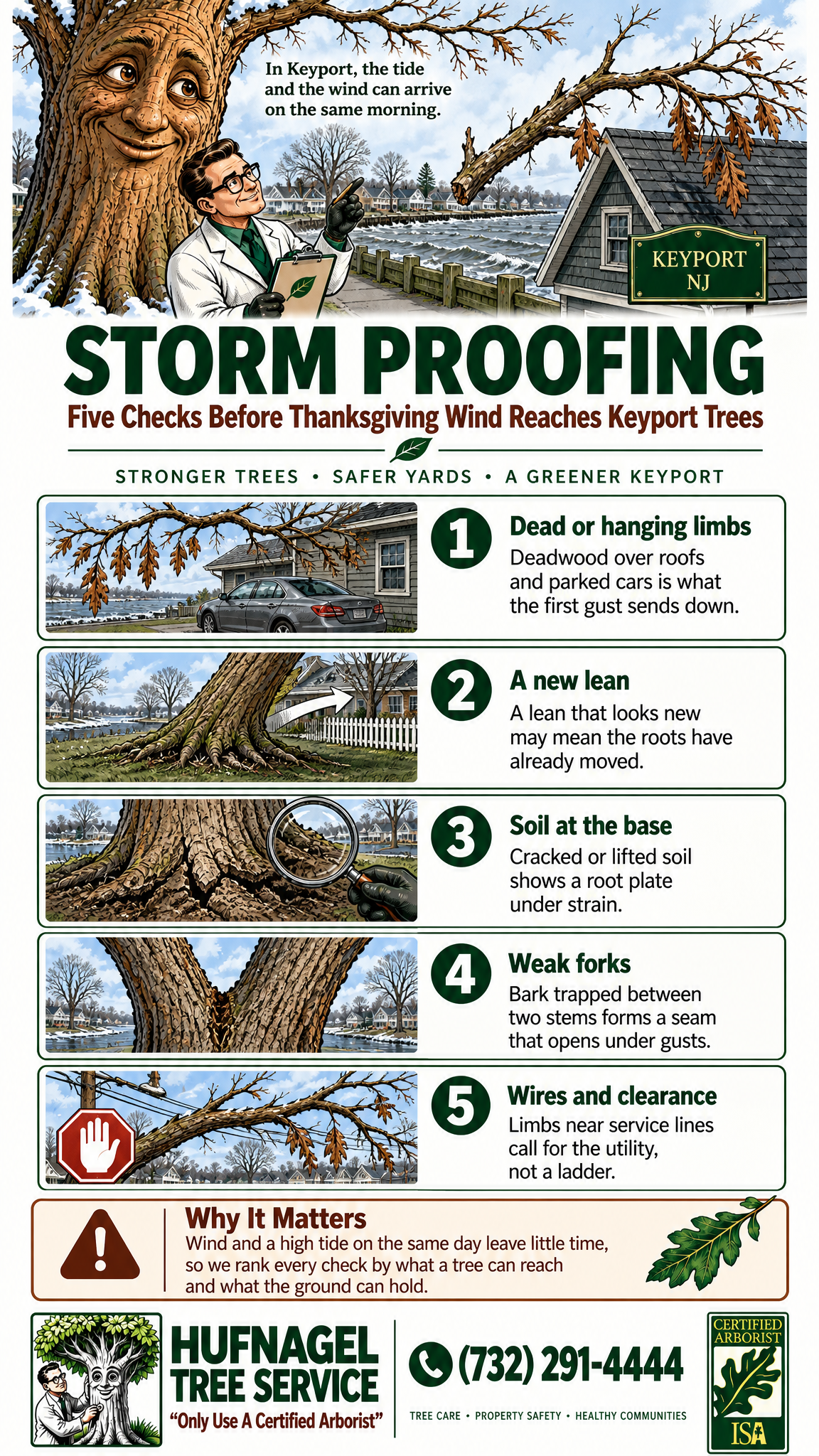
We start at the top of the tree and work down. Deadwood, hanging limbs, and cracks at branch unions come first, because they can fall in the first gust. Forks come next. Large codominant stems can trap bark between them and form a narrow seam that opens under load, and our guide to codominant stems shows what that seam looks like on a bare canopy.
Then we look at the trunk and the base. Fungal growth, a hollow sound, and cavities tell us where wood has been lost. The UConn forestry guide on tree risk lists mushrooms or conks, cavities, cracks, a sudden change in lean, and soil shifting around the root plate as signs of a hazard tree. Our guide to hidden tree rot covers the decay side of that list in more detail.
In Keyport the targets are close. Lots are small, streets near the waterfront are narrow, and a mature tree often stands within one limb length of a roof, a driveway, or a neighbor’s fence. A defect that is low concern over an open field can be much more important over a bedroom or a parked car. That is why our tree risk evaluation ranks by target first and size second, and why a modest tree over a house can come ahead of a large tree at the back of a lot.
Five Checks to Make Before Thanksgiving Wind Arrives
- Dead or hanging limbs over roofs, driveways, parked cars, and neighboring yards.
- A lean that looks new, or an old lean that looks stronger.
- Cracked or lifted soil on the side of the trunk away from the lean.
- Forks with bark pressed between two stems and a visible seam.
- Limbs near service lines, which call for the utility and an arborist.
None of these checks needs a ladder, and none should get one. A homeowner can look, photograph, and stay clear. If a check turns something up, the next step is a call and not a saw. Mike Hufnagel puts the rule this way: “Wind finds the one weak part of a tree. Our job is to find it first and decide whether it can be fixed or whether the tree needs a different plan.” That is the working idea behind every job we take on, and it leads straight to what the ground under the tree has to say.
Saturated Bay Soil Changes How Keyport Trees Hold Against Wind
The Coastal Flood Watch says confidence is high on at least moderate coastal flooding with Thursday morning’s high tide, and that tide levels could potentially reach the major threshold. At the level it describes, widespread roadway flooding occurs in coastal and bayside communities, and many roads become impassable. Any of that water that reaches a yard also reaches roots, which is why the National Weather Service in Mount Holly statement deserves a second read from anyone with a mature tree near the bay.
The Rutgers article describes a client in Allentown who lost seven large oaks during Hurricane Irene when a lake overflowed and the saturated ground loosened the soil enough for wind to topple them. Five trees survived, including one that had been flagged for removal before the storm. Weather does not follow a list. It tests roots as hard as it tests crowns, and a tree that looks sound from the street can still be the one that goes.
The UConn guide puts the mechanism plainly. Saturation destabilizes the root and soil plate and reduces oxygen in the ground, and trees often fail at the roots and not the trunk. It advises watching for soil heaving or a new lean after flood events. That is a short list a homeowner can follow without any tools, and it is the same list we use when we walk a property after high water.
Local plans show why water collects here. Keyport’s hazard mitigation plan describes stormwater backups after rain showers, proposes dredging Luppatatong Creek so it can hold more stormwater, and describes tidal surges moving up local streams. We read that as a reminder that a Keyport yard can be wet from above and from below on the same day, and the NWS forecast for Thanksgiving Day calls for rain along with the wind. Our own fall storm proofing article for Keansburg looked at the same bay wind a few miles east.
That is why the order of the checks matters. Before the wind, we look for the trees whose roots had the least margin to begin with: trees that lean, trees with a root flare buried under mulch or fill, and trees at the edge of a lawn that is already soft. Storm proofing in Keyport also means looking at those same trees again afterward, because a root plate that has moved once has less anchorage than before, even if the tree looks upright when the ground dries.
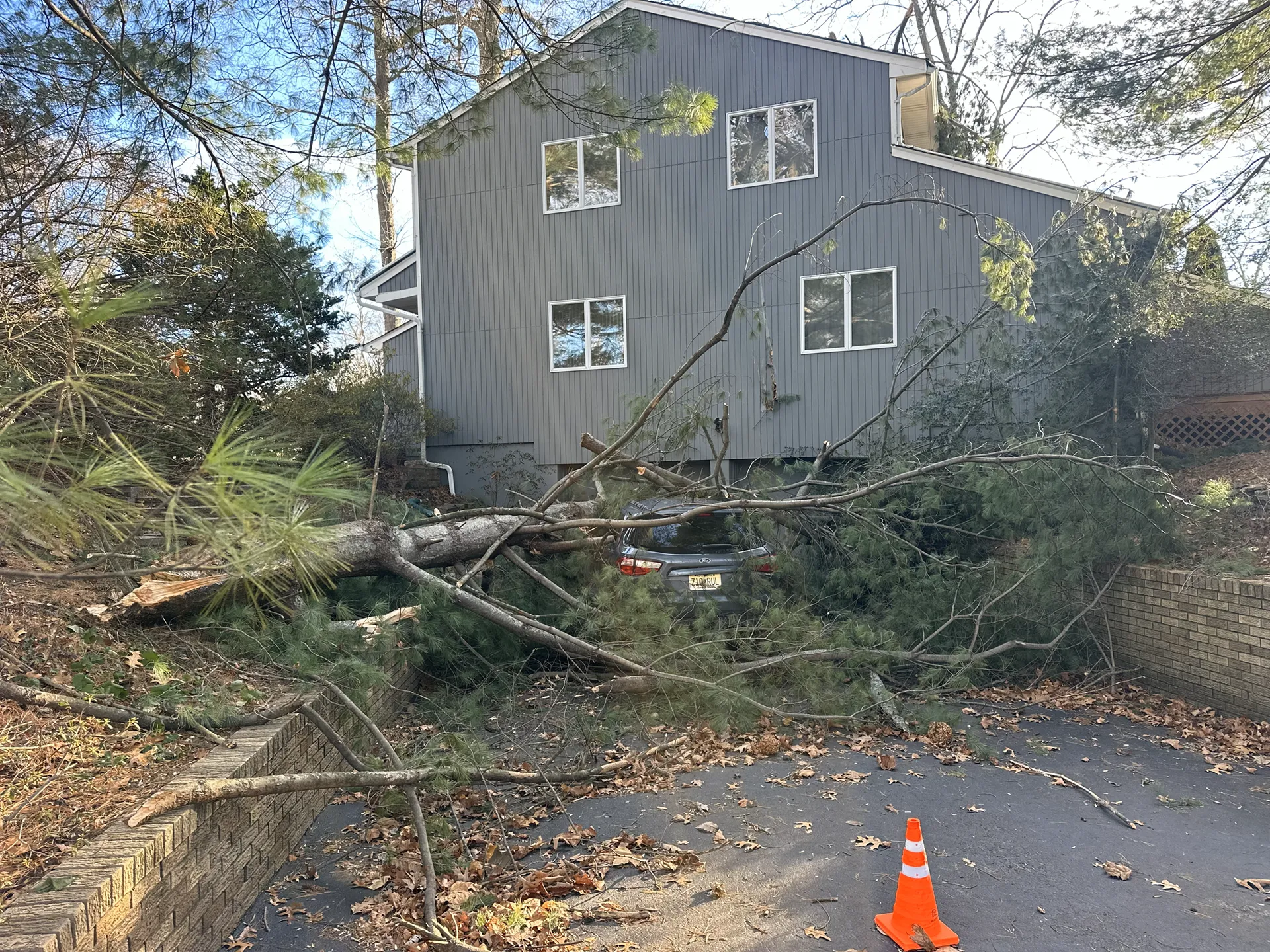
The photograph in this section shows a pine that came down across a driveway and onto a car beside a house. We include it because it shows how little distance can separate a tall tree from a house and a vehicle on a small lot. Our guide to weak tree roots covers what we check at the base of a leaning tree, and our earlier hurricane season prep for Keyport and Union Beach covers the same question from June.
Root and Soil Signs to Check After Wind and High Water
- Soil cracked, lifted, or mounded near the trunk, especially on one side.
- A trunk that now leans, or leans further than it did last week.
- Standing water around the base that lingers well after the rain stops.
- Mulch or fill piled against the trunk and covering the root flare.
- Fungal growth or fresh soil movement near the base after the tide drops.
None of these signs means a tree is coming down tomorrow. Each one means the margin has changed and deserves a second look once the ground can be walked. Where the roots are sound, pruning to reduce load can help. Where the roots are not sound, no pruning fixes the problem, and we say so. The next question is who owns the tree and what the borough expects.
Keyport Tree Rules Still Apply When Wind Leaves a Hazard Tree
Keyport added tree removal and replacement rules to its stormwater chapter. Ordinance 2024-04 sets requirements for tree removal and replacement to comply with the state’s Tier A stormwater permit, and the copy the borough posted shows it introduced on April 16, 2024, with a public hearing set for May 21, 2024. Because that copy is the introduced text, please confirm the final wording with the borough before relying on any detail below.
As introduced, the ordinance asks anyone planning to remove a street tree with a trunk diameter of 2.5 inches or more, or any other tree with a diameter of 6 inches or more, to file a Tree Removal Application with the Zoning Officer. The application fee is $50. A street tree is one planted in the public right of way, and that includes trees in shade tree easements, so the planting strip in front of a Keyport home may hold a tree the borough cares about.
The ordinance also exempts hazard trees, which may be removed with no fee or replacement requirement. It defines a hazard tree as one that is dead or dying, has an infectious disease or insect infestation, is causing obvious damage to structures, obstructs traffic signs or passage after pruning has failed, or is determined to be a threat by a licensed landscape architect, certified arborist, licensed tree expert, or licensed tree care operator. That last route is why a written assessment matters.
Where a tree is not exempt, the replacement table asks for one new tree of at least a 1.5 inch caliper for a smaller tree, with more replacement trees as the trunk grows, up to four for the largest trunks. A two year bond covers survival, and the introduced text lists fines of $100 to $1,000 per offense. None of that is a reason to hesitate over a dangerous tree. It is a reason to document the tree before it comes down.
Storm damage is where these rules meet real life. A split limb on a car or a trunk across a driveway is a bad day for the owner, and the first call is to the utility if a line is involved. After that we document the tree and the damage, explain what the borough’s rule is likely to ask for, and leave the decision with the owner. The ordinance itself says removal does not include responsible pruning and maintenance, and our guide to tree removal permits walks through the general process.
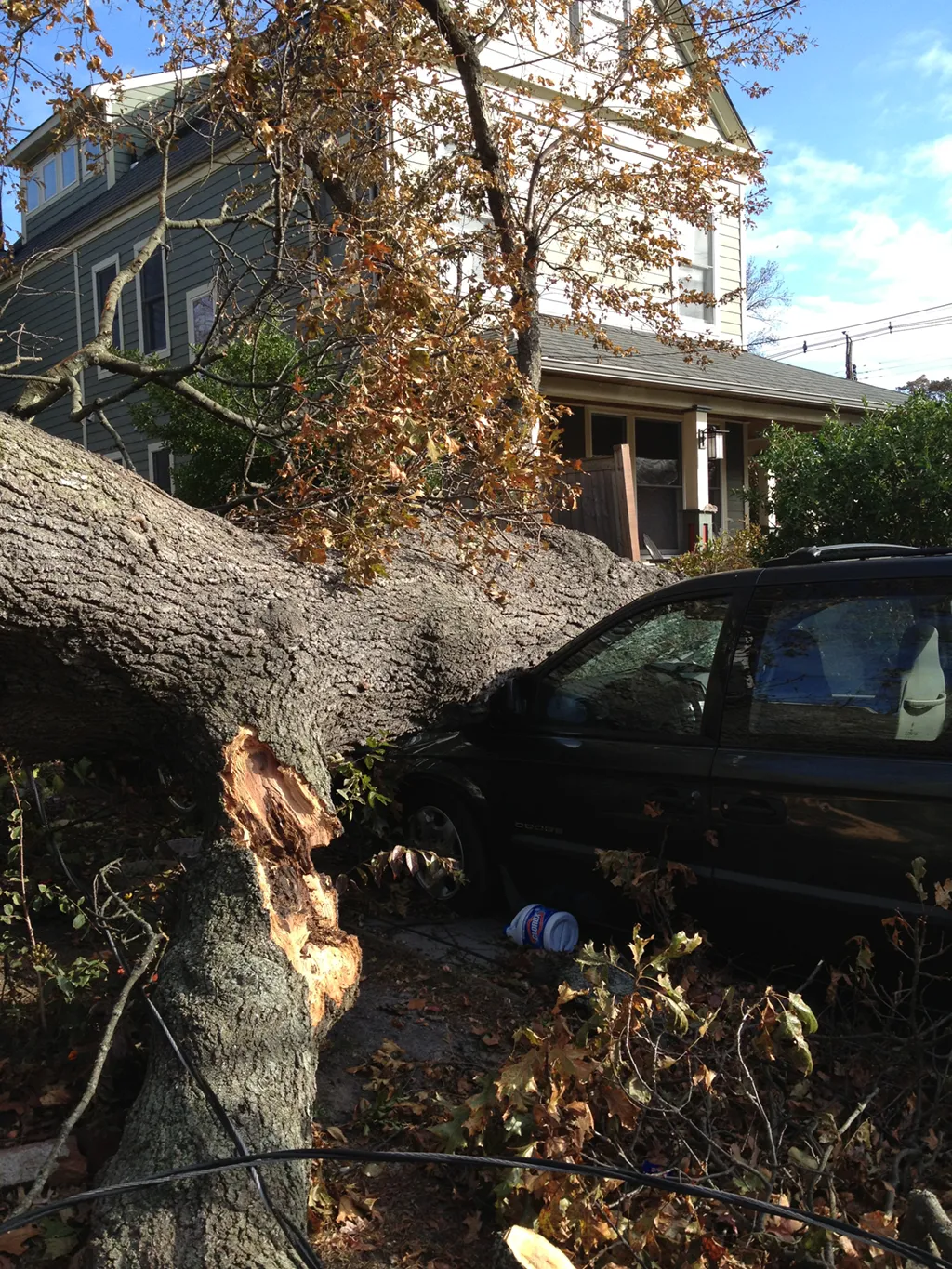
The photograph in this section shows an oak limb that split away from the trunk and landed on a minivan in front of a house. The torn pale wood marks where the union let go, and a cable lies across the foreground. That is why we tell homeowners never to approach a limb touching a line. The UConn guide says the same, advising people not to approach trees touching power lines and to report the hazard to the utility.
What to Do If Wind Brings a Tree or Limb Down in Keyport
- Stay clear of the tree and anything it touches, especially wires.
- Call the utility first when a line is involved, then call us.
- Photograph the tree, the damage, and the base from several sides.
- Leave limbs resting on a roof or hung up in a crown alone.
- Ask for an explanation of what failed before deciding on removal.
These steps keep people safe and leave every choice open. Not every damaged tree needs to come down, and a tree that has lost one limb may be preserved with a clean cut and monitoring. The Rutgers arborists quoted earlier make the same point, saying removal is not always necessary and that pruning or support cables often fixes the problem. When removal is the right answer, the hazard tree language in the borough’s rule is where we start.

Schedule Storm Proofing in Keyport Before the Thanksgiving Wind Arrives
If you have mature trees near your Keyport home, driveway, fence line, or a street frontage the borough may share, schedule an evaluation before the wind arrives. We provide tree storm proofing, tree risk evaluations, tree trimming and pruning, restoration, and tree removal when a tree cannot be managed safely.
Hufnagel Tree Service is led by a certified arborist with almost 30 years of local experience and more than 280 five star Google Maps reviews. We inspect first, explain what we found in plain terms, and recommend only the work that changes the outcome for your trees and your property.
Call or text (732) 291-4444 to schedule storm proofing in Keyport before the next wind event. Our Keyport tree articles list more local guidance.
Schedule Service Now!
From precision pruning and safe removals to health assessments and preventative care, Hufnagel Tree Service delivers expert solutions backed by decades of experience. We offer certified insight, fair pricing, and a commitment to doing what’s best for your landscape.
Learn More About Our Services
Related Articles
Matawan Fall Tree Care: Prepare Trees Before Winter
Tree Risk Evaluation Services Near Marlboro NJ