Contents
Aberdeen Grew From Matavan Township Into Parkway Era Neighborhoods With Mature Street Trees
Aberdeen has changed its name more than once and kept its trees through all of it. Wikipedia says the township was incorporated in 1857 as Matavan Township, became Matawan Township in 1882, and took the name Aberdeen after a vote of residents on November 8, 1977. The same page lists Cliffwood Beach, Strathmore, Freneau, Oakshades, River Gardens, and Woodfield among its communities, with 5.44 square miles of land and 2.33 of water. Tree pruning in Aberdeen starts with that mix of bay shoreline, postwar streets, and older neighborhoods.
Strathmore shows how pruning needs differ from one street to the next. Wikipedia notes that Levitt and Sons began building it in the early 1960s, so many of its street trees are now mature and stand close to roofs, wires, and driveways. Our tree trimming and pruning work and our tree risk evaluation service both begin with one plain question: what does each cut accomplish for this tree and for everything beneath it?
After almost 30 years working throughout Monmouth County, we have seen that pruning is the service homeowners most often buy for the wrong reason. A tree cut only to look tidy can lose its structure, while a tree cut for a reason can stay safe and healthy for decades. Late fall is a good time to sort that out, because the leaves are down and the framework of every tree is easy to read.
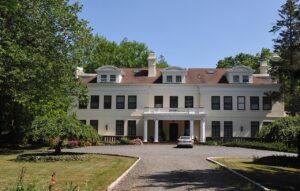
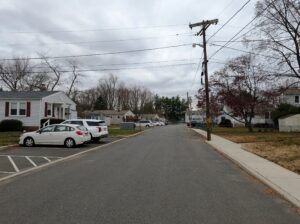
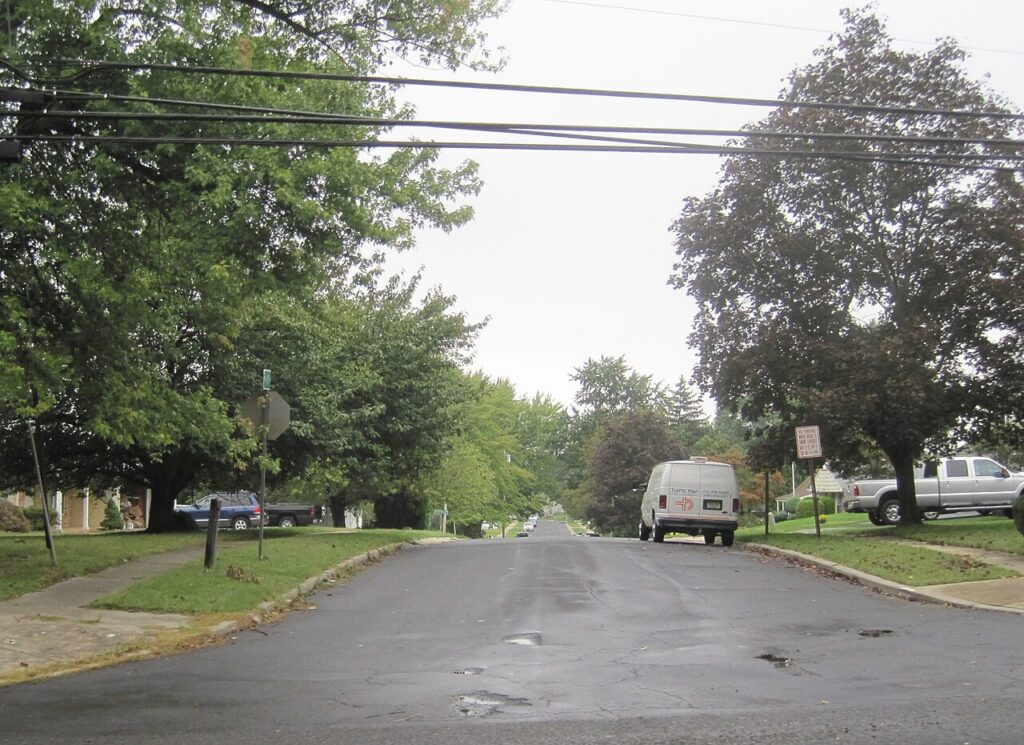
The photograph above shows a Strathmore street with large shade trees leaning over the pavement, overhead wires crossing the canopy, a sidewalk, and vehicles parked at the curb. That is the setting where pruning decisions matter most. A limb that is fine over an open lawn becomes a clearance and load problem when it hangs over a road, and a cut made in the wrong place on a street tree is very hard to undo.
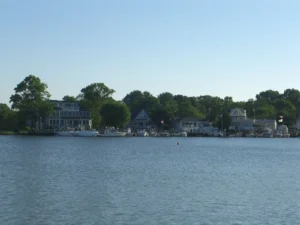
Water also shapes the township. The Wikipedia page lists Raritan Bay along the coast, Matawan Creek at the Keyport border, and Mohingson Creek near Oakshades, and about 30 percent of the township’s total area is water. Bay wind and wet ground add load to a canopy, so a pruning plan here has to leave a tree strong enough for a nor’easter, not just neat enough for the weekend. Our tree storm proofing service builds on the same idea.
Tree Pruning in Aberdeen Has a Legal Line Between Responsible Pruning and Removal
Aberdeen adopted a tree ordinance in 2024, and it speaks directly to pruning. Ordinance 22-2024, adopted June 20, 2024, added section 25-5.29 to the township code. It begins by saying the purpose is to reduce soil erosion and pollutant runoff, promote infiltration of rainwater, and protect public health, safety, and welfare. The text was written to meet a state stormwater permit requirement, so trees are treated as part of how the ground handles water and not only as scenery.
The most important sentence for homeowners is the definition of tree removal. The ordinance says removal means to kill a tree or cause irreparable damage that leads to its decline or death, and it names excessive pruning as one example, along with over mulching, improper grading, and soil compaction inside the critical root radius. It then adds that removal does not include responsible pruning and maintenance. Tree pruning in Aberdeen is therefore protected when it is responsible and counted as removal when it is not.
That line makes the quality of a cut a legal question as well as an arboricultural one. Topping a tree, stripping its lower crown, or taking off far more live growth than it can recover are the kinds of work that can leave a tree declining. The TreesAreGood site of the International Society of Arboriculture lists a guide titled Why Topping Hurts Trees, and the title says it plainly. We treat topping as damage and not as pruning, and we judge every cut by what the tree can recover from.
The ordinance also defines the critical root radius as the trunk diameter at breast height multiplied by 1.5 feet, so a tree 6 inches across has a protected zone 9 feet from the trunk. That matters for pruning because a visit often involves ladders, lifts, chips, and brush piles near the base of the tree. Work that compacts the ground inside that radius can count against a tree just as heavy cutting can, so the crew’s access plan is part of the pruning plan.
The same section asks anyone removing a street tree 2.5 inches across or larger, or any other tree 6 inches or larger, to submit an application to the Zoning Official, and it says no tree is to be removed until township officials have reviewed and approved the request. The replacement table runs from one tree and a $100 fee for the smallest category up to four trees and a $500 fee for trees 33 inches or larger. Hazard trees are exempt from the fee and the replacement requirement, and the township can fine violations $500. Residents who remove fewer than four trees per acre in the smaller replacement categories within a rolling five year period are exempt from replacement, but the ordinance asks for written justification, such as photos or a statement from a New Jersey licensed tree expert or arborist.
Mike Hufnagel puts the working rule this way: “A good pruning cut should be easy to explain. If we cannot say what a cut fixes, whether it is a defect, a clearance problem, or a weak union, then that cut should not be made.” That keeps every visit focused on what the tree needs instead of on how much material comes off.
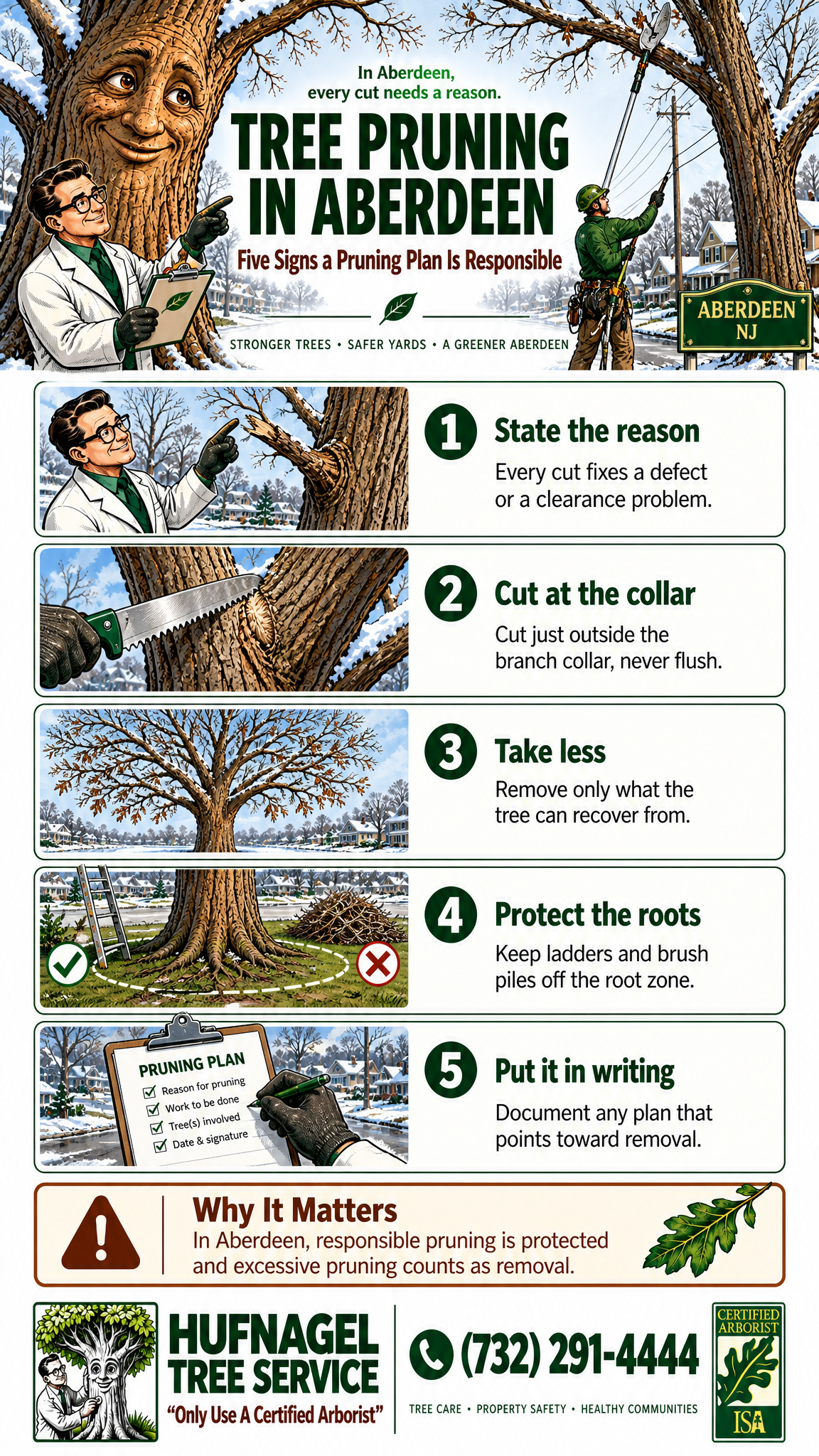
Five Signs a Pruning Plan Is Responsible
- Every cut has a stated reason, such as deadwood, clearance, structure, or risk.
- Cuts are made just outside the branch collar and never flush with the trunk.
- The crew removes only the growth the tree can recover from in one season.
- Ladders, lifts, and brush piles stay outside the sensitive root zone where practical.
- Any plan that points toward removal is documented in writing before work begins.
A plan that passes these five tests protects both the tree and the homeowner. It also leaves a record, because a written reason for each cut is the easiest way to show that the work was responsible pruning and not damage. Once the legal line is clear, the next question is timing, since the same cut made in the wrong season can cost a tree more than the cut itself.
Winter Timing Makes Structure Visible and Pruning Cuts Safer
Rutgers Master Gardeners of Hunterdon County explain the case for winter in a short guide to pruning trees in winter. Late February to early March is the best time for pruning many landscape trees, and the guide gives three reasons. Without leaves, the shape of a tree and anything out of proportion or structurally unsound is easier to see. Cuts on dormant trees do not stimulate new growth, and many disease organisms and pests are dormant too.
The guide is also clear about exceptions, which is where a certified arborist earns the visit. It says oaks and elms should only be pruned in winter to avoid oak wilt and Dutch elm disease, and that spring flowering trees are usually pruned right after bloom. Maple, birch, and beech may bleed sap from winter wounds, but the guide says the sap loss does not hurt the tree. Dead branches can be removed at any time of year.
That means one Aberdeen yard can need three different calendars. A mature oak belongs on the winter list. A flowering dogwood, one of the replacement species on the township’s approved list, is better pruned after it blooms. A broken limb hung up in a maple should come out as soon as it is found. Our ornamental tree pruning guide for Middletown shows how we sort these jobs by species instead of by habit.
Late fall and early winter also suit the practical side of the work. Bare crowns let us inspect every union, crotch, and old wound before cutting, and fewer leaves mean less debris to haul and less wind resistance while a climber works. Tree pruning in Aberdeen done now also leaves a tree lighter and better balanced when the first strong bay wind arrives, which is the point of pruning ahead of the season instead of after a storm. A tree that has already lost a limb in a storm can still be pruned, but the wound is ragged and the tree has already paid the price.
Timing also affects what the homeowner sees afterward. A dormant tree shows its work plainly, with clean cuts at the branch collars and an open, balanced outline. In spring the tree leafs out around those cuts and the wounds begin to close. Our guide to codominant stems explains one of the main reasons for winter pruning, because a bare canopy shows exactly where two leaders compete for the same space.
The Rutgers guide gives a practical checklist for a winter walk around the yard. It suggests starting with structure, then removing broken, diseased, or dangling branches back to the branch collar, checking for crossed branches that rub and open the bark, and looking for tight V shaped crotches under 45 degrees and codominant leaders. We follow the same order on a pruning visit, and we explain each finding before a saw is started.
What to Check on a Bare Winter Canopy
- Dead, broken, or hanging limbs, especially over roofs, driveways, and sidewalks.
- Crossed branches that rub together and wear through the bark.
- Tight V shaped unions and competing leaders that could split under load.
- Old pruning wounds that are closing around the branch collar or failing to close.
- Deadwood and sucker growth that can be removed without reshaping the whole crown.
None of these checks needs a ladder, and most can be done from the ground on a clear afternoon. The findings decide the plan, because they separate trees that need targeted pruning from trees that need monitoring or a closer look at the roots. Once the timing and the targets are set, the last questions are who does the cutting and under what license, which the next section covers.
Street Trees, Wires, and Shared Canopies Call for Targeted Cuts Instead of Shaping
Street trees sit in a special category in the ordinance. It defines a street tree as one planted in the sidewalk, planting strip, or public right of way beside the part of the street used by vehicles, and it sets the lower 2.5 inch trigger for them. As the Strathmore photograph shows, trunks on a street like that stand only a few feet from the curb and sidewalk. A pruning cut on a street tree in Aberdeen should be planned as carefully as a removal.
Overhead lines add another layer. The photograph shows several wires crossing the street under the canopy, which is common in older neighborhoods. Pruning near energized lines is not homeowner work and is not a job for an untrained crew, because a limb can swing into a conductor without warning. Our storm season tree risk assessment guide is a useful companion read for owners with trees near their homes and lines.
Shared canopies are the third issue. On smaller lots a large crown often spreads across a property line, and a limb pruned on one side changes the load on the other. A good plan looks at the whole crown rather than only the section that bothers one owner. That is one reason we inspect first and recommend work second, and why tree risk evaluation comes before heavy pruning on a mature tree.
Exposure changes the plan near the water. Wikipedia describes Cliffwood Beach as a former resort area that lost its boardwalk and amusements to hurricanes between 1954 and 1960, which is a reminder that the bay can be hard on the shoreline. Trees near the bay take wind from open water, so we favor reducing a heavy limb or removing a defect over thinning a crown in a way that lets wind pass through unevenly. The aim is balance, and every cut should leave the structure stronger.
Trees also grow along the Henry Hudson Trail, which the Monmouth County Park System describes as a paved, 10 foot wide former railroad right of way. The northern section begins at the Aberdeen and Keyport border at Lloyd Road and Clark Street, and the county notes that much of the trail is tree lined. Any homeowner whose lot meets the corridor should remember that a pruning plan stops at the property line, and that work on a tree growing on county land is a decision for the county.
Hedges and ornamentals follow the same logic at a smaller scale. A hedge trimmed to bare wood in late fall can stay thin for a full season, while a flowering ornamental cut at the wrong time can lose its bloom. Our hedgerow trimming service and our ornamental pruning article for Sea Bright cover those jobs, and the same rule applies in Aberdeen: know the species, then choose the season.
Licensing matters here too. The New Jersey Board of Tree Experts explains that Licensed Tree Care Operators handle pruning, repairing, brush cutting or removal, tree removal, and stump grinding, while Licensed Tree Experts can also consult, diagnose, and perform risk assessment, cabling, and bracing. The ordinance asks for written statements from a New Jersey licensed tree expert or arborist when someone claims an exemption, so a licensed professional is part of the process either way.
Five Steps Before a Crew Starts Pruning
- Confirm the crew holds a current state license in the Board of Tree Experts directory.
- Ask for the reason behind each cut in plain language before work begins.
- Keep all pruning clear of overhead lines and leave utility contact to professionals.
- Check whether the tree is on private land, in the right of way, or on county land.
- Leave the tree strong enough to handle the next bay storm and not merely tidy.
A crew that can answer these five points will usually leave a tree in better shape than it found it. The answers also protect the owner, since a clear plan and a licensed contractor make it far easier to show that the pruning was responsible. With the rules, the timing, and the people settled, the last step is to schedule the work.
Call Hufnagel Tree Service for Tree Pruning in Aberdeen Before Winter Storms
If you have mature trees near your Aberdeen home, driveway, or Strathmore street, schedule a pruning visit before winter storms arrive. We provide tree trimming and pruning, tree risk evaluation, tree health management, restoration, and tree removal when a tree cannot be managed safely.
Hufnagel Tree Service is led by a certified arborist with almost 30 years of local experience and more than 280 five star Google Maps reviews. We inspect first, explain what we found in plain terms, and recommend only the work that changes the outcome for your trees and your property.
Call or text (732) 291-4444 to schedule tree pruning in Aberdeen before the next winter storm. Our Aberdeen tree articles list more local guidance.
Schedule Service Now!
From precision pruning and safe removals to health assessments and preventative care, Hufnagel Tree Service delivers expert solutions backed by decades of experience. We offer certified insight, fair pricing, and a commitment to doing what’s best for your landscape.
Learn More About Our Services
Related Articles
Aberdeen Fall Tree Inspection: Find Problems Before Winter
Tree Pruning in West Long Branch NJ: Cut for a Reason Before Winter
Brielle Tree Risk Assessment for Storm Damage and Hazardous Trees