Contents
Bradley Beach Trees Face a High Wind Warning and a Thursday Morning Tide
Bradley Beach is a compact oceanfront borough of 0.63 square miles, set between Ocean Grove and Avon by the Sea. It was incorporated on March 13, 1893, and named for the developer James A. Bradley, according to Wikipedia. The 2020 census counted 4,282 residents, the summer population can reach 30,000, and Main Street, which is Route 71, runs through the middle of town. Storm proofing in Bradley Beach is under test this week, because the borough sits directly in the path of a strong east wind.
The National Weather Service in Mount Holly issued a High Wind Warning for Eastern Monmouth County early on Wednesday, November 25. It runs from 4 AM Thursday to 1 AM Friday, calls for east winds of 35 to 45 mph with gusts up to 70 mph, and says damaging winds will blow down trees and power lines. A Coastal Flood Warning covers 6 AM Thursday to 3 AM Friday. Forecasts change, so please check the latest statement before Thursday. This is the kind of day our tree storm proofing work is meant to prepare for.
After almost 30 years working throughout Monmouth County, we have seen that wind alone rarely does the damage. It is wind on a tree that already carried a crack, a lean, or deadwood, standing in ground that has been soaked. That leaves today and tomorrow to look, photograph, and call.
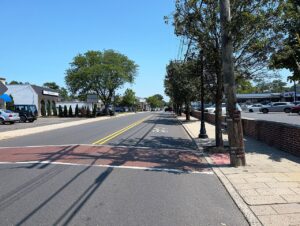
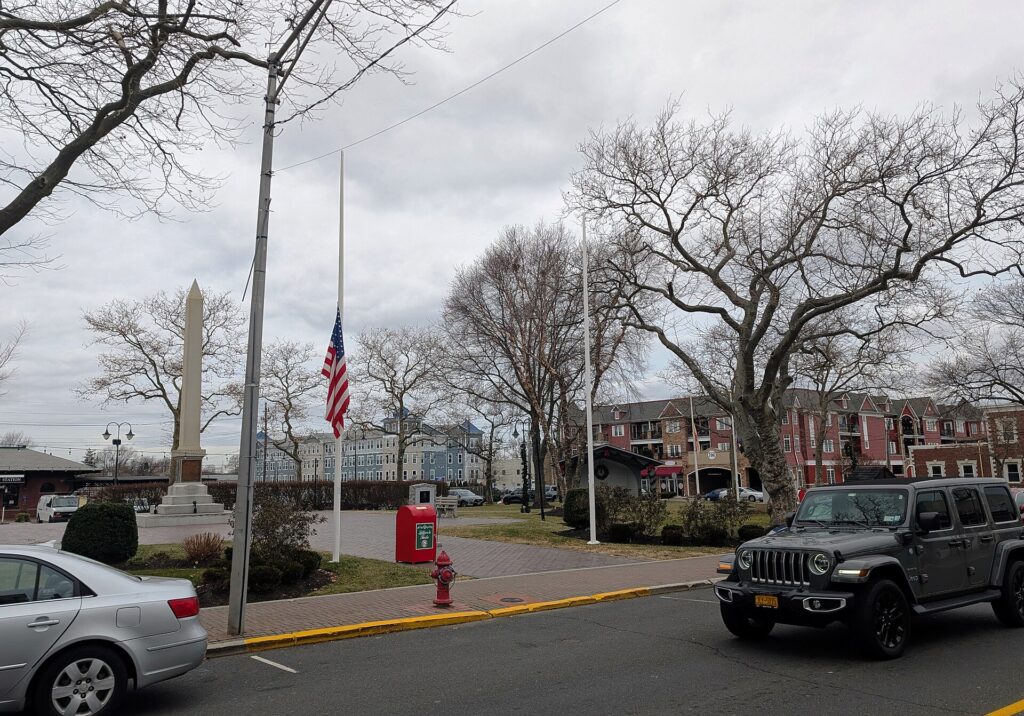
The photograph above shows Riley Park on Main Street, with large bare trees standing close to the roadway, the sidewalk, parked cars, and overhead wires. It is a fair picture of Bradley Beach. The Coastal Flood Warning describes one to two feet of water above ground in low lying areas near shorelines and tidal waterways, says the most impactful high tide will come Thursday morning, and says significant beach erosion is possible and sand dunes may be breached. Widespread roadway flooding is part of the same description, and the full text is on the Mount Holly forecast office page.
Bradley Beach has seen what a coastal storm does to the shoreline. Wikipedia reports that the borough built dunes on its beaches in 2000 using snow fences and discarded Christmas trees as a base, and that damage from Hurricane Sandy in October 2012 to beach areas and homes near the shore exceeded $3 million. Nothing in the current warnings says Thursday will match Sandy. The point is narrower. A Bradley Beach tree has to handle strong wind and wet roots together, on a lot where the next house is close.
Storm Proofing in Bradley Beach Starts With Trees Planted Close to Everything
Storm proofing in Bradley Beach is risk reduction, not a guarantee. No tree service can honestly promise that a tree will never fail in a wind event with gusts near 70 mph, and we do not. What we can do is find the defects most likely to matter, rank them by what the tree can hit, and reduce the ones that can be reduced. The goal is not to make every tree smaller. The goal is to give each tree the work it actually needs.
The borough’s own Community Forestry Management Plan for 2020 to 2024 explains why that ranking matters here. It says Bradley Beach is over 90 percent developed, that most of its tree resources stand on private property, and that the public trees are mainly 12 species along the roadways, set in a traditional tree lawn between the curb and the sidewalk. Our risk evaluation article for Bradley Beach looked at the same small lots and planting strips earlier this month.
The plan names plane trees as the main street species and credits their hardiness. It also notes that their larger root systems tend to conflict with sidewalks and curbs, and that a large portion of the trees had their roots cut hard during road paving, which left a fair number of them leaning. Those leaning trees have generally stabilized, according to the plan. We read that as a baseline. A tree that has stood at one angle for years is a different case from a tree that leans further this week.
The plan lists salt spray from the ocean, narrow planting strips, girdling roots, and drought stress among the notable problems. Each one weakens a tree in a different way, and none shows from the street unless someone knows to look. A girdling root can choke a trunk for years before a crown shows it, and a trunk with a hidden cavity can look fine until a gust loads it. Our guide to hidden tree rot shows the decay side of that list in more detail.
We start at the top of the tree and work down. Deadwood, hanging limbs, and cracks at branch unions come first, because they can fall in the first gust. Forks come next. Large codominant stems can trap bark between them and form a narrow seam that opens under load, and our guide to codominant stems shows what that seam looks like on a bare canopy. Then we look at the trunk and the base. The UConn forestry guide on tree risk lists mushrooms or conks, cavities, cracks, a sudden change in lean, and soil shifting around the root plate as signs of a hazard tree.
In Bradley Beach the targets are close. A tree in the planting strip can reach the sidewalk, the street, a parked car, and the service line in one fall. A defect that is low concern over an open field can be much more important over a bedroom or a frequently used walkway. That is why our tree risk evaluation ranks by target first and size second, and why a modest tree over a house can come ahead of a large tree at the back of a lot.
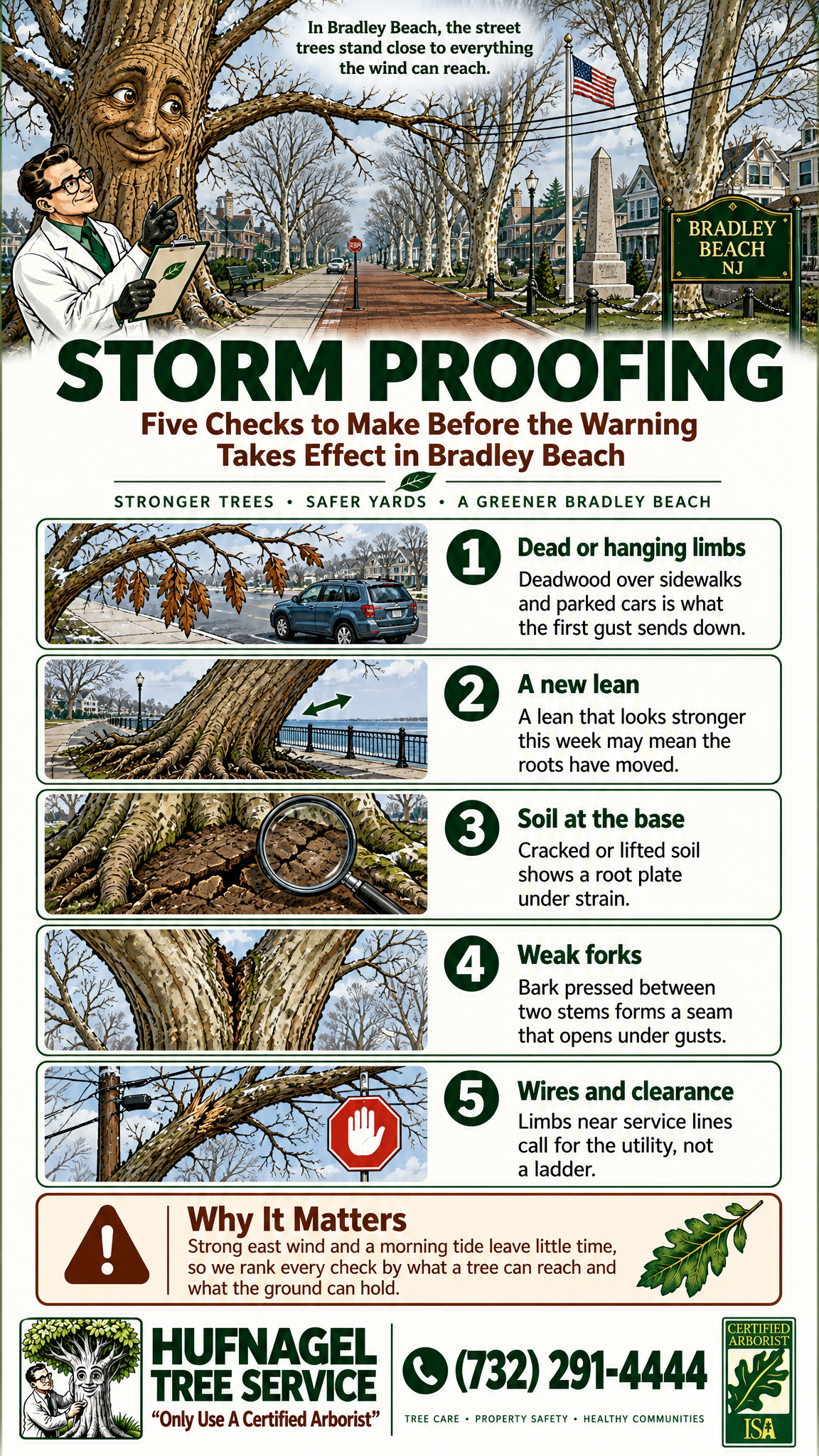
Five Checks to Make Before the Warning Takes Effect
- Dead or hanging limbs over sidewalks, parked cars, roofs, and neighboring yards.
- A lean that looks new, or an older lean that looks stronger than last week.
- Cracked, lifted, or mounded soil on the side of the trunk away from the lean.
- Forks with bark pressed between two stems and a visible seam or crack.
- Limbs close to service lines, which call for the utility and not a ladder.
None of these checks needs a ladder, and none should get one. A homeowner can look, photograph, and stay clear, and if a check turns something up the next step is a call and not a saw. Mike Hufnagel puts the working rule this way: “On a street where the tree, the sidewalk, and the parked car are all within a few feet of each other, there is very little room for a weak limb. We want to find it while we still have choices.” That is the idea behind every job we take on, and it leads to what the borough expects when a tree has to come down.
Bradley Beach Rules Treat a Storm Casualty Differently From a Planned Removal
Bradley Beach regulates tree removal through Chapter 425 of its borough code, and Article III is the part that applies to private property. It requires a permit before anyone removes or destroys a tree with a trunk diameter of five inches or more, an ornamental or evergreen tree 10 feet tall or more, a tree with a canopy over a public right of way, or any heritage, specimen, or significant tree. It also makes it a violation to cause or permit the work through a third party contractor without that permit, which is why we ask about permits before we ask about a schedule.
The same article carries exceptions that matter in a windstorm. A tree that poses imminent danger to life or property, or whose removal responds to an emergency, may be removed, but only to the extent needed to end the danger. If the Shade Tree Commission was not told beforehand, the code asks for notice by the next business day, with verification that the removal was necessary. A tree that has fallen solely as a result of storm damage, an accident, or another bona fide casualty is also excepted.
A planned removal follows a longer path. Article IV has the owner apply to the Shade Tree Commission with a narrative, a sketch of the lot, and a replacement plan, along with a $50 fee. The commission or its licensed tree expert has 25 business days to inspect and decide, and silence past that period counts as approval unless both sides agreed in writing to extend it. Replacement ranges from one tree for a trunk of five to eight inches to three trees for a trunk over 31 inches, each at least two and a half inches in caliper, with a fee into the borough’s Shade Tree Trust Reserve as an alternative to some planting.
The code was amended as recently as March 3, 2026, so please confirm the current wording with the borough before relying on any detail here. We are not the borough, and we do not decide what the code requires. What we do is document the tree, explain what we found, and help the owner reach the right office. Our guide to tree removal permits walks through the general process, and the borough’s Shade Tree Commission page lists the permit application and the contact address.
Ownership is the other question. In Bradley Beach a tree in the planting strip may be a public tree that the commission manages, while a tree behind the sidewalk is usually the owner’s responsibility. Neither case is a reason to wait on a dangerous limb. It is a reason to photograph the tree and the damage before anything is moved, so that the facts are on record for the borough, the utility, or an insurer.
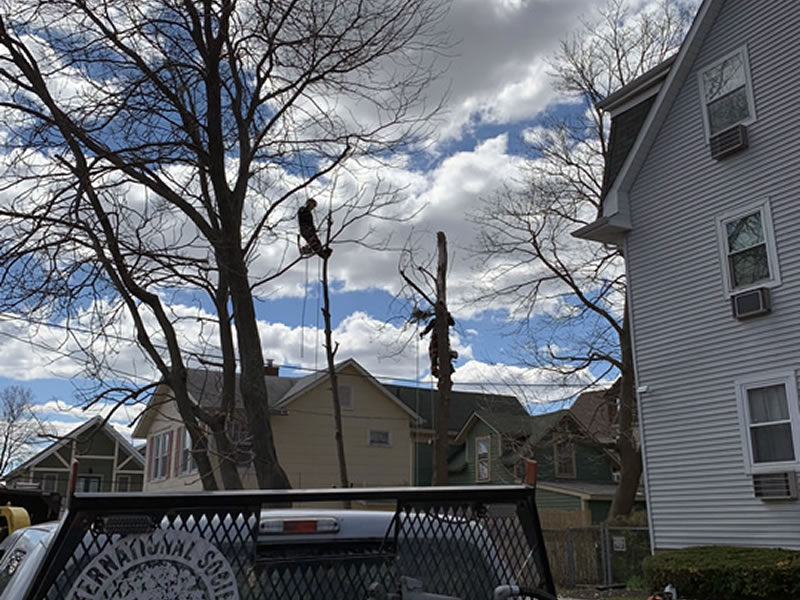
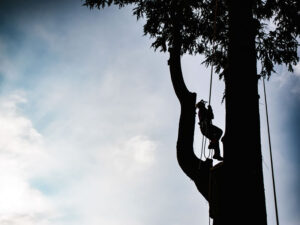
The photograph in this section shows two climbers working high in leafless trees above a residential street. Controlled work like that is planned, rigged, and cut in sequence. A tree that has already split, uprooted, or hung up in a neighbor’s crown is a different job, and it is the reason we ask homeowners to stay clear and call.
What to Do If Wind Brings Down a Tree or Limb in Bradley Beach
- Keep people and pets well away from the tree and anything it touches.
- Call the utility first when a wire is down or touching the tree.
- Photograph the tree, the damage, and the base from several sides.
- Tell the borough about an emergency removal by the next business day.
- Leave limbs resting on roofs or hung up in a crown to a professional.
These steps keep people safe and leave every choice open. Not every damaged tree needs to come down, and a tree that has lost one limb may be preserved with a clean cut and monitoring. When removal is the right answer, the exceptions in the borough code are where we start, and the next question is what the ground under the tree has to say.
Saturated Sand and Beach Erosion Change How Bradley Beach Trees Hold in Wind
The National Weather Service forecast for Thanksgiving Day calls for rain that may be heavy at times, with east winds of 35 to 45 mph and gusts up to 65 mph, according to the Mount Holly forecast. Rain on top of a coastal tide is the combination that worries us most. The borough’s forestry plan describes local planting conditions as sandy, well drained soil and salty air, and well drained sand does give a tree some margin on an ordinary day. Heavy rain and high water can still leave the ground around a root plate soft.
The UConn guide puts the mechanism plainly. Saturation destabilizes the root and soil plate and reduces oxygen in the ground, and trees often fail at the roots and not the trunk. It advises watching for soil heaving or a new lean after flood events. That is a short list a homeowner can follow without tools, and it is the same list we use when we walk a property after high water.
Wind direction adds to the picture. The forecast says east, which means the air arrives straight off the Atlantic. The National Weather Service wind safety page says sustained winds of 40 to 50 mph can cause isolated wind damage and that higher speeds can cause widespread significant damage. The gusts named in the warning go past that range. Gusts also load a crown in pulses, and a union that holds against a steady wind can open under a sharp one.
Before the wind, we look for the trees whose roots had the least margin to begin with. Those are trees that lean, trees with a root flare buried under mulch or fill, trees in a planting strip where the sidewalk has lifted, and trees whose roots were cut during road paving, which the forestry plan identifies as a past problem in town. Our guide to weak tree roots covers what we check at the base of a leaning tree.
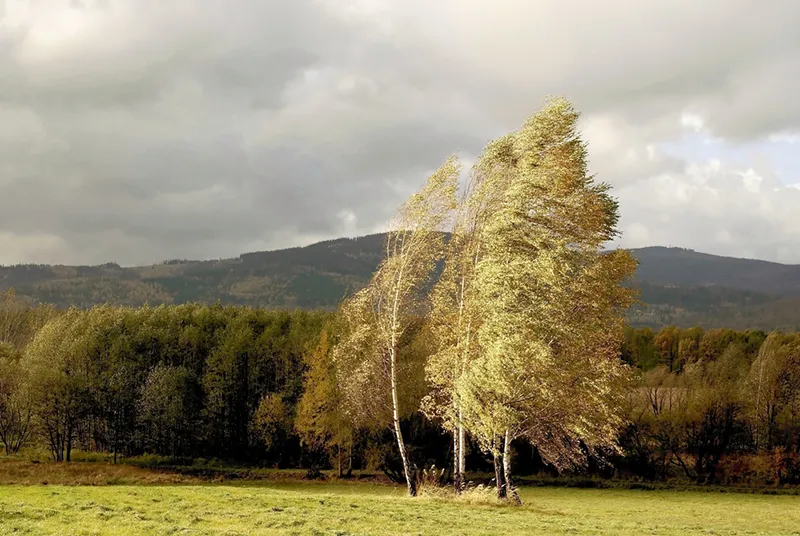
The photograph in this section shows birch trees bent hard by a strong wind. It is stock imagery from another landscape, and we include it for one reason. It shows how much a crown moves and how far the load travels down a trunk to the root plate. A tree that sways that far in a gust is pulling on its roots with every pulse, and soft ground gives those roots less to hold.
Bradley Beach has planted for this exposure. The forestry plan says the Shade Tree Commission uses a list of 23 species that are relatively tolerant of salt, wind, and sandy soil, and records groves planted at Sylvan Lake and at the firehouse. We apply the same thinking to existing trees. A sound tree that suits the site deserves preservation, and our tree restoration article for Bradley Beach shows what repair can look like when a tree is worth keeping.
Root and Soil Signs to Check After Wind and Heavy Rain
- Soil cracked, lifted, or mounded near the trunk, especially on one side.
- A trunk that now leans, or leans further than it did last week.
- Sidewalk slabs or curb edges that have shifted beside a street tree.
- Standing water at the base that lingers after the rain has stopped.
- Fresh fungal growth or loose soil at the base once the tide drops.
None of these signs means a tree is coming down tomorrow. Each one means the margin has changed and deserves a second look once the ground can be walked. Where the roots are sound, pruning to reduce load can help. Where they are not sound, no pruning fixes the problem, and we say so. A root plate that has moved once has less anchorage than before, even if the tree looks upright when the ground dries.
Schedule Storm Proofing in Bradley Beach Before Warning Level Wind Arrives
If you have mature trees near your Bradley Beach home, driveway, planting strip, or a street frontage the borough may share, schedule an evaluation before the wind arrives. We provide tree storm proofing, tree risk evaluations, tree trimming and pruning, restoration, and tree removal when a tree cannot be managed safely.
Hufnagel Tree Service is led by a certified arborist with almost 30 years of local experience and more than 280 five star Google Maps reviews. We inspect first, explain what we found in plain terms, and recommend only the work that changes the outcome for your trees and your property.
Call or text (732) 291-4444 to schedule storm proofing in Bradley Beach before the next wind event. Our Bradley Beach tree articles list more local guidance.
Schedule Service Now!
From precision pruning and safe removals to health assessments and preventative care, Hufnagel Tree Service delivers expert solutions backed by decades of experience. We offer certified insight, fair pricing, and a commitment to doing what’s best for your landscape.
Learn More About Our Services
Related Articles