Tree Removal in Fair Haven NJ: Permit Rules, Hazard Trees, and Replacement

In Fair Haven, a tree 6 inches across needs a borough permit before it comes down, and a licensed tree expert reviews each request. Learn how a hazard tree is judged and replaced.
Share This Article

Contents

Tree Removal in Fair Haven Starts With a Borough Between the River and the Road

Fair Haven is a small borough with a large canopy. Wikipedia places it on the Rumson peninsula along the Navesink River, with 1.59 square miles of land and 0.52 of water, and says it was carved out of Shrewsbury Township and incorporated as a borough in 1912. River Road, which is Monmouth County Route 10, runs through the middle of town, and the first permanent house went up near the river at what is now Fair Haven Road in 1816. Tree removal in Fair Haven starts with that long settled, closely built layout, because most trees stand a few feet from a house, a sidewalk, or a neighbor.

The borough also treats its trees as a shared asset. Its 2025 to 2029 Community Forestry Management Plan reports an average residential canopy of 40.3 percent, about 13 percent above the Monmouth County average, and the Shade Tree Commission page posts the tree removal application and ordinance for anyone who needs them. For a homeowner that means a removal is a request to the borough, not only a job order. Our tree removal work and our tree risk evaluation service both begin by working out what the tree is, what it can reach, and what the borough needs to see.

After almost 30 years working throughout Monmouth County, we have seen that most removal problems begin with a skipped step rather than with the saw. Late fall is a good time to sort those steps out. The leaves are down, the structure is easy to read, and a request filed now can be reviewed before winter weather adds load.

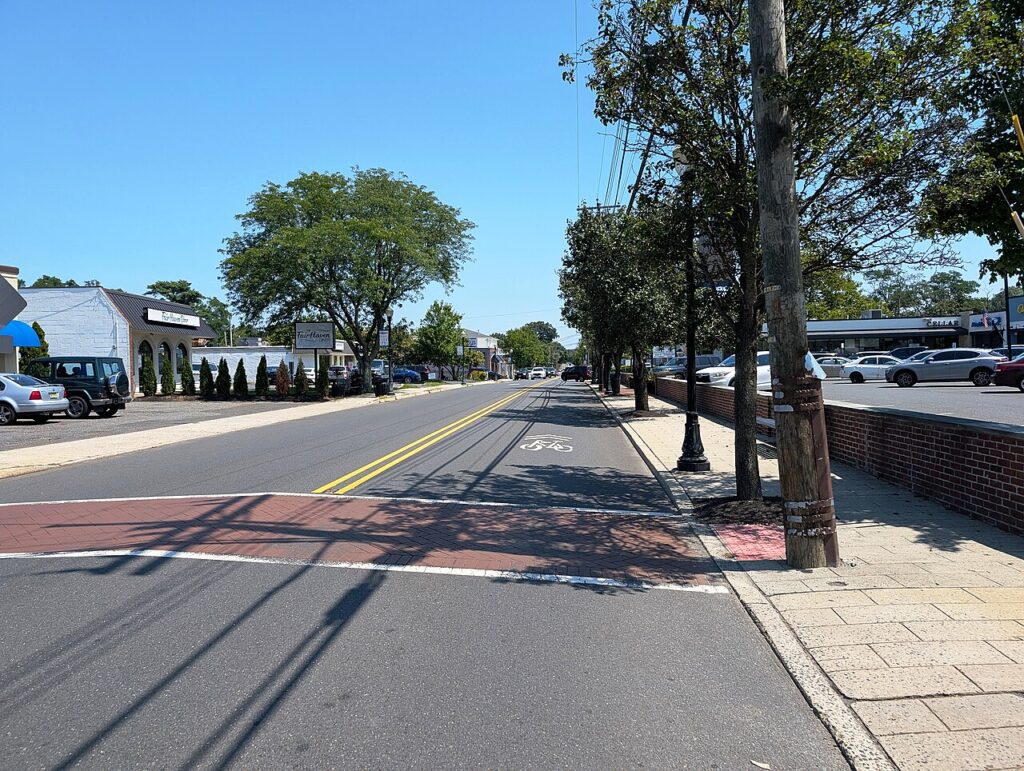
River Road in Fair Haven NJ with leafy street trees on both sides of the pavement, a sidewalk, overhead wires, shops and parked cars under a clear blue sky
River Road (Monmouth County Route 10) in Fair Haven, August 2025, with street trees on both sides. Photo: Mr. Matté, CC BY-SA 4.0, via Wikimedia Commons.

The photograph above shows River Road in the business district, with street trees on both sides of the pavement, overhead wires, and a sidewalk only a few steps from the trunks. That one view explains why removal here is a careful decision. A tree beside a road like this is part of the streetscape, and it also stands close to wires, curbs, parked cars, and storefronts. The borough form treats street trees differently from other trees, so where the trunk stands is the first fact to settle.

The Community Forestry Management Plan says an inventory completed by Arbor Pro in 2024 counted 2,636 street and park trees, and it describes a 38 acre natural area with 7 miles of trails and the old oaks at McCarter Park. That is a lot of public wood, and it explains why the borough cares about every removal. The commission also posted a Big Trees of Fair Haven list in May 2026. Our guide to tree removal permits covers the general process, and our look at weak tree roots explains the ground level signs that often lead to a removal request.

A Permit Is Required for Any Tree 6 Inches Across

The borough’s tree removal application is direct about the threshold. Any person who wants to remove a tree 6 inches or larger in diameter at breast height must receive permission first, and the figure drops to 2.5 inches for street trees. The form adds that no tree may be removed until municipal officials have reviewed and approved the application and issued a permit. Tree removal in Fair Haven is therefore a paperwork step first and a field step second.

The application asks for the owner’s name, the block and lot, and whether the owner has a pending zoning or planning application with the borough. It also asks for the number of trees requested, with the species, diameter, location, and reason for each, and it carries a $50 application fee. A property survey sketch is required with the trees marked on it, and the trees under consideration must be identified with tape or colored marking material when the form is submitted so the reviewer can find them.

Review comes from the borough’s Licensed Tree Expert, who looks at the trees and the property, and Borough Hall contacts the applicant with the determination within 21 days. The office section of the form also shows a $25 fee when an inspection is required. That timeline is worth knowing in late fall, because a request filed now has a clear review window before the first winter storm tests a weak tree.

Larger jobs have a second layer. The form defines a Large Scale Tree Removal as more than five trees on a lot or a reduction of the canopy by more than 20 percent, and it requires a Large Scale Tree Removal Report along with certified letters to the immediately abutting property owners. That matters for screening trees along a long lot, where several removals added together can cross the line even though no single tree looks large.

The form also reminds owners to call 811 for mark outs before any digging, and it says tree work must be performed by registered tree care businesses in good standing with the state, with a current tree removal registration on file with the borough. Owners can check a contractor’s state license in the Licensee Directory described on the Board of Tree Experts licensing page. That page explains that Licensed Tree Care Operators perform pruning, removal, and stump grinding, while Licensed Tree Experts handle consulting, diagnosis, and cabling and bracing.

Mike Hufnagel puts the working rule this way: “A permit does not slow down a good removal. It puts the diameter, the reason, and the location on paper, and that is the same record we want in hand before anyone starts a saw.” That keeps the visit focused on facts rather than on how large or old a tree looks from the street.

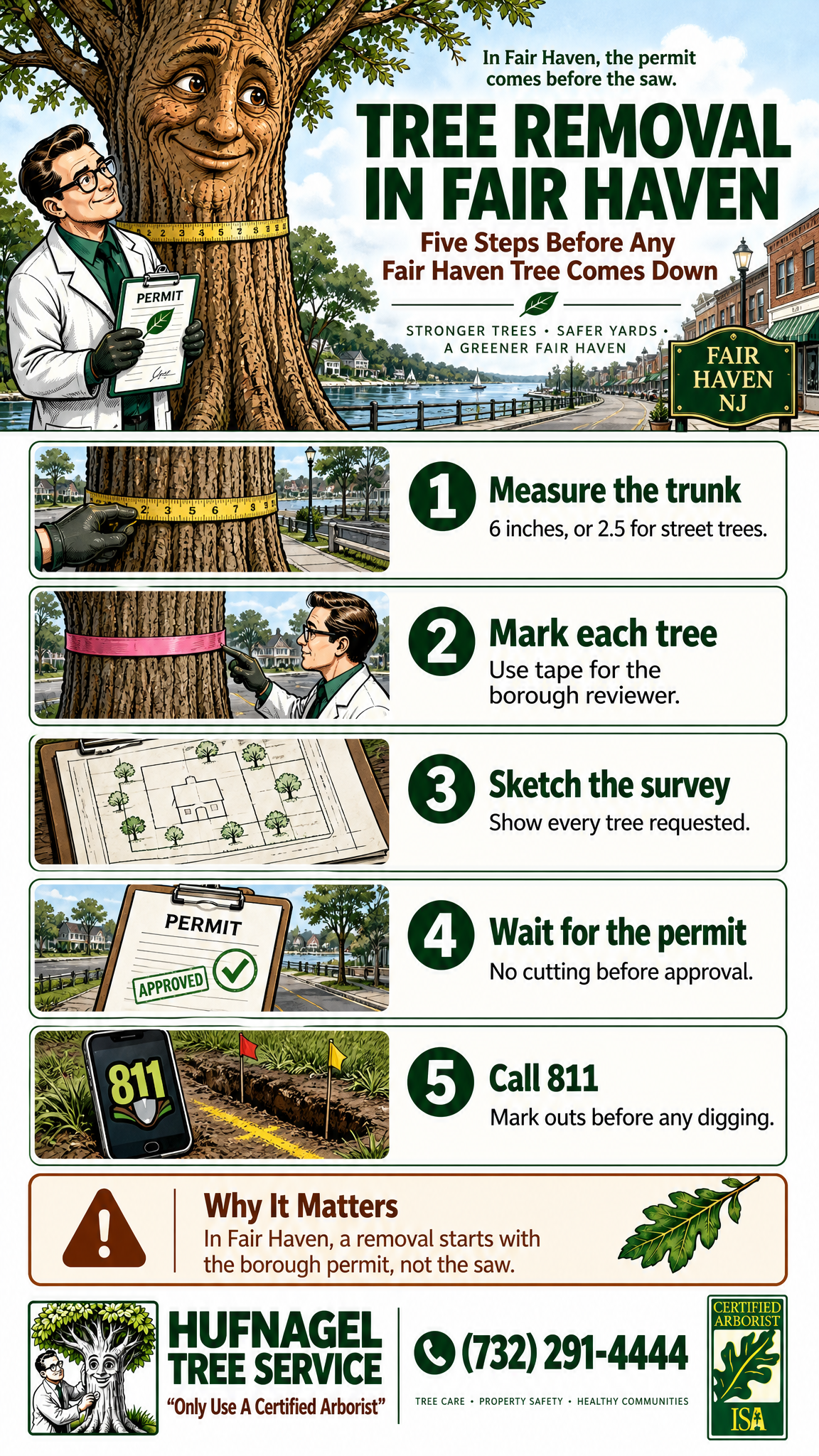
Five Steps Before Any Fair Haven Tree Comes Down

  • Measure the trunk at breast height and note whether the tree is a street tree.
  • Mark each tree with tape or colored marking material for the borough reviewer.
  • Sketch the lot on a property survey and show every tree requested for removal.
  • Wait for the written permit from Borough Hall before any cutting begins.
  • Call 811 for mark outs before any stump work or digging near the tree.

Each step is small, and together they keep a removal from turning into a violation. A clean application also gives the reviewer what is needed to answer within the borough’s window instead of asking for more. Once a permit is moving, the next question is whether the tree is a hazard, because that finding changes what the borough asks for in return.

The Borough’s Licensed Tree Expert Decides What Counts as a Hazard Tree

The application states that hazard tree determination is made solely by Fair Haven’s designated Licensed Tree Expert, and that hazard trees may be removed with no replacement fee or replacement requirement. That means an owner’s opinion, a neighbor’s opinion, or a contractor’s opinion does not settle the question. The best preparation is clear evidence at the review, such as dated photographs, a plain description of the defect, and a written recommendation from the person who examined the tree. The form has a line for the contractor’s recommendation and a Tree Expert signature, so that record has a place to go.

In our work a hazard is a tree with a defect, a target, and a realistic path to failure. A large dead limb over a roof, a trunk crack above a driveway, or a lean that is new after heavy rain all fit that description, while a sound tree that is simply large does not. Our guide to codominant stems explains why two stems of equal size can press together and leave included bark at the union, which is a common point of failure under wind and wet snow.

The borough’s own plan shows what to watch for in local species. It says Norway maple makes up about 9 percent of the inventoried trees, that the species historically begins to decline at about 60 years of age, and that 18.88 percent of the Norway maples in the inventory were rated poor, dead, or critical. The plan flags the red oak side of the oak family for monitoring and recommends white oak, swamp white oak, and bur oak as more resistant replacements.

Ash is a smaller part of the picture. The plan says there were only three green ash in the inventory, that emerald ash borer is probably present, and that these trees should be scheduled for removal before they deteriorate to the point where removal is difficult and riskier for crews. The same logic applies on a private lot. A dead or dying tree gets harder and more dangerous to take down with every season, which is a reason to act while the structure is still sound enough to climb or rig.

A full crown can hide trouble. A tree can show good leaf color in summer while decay works inside the trunk, and a bare late fall canopy lets us follow each limb back to its union and see dead wood that foliage covered. Our tree risk evaluation work records the defect, the target beneath it, and the weather the tree is likely to face, and our tree health management service looks at why a tree is declining before anyone decides to remove it.

No tree service can honestly promise that a tree will never fail in severe weather, and a hazard finding is not a prediction of the next storm. It is a documented reason to act on a specific tree. That written finding supports the permit request, can support the waiver of replacement for a true hazard, and gives the owner something firm to show the borough, a neighbor, or an insurer if questions come up later.

Five Signs a Fair Haven Tree May Qualify as a Hazard

  • Large dead branches or a mostly dead crown over a roof, driveway, or sidewalk.
  • Cracks, splits, or included bark where two stems of equal size meet.
  • Mushrooms, cavities, or soft wood at the base or along main limbs.
  • Soil cracks, heaving, or a new lean after wind or heavy rain.
  • A declining species near the end of its usual life span, such as an older Norway maple.

None of these signs means a tree has to come down. Each one tells us where to look more closely and which of the four outcomes is likely to fit, which are pruning, restoration, monitoring, or removal. When removal is the right answer, the next part of the plan is what goes back in the ground.
Replacement Trees and Penalties Keep the Canopy Whole

For trees that are not hazards, the office section of the application shows either a replacement requirement with a due date or a replacement fee assessed under the borough’s Table A, paid into the Shade Tree Trust Reserve Fund. Hazard trees are exempt from both, as noted above. The structure is simple. A healthy tree that leaves a lot is expected to be replaced, or the owner pays toward replanting elsewhere in the borough.

The penalties explain why the paperwork matters. The application says Ordinance 2025-16 amended the penalty schedule, and the ordinance text states that a violation brings a mandatory court appearance. Schedule B scales with the diameter of the tree that was removed or destroyed. The violator may pay a fine and provide replacement trees, or in the alternative pay a double fine, and any money collected goes into the Shade Tree Trust Reserve Fund for tree maintenance and replacement.

Replacement is also a stated goal of the borough’s plan, which aims for a net gain in trees planted over trees removed and to plant a replacement for every tree removed as a priority in the inventory. The plan notes that Norway maple and Callery pear have become too common in Fair Haven and says they will be replaced by native shade trees. The commission’s resident tree buying program, started in 2023, has added more than 200 trees to residents’ yards, according to the plan.

The commission’s page reports that children at Sickles School and the commission planted two Salem white oaks at McCarter Park in honor of Arbor Day, and it links a recommended tree list for planting in Fair Haven. That list is the right place to start when a permit comes with a replacement requirement. It keeps the choice local, and it helps an owner avoid trading one declining species for another.

Planting the right tree in the right place matters as much as planting one. During an evaluation we note where overhead wires, a foundation, a driveway, or a shared fence line will limit the next tree, and we point out where a stump and root zone will affect new planting. Our restoration and tree storm proofing work show how care for a surviving tree can reduce the odds of another removal later. Our tree trimming and pruning service handles the pruning that keeps mature trees from becoming hazards in the first place.

Stump removal is its own decision once the trunk is down. A stump can be ground below the surface so grass or a new tree can take its place, and the grinding depth, the spread of the old roots, and any buried utility lines all affect what can be planted nearby. That is another reason the 811 call comes before the work and not after it, and it is a good question to settle with the contractor before the permit is submitted.

Late fall and winter suit this kind of planning. The ground is workable, the canopy is bare, and the borough’s review window gives a request filed now time to clear before spring planting. Our storm season tree risk assessment guide explains how to keep a dated record of each tree, which makes the next permit request faster and the next decision simpler.

Five Things to Gather Before You Apply for a Tree Removal Permit

  • Photographs of each tree from several sides, including the base and any defect.
  • The species, trunk diameter, and location of every tree on your list.
  • A property survey with each tree marked on it.
  • The reason for removal in plain words, with any written recommendation from a tree expert.
  • The name and state license of the contractor who will do the work.

With these five items in hand, an application is quick to complete and easy to review. They also protect good trees, because a clear record lets an owner say no to unnecessary work with confidence and yes to the work that cannot wait.

Call Hufnagel Tree Service for Tree Removal in Fair Haven Before Winter Weather

If you have mature trees near your Fair Haven home, driveway, or River Road lot, schedule an evaluation before winter storms arrive. We provide tree risk evaluation, tree health management, tree trimming and pruning, restoration, and tree removal when a tree cannot be managed safely.

Hufnagel Tree Service is led by a certified arborist with almost 30 years of local experience and more than 280 five star Google Maps reviews. We inspect first, explain what we found in plain terms, and recommend only the work that changes the outcome for your trees and your property.

Call or text (732) 291-4444 to schedule tree removal in Fair Haven or a risk evaluation before the next Nor’easter arrives. Our Fair Haven tree articles list more local guidance.

Schedule Service Now!

From precision pruning and safe removals to health assessments and preventative care, Hufnagel Tree Service delivers expert solutions backed by decades of experience. We offer certified insight, fair pricing, and a commitment to doing what’s best for your landscape.

Where Do You Need Service?
Please Enter Your Contact Information
Are You A New or Existing Customer?
How Can We Help You?

Thank You!

Your Message Has Been Sent

We Will Contact You About Your Inquiry Shortly.

We Could Not Find A Direct Link To A Tree Removal Permit Application For The Town You Selected.

Please contact your local municipality to determine if a permit is required for your tree removal project. They will provide you with the most accurate and up-to-date information.