Tree Restoration in Aberdeen NJ: Bay Winds, Old Wounds, and Wires

Aberdeen’s trees stand beside Route 34, overhead wires, and the Raritan Bay shore. Learn what decides whether a damaged tree can be restored before winter.
Share This Article

Contents

Tree Restoration in Aberdeen Begins With a Township Split in Two

Aberdeen Township is made of two separate sections divided by Route 79, with a stretch of Matawan between them, according to Wikipedia. Together they cover 7.77 square miles, about 30 percent of it water, and counted 19,329 residents in 2020. The Garden State Parkway crosses the township at exit 118, Route 35 runs through the north, and Route 34 runs through the south, so a great many of its trees stand beside busy roads.

That mix of highways, creeks, and older neighborhoods is why tree restoration in Aberdeen is rarely one job. Strathmore, Freneau, Oakshades, Cliffwood, Cliffwood Beach, River Gardens, and Woodfield each have different lots, different exposure, and different trees. Our tree restoration service is built around one idea, which is that a damaged or declining tree deserves a fair chance before anyone talks about removal.

After almost 30 years working throughout Monmouth County, we have seen that late fall is the right time to make that call. Many crowns are still readable, the roots are still active, and winter has not yet added snow and ice to every weak limb. A tree that is judged now can be corrected now, and a tree that cannot be saved can be handled on a calm day instead of during a storm.

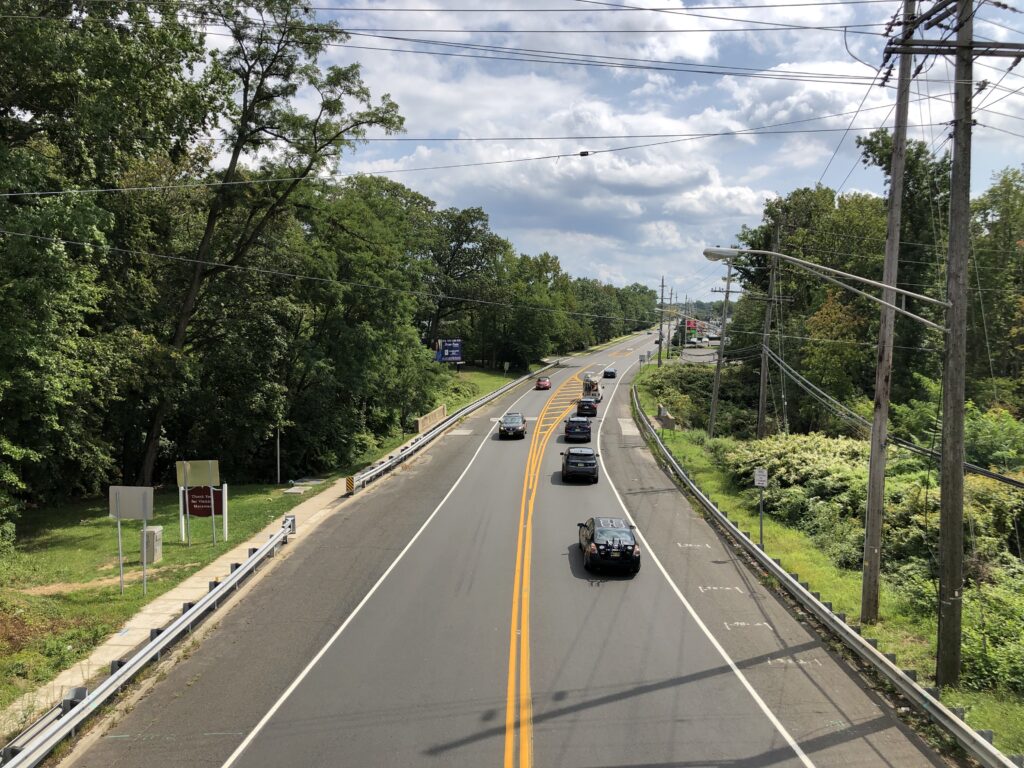
Route 34 in Aberdeen NJ seen from the Henry Hudson Trail overpass, with mature trees on both sides of the road and overhead wires along the shoulder
Mature trees and overhead wires along Route 34 at the Aberdeen and Matawan border, seen from the Henry Hudson Trail overpass. Photo: Famartin, CC BY-SA 4.0, via Wikimedia Commons.

The photograph above shows Route 34 near the border of Aberdeen and Matawan, seen from the overpass for the Henry Hudson Trail. Mature trees line both sides of the road, and overhead wires run along the shoulder beside them. A tree in that strip has little room for its roots and crown, so any injury to it has an immediate neighbor in the form of a road, a pole, or a roof.

The same township has a very different edge. Aberdeen’s shoreline faces Raritan Bay, and Wikipedia records that hurricanes between 1954 and 1955 destroyed the beachfront boardwalk and amusements at Cliffwood Beach. The township website also lists Matawan Creek and Mohingson Creek among its waters. Trees near open water meet wind and wet ground in a way that inland trees do not, and we weigh that exposure whenever we judge what a damaged tree can still carry.

Tree Restoration in Aberdeen Starts With What Is Still Sound

Restoration starts with an honest question: what is still sound? Colorado State University Extension, in its guide to pruning mature shade trees, lists the removal of dead or diseased wood and the management of water sprouts among the acceptable reasons to prune a mature tree. It also advises waiting until the roots and crown stabilize before correcting a storm damaged tree. We follow that order. A damaged tree gets a safety review first, and the larger decisions follow once the tree shows what it can still do.

We read the tree from the bottom up. We start at the root flare and the soil around it, looking for heaved ground, cracks, fungus, or fresh movement. We move up the trunk to old wounds, cavities, and bark that has begun to separate, then to every union where large stems meet, because narrow unions with included bark are where weather does the most harm. Only after that do we look at the crown, since broken tips and torn limbs are the part of the problem that homeowners can already see.

Overhead wires change the plan. FirstEnergy states on its tree and vegetation page that trees are a leading cause of electrical outages and that contact between trees and lines is very dangerous. A JCP&L release on its trimming program adds that trimming on its own corridors follows a four year cycle and that 86 percent of tree related outages in 2023 came from trees outside those corridors. A limb that is already near a service line is not a do it yourself project. Photograph it, stay well back, and report it to the utility.

Roofs and walkways are the next targets. Homes from Strathmore and Freneau to Cliffwood and River Gardens sit close to mature trees, and a limb that overhangs a roof carries more than its own weight when rain, wet leaves, or snow collect on it. A limb over a driveway or sidewalk is judged the same way. We measure what each defect could reach, because the target decides how urgent the work is and how much of the tree we are willing to remove.

Species and history matter as well. Trees along Route 34 or Route 35 often carry old utility cuts, uneven growth toward the road, or crowded crowns from decades of competition. Those histories tell us how a tree is likely to answer new work. A tree that has already produced weak sprouts after a poor cut cannot be asked to do it again. We would rather leave a defect under observation than add a second wound to a tree that is already working to close the first. Our tree risk evaluation sorts those cases.

Mike Hufnagel puts it simply: “A damaged tree is not a lost tree until the wood tells us it is. We look at what is holding the tree up first, and only then decide how much of the crown we are allowed to touch.” That order keeps the work honest. It keeps us from removing a tree that still has a dependable structure, and it keeps us from keeping one that does not.

What Decides Whether a Damaged Aberdeen Tree Can Be Restored

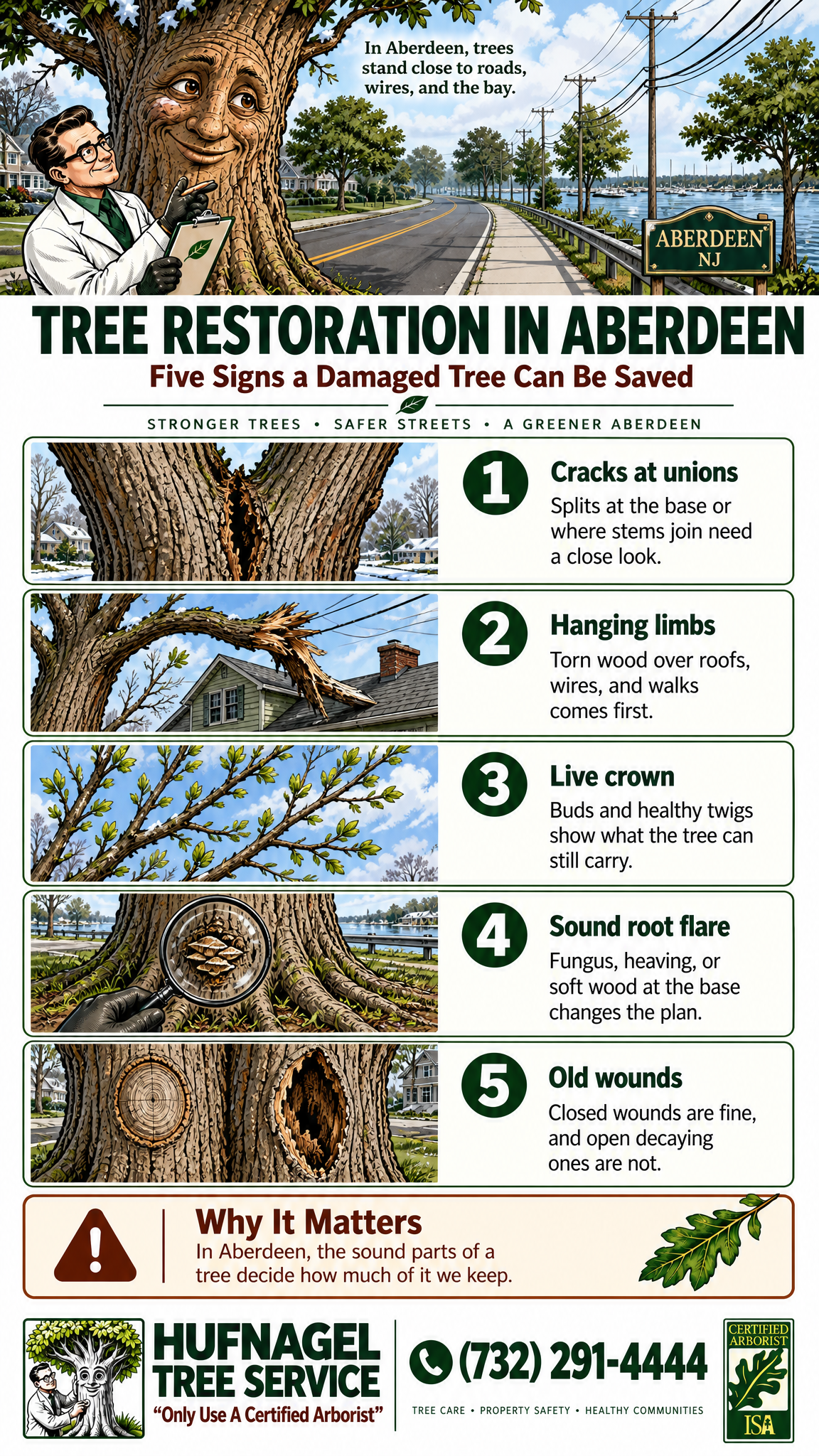
  • Cracks or splits at the base of the trunk or where main stems join.
  • Torn or hanging limbs still attached over roofs, wires, driveways, and walkways.
  • Live buds and healthy twigs across most of the crown.
  • Sound wood at the root flare, without fungus, heaving, or soft spots.
  • Old wounds that have closed well, compared with ones still open and decaying.

No single item on that list decides the outcome. We weigh them together, and the answer is usually some mix of pruning, restoration, monitoring, or removal. A heavy limb on a narrow union is the case described in our guide to codominant stems, and it often changes the plan on its own. Once we know which trees are worth keeping, the next question is how the cuts are made, because the method decides how well the tree answers them.

Restoration Cuts Remove Little and Respect the Branch Collar

The same Colorado State guide gives clear limits. It says that ideally all pruning cuts are made on branches two inches or less in diameter, and that a maximum of 10 percent of a mature tree’s foliage should be removed during each pruning cycle. Homeowners are often surprised by that number, because they picture a restoration as a visible haircut. For most mature trees, good tree restoration in Aberdeen is hard to see from the street. The crown still looks like a shade tree, and the hanging limb over the roof is gone.

Placement is the second part. The guide warns against cutting into the branch collar, the swollen ring where a branch meets the trunk, because that gives decay an easier path into the trunk. A cut made just outside the collar leaves the tree’s own tissue to deal with the wound. We remove large limbs in stages so that their weight does not tear bark down the trunk, which is why a job near a roof or a wire often involves ropes, a lift, or both.

Topping is the third part, and we name it only to reject it. The guide defines topping as the arbitrary shortening of a tree’s branches or trunks and treats it as something to avoid. A tree that feels too tall beside the house is not fixed by cutting it to stubs. When a crown truly has to be smaller, a measured reduction back to a suitable lateral serves the structure better. A tall tree is not automatically a problem. A tree with a defect over a target is, and that is what our tree trimming and pruning is designed to address.

Soil and water are the quiet side of restoration. A tree that has lost limbs has less foliage to feed its roots, and a tree beside paving or a road has less ground to draw from. We look at compaction, drainage, and mulch at the base, and we correct what can be corrected without disturbing the roots. Fine feeder roots live near the surface, so a light hand does more good than any machine on a root zone that is already stressed.

Timing in late fall is practical. Many leaves have dropped or are dropping, so the branching structure, cracks, and dead tips are easier to see, and the work can be planned against a clear view of the tree. A tree that lost limbs in a recent storm may need a first safety cut now and a second look in the dormant season, rather than a full correction in one visit. Waiting for the tree to stabilize, as the extension guide advises, is part of the method and not a delay.

Record keeping ties the work together. We photograph cracks, tears, and dead tips so they can be compared with what we see after the next storm. A crack that has not changed is a very different finding from one that has opened by a few millimeters. That comparison is often what lets us keep a tree, because it replaces a guess with a trend, and it is the reason our crews note where each cut was made and why.

How We Tell Good Restoration Work From a Poor Cut

  • Cuts made just outside the branch collar, never flush to the trunk.
  • Most cuts made on branches two inches or less in diameter.
  • A crown that still has the natural shape of the species.
  • Dead and hanging wood gone, with healthy structure left in place.
  • No topping, no stubs, and no interior stripped of its branches.

A job that passes those tests leaves a tree that is easier to read next year, and that matters because trees change from season to season. The record we keep lets us choose between pruning, restoration, monitoring, or removal later, and it connects to our guide on weak tree roots for the trees whose problems begin below ground. The next step is the ground around the tree, the property line, and the way the township handles what comes down.

Wooded Edges, Bay Exposure, and Township Rules Shape the Plan

Aberdeen is not only roads and rooftops. The Monmouth County Park System’s Henry Hudson Trail page describes a paved, 10 foot wide trail on a former railroad right of way, and its northern section begins at the Aberdeen and Keyport border at Lloyd Road and Clark Street. Properties that back onto a trail, a creek, or a wooded lot have a different tree problem from a house on Route 34. The nearest large tree is often at the property line, where it leans toward open space and overhangs a fence, a shed, or a neighbor’s roof.

Trees on a property line raise a practical question: who is responsible for which limb? We do not give legal advice, but we do write down where a defect sits and what it can reach, because that record helps neighbors talk about the work. Removal has its own rules, and we explain them in our guide to tree removal permits. Our earlier article on fall tree inspection in Aberdeen covers the inspection side of the same question.

Disposal is the other practical side. The township’s trash and recycling page lists the Public Works Garage at 147 Lenox Road in Cliffwood Beach, open Monday through Saturday from 7 am to 3 pm to Aberdeen residents only, with IDs checked. Brush is among the items it accepts. The page posts the seasonal brush and leaf pickup schedules as images, so residents should read the current schedule there, or contact Public Works through the township, before putting anything at the curb.

Bay exposure is the third piece. Cliffwood Beach had 3,036 residents at the 2020 census, according to Wikipedia, and it faces Raritan Bay. The same article notes that Aberdeen opened Veterans Park there in 2017, with a picnic grove, playgrounds, and fields. Trees at bayfront parks and yards take more wind than trees farther inland, so we look hard at crown balance and unions there before winter. Our storm proofing work often follows a restoration for exactly that reason.

Health comes before shape. A tree that is stressed by compacted soil, root damage, or pests will not recover simply because its limbs were corrected, so we pair restoration with the checks in our tree health management service. Where a tree cannot be managed safely, because the base is decayed or the roots are moving, removal is risk reduction and not a failure of care. We say so plainly and explain what we found, including when a tree is better kept than cut.

Planning the work in order keeps the visit focused. Hazards come first, structure second, and shape last. Wires and dead limbs over targets are handled before anything cosmetic, and the correction that matters most is made before the one that looks best. That order is also why a single visit can cover a Route 34 shade tree, a creek side maple, and the hedge by the driveway, with none of the cuts being arbitrary.

Questions a Good Restoration Plan Answers for an Aberdeen Property

  • Which limbs sit closest to wires, roofs, and neighboring property lines.
  • Which dead or hanging branches should come out first this fall.
  • How much live crown can stay in place to keep the tree balanced.
  • Where the brush will go, using the township rules for drop off.
  • Which trees should be looked at again after the first winter storm.

Those five answers turn a general worry into a short list that a homeowner can follow. A plan like that also makes it easier to tell what can wait. Some trees need only monitoring. Others need targeted pruning, restoration, support, or removal. When the list is clear, the work can be scheduled before the weather decides the order, and the owner knows why each step comes when it does. Our tree removal service is the last option on that list, never the first.
Call Hufnagel Tree Service About Tree Restoration in Aberdeen Before Winter

If you have mature trees near your Aberdeen home, driveway, creek side lot, or property line, schedule an evaluation before winter weather adds load. We provide tree restoration, tree trimming and pruning, tree risk evaluations, storm proofing, and removal when a tree cannot be managed safely.

Hufnagel Tree Service is led by a certified arborist with almost 30 years of local experience and more than 280 five star Google Maps reviews. We inspect first, explain what we found in plain terms, and recommend only the work that changes the outcome for your trees and your property.

Call or text (732) 291-4444 to schedule tree restoration in Aberdeen before the next coastal storm arrives.

Schedule Service Now!

From precision pruning and safe removals to health assessments and preventative care, Hufnagel Tree Service delivers expert solutions backed by decades of experience. We offer certified insight, fair pricing, and a commitment to doing what’s best for your landscape.

Where Do You Need Service?
Please Enter Your Contact Information
Are You A New or Existing Customer?
How Can We Help You?

Thank You!

Your Message Has Been Sent

We Will Contact You About Your Inquiry Shortly.

We Could Not Find A Direct Link To A Tree Removal Permit Application For The Town You Selected.

Please contact your local municipality to determine if a permit is required for your tree removal project. They will provide you with the most accurate and up-to-date information.