Contents
Codominant Stems in Tinton Falls Hide in Plain Sight on Large, Wooded Lots
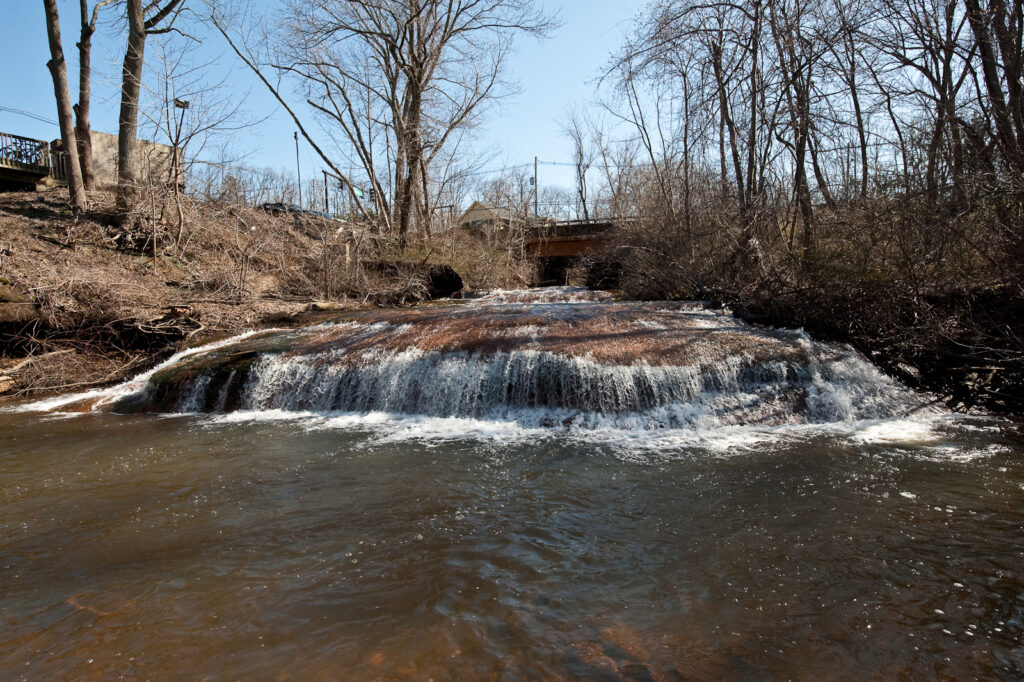
Tinton Falls covers 15.61 square miles in central Monmouth County and is still named for a waterfall. According to the borough history on Wikipedia, James Grover built an ironworks beside the river in the late 1600s, and in 1675 Colonel Lewis Morris bought a half interest in it and assembled 3,540 acres he called Tintern Manor. The falls were about 30 feet high then, and erosion and the loss of a dam have reduced them since. The community was incorporated as New Shrewsbury in 1950, took the name Tinton Falls in 1975, and counted 19,181 residents in the 2020 census.
That size changes how we think about codominant stems in Tinton Falls. The Garden State Parkway, Route 18, Route 33, and Route 66 cross the borough, and neighborhoods such as Pine Brook, Wayside, Green Grove, Hockhockson, and West Shrewsbury sit inside it, so a single borough holds compact village lots, suburban streets, and large properties with mature trees. Any of those trees can have two main stems of nearly equal size, and the place where they join is often the weakest point in the whole tree. Our tree risk evaluation looks at that union before it looks at almost anything else.
After almost 30 years working throughout Monmouth County, we have seen that a codominant union rarely looks dangerous from the driveway. The tree is full, the leaves are still on, and the fork has held through many storms. What changes is the load. Fall is a good time to look, while the leaves still help us read the crown, and before winter wind, wet snow, and ice add weight to a seam that may already be opening.
The same ground that makes Tinton Falls varied also makes it wooded. Monmouth County Park System describes Shark River Park, which opened in 1961 and reaches into Tinton Falls, Neptune, and Wall, as a place where trail visitors see pine and oak forest alongside wetlands and floodplain, with about 7.5 miles of trails. The borough keeps a list of approved shade trees that runs from sweetbay and flowering dogwood to white oak, red oak, scarlet oak, red maple, black cherry, tuliptree, and American sycamore. Large oaks and maples are the trees that most often show us a seam where two big stems meet.
A fork like that does not announce itself. Two stems can grow side by side for decades and carry a full crown, and the weakness only shows when wind or weight pulls them apart. We look for it in the fall for a practical reason: the next few months bring storms, wet snow, and ice, and the time to find a weak union is before the weather finds it for us.
A Codominant Union Fails Because of What Is Missing Inside It
A codominant stem is one of two or more stems of about the same size that grow from the same point on a tree. The Purdue Extension bulletin on large tree cabling and bracing calls the presence of one or more codominant stems the most common risk of tree failure. It also explains why. A codominant fork, which it describes as a V crotch branch union, is structurally weak compared with a single stem, because there is a lack of connective tissue anchoring the stem to the trunk and there is included bark between the stems.
Included bark is the part homeowners cannot see. When two stems grow tightly together, bark can become pinched into the seam between them, and bark does not knit with wood the way a normal branch collar does. The union looks solid from the street, but the two stems are not truly joined at the point where they meet. Purdue adds that the longer the codominant stems, the greater the likelihood of failure, especially on larger trees. A young fork and a fifty year old fork are not the same problem.
The International Society of Arboriculture says the same thing in plain terms in its brochure on recognizing tree risk. It lists codominant stems, which it also calls a split trunk, as a defect that can often be a failure point, and it notes that multiple branch attachments at one point on a stem can also be considered a defect. The same brochure asks homeowners whether there are cracks or splits in the trunk or where branches are attached. A seam that has started to open is exactly what that question is meant to catch.
Not every fork is a defect, and we try to be honest about that. Many healthy trees have more than one stem, and a clump of birch or a multi stem ornamental can be perfectly sound. What matters is how the stems join, how long they are, whether bark is trapped between them, and what stands underneath. A defect that is low concern in the middle of a field can be a serious one over a roof, a driveway, or a play area. That is why our guide to codominant stems and multi stem trees begins with the target and not with the tree alone.
Tinton Falls gives homeowners a second reason to pay attention to structure. The borough Shade Tree Commission, which the commission page describes as an advisory board of five volunteers appointed by the Mayor, recommends how to plant and care for shade trees, ornamental trees, and shrubbery on borough property and along local roads, and it advises residents on plantings on their own property. A tree chosen well and pruned early rarely develops a bad fork. The trees we see with serious unions are usually older ones that were never guided when they were young.
Mike Hufnagel puts the working rule this way: “Two stems of the same size are not a defect by themselves. The defect is the seam between them, and we want to know what is inside that seam before the weather tests it.” That is a rule for looking and not a diagnosis. It keeps us from condemning a good multi stem tree, and it keeps us from ignoring a fork that has been quietly splitting for years.
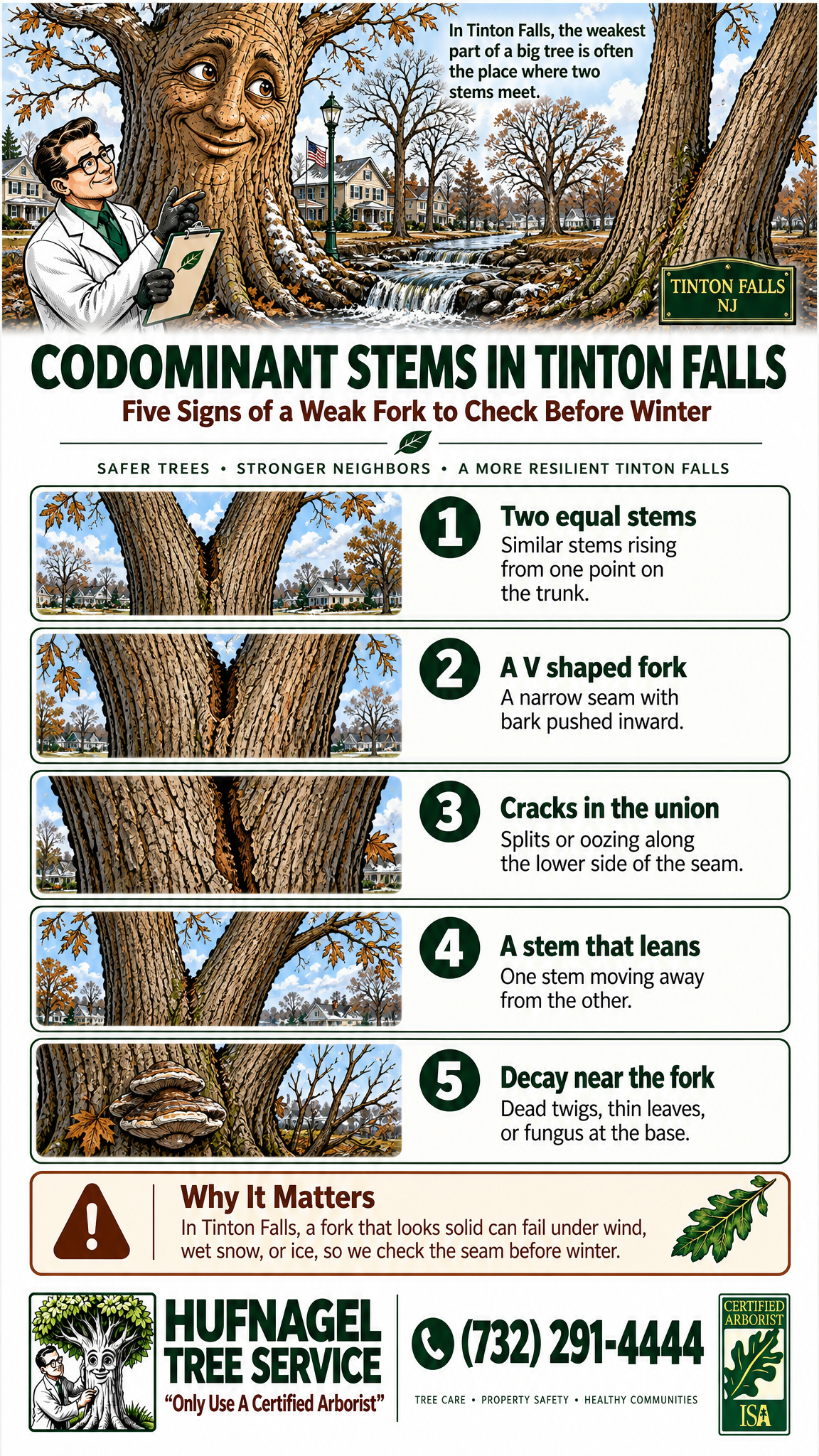
Five Signs of Codominant Stems in Tinton Falls to Check Before Winter
- Two upright stems of similar thickness that rise from a single point on the trunk.
- A narrow, V shaped fork with a dark seam or a ridge of bark pushed inward.
- Cracks, splits, or oozing along the union, especially on the lower side.
- A fork where one stem has started to lean away from the other.
- Dead twigs, thinning leaves, or fungal growth near the base of one stem.
Any one of these signs is a reason to look more closely and not a reason to panic. A seam can look dramatic and still be stable, and a quiet fork can hide decay. What matters is change, so we ask homeowners to photograph the fork from the same spot each season and note the date. A series of photographs tells us more than a single visit can. Once the structure is understood, the next question is how weather puts that structure to work.
Weather Finds the Weak Union, and the Failure Is Rarely Small
Weather does not break a sound tree. It finds the part that was already weak. Purdue notes that overextended limbs, meaning unusually long, heavy, or far outstretched limbs with most of the foliage at the end, often break where the branch meets the stem, and that these failures usually occur when a branch is under a heavy load of wind, snow, or ice. A codominant fork that carries two heavy crowns is under the same kind of load, because each stem acts as a lever on the seam between them.
That is why fall matters. Wind that moves a crown back and forth works on a fork a little more each season, and wet snow or ice can add far more weight than the stems carried in August. The first sign is often small. A hairline crack along the seam, a lip of bark that has been pushed outward, or a fresh scar where a stem rubbed its neighbor can all mark a union that has begun to move. After a storm, the tree may look the same from the street while the seam has changed.
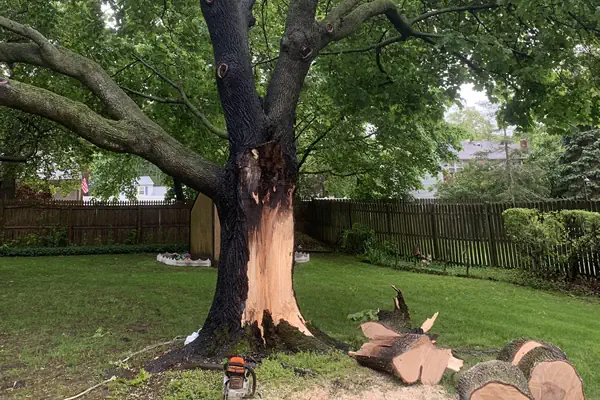
The failure itself is usually sudden and it is rarely small. When a codominant union lets go, one whole stem can peel away from the other, taking half of the crown with it. The tree in the photograph for this section has a trunk that has opened along its length beneath a fork, with cut sections lying on the lawn beside it. We cannot tell from the frame what caused that damage, and we do not guess, but it shows how much wood can be involved when a trunk splits. Whatever stands beneath a tree like that, whether a roof, a patio, a fence, or a driveway, is what the risk assessment is really about.
The ISA brochure ties this to decay and to history. Among its warning signs are cavities or rotten wood along the trunk or in major branches, mushrooms at the base, and whether a tree has been topped or heavily pruned. A tree that was topped years ago often grows several vigorous stems from one cut, and those stems can form unions that are weaker than anything the tree grew naturally. We never top a tree, and we do not thin a crown as a blanket answer to wind. Our storm proofing work starts by finding the specific union that worries us.
Roots matter here too. A tall crown with two heavy stems is a long lever on the roots, and soil that stays soft after heavy rain gives that lever more room to work. Our guide to weak tree roots explains the ground level signs, and our article on hidden tree rot explains why a fork that looks sound can hide decay inside. When both a weak union and a weak root plate are present, the tree has less margin than either problem alone would suggest.
We also pay attention to what stands below the crown, because location decides how seriously we treat a finding. On a large property in Tinton Falls, a fork in a tree at the back of a woodlot may only need monitoring. The same fork over a driveway, a play set, a pool deck, or a neighbor’s fence is a different problem, even though the tree is identical. Size of the property does not reduce risk when a target is underneath. The question we ask is what the tree could reach if it let go.
What Weather Adds to a Weak Fork Before and During Winter
- Wind that moves two heavy crowns against each other and works the seam.
- Wet snow or ice that adds weight to the ends of both stems.
- Saturated soil that lets the whole tree move more at its base.
- Old wounds or topping cuts that left several weak stems on one trunk.
- Decay or fungal growth inside the seam that no one can see from below.
None of these forces is a reason to fear every fork. They are reasons to look at forks before the weather arrives, not after. A seam that has been checked and either monitored or supported can come through winter without drama. A seam that no one has looked at is the one that surprises people, and the surprise tends to land on a roof or a vehicle. That is why we move from finding the weakness to deciding what to do about it, and in Tinton Falls that decision involves both the tree and the borough code.
Support, Pruning, or Removal Depends on the Union and on Borough Rules
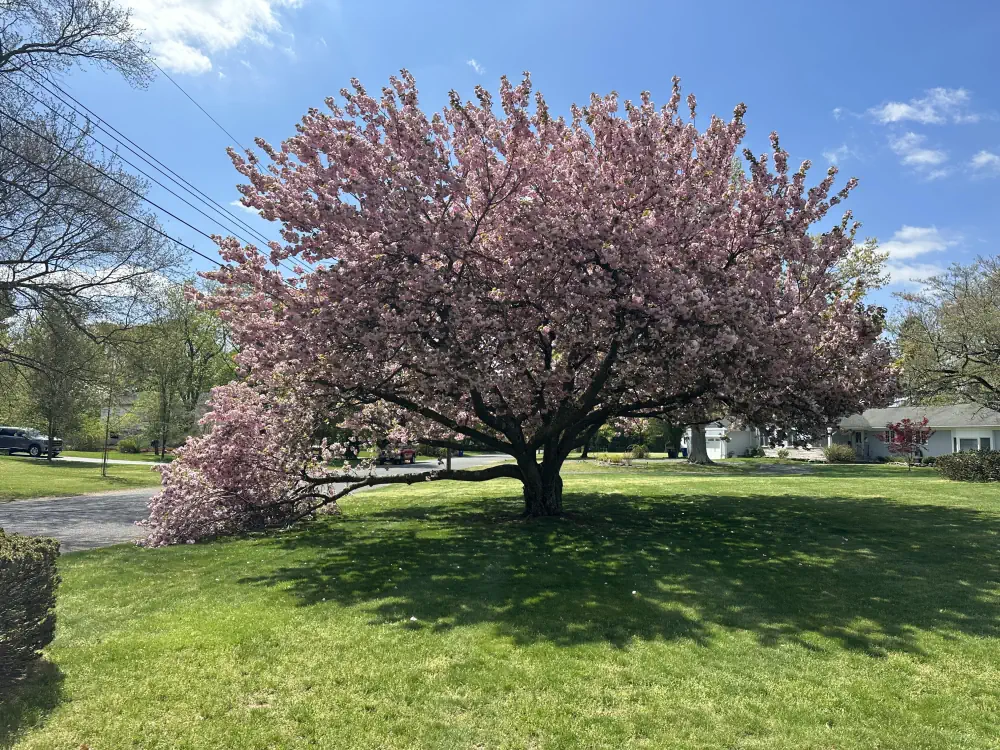
Once a weak fork is found, the options are narrower than most homeowners expect, and none of them is a guarantee. Purdue says the best solution is to avoid codominant stems by choosing plants with good branch structure, and that for a young tree with poor structure, one of the stems can be removed or subordinate pruned as early as possible so a dominant leader can develop. For older trees with poor branch structure, it says bracing or cabling may be the only option for strengthening the weak area. That is the reality for most of the mature oaks and maples we are asked to look at.
Support systems come in more than one form. Purdue describes cabling as flexible, extra high strength steel strand attached to bolts installed in the upper crown, which transfers weight from a weak union to a stronger one and limits how far a branch can move. It describes dynamic cabling as synthetic rope that avoids invasive drilling, and it describes brace rods as threaded rods installed through unions to give more rigid support. It also warns that not all risk can be mitigated by a support system and that not all trees can be reinforced. A qualified arborist has to decide whether a particular tree is eligible.
The same bulletin says that pruning is often an integral part of the process and should be completed before any installation, and that significant branches and even entire trees are needlessly removed when supplemental support may mitigate the defect. We agree with that approach, and it matches our preservation first habit. When a tree is sound apart from one weak union, we would much rather reduce the weight on that union and support it than remove a healthy tree. Our tree trimming and pruning work is built around cuts that have a reason, and our tree restoration work helps trees that were cut badly in the past.
Sometimes the honest answer is removal. If decay has consumed the seam, if the union has already split, or if the roots no longer hold the tree, then keeping it because it is mature is not a safe plan. When tree removal is the right call, we explain why in plain terms, and we tell the homeowner what the borough will want to see.
In Tinton Falls, that starts with Chapter 17 of the borough code. The chapter on tree removal and replacement makes it unlawful to remove a tree with a diameter at breast height of six inches or more, on any property in the borough, without a tree removal permit. The application goes to the Zoning Department, and for a single family lot the application fee is $25. The Zoning Officer or the Tree Specialist inspects within 30 days of a complete application, and the Zoning Officer approves or denies within 10 business days after that inspection. The borough zoning page lists tree removal among the improvements that need zoning approval, asks for a property survey showing the location and diameter of the trees, and tells residents to call the zoning office at (732) 542-3400, extension 238, before starting any work.
The chapter also explains what the Zoning Officer looks for. A permit can be approved when a tree is dead, diseased, injured, in danger of falling, too close to a structure, or interfering with utility service, among other criteria. Specimen and historic trees need approval from the governing body, with the Shade Tree Commission’s recommendations considered. Section 17-12 lets the Tree Specialist waive the requirements after an emergency such as a windstorm, ice storm, or flood, when a hazard has to be cleared quickly. We do not decide how the borough applies its code, and we always suggest that an owner confirm with the zoning office, but we do help owners document the condition of the tree so the facts are clear. Our article on tree removal permits explains how rules like these usually work.
Questions to Settle Before Any Tinton Falls Fork Is Cabled, Pruned, or Removed
- Whether the fork is sound enough to support with pruning, cabling, or bracing.
- Whether the tree is six inches or more across at breast height, which brings in the borough permit.
- Whether the tree is a specimen or historic tree, which needs governing body approval.
- Whether a survey showing the location and diameter of the tree is on hand.
- Whether a storm split tree needs urgent action under the emergency provision.
Settling those questions first protects both the tree and the owner. A homeowner who knows what the fork is doing, which rule applies, and which options exist can make a calm decision instead of a rushed one. The Shade Tree Commission meets on the first Wednesday of each month at 7:00 p.m. at the Crawford House, and the commission page lists Tree@tintonfalls.com for questions. With the structure understood and the paperwork clear, the plan can follow the season.
Call Hufnagel Tree Service About Codominant Stems in Tinton Falls Before Winter
If you have a mature tree near your Tinton Falls home, driveway, patio, or lot line, schedule an evaluation before winter storms arrive. We provide tree risk evaluations, tree health management, tree trimming and pruning, storm proofing, restoration, and tree removal when a tree cannot be managed safely.
Hufnagel Tree Service is led by a certified arborist with almost 30 years of local experience and more than 280 five star Google Maps reviews. We inspect first, explain what we found in plain terms, and recommend only the work that changes the outcome for your trees and your property.
Call or text (732) 291-4444 to schedule an inspection for codominant stems in Tinton Falls before the next winter storm arrives. More of our local work is collected in the Tinton Falls location archive.
Schedule Service Now!
From precision pruning and safe removals to health assessments and preventative care, Hufnagel Tree Service delivers expert solutions backed by decades of experience. We offer certified insight, fair pricing, and a commitment to doing what’s best for your landscape.
Learn More About Our Services

Related Articles
Tree Risk Evaluation Services Near Marlboro NJ

Winter Storm Proofing Trees in Sea Bright NJ: Get Prepared
Tree Risk Mitigation Services Near Monmouth Beach NJ