Contents
Got a Letter About Branches Over Your Roof?
If your homeowners insurance company sent a letter saying tree branches must be trimmed back from your roof, you are not alone. We are seeing more homeowners surprised by notices about branches that have grown over the house, especially on mature properties throughout Middletown, Lincroft, Rumson, Fair Haven, Little Silver, Red Bank, Monmouth Beach, Long Branch, and the surrounding Monmouth County communities. At Hufnagel Tree Service, this is exactly the kind of precision work we handle. We are certified arborists with more than 25 years of local experience, and careful tree trimming close to a home is one of our core specialties.
The confusing part for many homeowners is how the insurance company noticed the branches in the first place. Today, insurers can review high resolution aerial photographs, satellite imagery, drone images, and other exterior property data. Some still use traditional exterior inspections or simple drive by observations. Consumer guidance from United Policyholders notes that remote technology can identify overhanging tree limbs and other exterior conditions, while insurance regulators have also documented the use of drone and satellite imagery for property review.
The good news is that a letter about roof clearance does not automatically mean a healthy tree needs to be removed. In many cases, professional tree trimming and pruning can create the needed separation while preserving the tree’s structure, balance, shade, and appearance. The key is to remove the right branches in the right places. When a mature oak, maple, tulip poplar, sycamore, pine, or ornamental tree is growing close to the house, that work should be planned as arboriculture, not treated like simple cutting.
How Insurance Companies Are Seeing Branches Over Your House
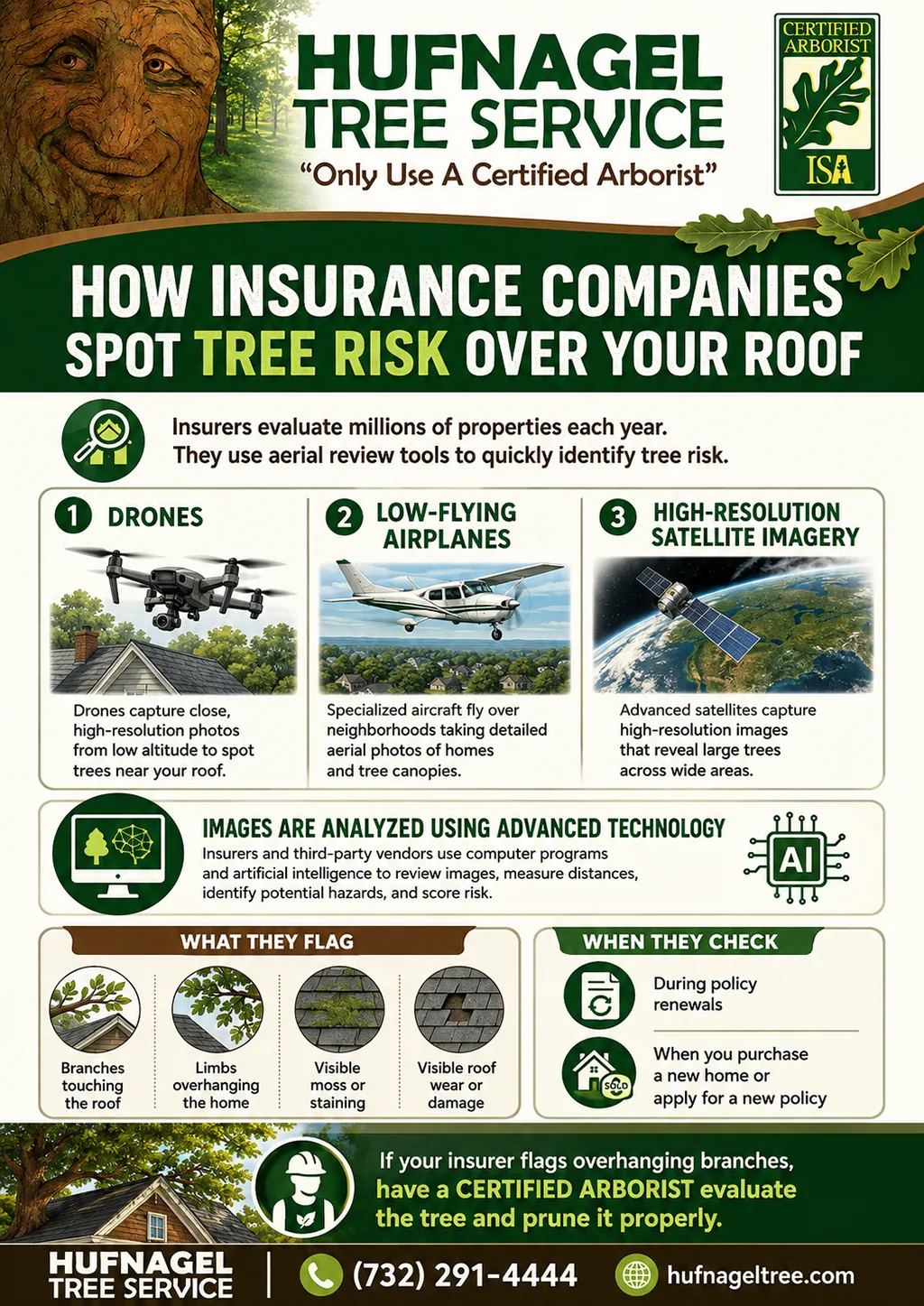
Insurance underwriting has changed. The National Association of Insurance Commissioners describes underwriting as the process insurers use to examine risk and determine coverage and pricing. For a house, that risk review can include the condition of the roof, nearby vegetation, exterior hazards, and features visible from outside the property.
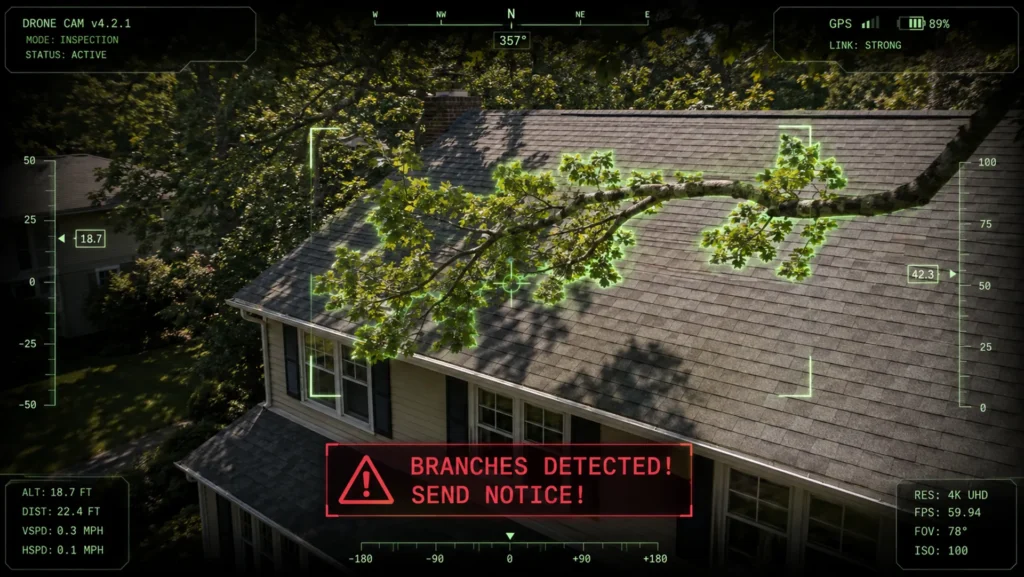
Aerial imagery has become a major part of that process. A state insurance regulator has publicly explained that insurers may use aerial images from drones or satellites to evaluate homes. High resolution images can make a roofline easy to see from above, including limbs extending across shingles, branches touching the structure, heavy canopy cover, or debris collecting in roof valleys and gutters.
Drones are only one tool. Some imagery is collected by aircraft, some comes from satellite providers, and some property information can be reviewed through software that organizes exterior images for an underwriter. A homeowner may never see anyone standing in the yard before a letter arrives. That is why these notices can feel so sudden.
The old fashioned inspection has not disappeared either. An exterior inspection can involve a person photographing the house from the property or observing visible conditions from a public street. General home insurance inspection guidance explains that insurers commonly review roofs and exterior maintenance issues as part of underwriting for new or renewing policies.
Around Monmouth County, this matters because many homes were built into established landscapes rather than empty lots. In places such as Locust, Chapel Hill, Lincroft, Rumson, and Little Silver, large shade trees may have been growing beside the house for decades. A canopy that looked comfortably separated from the roof several years ago may now extend directly over it.
How your property may have ended up on an underwriter’s screen
A notice may be triggered after several different kinds of exterior review, so the method is not always obvious from the letter.
- High resolution aerial photographs may show the roof and surrounding canopy from above.
- Satellite imagery can reveal larger branches extending across the roofline.
- Drone imagery may provide a closer exterior view when an insurer or inspection provider uses it.
- A field inspector can still identify overhanging branches during a traditional exterior or drive by inspection.
However the condition was spotted, the important next question is why the insurer cares about roof clearance and what kind of pruning will satisfy the concern without damaging the tree.
Why Branches Over a Roof Get Flagged
From an insurer’s point of view, a branch extending over a roof represents a potential source of future damage. It may break during wind, snow, heavy rain, or a thunderstorm and strike shingles, flashing, gutters, a chimney, or the roof deck. Even a healthy branch can become a problem if it is long, heavily weighted at the end, or exposed to repeated wind loading.
There is also a difference between a branch that is merely visible above the roof and one that is touching or pressing into the structure. Limbs that contact shingles can move as the wind moves the canopy. Smaller twigs may scrape roofing materials, while leaves and needles can collect in gutters and valleys. The insurer may simply be trying to create more separation between the tree and the building.
Local weather makes that concern easy to understand. Along the Bayshore in Leonardo, Belford, Port Monmouth, and Atlantic Highlands, trees regularly deal with wind moving off the water. Near Monmouth Beach, Sea Bright, Long Branch, and Oceanport, coastal exposure can add another layer of stress. Farther inland, mature canopies in Holmdel, Colts Neck, Shrewsbury, and Tinton Falls can still take substantial wind during summer storms and nor’easters.
We also look beyond the single limb named in the insurance letter. A proper tree risk evaluation considers branch attachments, deadwood, cracks, decay, canopy balance, and how the tree is carrying weight over the target below. That does not mean we turn every insurance trimming job into a major project. It means we make sure the requested clearance is created intelligently and safely.
This is especially important with older oaks and maples common around Red Bank, Fair Haven, Rumson, and Middletown. A rushed crew may see a branch over a roof and simply remove a large portion of the canopy. We see a living structure that must remain balanced after the cut. Michael Hufnagel puts it simply in our certified arborist interview: “Anyone can cut wood. A certified arborist protects your home.”
What the carrier is usually trying to reduce around the roof
The exact requirement comes from your own insurer, but these are common reasons branches near the house draw attention.
- A limb could break and directly strike the roof, gutter, chimney, siding, or nearby structure.
- Branches touching the roof can rub against roofing materials as the canopy moves.
- Dense growth over the house can drop leaves, needles, and small deadwood onto the roof and into gutters.
- Long overextended limbs may carry more leverage and become more vulnerable during severe weather.
Once the goal is clear, the job becomes a precision pruning problem: create useful clearance, reduce the obvious exposure, and leave the tree in better condition than we found it.
Insurance Tree Trimming Takes Precision Near the House
Tree work over a house is not the place for aggressive cutting. Roofs, gutters, fences, patios, pools, landscaping, air conditioning equipment, and utility service can all sit directly below the work zone. Our crews plan the sequence carefully so branches are controlled as they come down. The objective is to protect the property while making exact pruning cuts that preserve the tree whenever possible.
Good pruning is selective. We may shorten an overextended limb back to an appropriate lateral branch, remove a low branch that has grown into the roof area, or reduce smaller growth that is closing the gap between the canopy and the structure. The correct choice depends on species, branch size, attachment, tree condition, and the amount of clearance the homeowner needs to document for the insurer.
What we do not want is a tree hacked flat on the house side or stripped of a huge portion of its canopy just to make the problem disappear quickly. Rutgers tree pruning education emphasizes proper pruning positions and techniques, and the International Society of Arboriculture provides similar guidance for mature tree care. Correct pruning protects the branch collar, limits unnecessary wounds, and respects the natural form of the tree.
That experience is especially valuable in tight Monmouth County properties. In Rumson, Fair Haven, Little Silver, and Red Bank, mature trees often share space with older homes, additions, narrow side yards, detached garages, and established gardens. In Leonardo and Monmouth Beach, the same close quarters may also include wind exposed canopies and compact coastal lots. There is often very little room for careless work.
Michael says, “We do not rush jobs. We do not cut corners. Precision takes time.” That standard is why homeowners call us for difficult pruning close to homes and other structures. Our tree trimming service is built around shaping, selective reduction, deadwood removal, and risk reduction rather than simply removing as much wood as possible.
What careful roofline pruning should accomplish
A successful insurance related trimming job should solve the immediate concern without creating a new tree problem.
- Create visible separation between the requested branches and the roof or structure.
- Keep the remaining canopy balanced instead of removing excessive growth from one side.
- Use appropriate pruning cuts that support long term tree health and structure.
- Control branches carefully around the roof, landscaping, fences, pools, and other property features below.
That combination of clearance and restraint is the difference between simply cutting a branch and providing professional tree care, which becomes even more important when an insurance deadline is involved.
What To Do After an Insurance Tree Trimming Notice

Start by reading the notice closely. Look for the exact condition the insurer identified, the deadline, and whether it asks for trimming, removal, inspection, photographs, an invoice, or some other proof of correction. Insurance companies do not all use the same standards. If the wording is vague, call your agent or carrier and ask what they need to see before you hire anyone.
Then call a qualified tree service before trying to solve the problem yourself. Branches over a roof are difficult to judge from the ground, and cutting the wrong limb can damage the tree or create a dangerous drop zone. New Jersey regulates professional tree care, and the New Jersey Board of Tree Experts explains the licensing requirements and standards that apply to tree pruning and related services.
When we visit, show us the insurance letter if you have it. That helps us understand whether the concern is one specific limb, general roof clearance, dead branches, or a larger canopy issue. We can evaluate the tree itself and explain what can reasonably be pruned while maintaining a sound structure. If we see a separate safety concern, we will explain that too rather than quietly cutting around it.
Do not assume the insurer is asking for the entire tree to come down unless the letter actually says that. Many healthy trees can be retained with proper pruning. Our work throughout Little Silver, Red Bank, Middletown, and the Two Rivers area regularly involves preserving mature trees while improving clearance around homes, driveways, patios, and other targets.
After the work is completed, follow the carrier’s instructions for documenting the correction. Depending on the company, that may involve current photographs, an invoice, or another form of confirmation. Keep your notice and your service records together. If the insurer has a specific photo angle or documentation requirement, ask for that before the job so you know exactly what must be submitted.
Before you send anything back to the insurance company
A little organization can make the process much easier once the tree work is complete.
- Confirm the insurer’s deadline and the exact branch or roof clearance concern named in the notice.
- Ask whether the company wants photographs, an invoice, or another form of proof after trimming.
- Use a qualified New Jersey tree care professional for branches that are high, heavy, or positioned over the house.
- Keep copies of the notice and the completed tree service records in case underwriting asks for follow up information.
The sooner you know what the carrier wants, the easier it is for us to build the pruning plan around that requirement and get the property back into shape without unnecessary cutting.
Call Hufnagel Tree Service for Insurance Required Tree Trimming
If your insurance company sent you a notice about branches over your roof, call Hufnagel Tree Service at (732) 291-4444. We are certified arborists with more than 25 years of experience working throughout Monmouth County, and our team specializes in precise tree trimming around homes, roofs, wires, pools, fences, and established landscapes. We have earned more than 275 five star Google reviews by showing up, explaining the work clearly, protecting the property, and cleaning up thoroughly.
From Middletown, Lincroft, Leonardo, and the Bayshore to Rumson, Fair Haven, Little Silver, Red Bank, Monmouth Beach, Long Branch, Oceanport, Holmdel, and surrounding communities, we know the trees and the tight residential settings that define this part of New Jersey. Bring us the insurance notice and let us help create the clearance your home needs while treating the tree like the valuable living asset it is.
Schedule Service Now!
From precision pruning and safe removals to health assessments and preventative care, Hufnagel Tree Service delivers expert solutions backed by decades of experience. We offer certified insight, fair pricing, and a commitment to doing what’s best for your landscape.
Learn More About Our Services

Related Articles
Tree Health Inspections in Middletown: Hidden Rot
Winter Tree Prep in Old Bridge: Schedule An Inspection