Contents
July Storm Damage Conditions in Eastern Monmouth County
In Monmouth Beach, Long Branch, West Long Branch, Oceanport, and Asbury Park, this July storm stretch showed why storm damage tree service in Monmouth County NJ is not just about cutting up trees after they fall. The area was hit by wind, flash flooding, saturated soil, road flooding, and emergency response conditions within the same weather window. The National Weather Service July 6 local storm report summary documented flash flooding in Monmouth Beach, Ocean Township, Asbury Park, Deal, Eatontown, Neptune Township, and nearby shore communities.
For trees, that combination matters. Heavy rain softens the soil that holds roots in place. Wind pushes against the canopy. Once the ground is saturated, the trunk acts like a lever against the root plate. That is when a tree that looked stable before the storm can begin to lean, crack, lift soil, or fail completely.
The rainfall numbers support what we saw in the field. The National Weather Service rainfall statement issued July 7, 2026 listed 48-hour totals that included 5.13 inches in Long Branch, 3.03 inches in Asbury Park, 3.40 inches in Eatontown, 4.70 inches in Neptune City, and 6.06 inches west-northwest of Neptune City. That kind of water does not just run across streets. It settles into lawns, planting beds, curb strips, and compacted root zones.
As certified arborists, we look at these storms from the tree’s point of view. We are not only asking whether a limb broke. We are asking whether the roots shifted, whether the trunk moved, whether the canopy is now unbalanced, and whether the next storm will finish what this one started. That is especially important near Wesley Lake and Lake Avenue in Asbury Park, Ocean Boulevard and Elberon in Long Branch, low-lying streets in Monmouth Beach, river-adjacent properties in Oceanport, and mature residential landscapes around West Long Branch.
This article follows the same process we use after a storm call. First, we look at the real weather conditions. Then we explain what flooding and wind do to trees. Then we explain why post-storm tree inspections help protect homes, cars, fences, sidewalks, utility lines, and the people who use the property every day.
Severe Thunderstorms and Damaging Winds
Asbury Park was hit hard enough that the city issued storm guidance warning residents to avoid flood-prone areas near Wesley Lake, Sunset Lake, and Deal Lake, and to move vehicles to higher ground away from trees and other hazards. That local warning from the City of Asbury Park flood watch update fits exactly with the tree concerns we inspect after this type of storm: flooded root zones, softened soil, hanging limbs, and trees under stress near streets, parking areas, and homes.
Local and national reports also captured the same flooding pattern. ABC News posted drone video of severe flooding on Lake Street in Asbury Park on July 6, 2026. Reuters Connect showed Wesley Lake flooding onto Lake Avenue. CBS New York reported severe flooding in Asbury Park, including streets covered with deep water near Wesley Lake.
The wind side of the storm was just as important for trees. JCP&L’s July 4 power restoration update reported wind gusts up to 67 mph, significant tree and equipment damage, and more than 200,000 customers affected by outages across central and northern New Jersey. NJ 101.5 reported that the July 3 thunderstorms brought down trees onto utility poles, and News 12 New Jersey reported downed trees, damaged power lines, and road closures in Monmouth County.
The roof collapse at BJ’s Wholesale Club in Ocean Township also shows how much water fell in a short time. ABC7NY reported the Route 35 roof collapse during excessive rain, and the Associated Press reported that heavy rain led to the New Jersey store roof collapse. We are not using that building damage as a tree claim. We are using it as proof of the storm intensity that also saturated lawns, root zones, and planting areas across nearby properties.
Emergency Storm Damage Tree Service After Flooding and Wind
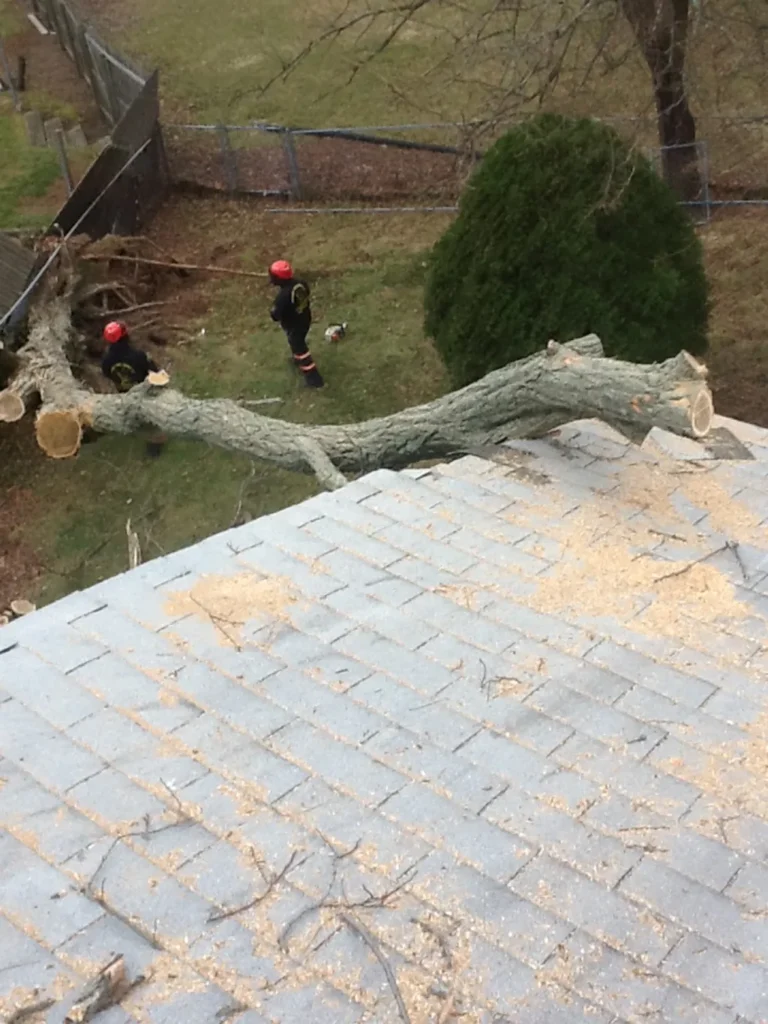
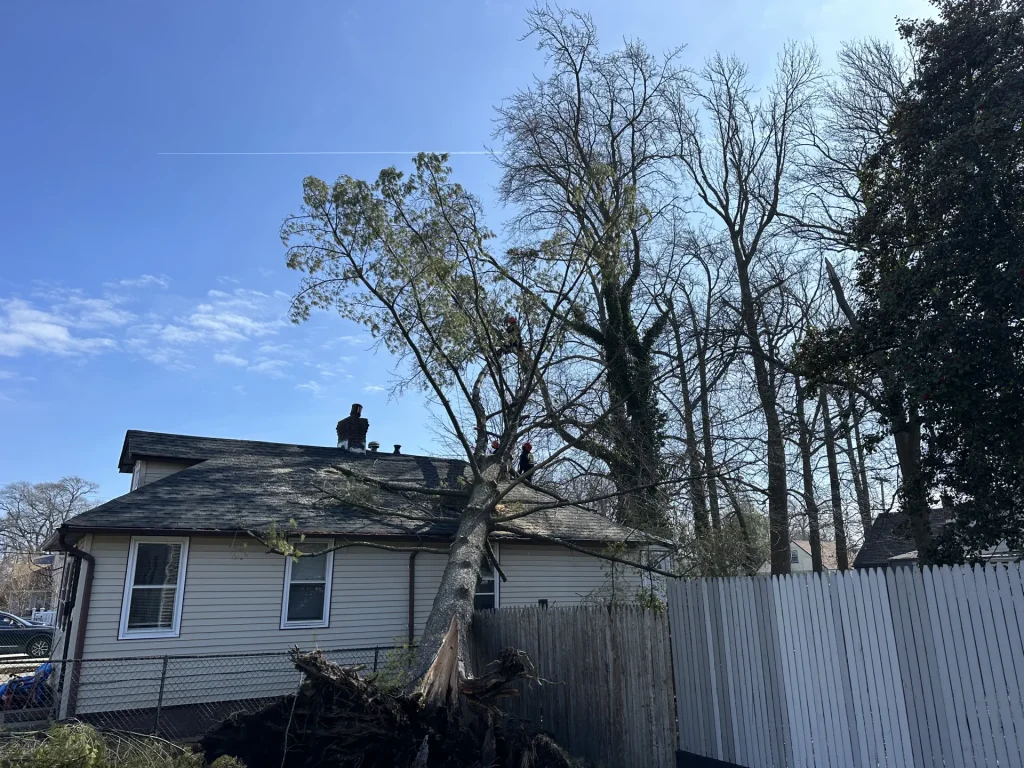
Emergency storm damage tree service starts with the hazard that cannot wait. That may be a fallen maple across a driveway in Long Branch, a split oak limb over a sidewalk in Asbury Park, a leaning spruce in Monmouth Beach, or a storm-damaged tree near a fence in Oceanport or West Long Branch. After storms like the July 6 flash flooding documented by the National Weather Service, the first job is to make the area safer before anyone walks under cracked limbs or near unstable trunks.
A fallen tree is rarely just a pile of wood. Large limbs can be under tension. A trunk may be pinned against a roof, vehicle, deck, shed, fence, or service line. Roots may still be partly attached, which can cause the root plate to shift when weight is removed. That is why storm cleanup should be planned, not guessed. A wrong cut can make the tree roll, swing, or drop into the structure it already damaged.
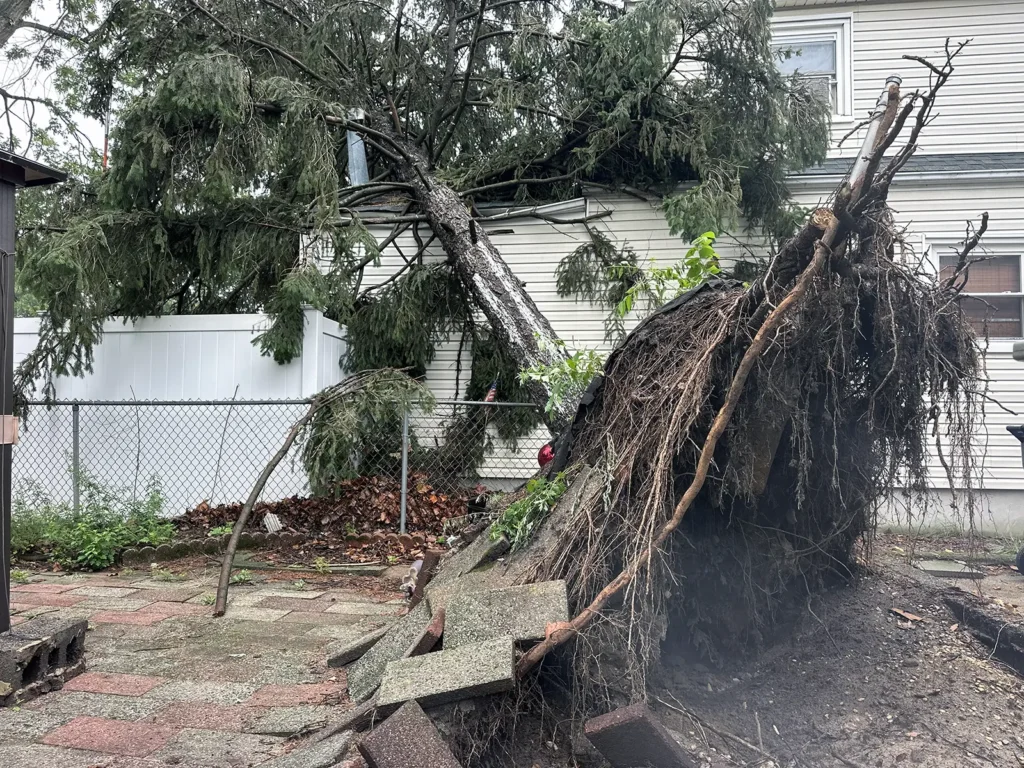
This is especially important in the tight shore properties we see in Asbury Park and Long Branch. A falling limb may affect a parked car, porch, sidewalk, neighboring fence, or utility connection. In Monmouth Beach, wet ground and low-lying areas can make equipment placement more complicated after flooding. In Oceanport, river-adjacent soils near the Shrewsbury River can stay wet after the rain stops. In West Long Branch, large mature trees near driveways and homes may look fine from the street while the root zone is still soft.
Our field rule after a storm is simple: look up, look down, and stay clear. Look up for hanging limbs, split unions, broken branches lodged in the canopy, and large limbs resting on other limbs. Look down for lifted soil, exposed roots, fresh cracks around the trunk, and turf mounding on one side of the tree. If branches or trees are near wires, follow utility safety guidance and stay away. FirstEnergy’s outage guidance notes that trees falling on power lines can create outages and repair hazards.
Emergency cleanup removes the immediate hazard, but it does not answer the whole question. The same wind and saturated soil that brought down one tree may have weakened the next tree over. After the debris is cleared, a certified arborist inspection helps determine whether nearby trees are stable, whether pruning is needed, and whether another failure is likely during the next summer squall.
After flooding and wind, emergency tree concerns usually include:
- Fallen trees blocking driveways, streets, sidewalks, entrances, or emergency access.
- Broken limbs hanging over homes, garages, cars, fences, sheds, and walkways.
- Leaning trees with fresh soil cracks, exposed roots, or lifted turf at the base.
- Trees or branches touching utility lines, which should be treated as electrical hazards.
- Standing trees near the failure that took the same storm load and still need inspection.
Once the immediate hazard is under control, the next step is to inspect the trees that survived the storm. Those are often the trees homeowners overlook.
Tree Risk Inspections After Heavy Rain in Monmouth County
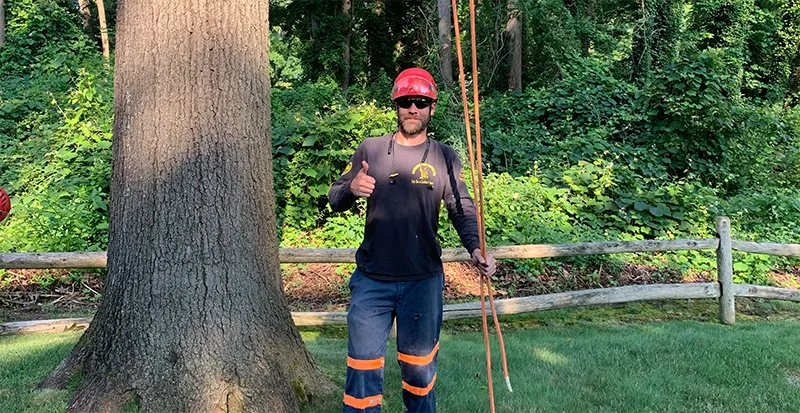
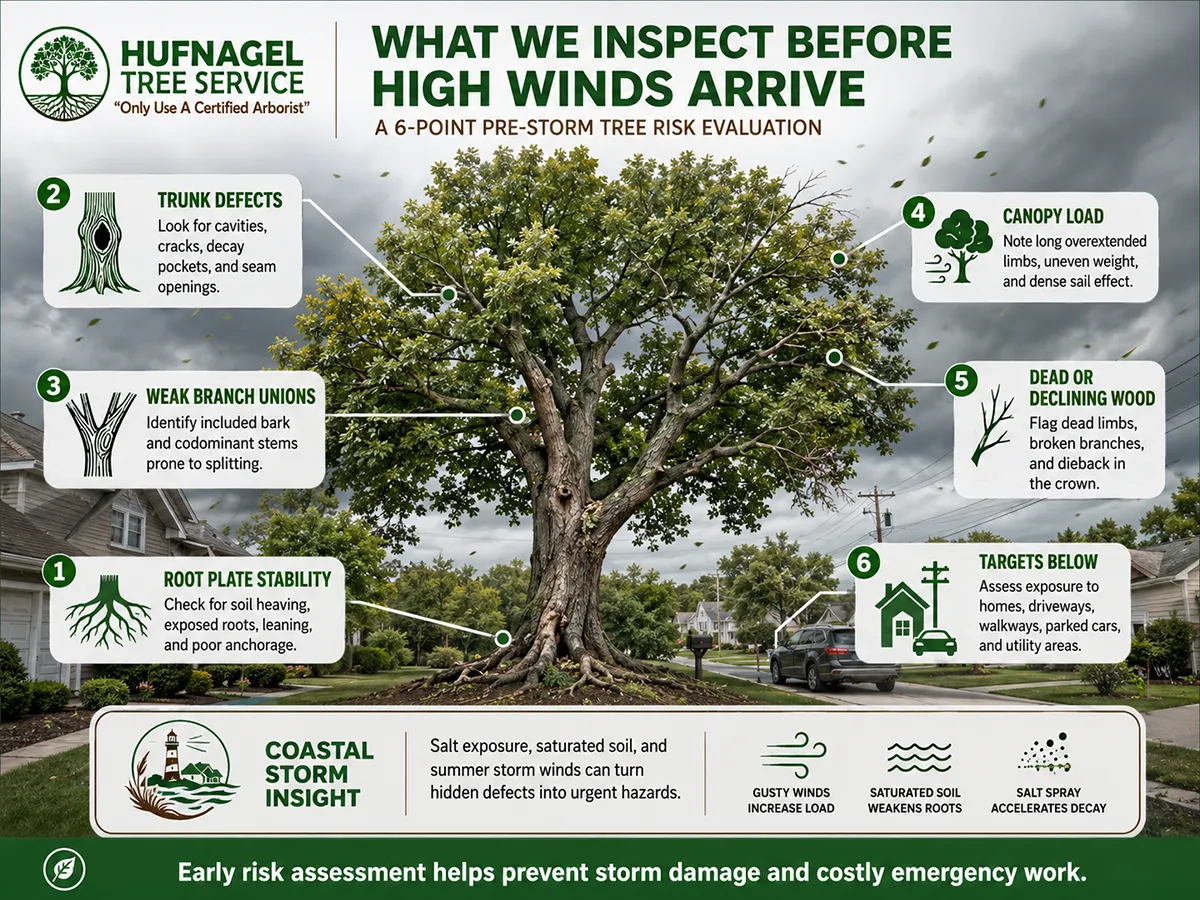
A tree risk inspection after heavy rain focuses on the parts of the tree most likely to fail next. We inspect the root flare, trunk, canopy weight, major limbs, branch unions, cavities, decay indicators, fungal growth, and soil movement around the base. We also compare the tree’s current lean, canopy balance, and root-zone condition to what we expect for that species and location.
The benefit to the homeowner is early decision-making. Not every storm-damaged tree has to be removed. Some trees can be preserved with structural pruning, clearance pruning, cabling review, soil care, or monitoring. Other trees show warning signs that should not be ignored. A fresh lean, a lifted root plate, new cracks in the soil, or sudden canopy movement can mean the tree has already started to lose anchorage.
The July storm reports give homeowners a reason to take this seriously. The National Weather Service reported vehicles flooded in approximately two feet of water along Memorial Drive and 9th and 10th Avenues in Asbury Park. The same summary reported water rescues in Monmouth Beach and Ocean Township, plus cars stuck in high water on Route 35. When a storm puts that much water into streets, it also puts a heavy load into lawns, planting strips, and root zones.
Tree roots need both water and oxygen. When soil stays saturated, oxygen drops. University of Minnesota Extension explains that water covering the soil reduces oxygen to tree roots. That is why a tree can look green right after a flood but still be under stress below ground. Root decline, decay, and instability can show up later.
Our arborist tip is to inspect the tree before cleanup equipment and lawn repairs erase the evidence. Soil cracks, heaved turf, new depressions, torn roots, and fresh movement at the base tell us what happened during the storm. Once a yard is raked, driven over, or regraded, those clues can disappear. Photos and video from your Hufnagel storm work are useful here because they show the actual failure pattern, not a generic storm image.
A post-storm tree risk inspection should focus on:
- New or increased lean after heavy rain or wind.
- Soil cracks, mounded turf, or lifted root plates around the trunk.
- Cavities, mushrooms, decay, soft wood, or trunk wounds near the base.
- Broken limbs, split unions, and canopy imbalance after storm breakage.
- Trees near homes, sidewalks, driveways, patios, parking areas, and wires.
Risk inspection is not guesswork. It is how we separate trees that need immediate action from trees that can be preserved with the right care.
Flooded Root Zone Assessment for Saturated Soil and Uprooted Trees

Flooded root zone assessment looks below the obvious storm damage. A tree can lose stability even when its trunk is not cracked and its branches are still green. After heavy rainfall, the soil around the root plate may be too soft to hold the tree against wind. That is why flooding and wind are so dangerous together.
The science is straightforward. Alabama Cooperative Extension explains that saturated soil and wind can allow roots to slip through softened soil. The same source notes that compacted soils can lead to shallower root systems, which are more vulnerable when soil turns wet and loose. That fits many shore-area properties where roots are restricted by patios, driveways, sidewalks, curbs, utility trenches, and compacted lawns.
The local rainfall totals make this more than a general warning. The National Weather Service July 7 rainfall statement listed 5.13 inches in Long Branch and more than 6 inches near Neptune City. In Asbury Park, the ABC News drone video of Lake Street flooding and the Reuters image report showing Wesley Lake flooding onto Lake Avenue show the kind of water load that can also affect root zones.
In Monmouth Beach, flooded soils and waterfront exposure can combine with salt stress and wind. In Oceanport, river-adjacent properties may hold moisture longer after storms. In West Long Branch, clay pockets and compacted residential soils can keep water near shallow roots. In Long Branch and Asbury Park, many mature trees grow in limited soil space near pavement, curbs, sidewalks, and older hardscape.
Our inspection tip is to check the root zone before assuming the tree is safe. A tree with a raised root plate, cracked soil, or new lean after flooding should be treated as unstable until inspected. We also look for delayed stress. Leaves may wilt later. Branch tips may die back weeks later. Fungal growth may appear near the base. Root damage often takes time to show above ground.
Flooded root zones create several post-storm concerns:
- Saturated soil can reduce root anchorage and increase whole-tree failure risk.
- Compacted soil can force roots to stay shallow, which weakens storm stability.
- Standing water can reduce oxygen around roots and lead to delayed decline.
- Lifted root plates and soil cracking may show that the tree already shifted.
- Trees near pavement, utilities, patios, and driveways may have restricted roots.
Flood damage does not end when the street drains. The tree may still be recovering, shifting, or declining below the soil line.
Wind Damage, Limb Failure, and Structural Pruning
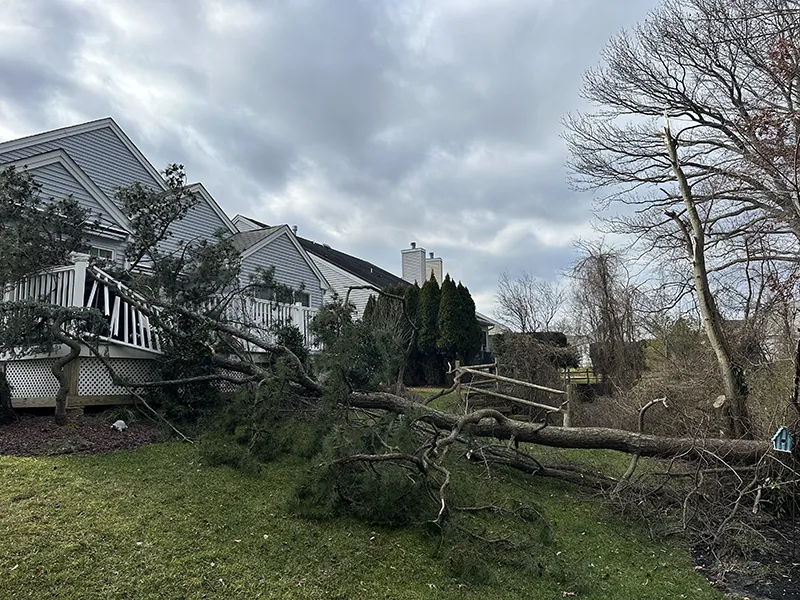
Wind damage is not always obvious from the ground. A storm can crack a major limb, split a weak branch union, twist the canopy, or leave broken branches lodged high in the tree. Those defects may not fall until the next gust, the next rain, or the next time the branch takes extra weight. That is why structural pruning and post-storm canopy inspection matter.
During the July storm window, JCP&L reported significant tree and equipment damage after wind gusts up to 67 mph. News 12 New Jersey reported downed trees, damaged power lines, and road closures in Monmouth County. That kind of wind can expose weak limbs in oaks, maples, sycamores, pines, spruce, and ornamental trees.
For homeowners, structural pruning reduces risk without stripping the tree. We remove deadwood, cracked limbs, broken hangers, rubbing limbs, and overextended branches. We also reduce end weight where limbs are too long and heavy. The goal is not to “thin everything out.” The goal is to improve structure while preserving the tree’s health and natural form.
This is especially important on properties with mature shade trees. In Long Branch, limbs over driveways, porches, and parking areas need close attention after wind. In Asbury Park, street trees and backyard trees often stand close to structures. In West Long Branch, older oaks and maples can carry heavy summer canopies. In Oceanport and Monmouth Beach, open exposure can increase wind load on already saturated root systems.
Our pruning advice is to avoid panic cutting. Iowa State University Extension warns that storm-damaged limbs should be pruned with proper cuts, not flush cuts or oversized wounds. Bad cuts create new decay points and weak regrowth. A storm-damaged tree needs careful pruning, not topping.
Wind damage inspections usually focus on:
- Broken limbs, hanging branches, and cracked wood high in the canopy.
- Weak branch unions, included bark, and co-dominant stems.
- Deadwood over homes, vehicles, decks, fences, sidewalks, and streets.
- Heavy canopies that caught wind while the soil was saturated.
- Old topping cuts or poor pruning cuts that produced weak regrowth.
Good pruning after a storm protects the property and gives the tree a better chance to recover before the next round of summer weather.
Shallow-Rooted Spruce and Evergreen Storm Failure
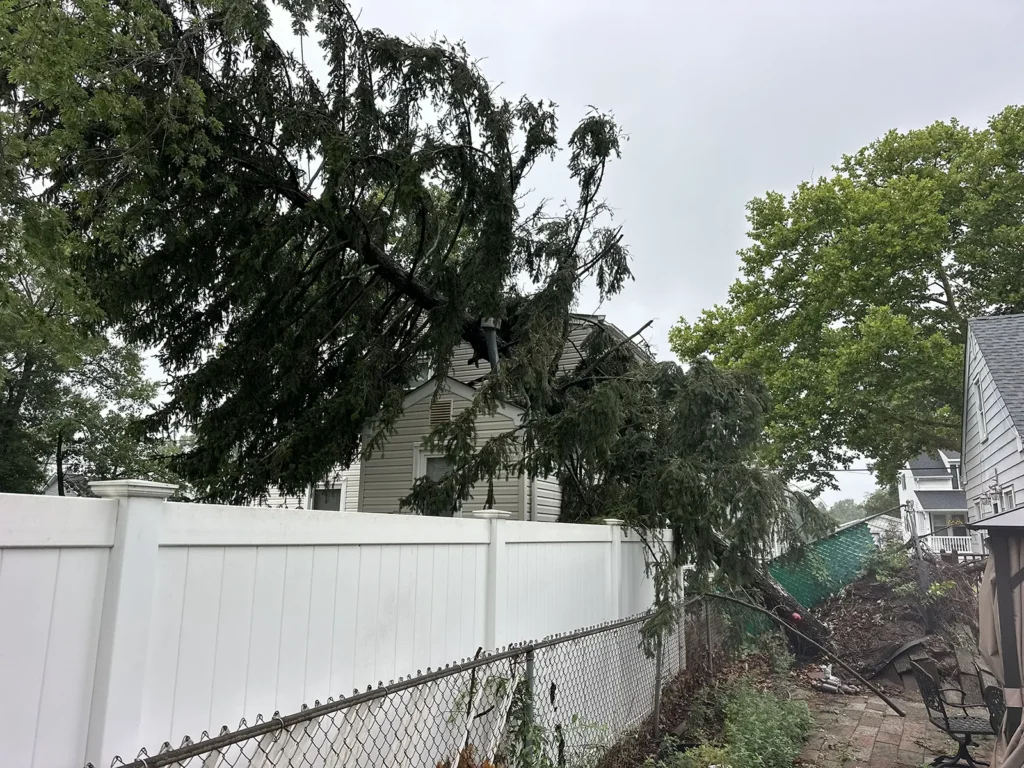
Spruce and other evergreens are common on Monmouth County properties because they provide privacy, screening, wind protection, and year-round color. They also carry foliage all year. That means they catch wind even when deciduous trees are bare. In summer, when the soil is already soaked and the canopy is dense, a spruce can take a heavy wind load.
Mike’s line fits this storm pattern exactly: “Shallow roots on a spruce are no match for a pop-up squall rolling off the Raritan Bay.” For this service area, we would add the Shrewsbury River, the oceanfront, and the open shore exposure around Monmouth Beach and Long Branch. The point is the same. A fast storm does not need to be a hurricane to push over a shallow-rooted evergreen when the soil is saturated.
Spruce roots are often shallow and wide-spreading. Ask Extension notes that spruce trees typically have shallow, wide-spreading root systems, and Colorado State University Extension explains that most tree roots are in the upper soil layers. When those roots are restricted by sidewalks, driveways, fences, patios, retaining walls, or compacted lawn soil, the tree may have less anchorage than its size suggests.
We see this in privacy rows along property lines, driveways, pools, and fences. In Monmouth Beach, salt exposure and shore wind add stress. In Long Branch and Asbury Park, tight lots can limit root spread. In Oceanport and West Long Branch, older plantings may sit in compacted soil that holds stormwater. One spruce failure can also expose the next evergreen in the row to more wind.
Our inspection tip is to take a new lean seriously. A spruce that shifted during the storm is not “fixed” because the rain stopped. We check for root plate lift, soil cracking, fresh trunk movement, torn roots, and changes in the line of the screen. If one evergreen failed, the rest of the row should be inspected before the next squall.
Spruce and evergreen storm failures often show these warning signs:
- A new lean after heavy rain, especially in soft soil.
- Lifted turf, cracked soil, or exposed roots on one side of the trunk.
- Dense evergreen foliage catching wind like a sail.
- Restricted root zones near fences, patios, sidewalks, driveways, and utilities.
- One failed tree in a screen creating new wind exposure for the remaining trees.
Evergreen failure is often sudden and heavy. Inspection is the step that helps determine whether a leaning spruce can be managed or whether it has become a removal hazard.
Sources
- National Weather Service, July 6 Local Storm Report Summary for flash flooding in Monmouth County
- National Weather Service, 48-hour rainfall totals issued July 7, 2026
- City of Asbury Park, Flood Watch and flash flood risk near lakes, July 6, 2026
- ABC News, drone video of severe flooding on Lake Street in Asbury Park, July 6, 2026
- Reuters Connect, Wesley Lake flooding onto Lake Avenue in Asbury Park, July 6, 2026
- CBS New York, severe flooding damages New Jersey communities after strong storms
- JCP&L, July 4 power restoration update after severe thunderstorms
- JCP&L, July 6 power restoration update after consecutive severe storms
- FirstEnergy storm information and outage restoration process
- NJ 101.5, July 3 thunderstorms bring down trees and utility poles
- News 12 New Jersey, storm cleanup continues with downed trees and damaged power lines
- ABC7NY, roof collapse at BJ’s Wholesale Club in Ocean Township during excessive rain
- Associated Press, heavy rain leads to New Jersey store roof collapse
- 6ABC, partial roof collapse at BJ’s on Route 35 in Ocean Township
- FOX 5 New York, dramatic video of BJ’s roof collapse during New Jersey rain storm
- NBC New York, roof of BJ’s store collapses amid heavy rain and flooded roads
Call Hufnagel Tree Service for a Certified Arborist Storm Inspection
If your property in Monmouth Beach, Long Branch, West Long Branch, Oceanport, or Asbury Park saw flooding, high wind, leaning trees, cracked limbs, uprooted evergreens, or fallen trees during this July storm stretch, do not wait for the next storm to test the same roots and branches again. A certified arborist inspection can identify which trees need immediate attention and which trees can be preserved with the right care.
Hufnagel Tree Service brings certified arborist judgment, more than 25 years of Monmouth County experience, local roots, and 200+ five-star Google reviews to storm damage inspections, emergency tree service, structural pruning, and fallen tree cleanup. Call us for a location-specific consultation before the next pop-up squall moves through the Shore.
Schedule Service Now!
From precision pruning and safe removals to health assessments and preventative care, Hufnagel Tree Service delivers expert solutions backed by decades of experience. We offer certified insight, fair pricing, and a commitment to doing what’s best for your landscape.
Learn More About Our Services



Related Articles

Old Bridge Fall Tree Inspection: Catch Hidden Hazards Early
Aberdeen Fall Tree Inspection: Find Problems Before Winter

Matawan Fall Tree Care: Prepare Trees Before Winter