Contents
Tree Trimming in Tinton Falls Starts With a Borough Built Around Water
Tinton Falls was incorporated on August 15, 1950, as New Shrewsbury, and the borough took its present name in 1975, according to Wikipedia. It covers about 15.6 square miles at an elevation of about 98 feet, and the same page describes it as the home of the highest waterfall on New Jersey’s coastal plain. The name traces back to Tinton Manor, the plantation of Colonel Lewis Morris, who bought a half interest in the ironworks company in 1675, and James Grover’s ironworks beside the river is described as one of the oldest built in the country. Pine Brook, Hockhockson, Wayside, Green Grove, and Reevytown are some of the communities that lie wholly or partly inside the borough. With that much ground and that much history, tree trimming in Tinton Falls is never a one size job.
The borough is served by the Garden State Parkway, Routes 18, 33, and 66, and county routes that include Tinton Avenue and Shafto Road, and mature trees stand near all of them. Our tree trimming and pruning service begins by asking what each cut is supposed to accomplish, and our tree risk evaluation work tells us whether a limb is a real defect or simply a branch that bothers the eye. That order matters. A trim without a reason can leave a tree weaker than it was, and a tree that has been cut hard once is usually harder to manage afterward.
After almost 30 years working throughout Monmouth County, we have seen that mid November is a good time to plan trimming. With the leaves down, deadwood, crossing limbs, and heavy end weight are easy to read from the ground. The National Weather Service says nor’easters are most frequent and most violent between September and April, so the season that tests a trimmed tree is still ahead of us.
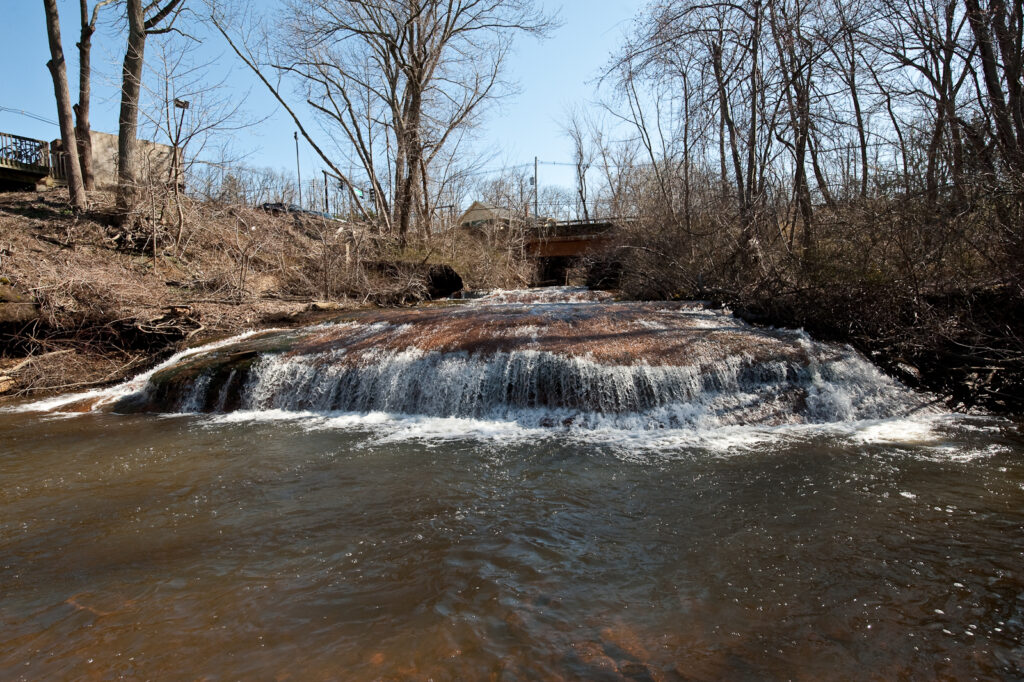
The photograph above shows a low waterfall spilling over a rock ledge in a brown stream, with bare trees and brush on both banks and a bridge in the distance. It is a fair picture of what November does to a canopy. Without leaves, the branch structure shows plainly, and a trunk that leans toward the water or a limb that reaches over the bank is easy to judge. Wikipedia notes that erosion and the destruction of the dam near the ironworks have diminished the falls, and that Overlook by the Falls is a wildlife area near them with trails for viewing the water.
Moving water and sloping banks are hard on trees. A root system on a bank has less soil to hold it than one under a flat lawn, and a leaning trunk over a stream is a different problem from one over grass. We do not trim a bank tree to reduce weight until we have looked at the roots, because removing crown weight changes how a tree moves in wind. Our guide to weak tree roots explains the warning signs we look for at the base before any cut is planned.
Dormant Season Trimming Works Best When Every Cut Has a Reason
The Trees Are Good page on pruning from the International Society of Arboriculture says growth and wound closure are maximized when pruning takes place before the spring growth flush. It also says the routine removal of weak, dead, or diseased limbs can be done at any time of year with little effect on the tree. That gives homeowners a useful window. From late fall through winter the tree is dormant, the crown is bare, and the whole structure can be read from the ground and from the lift.
Dormant season trimming is not a license to cut more. Our tree trimming and pruning work removes deadwood, crossing and rubbing limbs, and weight that has built up at the branch ends, and it leaves the rest of the crown alone. The same Trees Are Good page calls topping, the cutting of branches back to stubs, perhaps the most harmful pruning practice known. We name it only to reject it. A topped tree answers with a flush of fast shoots, and the stubs left behind can decay behind them, which is how a quick fix becomes a lasting problem.
Reduction cuts follow a rule as well. The page advises cutting a terminal back to a branch at least one third the diameter of the stem being cut, so the remaining branch can take over as the leader. We apply that idea to every limb that has grown too long, whether it reaches toward a roof or toward the next tree. A cut made to a proper branch heals better and directs the growth that follows, while a cut made to nowhere leaves a wound with no purpose.
Deadwood is the simplest example of a trim with a reason. A dead limb has no function, it can drop without warning, and it is easy to see in a bare canopy. Our guide to hidden tree rot explains why we also look at the trunk and the base before we decide a limb is the only problem, because a crown with a lot of deadwood sometimes has decay lower down.
Structure comes next. Where two stems of similar size grow from the same point, bark can be trapped between them and the union can split under load. Our article on codominant stems covers the signs, and our earlier piece on codominant stems in Tinton Falls applies them to local trees. Trimming can take weight off one stem to slow that problem, but it cannot repair a union that has already cracked. In that case we talk about support, monitoring, or removal instead of another cut.
Homeowners should photograph a limb from the ground, note the date, and stay clear of anything that looks cracked, leaning, or hung up, and they should never climb or cut it themselves. Mike Hufnagel puts the working rule this way: “A good trim should leave a tree looking like itself. If we cannot say what a cut does for safety, structure, clearance, or health, we should not be making that cut.” That rule keeps the plan honest. It also makes the plan easy to explain to an owner, because every cut on the list has a stated purpose.
Five Trimming Checks We Make on a Tinton Falls Property
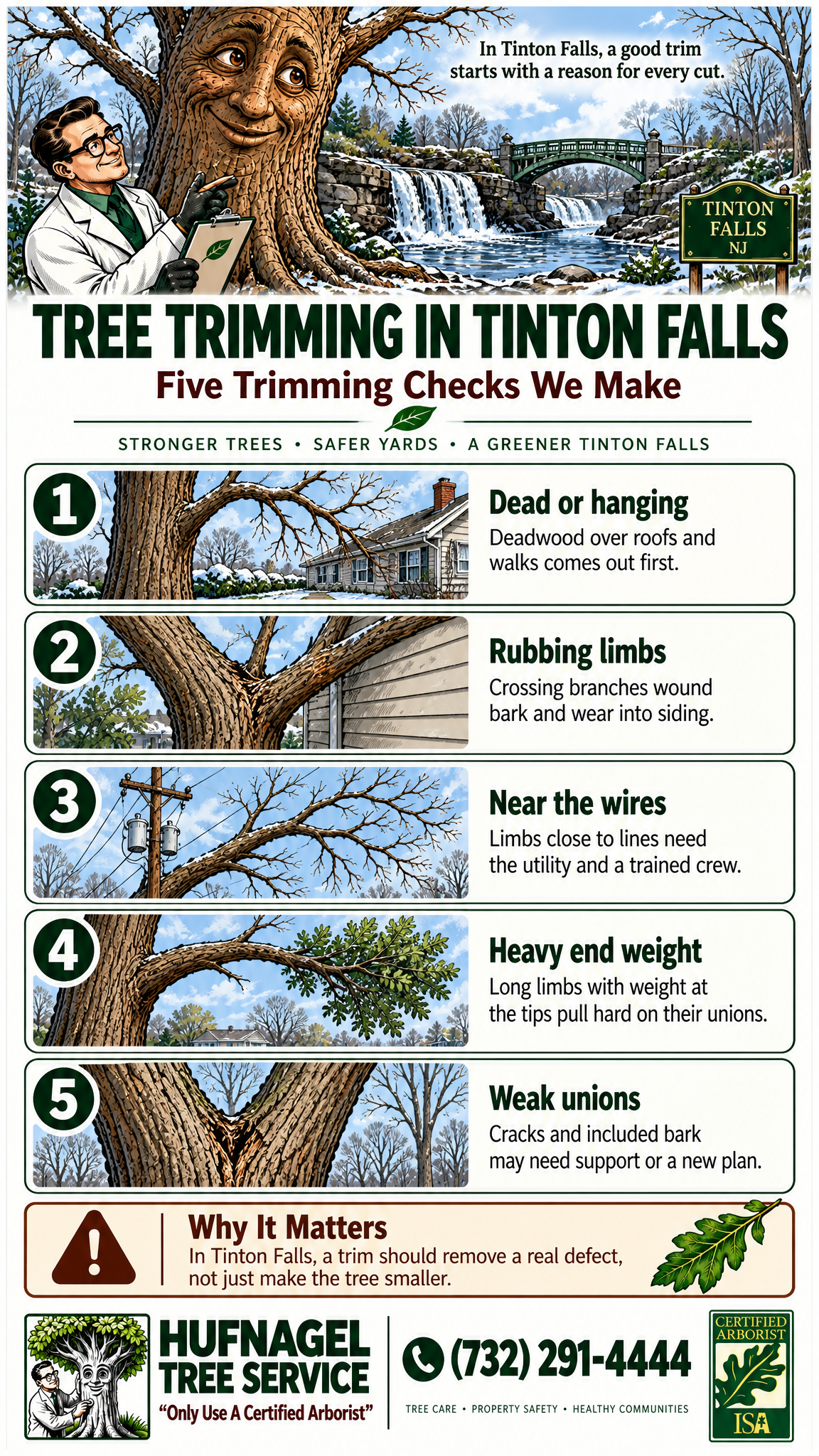
- Dead or hanging branches over roofs, driveways, walks, and neighboring property.
- Crossing or rubbing limbs that are already wounding bark or siding.
- Branches close to service wires that need a utility and a trained crew.
- Long limbs carrying heavy end weight well beyond the trunk.
- Cracks, weak unions, or included bark that call for support or a second opinion.
These checks overlap, and the target decides how urgent each one is. Deadwood over an empty corner of a yard can wait for the next visit. The same limb over a driveway, a pool deck, or a bedroom roof should not wait. Once the crown is sorted, the next question is not about the tree at all. It is about the paperwork the borough asks for when a trim turns into a removal, and in Tinton Falls that starts with a call to the zoning office.
Borough Permits and the Shade Tree Commission Shape the Plan

The borough’s zoning permits page lists tree removal among the work that needs a zoning permit application. For a residential property the page lists a $25 fee, and it asks for a property survey that shows the location of each tree to be removed and its diameter. It gives the office as 556 Tinton Avenue, with a main number of (732) 542-3400, and it tells callers to use extension 238 to confirm whether a permit is required before starting work. The page also links to the borough’s tree removal and replacement ordinance.
We do not decide what the borough will approve, and we do not guess at the size thresholds in the ordinance. The page we read does not state one, so we send owners to extension 238 for the current answer. What we can do is prepare the facts the office asks for. A survey, dated photographs, and a plain description of the defect make the call short, and they make the answer easier to act on.
Trimming and removal are different jobs, but in practice tree trimming in Tinton Falls can drift into removal. A tree that has been cut back hard can decline for years and may eventually need to come down, which turns a trim into a removal after the fact. That is one more reason we avoid topping and heavy reduction, and it is why we describe the cuts in advance. Our guide to tree removal permits explains how permit steps usually work, and our tree removal service follows the borough’s process when a tree has to come down.
The borough also has a Shade Tree Commission. Its page says the commission was established as an advisory board to offer recommendations on the planting and care of shade trees, and that it also advises residents on plantings on their own properties. Meetings are held monthly on the first Wednesday at 7:00 p.m. at the Crawford House, 750 Tinton Avenue, and questions can go to Tree@tintonfalls.com. We would rather an owner hear the commission’s planting advice directly than depend on our summary of it, and we suggest confirming the schedule with the borough before attending.
Many Tinton Falls properties are wide and wooded. Shark River Park, which the Monmouth County Park System describes as 1,006 acres on either side of the Shark River in Neptune, Wall, and Tinton Falls, has a pine and oak forest habitat. We do not claim that a yard near the park holds the same trees, but the setting is a reminder that oaks and pines both grow here and carry weight differently. We judge each tree on its own structure instead of applying one rule to every species, and we keep that in mind near Hockhockson Park, Liberty II Park, Riverdale West Park, and the Sycamore Recreation Complex, where the tallest trees often stand beside places people gather.
Access matters on a large lot. A long drive or a sloped lawn changes how we stage equipment, where we set a lift, and how we protect turf. The photograph above shows a wide hillside property with tall bare trees, a curving paved drive, and a tracked machine and a chipper truck set well back from the trees. We plan the work so the crew has room, the brush has a clear path out, and nothing heavy crosses a root zone more than it must.
Questions to Ask Before Trimming or Removing in Tinton Falls
- Whether the planned work is a trim or a removal under the borough’s rules.
- Whether a zoning permit application and a property survey are needed.
- What the diameter of each tree is, since the borough asks for it.
- Whether any limb is near a service wire and needs the utility involved.
- Whether new plantings should follow the borough’s list of approved shade trees.
Answering these in order keeps a sound plan from stalling at the curb. A trim that is described clearly, scheduled around the weather, and checked against the borough’s rules rarely causes surprises. A job that starts without answers can end with a stop work call, a replanting question, or a tree that was cut more than anyone intended. Winter weather is the last piece of the plan, because it decides which trimming comes first.
Winter Wind and Timing Decide Which Trimming Comes First

The National Weather Service says the winds over coastal areas in a nor’easter are typically from the northeast, that these storms nearly always bring gale force winds along with heavy rain or snow, and that they can cut power. It also says they are most frequent and most violent between September and April. Those facts shape our winter plan for any Monmouth County property, including a property in Tinton Falls, because the tree trimming in Tinton Falls we do now is meant to help a tree handle the weather that follows.
Wind does its work through leverage. A long limb with weight at the tip pulls harder on its union than the same limb with the weight spread along its length. A selective reduction that removes end weight lowers that pull without cutting the tree back to a stub. We do not try to “thin a tree out for wind” as a blanket treatment, because stripping the interior of a crown can move weight outward and make the leverage worse.
Wires change every plan. A limb touching a service line, or hung up above one, is not a homeowner project and not something we treat casually either. We keep everyone clear, photograph from a safe distance, and work with the utility, because a line can be live even when nothing looks wrong. If a tree is near a service drop or a pole, tell us when you call so we can plan the work around it.
The photograph above shows climbers working high in a bare tree beside a red chipper on a quiet street, with cut brush on the lawn and a cone set out at the left. Winter trimming looks like this. With no leaves, a climber can see every union and a ground crew can see where each piece will land. Large limbs come out in short sections on a rope, never in one drop, and the chipper keeps the site clear as the work goes on.
Trimming is one outcome among four, along with restoration, monitoring, and removal. A tree damaged in a past storm may need restoration cuts that rebuild structure over several visits instead of one heavy cut, and our storm proofing work is built around that same patience. We prefer preservation when a tree still gives us a safe path forward, and we say so plainly when it does not.
The Tinton Falls Historic District, where Tinton Avenue meets Sycamore Avenue, was added to the National Register of Historic Places on November 10, 1977, according to Wikipedia. It is a reminder that some trees here have outlived several owners. We keep that in mind for older trees anywhere in the borough. Smaller cuts, spaced over more than one visit, work better than an attempt to correct decades of growth in a day. Our guide to storm season risk assessment explains how we rank trees when several need attention.
Winter Trimming Priorities for Tinton Falls Trees
- Dead and hanging limbs over roofs, drives, walks, and play areas come first.
- Long limbs with heavy end weight over a target are reduced selectively.
- Crossing or rubbing branches that are wounding bark get a clean correction.
- Branches near wires wait for the utility and a crew trained for that work.
- Evergreen limbs that will collect snow over roofs and drives are reviewed.
No tree service can honestly guarantee that a tree will never fail in severe weather. What a good trim does is reduce predictable leverage and remove clear defects, so the next storm tests a better prepared tree. We also tell owners which trees we would leave alone. Not every defect needs a cut, and a limb that looks awkward from the street may be perfectly sound. Our tree health management work covers the trees that need care at the roots more than care in the crown.
Call Hufnagel Tree Service for Tree Trimming in Tinton Falls Before Winter Storms
If you have mature trees near your Tinton Falls home, driveway, pool, or property line, schedule an evaluation before winter storms arrive. We provide storm proofing, tree risk evaluation, tree trimming and pruning, restoration, and removal when a tree cannot be managed safely.
Hufnagel Tree Service is led by a certified arborist with almost 30 years of local experience and more than 280 five star Google Maps reviews. We inspect first, explain what we found in plain terms, and recommend only the work that changes the outcome for your trees and your property.
Call or text (732) 291-4444 to schedule tree trimming in Tinton Falls before the next nor’easter arrives. Our Tinton Falls tree articles list more local guidance.
Schedule Service Now!
From precision pruning and safe removals to health assessments and preventative care, Hufnagel Tree Service delivers expert solutions backed by decades of experience. We offer certified insight, fair pricing, and a commitment to doing what’s best for your landscape.
Learn More About Our Services

Related Articles