Contents
In Oceanport, Leaf Drop Shows What Vines Have Been Hiding
Vines on trees in Oceanport are easiest to judge in November, when the leaves come off the maples and oaks and anything still green on a trunk stands out. Wikipedia says Oceanport became a borough by an act of the New Jersey Legislature on April 6, 1920, carved from portions of Eatontown Township, with a referendum on May 11, 1920. The borough forms a peninsula jutting into the Shrewsbury River, covers 3.80 square miles of which 3.17 are land, and had 6,150 residents in the 2020 census. Monmouth Park has hosted racing there since 1946, County Route 537 runs through the borough, and Elkwood Park, Gooseneck Point, and Sands Point are among the neighborhoods the page names.
That mix of older lots, mature street trees, and close setbacks changes how we think about vines. A vine climbing a trunk beside a driveway or a utility wire is not a cosmetic matter where a tree does not have to fall far to reach a roof, a wire, or a neighbor. Our tree health management and tree risk evaluation work starts with what is actually growing on and under a tree, and vines are one of the first things we look for.
After almost 30 years working throughout Monmouth County, we have seen vines ride along with a tree through the summer unnoticed and then add weight at the worst moment, when wet snow or a hard northeast wind arrives. This article explains what a vine can hide, what the published sources say about its weight, and how the Oceanport tree rules fit with an inspection.
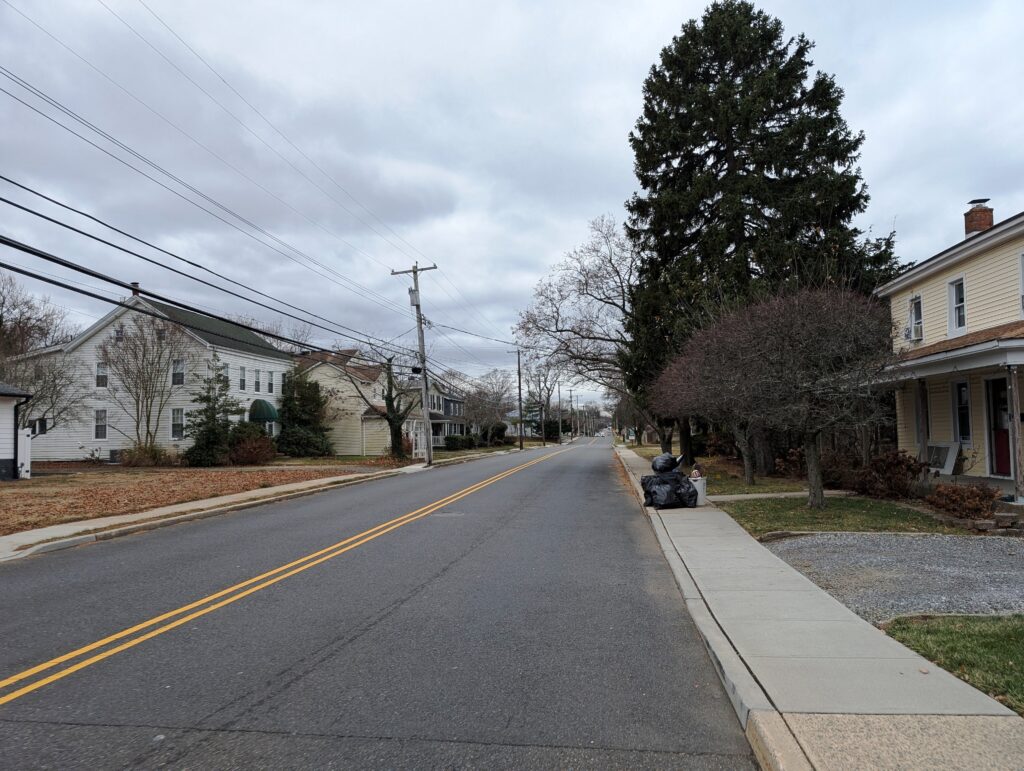
The photograph above shows westbound Main Street looking southwest at Center Street, according to the Wikimedia Commons description, and it was taken in December 2024. A tall dark evergreen stands beside a yellow frame house, bare deciduous trees line the far end of the block, and utility wires cross the street along the left side. In a winter scene like this the green and the bare sit side by side, which is exactly the contrast that makes a vine on a trunk easy to see. Anything evergreen climbing a bare tree deserves a second look, and anything climbing toward a wire deserves a call.
Ground conditions matter as much as the canopy. Wikipedia lists the borough elevation at 20 feet and says Hurricane Sandy flooded the 1965 borough hall in 2012, and that the building was demolished in 2017. The borough keeps a flood protection and storm safety page and says it takes part in the FEMA Community Rating System. Wet ground does not make a vine dangerous by itself, but a tree standing in soft soil under a heavy vine load, with a northeast storm coming up the river, has less margin than the same tree on dry ground.
Vines on Trees in Oceanport Add Weight a Bare Canopy Cannot Hide
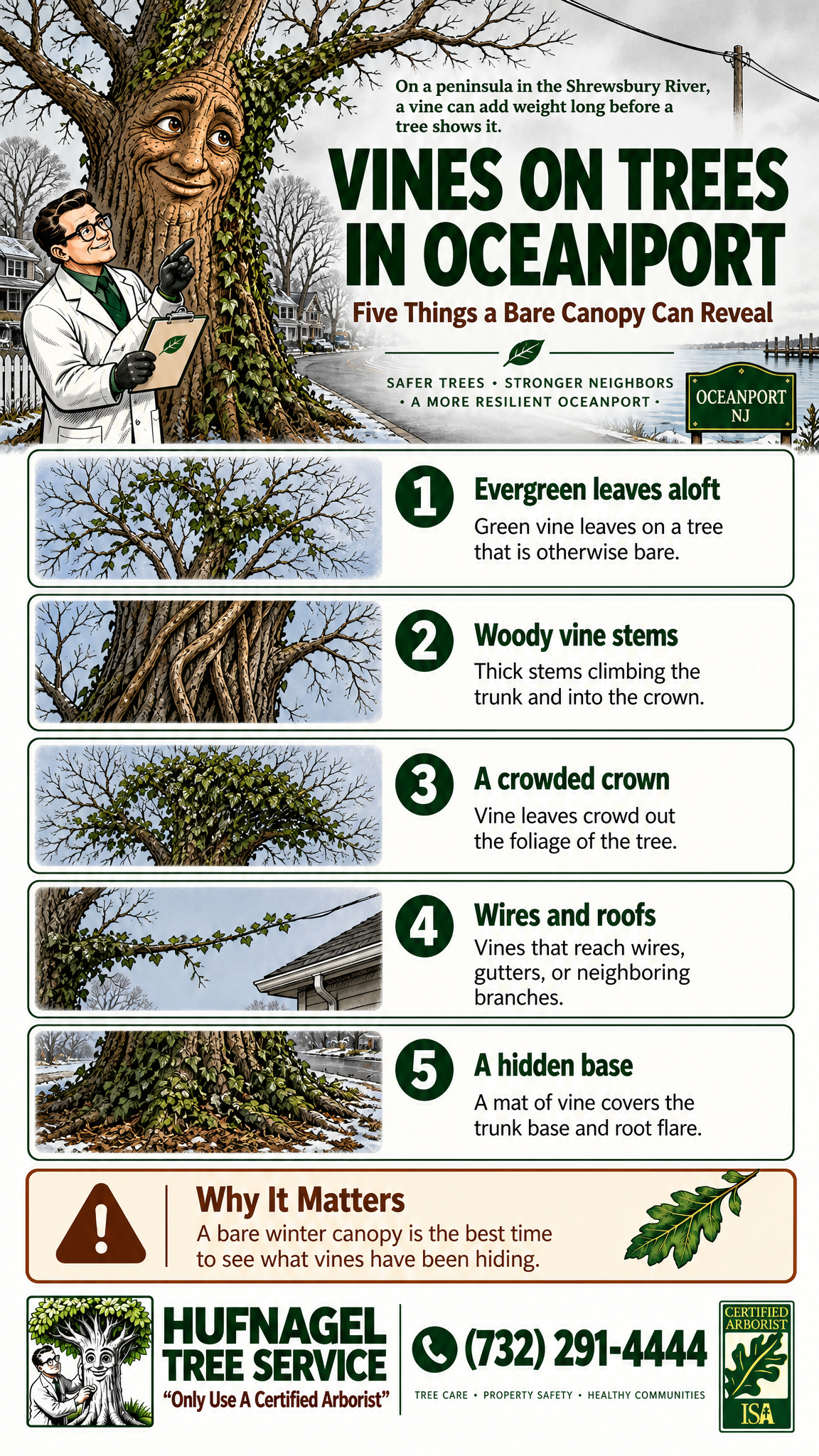
The first thing a bare canopy shows is weight. The University of Maryland Extension invasive vine guide, updated February 22, 2023, says English ivy engulfs branches in trees, shading and slowly killing them, and that its weight topples trees in wind, snow, or icy conditions. Of Oriental bittersweet it says thick woody vines engulf and smother trees while their weight can topple them. Japanese honeysuckle, it adds, spirals up trees and shrubs, strangles by blocking sunlight, and fells weakened trees with its weight.
Those are plants we see on Monmouth County trees, and they share a habit that matters for risk. They keep adding growth high in the crown, where leverage is greatest. A tree that has carried a vine for years has grown around it, so the tree and the vine now act as one load. The same guide describes English ivy as an evergreen vine and says Japanese honeysuckle keeps growing evergreen foliage through the year, which means a vine can hold leaves on a tree that has none and give wet snow and wind something to catch.
On Oceanport lots the question is rarely the tree alone. Streets such as Main Street carry overhead wires, as our first photograph shows, and a vine climbs whatever it reaches first, whether that is a trunk, a limb, a fence, or a gutter. When vines on trees in Oceanport reach a wire or a roof edge, the job stops being a gardening question. We treat it as a clearance and weight question, and we look at what the tree and the vine can do together under load.
There is a disease angle as well. The Maryland guide says English ivy can serve as a reservoir for bacterial leaf scorch, a serious disease of trees including maples, oaks, and elms. Maples and oaks are common large trees on the residential lots we visit, so a vine on one of them can be weight, shade, and a possible source of disease at the same time. We do not claim a vine caused a decline we have not examined, but we do note it and weigh it in the plan.
Late fall is a good time to look and a poor time for homeowners to start cutting. The useful work for a homeowner in November is to stand back, photograph the trunk and crown from several sides, note the date, and leave the cutting to a trained crew. Climbing, saws, and wires change the risk at once, and a vine mass that has grown into a crown cannot be judged from a ladder.
Mike Hufnagel puts it simply: “A vine does not have to hurt a tree to hide a problem. If we cannot see the trunk, we cannot tell you what the trunk is doing, and that is where the inspection has to start.” That is why a vine on a mature tree is a reason to schedule a look, not a reason to panic.
What a Bare Oceanport Canopy Can Reveal About Vines
- Evergreen vine leaves on a trunk or limb of a tree that is otherwise bare.
- Woody vine stems climbing the trunk and spreading into the crown.
- Sections of the crown that look thin because vine leaves crowd out the tree.
- Vine growth that reaches wires, roof edges, gutters, or neighboring branches.
- A trunk base or root flare buried under a mat of vine leaves.
None of these signs means a tree is failing, and most of them can be managed with a plan. The goal is not to strip every vine from every tree. The goal is to know how much weight the vine adds, what it is covering, and whether it is reaching a target. Once we know that, the next question is what the vine is hiding on the trunk itself.
A Vine Covered Trunk Can Hide the Defects We Need to See

A vine covered trunk is hard to inspect, and that is the second reason we care about vines. The University of California Statewide IPM Program lists the warning signs that a tree may be hazardous: brackets, conks, mushrooms, or other fungal fruiting bodies on the bark or around the base, cankers or wounds, cavities on the trunk or at the base, cracks in the trunk or at forks, dead or dying limbs, fissures in the soil near the base, and trunks that lean or tilt. A dense mat of vine leaves can cover nearly every item on that list.
The photograph above shows a crew with ladders working around a large blue spruce and two ivy covered trees on a brick paved property, with a utility pole and overhead wires between them. The ivy on the left has climbed high into the trunks and leaves almost no bark in view. We chose it because it shows the problem plainly. A person looking at that trunk from the street cannot see its cracks, its wounds, or the root flare at its base, and neither can we until the vine is dealt with.
Cracks deserve special attention. An Iowa State University Extension article from April 2017 says cracks on trunks can come from wind, harsh winter conditions, or mechanical injury, and that cracks become the entrance point for decay fungi. It says that once either white rot or brown rot has started in the wood there is no cure or treatment proven to eradicate it, and that a mushroom or conk raises concern about internal decay. Its clinic recommends evaluation by a trained arborist to see whether the tree still has its structural integrity.
That advice fits Oceanport trees well. Many of the lots we visit have mature trees planted decades ago, close to houses and wires, and a decayed trunk matters most where something valuable stands underneath. Our guide to hidden tree rot explains how decay can hide inside a tree that still looks full, and the vines and tree health article covers how vines add to that picture.
Dead limbs are the other thing a vine can disguise. Evergreen vine leaves can stay green on a limb that has died, so the limb looks alive from a distance. A bare canopy helps because the tree itself shows which limbs have no buds, but the vine can still mask the picture on the limbs it covers. When we climb or use a lift, we look at the wood under the vine, not at the leaves above it.
A fair question is whether a vine always has to go. It does not. A small, shallow vine on a sound trunk may only need monitoring, and a vine that has not reached a wire or a limb can sometimes be managed in stages. What decides the answer is what the vine covers, how much weight it carries, and what stands under the tree. We explain that reasoning to the homeowner in plain terms before any work is scheduled.
Defects a Vine Mat Can Hide on an Oceanport Tree
- Conks, mushrooms, or brackets growing on the trunk or around the base.
- Cracks in the trunk or at the point where two stems fork.
- Cavities, wounds, or cankers in bark that the vine leaves have covered.
- Dead or dying limbs hidden inside dense evergreen vine growth.
- A new lean, or soil fissures near the base after a wet spell.
These are the same signs we look for on any mature tree, and the vine only makes them harder to read. A thorough inspection connects the crown, trunk, roots, and the target underneath. When the vine blocks any part of that picture, we recommend dealing with the vine first so the tree can be judged on what it is actually doing.
Borough Rules Shape What Happens After We Find a Problem Vine
Oceanport has its own rules for what happens after a problem tree is found. Chapter 371 of the borough code, amended May 1, 2025, says that anyone planning to remove a non street tree with a trunk diameter of six inches or more on their property must submit a tree removal application to the Zoning Official, and that no tree shall be removed until municipal officials have reviewed and approved the removal. For a street tree the threshold is 2.5 inches. The chapter measures diameter at breast height, which is 4 1/2 feet above the ground.
The same chapter defines a hazard tree as one that meets any of several criteria: it has an infectious disease or insect infestation, it is dead or dying, it obstructs a traffic sign or the free passage of people or vehicles where pruning has not worked, it is causing obvious damage to structures, or a certified arborist or licensed tree expert determines it is a threat to public health, safety, or welfare. A hazard tree backed by a New Jersey licensed tree expert or arborist, or by color photographs and a written statement, can be removed without the replacement requirement, if the reviewing officer approves.
There is a second part of the code that surprises homeowners. The chapter defines tree removal to include any action that kills a tree or causes irreparable damage leading to its decline, and it names excessive pruning, over mulching, and improper grading or soil compaction within the critical root radius as examples. That is one more reason we do not strip a vine or a crown in a single aggressive visit. A plan that spreads the work over more than one visit often protects the tree and the homeowner.
The borough also has people who care about trees. The Oceanport Shade Tree Committee page says the committee is committed to maintaining and enhancing the tree population, and the code behind it, which you can read in the Shade Tree Committee article, sets it up with seven members. For a permit question about a tree on a street frontage, the borough is the place to ask first. We can describe what we found on the tree, but we do not issue or approve permits. Our overview of tree removal permits explains what to expect in general.
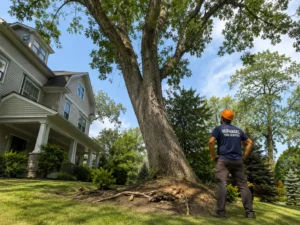
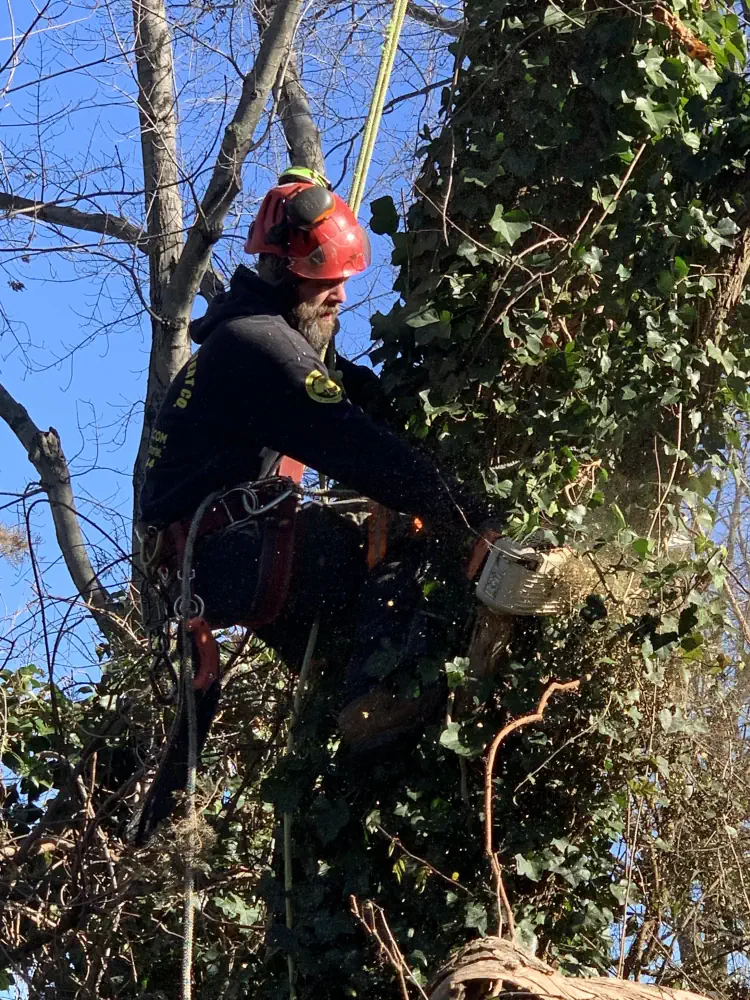
The photograph above shows a climber in a red helmet and harness cutting into an ivy covered trunk, with a rope overhead and blue sky behind. The picture is a reminder of what this work involves. The New Jersey Department of Health says tree work is hazardous under normal conditions, that contact with electrical power sources is a high risk, and that this work should be left to licensed tree care professionals. That page is about storm cleanup, but the same logic applies to a vine in a crown near a wire.
Choosing who does the work matters. Trees Are Good says pruning or removing trees, especially large ones, can be dangerous and that tree work should be done only by those trained and equipped to work safely in trees. When we find vines on trees in Oceanport that need work, we weigh trimming and pruning, tree restoration, monitoring, and removal, and we explain why each one is or is not on the table. Removal is the last option, not the first.
What a Written Plan for a Vine Covered Tree Should Cover
- Which tree and which vine are included, and what stands under the tree.
- Which cuts happen now, and which should wait for the right season.
- Where wires, roofs, fences, and neighbors set the limits of the work.
- How the crew will reach the crown and handle every piece of debris.
- Whether any borough application or approval is needed before work begins.
A plan like this turns a vine problem into a sequence. Each item can be answered before a crew arrives, and each one protects the tree as well as the property. The same attention to weight and wires applies to the larger trees on a lot, and our storm proofing work covers what we check on those before winter weather adds load.
Call Hufnagel Tree Service About Vines on Trees in Oceanport
If you have mature trees near your Oceanport home, driveway, or wires, and a vine is climbing any of them, schedule an evaluation before winter storms arrive. We provide tree risk evaluations, tree trimming and pruning, storm proofing, tree restoration, and removal when a tree cannot be managed safely. You can also read more local articles in our Oceanport category.
Hufnagel Tree Service is led by a certified arborist with almost 30 years of local experience and more than 280 five star Google Maps reviews. We inspect first, explain what we found in plain terms, and recommend only the work that changes the outcome for your tree and your property.
Call or text (732) 291-4444 to schedule an inspection of vines on trees in Oceanport before the next winter storm arrives.
Schedule Service Now!
From precision pruning and safe removals to health assessments and preventative care, Hufnagel Tree Service delivers expert solutions backed by decades of experience. We offer certified insight, fair pricing, and a commitment to doing what’s best for your landscape.
Learn More About Our Services

Related Articles

Old Bridge Fall Tree Inspection: Catch Hidden Hazards Early
Matawan Fall Tree Care: Prepare Trees Before Winter