Contents
Allenhurst Packs Historic Streets, Clipped Hedges, and Ornamental Trees Into Less Than a Third of a Square Mile
Allenhurst is one of the smallest boroughs on the Monmouth County shore, and its yards are full of clipped evergreens, flowering shrubs, and carefully shaped trees. Wikipedia says the borough was incorporated on April 26, 1897, after the Coast Land Improvement Company bought Abner Allen’s 120 acre farm in 1895 to build an upscale summer resort. The borough covers 0.28 square miles, with the Atlantic Ocean to the east and Deal Lake to the west. Ornamental pruning in Allenhurst has to work on small lots where every plant is seen from the street.
The same page says the Allenhurst Residential Historic District was listed in the National Register of Historic Places on June 18, 2010, and includes 412 contributing buildings. Large houses stand close to the sidewalk, and the plantings in front of them are part of the picture: columnar evergreens along a lawn edge, a hedge that screens a driveway, a flowering specimen beside a porch. Our tree trimming and pruning and hedgerow trimming work treats those plants as structure and not decoration, because a bad cut takes years to grow out.
After almost 30 years working throughout Monmouth County, we have seen how many ornamental plants are hurt by the wrong cut made in the wrong month. Late fall is a useful time to look, because the leaves are nearly down and the shape of every hedge, shrub, and small tree can be read before the first hard freeze.
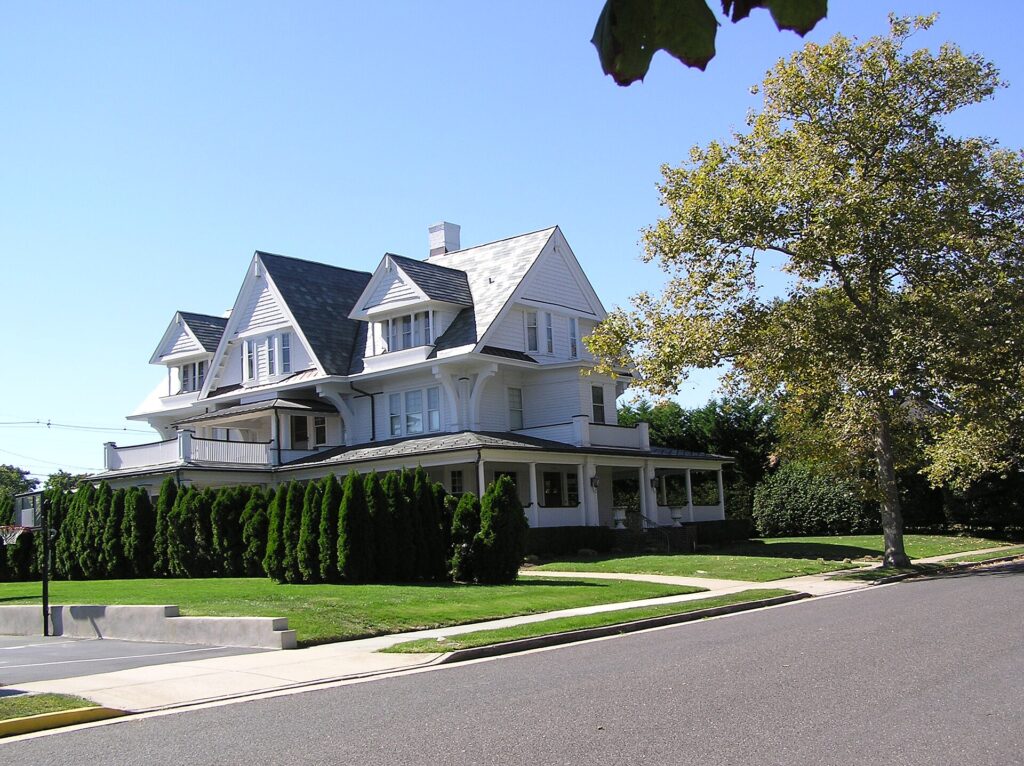
The photograph above, taken in the historic district in September 2013, shows a row of tall clipped evergreens along the edge of a lawn and a broad shade tree at the curb beside a large white house. That is the Allenhurst planting pattern in one frame: a formal hedge, an open lawn, and a tree reaching toward the street. A hedge like that keeps its shape only when the cuts stay inside the green growth, and the tree overhead is judged by different rules than the hedge beneath it.
Water sits on both sides of the borough. Deal Lake covers about 158 acres with 12.5 miles of shoreline, and the Deal Lake Commission says its lower main section sits only 3.2 feet above mean high tide. The Atlantic bounds the borough on the east. Salt, wind, and wet ground reach every plant in Allenhurst sooner or later, so a pruning plan has to leave plants strong enough for a nor’easter and not only neat enough for the weekend. Our tree storm proofing service follows the same idea.
Ornamental Pruning in Allenhurst Sits Between Chapter 23 and the Shade Tree Commission
Allenhurst adopted a tree ordinance on August 20, 2024, and it speaks directly to pruning. Chapter 23, Tree Removal and Replacement, adopted as Ordinance 2024-09, says its purpose is to reduce soil erosion and pollutant runoff, promote infiltration of rainwater into the soil, and protect the environment, public health, safety, and welfare. The text follows a state model written for stormwater permits, so trees are treated as part of how the ground handles water and not only as scenery.
The sentence homeowners need most is the definition of tree removal. It means to kill a tree or cause irreparable damage that leads to its decline or death, and it names excessive pruning along with over mulching, improper grading, and soil compaction inside the critical root radius. It then adds that removal does not include responsible pruning and maintenance. Ornamental pruning in Allenhurst is therefore protected when it is responsible and can count as removal when it is not.
The chapter defines a tree as a woody perennial plant that typically has a single stem or trunk and grows to a considerable height. We read that wording as reaching single stem ornamentals such as a flowering cherry or a weeping form on a front lawn. A clipped hedge of many stems is a different question, and a call to the borough before any heavy cutting is the safe way to settle it.
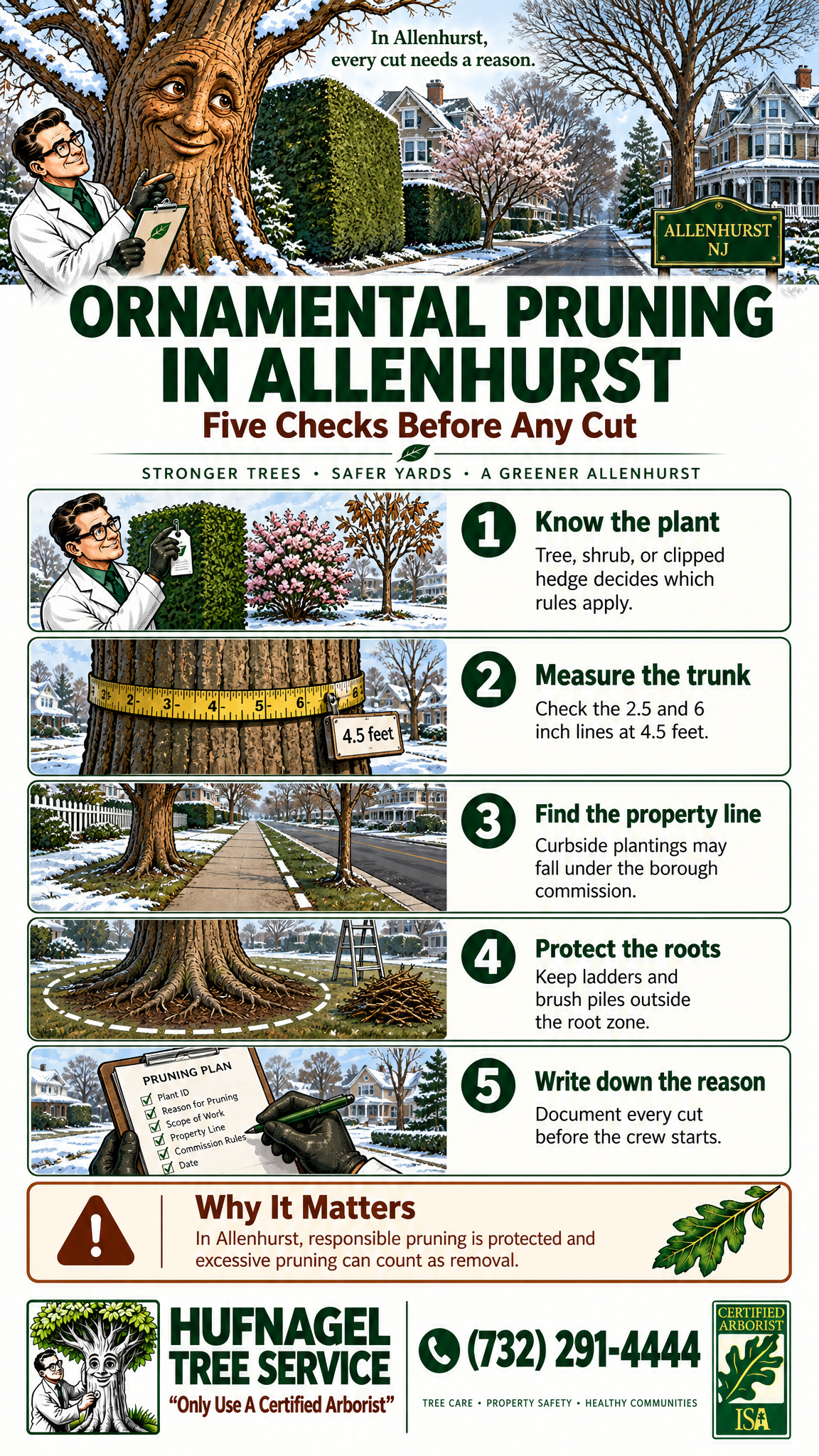
Anyone planning to remove a street tree with a trunk diameter of 2.5 inches or more, or any other tree 6 inches or more, must submit a Tree Removal Application to the Conservation Officer, and no tree is to be removed until that officer has reviewed and approved it. The first category in the replacement table covers trunks up to 12.99 inches, with one replacement tree of at least 1.5 inch caliper, a $155 application fee, and a $240 replacement fee when the tree is not replaced. Hazard trees, which include dead or dying trees and trees causing obvious damage to structures, may be removed with no fee or replacement requirement, and the chapter asks for written justification such as photos or a statement from a New Jersey licensed tree expert or arborist. A violation carries a fine that cannot be less than the cost of the replacement trees and their planting.
The ordinance also defines the critical root radius as the trunk diameter at breast height multiplied by 1.5 feet, so a tree 6 inches across has a protected zone 9 feet from the trunk. That matters for pruning because a visit involves ladders, lifts, chips, and brush piles, and work that compacts the ground inside that radius can count against a tree as surely as heavy cutting can. The crew’s access plan is part of the pruning plan.
Public ground follows a second rule. Section 2-38 of the borough code creates a five member Shade Tree Commission with full and exclusive control over the regulation, planting, and care of shade and ornamental trees and shrubbery in public highways, parks, and parkways, including their planting, trimming, and spraying. State highways are excluded unless the Department of Transportation assents. A tree or shrub growing in the public right of way in front of a house may therefore fall under that commission and not under the homeowner, so the question of who owns the ground comes first.
Mike Hufnagel puts the working rule this way: “An ornamental plant is easy to ruin and slow to repair. If we cannot explain what a cut is for, whether it is deadwood, clearance, or shape, then that cut is not ready to be made.” That keeps every visit focused on what the plant needs and not on how much material comes off.
Five Checks Before Any Ornamental Pruning Cut
- Confirm whether the plant is a single stem tree, a multi stem shrub, or a clipped hedge.
- Measure the trunk at four and a half feet to see which diameter line applies.
- Find the property line, since plantings in the public right of way may belong to the commission.
- Keep ladders, lifts, and brush piles outside the critical root radius wherever practical.
- Write down the reason for every cut before the crew starts work.
A plan that passes these five checks protects both the plant and the owner. A written reason for each cut is also the easiest record to show that the work was responsible pruning and not damage. Once the rules are clear, the next question is timing, because the cut that helps one shrub in March can cost another its bloom for the whole year.
Flowering Shrubs and Clipped Evergreens Run on Different Calendars

Rutgers Cooperative Extension fact sheet FS1221, Pruning Flowering Shrubs, sorts flowering shrubs into two groups. Spring flowering shrubs bloom on one year old wood, usually before the end of June, so they are pruned right after they flower, because cutting earlier removes the buds formed last year. Summer flowering shrubs bloom on new wood grown that spring and are pruned in late winter or early spring.
The fact sheet also gives a warning that fits the calendar right now. Do not prune spring or summer flowering shrubs from mid August through leaf fall, because the new growth may not harden off before winter. The exception is dead, diseased, damaged, or double crossed limbs, which the sheet calls the Four D’s and which can come out at any time. In late November that means a flowering shrub gets a careful look and not a haircut, and the real work waits for late winter or for the weeks right after bloom.
Penn State Extension covers the evergreen side. Late winter to early spring, before new growth develops, is usually the best time, and sheared plants such as arborvitae, hemlock, and yew hedges are pruned in early spring with an optional light pass in summer. The page notes that most needled evergreens will not regrow from bare wood, so a cut back to brown wood on most of them leaves that branch dead. Yews are the exception, because they carry dormant buds on old wood and can be renewed with hard cuts.
That is why a tall hedge cannot be dropped to a lower height in one visit. Arborvitae tolerates gentle shearing for screens and hedges, according to the same page, and the safe cut stays inside the green growth. A hedge that has outgrown its space may need a staged reduction over more than one season, or it may need to be replaced, and that is a conversation to have before any cutting begins. Our hedgerow trimming service starts with that kind of look at the plant.
Shape matters as much as timing. Penn State recommends an inverted V, wider at the bottom than the top, so sunlight reaches the lower branches, because shaded lower branches may thin or die. A hedge cut flat sided or wider at the top tends to lose its lower growth, and on a small lot with a fence or a house wall close by the loss shows quickly.
The photograph in this section shows two crew members pruning beneath a weeping ornamental tree beside a brick paver walk, with cut branches on the ground. Thinning cuts, which the Rutgers fact sheet describes as removing an entire limb back to its point of origin, open a plant to light and air without changing its form, and that is the cut a weeping or rounded ornamental needs most. Our guide to ornamental tree and hedge shaping and our ornamental pruning article for Sea Bright show how we sort these jobs by species and not by habit.
Older flowering shrubs need a longer plan. Rutgers describes renewal pruning as cutting about one third of the oldest stems to the ground in spring or summer, and rejuvenation pruning as cutting all stems to within six inches of the ground in early spring, no more often than every three to five years. Either method changes how a front yard looks for a season, which is why we agree on the plan with the owner before work starts.
Five Things to Check on Ornamentals Before Late Winter
- Dead, broken, or hanging stems that can come out now without waiting for the season.
- Crossed or rubbing branches that wear through the bark where they touch.
- Whether each flowering shrub blooms on old wood or on new wood.
- Bare brown patches inside evergreens that will not fill back in.
- Lower branches that have thinned because the top of the hedge shades them.
These checks need no ladder, and most can be made from the sidewalk on a clear afternoon. The findings sort plants into those that need a cut, those that need patience, and those that need a different plan. With the calendar settled, the last piece is the setting, because Allenhurst plants live between a state highway, an ocean, and a lake.
Salt Spray, Lake Edges, and Tight Lots Decide How Hard Ornamentals Can Be Cut

Norwood Avenue carries New Jersey Route 71 through the borough, according to Wikipedia, and a state highway means salt in winter. A Rutgers advisory on road salt and nearby plants says plants within roughly 15 feet of treated pavement sit in the spray zone and that damage is usually worst on the side facing the road. Salty runoff can also reach roots through the soil, and poorly drained soil lets salt accumulate.
Rutgers lists conifers among the more vulnerable plants because they keep their foliage year after year and salt builds up. Yews, hemlock, boxwood, and spruces are named as sensitive, while arborvitae, Leyland cypress, and American holly are named as moderately to highly tolerant, though the advisory notes that sources disagree and the species should be checked. A salt burned hedge looks like a pruning problem, but cutting brown growth hard can leave a plant with less foliage to recover on.
The remedies in the advisory are practical. Clear snow before applying deicer and use the minimum needed, install barriers or screens over winter, apply anti desiccants to evergreen foliage where salt is used, and wash salt coated foliage with salt free water. Our tree health management service covers the soil side of the problem, and our fall tree care article for Allenhurst goes deeper on salt and wind in the borough.
The lake edge adds a state layer. The Deal Lake Commission says strict NJDEP compliance applies to land within 50 feet of the lake shoreline and within 50 feet of any stream that drains into it, and it advises property owners to contact the NJDEP before any maintenance or construction along the shoreline, since work without the required permits can bring fines and delays. A trim near the water should start with that question.
The photograph in this section shows a tall, dense evergreen hedge across the back of a lawn with an extension ladder and two stepladders set against it and bare trees behind. A hedge that tall is a structure. Ladders and lifts need level ground and open access, and on a small lot that can mean working across a planting bed or along a shared fence, so we walk the site before we give a plan.
Tall dense hedges also catch wind in a nor’easter, so a hedge that leans, or a large ornamental beside a house or driveway, deserves a closer look than a low border does. Our tree risk evaluation service covers those plants, and our restoration work repairs them after storm damage. For a deeper look at the ground under the plants, our guide to root flare care in Allenhurst explains why mulch and grade matter.
Licensing matters here too. The New Jersey Board of Tree Experts explains that Licensed Tree Care Operators may prune and repair trees, cut brush, remove trees, and grind stumps, while Licensed Tree Experts can also diagnose tree ailments, install support cables and bracing, and assess trees and manage their risks. Chapter 23 asks for statements from a New Jersey licensed tree expert or arborist to document an exemption, so a licensed professional is part of the process either way.
Five Steps for Hedges and Ornamentals Before Winter Weather
- Clear snow before applying deicer and keep salt off foliage and planting beds.
- Screen salt sensitive evergreens that stand close to treated pavement.
- Wash salt coated foliage with salt free water and flush the soil during a thaw.
- Contact the NJDEP before any work within 50 feet of Deal Lake or its feeder streams.
- Hire a licensed crew and ask for the reason behind each cut in plain language.
A crew that can answer these five points will usually leave a plant in better shape than it found it. The answers also protect the owner, since a clear plan and a licensed contractor make it much easier to show that the work was responsible. With the rules, the calendar, and the setting understood, the last step is to schedule the visit.
Call Hufnagel Tree Service for Ornamental Pruning in Allenhurst Before Winter Weather
If you have hedges, ornamental trees, or mature plantings near your Allenhurst home, driveway, or lakeside lot, schedule an evaluation before the first hard freeze and the winter storms that follow. We provide tree trimming and pruning, hedgerow trimming, tree risk evaluation, tree health management, restoration, and tree removal when a tree cannot be managed safely.
Hufnagel Tree Service is led by a certified arborist with almost 30 years of local experience and more than 280 five star Google Maps reviews. We inspect first, explain what we found in plain terms, and recommend only the work that changes the outcome for your plants and your property.
Call or text (732) 291-4444 to schedule ornamental pruning in Allenhurst before the next winter storm. Our Allenhurst tree articles list more local guidance.
Schedule Service Now!
From precision pruning and safe removals to health assessments and preventative care, Hufnagel Tree Service delivers expert solutions backed by decades of experience. We offer certified insight, fair pricing, and a commitment to doing what’s best for your landscape.
Learn More About Our Services
Related Articles

Winter Storm Proofing Trees in Sea Bright NJ: Get Prepared