
Contents
Weak Tree Roots in Avon-by-the-Sea Matter in a Borough Between Two Waters
Avon-by-the-Sea became a borough on March 23, 1900, when the New Jersey Legislature set it apart from Neptune City, according to Wikipedia. It covers about half a square mile, roughly a fifth of it water, with the Atlantic Ocean to the east, the Shark River on the south side, and Sylvan Lake at the north end. The 2020 census counted 1,933 residents, and the borough website lists the borough office at 301 Main Street.
That layout shapes how we think about weak tree roots in Avon-by-the-Sea. A tree here grows in a small lot beside a street, a sidewalk, and a neighbor’s fence, in ground that is never far from water. Our tree risk evaluation service starts below the crown, because the roots decide whether a tree keeps its footing when wind and wet weather arrive together.
After almost 30 years working throughout Monmouth County, we have seen that November is a good month to read the base of a tree. The leaves are down, so a lean, a crack, or a raised edge of soil is easy to see. The National Weather Service says nor’easters are most common and most severe from September through April, so most of the season is still ahead. A root problem found now can be handled on a calm day.
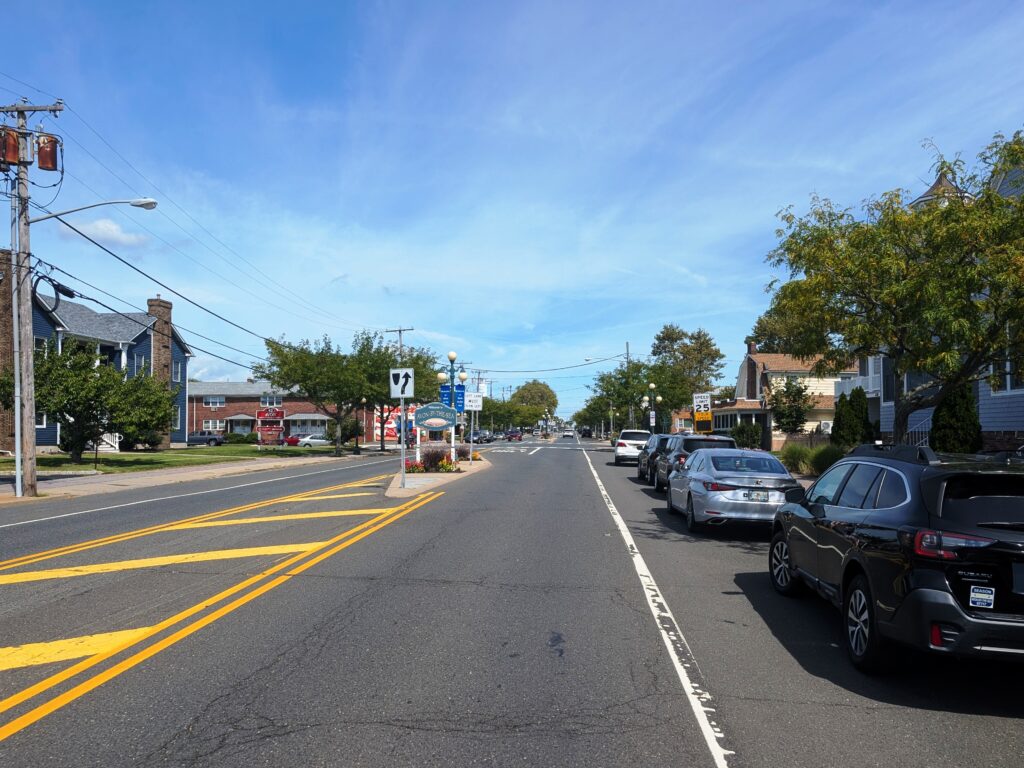
The photograph above shows northbound Main Street, which Wikipedia identifies as Route 71, the main north and south road through the borough. It was taken in September 2026. Street trees stand on both sides, a utility pole and its wires run along the left edge, and parked cars line the curb on the right. We see that mix often at the shore. A tree grows in a narrow strip between pavement and a house, and wires cross the air above it.
The water edges matter just as much. The same Wikipedia entry gives the borough an elevation of about 10 feet, with the Shark River along the south side and Sylvan Lake at the north end, and the borough homepage carries a flood information notice. We do not claim to know which blocks hold water after a storm. We do know that a tree near either edge can stand in soil that stays soft for days after heavy rain or a high tide, and that is when roots are asked to do the most.
Roots Spread Wide and Shallow, So the Base Tells the Story
Roots are shallower than most owners expect. Colorado State University Extension describes the rooting system of a landscape tree as shallow and wide spreading, with roots reaching only about one tenth of the height of the tree in depth. The radius of the root plate, the zone where the main structural roots branch and taper from the trunk, is three to six times the trunk diameter. For a tree about 50 feet tall, that puts most roots in roughly the top five feet of soil, spread across a wide circle. In a lot as small as an Avon lot, that circle usually runs under a driveway, a walk, and a neighbor’s fence.
The same page says the root plate is the primary support of a tree in winds up to 40 mph, and that transport roots add support above that. It also reports that fewer than 2 percent of landscape trees have a taproot. In plain words, there is no single deep anchor hiding underground. A tree stays upright because a plate of roots holds a mass of soil, and when that soil is soft, packed, or cut, the whole plate can shift. That is why weak tree roots in Avon-by-the-Sea is a question about footing and not only about branches.
The crown often reports on the roots before anyone digs. The Colorado State page notes that uniform stress throughout the canopy, or stress that moves from the top down, suggests root, soil, and water problems. Thin foliage, small leaves, and dieback in older branches can all point below ground, though none of them proves it alone. We compare what we see in the crown with what we see at the base, and we compare both with what the tree looked like in past seasons. A homeowner who photographs the same tree each fall gives us a record that no single visit can.
Some root problems are decay problems. A tree can look full and green while the wood at its base is soft, and a clear day does not make that tree safe. Our guide to weak tree roots and our guide to hidden tree rot describe the signs we look for at the root flare, where the trunk widens at the ground, and in the first few feet of the trunk. We look for fungus, cavities, cracks, and soft or crumbling wood, and we note where they sit in relation to the roots.
Targets decide how urgent a finding is. A root problem under a tree in an open field is a small concern. The same problem beside a house, a car, a service line, or a busy walk is a large one, and Avon lots leave little open space. Our tree risk evaluations tie each defect to the thing it could hit, and that ranking tells us what to do first, what can be watched, and what can wait until the ground is calm.
We also keep the cause and the symptom apart. A lean can come from wind, from soil that moved, or from a crown that grew toward light, and each cause calls for a different response. Mike Hufnagel puts it simply: “In a town this small, the roots of one tree often sit under a driveway, a walk, and a neighbor’s fence at the same time. I want to know what the ground has been doing before I decide anything about the branches.” That order keeps the work honest. It keeps us from pruning a crown that is fine and from ignoring a base that is not.
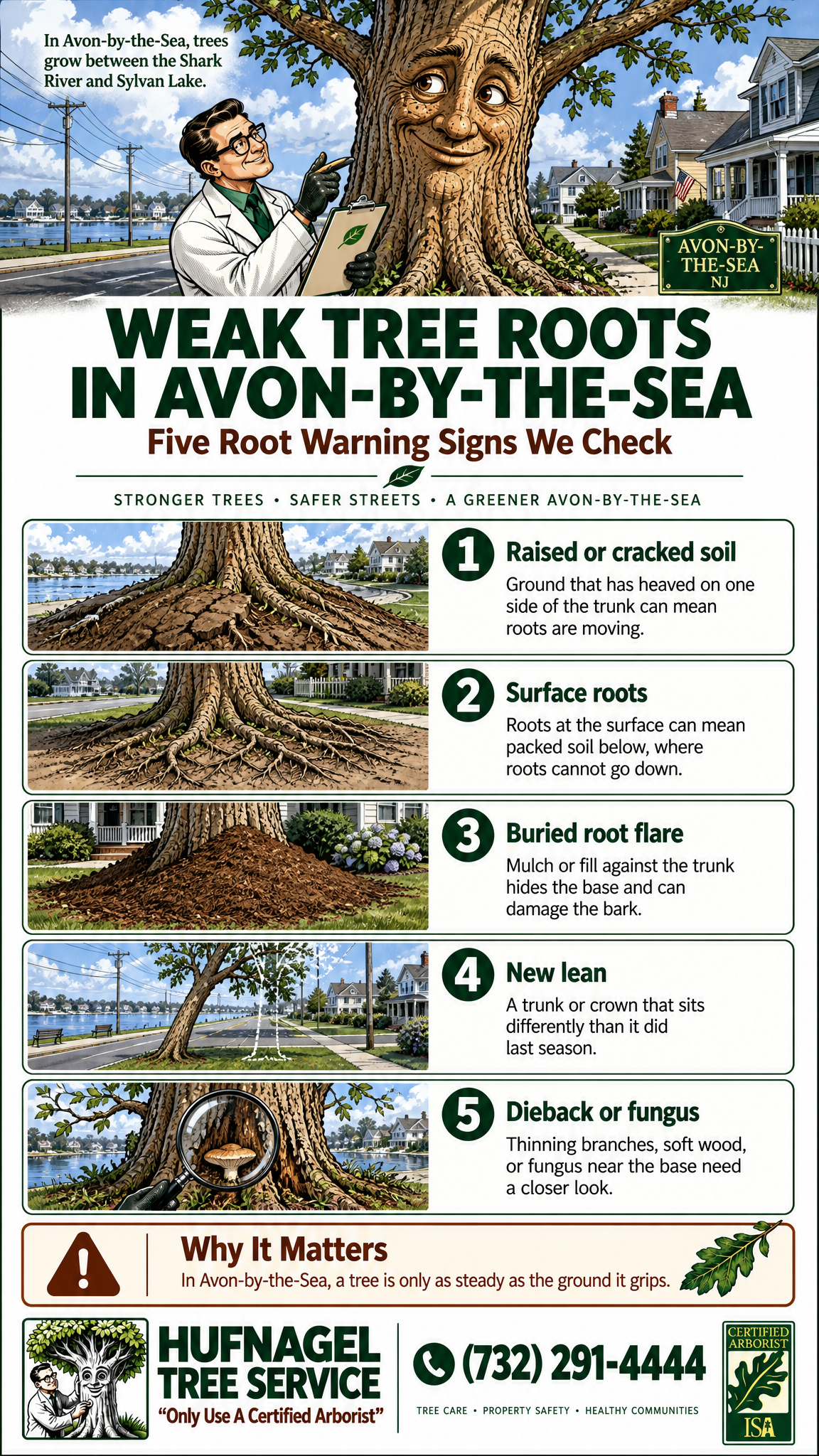
Five Root Warning Signs We Check in Avon-by-the-Sea
- Soil that is cracked, raised, or heaved on one side of the trunk.
- Roots lying at the surface where the ground is walked or driven on.
- Mulch or fill piled against the trunk and covering the root flare.
- A new lean, or a crown that sits differently than last season.
- Fungus, soft wood, or unexplained dieback near the base or in the crown.
Those signs rarely appear alone, so we weigh them together. The answer is usually some mix of pruning, restoration, monitoring, or removal, and a leaning tree with a firm base is a very different case from a leaning tree with a raised edge of soil. Once the structure is understood, the next question is the ground itself, because a small borough between a river and a lake asks a lot of the soil under its trees. Our guide to storm season risk assessment covers the same ground level look at greater length.
Water on Two Sides and Packed Soil Change How Avon Roots Hold

Avon-by-the-Sea has water on two sides, and Wikipedia puts about 21 percent of the borough’s total area under water. After a nor’easter pushes rain and tide into a low town, the soil under a tree can stay soft for days. We treat wet ground as part of the storm. The roots hold a tree up, and the crown is only what the wind pushes on, so weak tree roots in Avon-by-the-Sea matters most when the ground is wettest.
Packed ground does damage too. Colorado State describes compaction as a loss of large pore space that lowers soil oxygen and drainage, and says rooting depth is reduced as a result. It adds that soils are most prone to compaction when they are wet. On a small lot, the places where soil gets packed are easy to name: a parking pad, a path to the side gate, a spot where a contractor stacked materials, or a lawn that every delivery truck crosses. A tree beside any of them is rooted in soil that has lost air.
Rutgers Cooperative Extension explains that plant roots cannot penetrate soil as it becomes denser. Its warning signs include shallow or surface roots, exposed soil in continuous pathways, and water that pools on the ground. It also notes that wet soil is especially vulnerable to heavy machinery. We would add one thing from the field. A tree that was healthy before a patio or a driveway went in can start to decline a few seasons later, and the owner rarely connects the two. We ask about past work near the root zone for that reason.
The photograph above shows what it looks like when a root plate lets go. A large leafy tree lies across a lawn and a driveway with its root plate tipped up at the left edge and a house behind it. We include it as an example of the failure, and it is not a record of an Avon tree. When this kind of failure happens it can look sudden, but the warning is often at the base for weeks in the form of cracked soil, a raised edge, or a lean that was not there last season. That is why we look at the ground before we look up.
Winter adds wind to wet soil. The National Weather Service describes nor’easters as storms with winds of gale force that can also bring coastal flooding, and it warns that a storm could cut power. A tree on soft ground does not get one gust. It gets hours of repeated loading, and the roots on the windward side are the ones that carry the pull. A root plate that has been fine for years can lose margin in a single long event.
We are careful about what we recommend. Homeowners should look, photograph, stay clear, and call. Digging at the base to see the roots, cutting a root that is in the way, or adding soil over the root zone can each make a weak tree weaker. When we find a root problem, the response may be pruning to reduce load on the weak side, restoration, a plan to monitor the tree after each storm, or removal when the base can no longer be trusted. Which one applies depends on the findings, not on the fear.
Ground Level Checks After a Soaking Rain or Coastal Flood
- Soil that has cracked, lifted, or heaved on one side of the trunk.
- Standing water or soft ground that lingers over the root zone.
- A trunk that leans more than it did before the storm.
- Bare, packed soil where vehicles or foot traffic cross the root zone.
- Roots exposed at the surface, or a tipped edge on the root plate.
Those five checks give an owner something specific to do before a call, and they give us a clear starting point when we arrive. Some trees need only monitoring. Others need targeted work. If a tree is leaning toward a house or a wire after a storm, keep people and cars away from the area and call us. With the ground understood, the last part of the plan is what an owner controls year round: mulch, planting choices, and the rules that apply to trees in the borough.
Mulch, Planting Choices, and Borough Rules Shape the Root Plan

Mulch is the part of the root zone an owner controls, and it is easy to overdo. Rutgers Cooperative Extension Fact Sheet FS099, Problems With Over-Mulching Trees and Shrubs, says total mulch depth should not exceed 3 inches, and should be 2 inches or less on compacted or poorly drained soil. It says to keep mulch 8 to 12 inches from the trunk of a mature tree, because mulch piled against the trunk can kill the inner bark. It also notes that root growth in most trees declines once soil oxygen falls below 10 percent. For weak tree roots in Avon-by-the-Sea, that means a mulch volcano is a slow problem that looks like a neat landscape.
The same fact sheet warns that symptoms can take several years to show up, and that by the time foliage turns off color, leaves shrink, and older branches die back, the decline is usually irreversible. We see the early version of that story when we pull mulch away and find a root flare that has been buried for years. Colorado State goes further and says that trunk girdling roots, caused by planting too deep, are the most common cause of tree decline and death in the landscape, and that a missing root flare on an established tree suggests the tree was planted too deep.
The borough gives owners useful guidance on what to plant. The Shade Tree Committee, part of the Environmental Commission, publishes a list of trees approved for rights of way. It groups them by space: full size shade trees of 40 to 60 feet, such as black gum, honey locust, northern catalpa, and several oaks, smaller trees of 20 to 35 feet for sites under utility lines, such as eastern redbud, tree form serviceberry, and Japanese tree lilac, and columnar choices for narrower strips. The committee says it encourages native species and a diverse canopy.
We read that list as a root decision as much as a canopy one. A tree matched to its strip has roots that can spread without lifting a sidewalk or crowding a foundation, and a tree under wires that stays small needs less pruning later. The page covers rights of way, so it says nothing about a private lot, and it does not replace a conversation about a specific property. We suggest owners use it as a starting point and ask us before putting a large species in a small space.
The photograph above shows two crew members on a lawn around a young tree with several stems and a ring of dark mulch at its base. One of them is using a power auger on the soil near the stems. Work in the root zone is a good example of why we ask owners to call first. Soil work can help a tree when it is done for a reason, and it can hurt a tree when it is done to a mature root zone without a plan.
Debris has rules as well. The borough public works page says loose leaves are collected from the street only between October and early December, kept four feet from the curb, and free of other yard debris. It asks that limbs be cut to 4 foot lengths and tied in bundles, and to call ahead for a load larger than half a standard pickup. Landscapers are responsible for removing their own brush and debris. None of that requires piling leaves or brush over the roots of a tree, and we would not do it.
We cannot tell an owner from here what the borough requires for a specific tree. The pages we reviewed cover planting and collection, and the Environmental Commission page says the commission was created by ordinance in December 1992 under Chapter 15 of the municipal code. For any question about removing or cutting a tree, ask the borough office at 301 Main Street first. Our guide to tree removal permits explains what that conversation usually involves.
Root Zone Habits That Protect Trees in Avon-by-the-Sea
- Keep mulch shallow and pulled back from the trunk of every mature tree.
- Keep vehicles, stored materials, and piled soil off the root zone.
- Leave the root flare visible where the trunk meets the ground.
- Choose trees sized for the planting strip and the wires above it.
- Call us before trenching, regrading, or paving near a mature tree.
These habits cost very little, and they protect the structure that every storm eventually tests. The goal is not to fuss over a tree. The goal is to keep the ground around it open, level, and breathing, and to catch a change early enough that we still have choices. Where a root problem is already present, our tree health management service looks at the soil, the roots, and the crown as one system, and it ties the plan to the tree and the property.
Call Hufnagel Tree Service About Weak Tree Roots in Avon-by-the-Sea Before Winter
If you have mature trees near your Avon-by-the-Sea home, driveway, sidewalk, or property line, schedule an evaluation before winter storms arrive. We provide tree storm proofing, tree risk evaluations, tree trimming and pruning, restoration, and removal when a tree cannot be managed safely.
Hufnagel Tree Service is led by a certified arborist with almost 30 years of local experience and more than 280 five star Google Maps reviews. We inspect first, explain what we found in plain terms, and recommend only the work that changes the outcome for your trees and your property.
Call or text (732) 291-4444 to schedule a root and tree risk inspection in Avon-by-the-Sea before the next nor’easter arrives. Our Avon-by-the-Sea tree articles list more local guidance.
Schedule Service Now!
From precision pruning and safe removals to health assessments and preventative care, Hufnagel Tree Service delivers expert solutions backed by decades of experience. We offer certified insight, fair pricing, and a commitment to doing what’s best for your landscape.
Learn More About Our Services




Related Articles
Tree Health in Sea Bright NJ: Salt, Sand, and Flooded Roots
Tree Trimming in Keansburg NJ: Clearance, Disposal Rules, and Timing
Tree Risk Evaluation in Colts Neck, NJ