Contents
Tree Restoration in Sea Girt Begins Where the Cedars Meet the Sea
Sea Girt became a borough in 1917 by an act of the New Jersey Legislature, with land taken from Wall Township, according to Wikipedia. The name comes from the estate of Commodore Robert F. Stockton, who bought property there in 1853. The borough covers 1.46 square miles, about 27 percent of it water, and counted 1,866 residents in 2020. Its motto, Where the Cedars Meet the Sea, names the exposure that every tree in town lives with.
That exposure is why tree restoration in Sea Girt is rarely a simple trim. Salt, wind, shifting sand, and winter storms leave marks on a crown and on the ground around it, and those marks decide how much of a damaged tree can be kept. Our tree restoration service is built around a fair chance for that tree, with the sound parts kept and the failing parts corrected. The answer changes from the ocean blocks near Ocean Avenue to the streets along Route 71, which follows Seventh Avenue on the west side of the borough.
After almost 30 years working throughout Monmouth County, we have seen that late fall is the right time to judge a coastal tree. Leaves are down, so cracks, dead tips, and lopsided growth show clearly, and the ground has not yet frozen. A tree judged now can be corrected on a calm day, and one that cannot be kept can be handled before a winter storm decides the schedule.
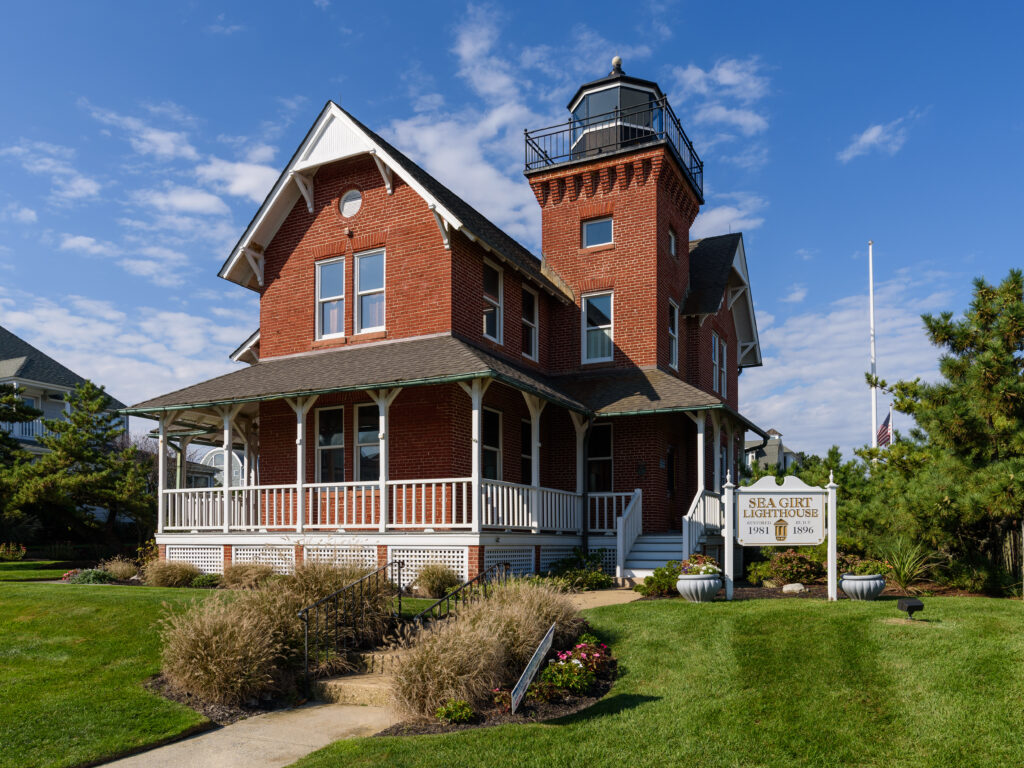
The photograph above shows the Sea Girt Lighthouse, which stands where Ocean Avenue meets Beacon Boulevard. Evergreens grow close to its brick walls, with ornamental grasses along the front walk and a lawn running out to the street. The Wikipedia history of Sea Girt Light says the light was first lit on December 10, 1896, and that shifting sand and erosion were problems from early on, with fencing added in 1900 and steel pilings in the 1920s to contain them. Ground that moves around a lighthouse also moves around tree roots, and we check for that whenever a tree stands this close to the beach.
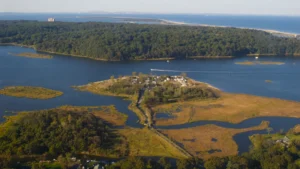
The other edge of the borough is wet in a different way. Wikipedia describes Wreck Pond as a coastal tidal pond of about 73 acres, shared by Sea Girt, Spring Lake, Spring Lake Heights, and Wall Township. After Hurricane Sandy the ocean was found to have restored a natural inlet, and an expanded gated culvert was completed in 2016. Trees on low ground near the pond can stand in wet soil after heavy rain, and in our experience that is where we see leaning and root movement most often.
Salt, Wind, and Sand Leave Marks That a Restoration Plan Must Read
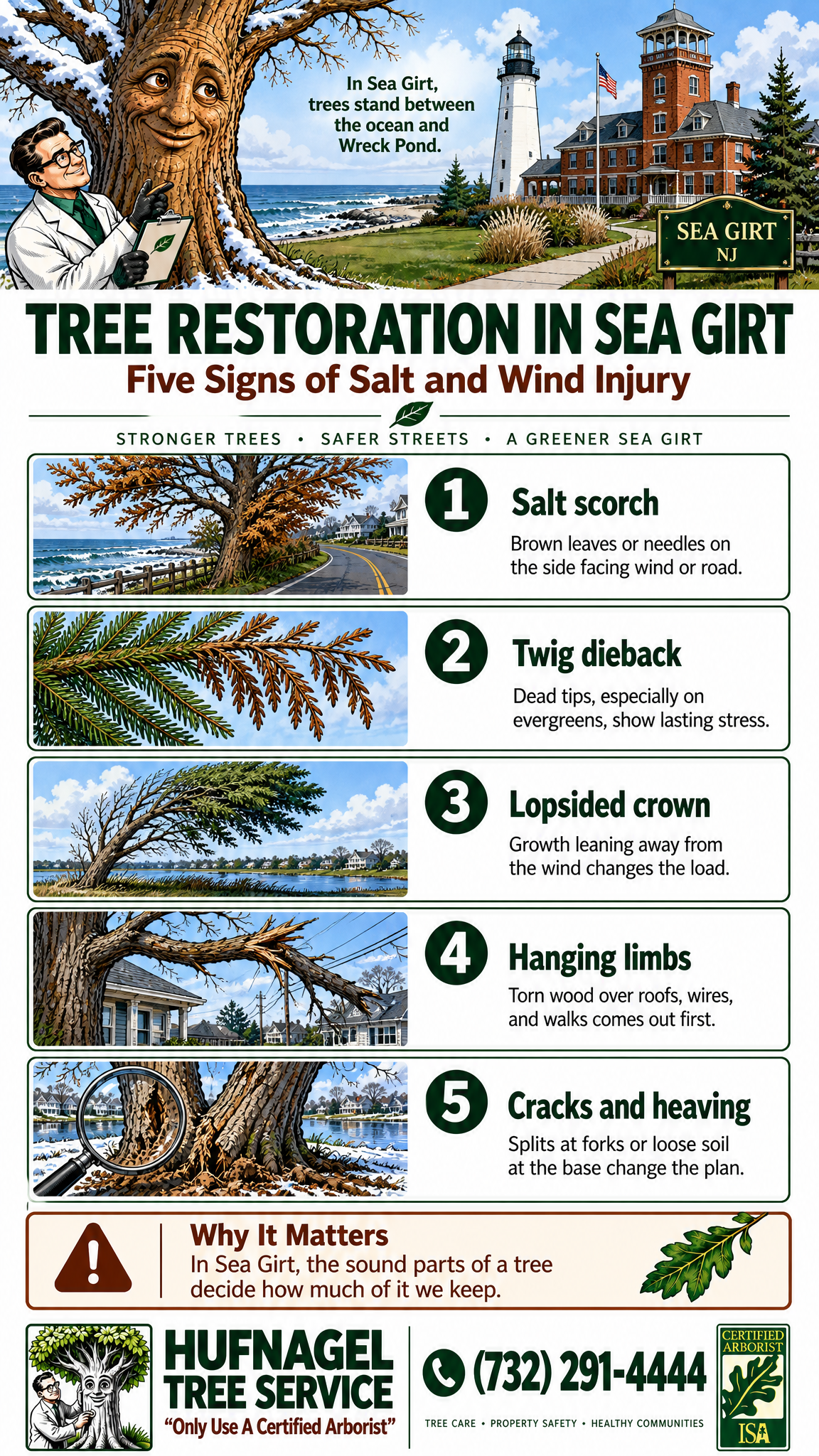
A coastal tree keeps a record of what it has been through, and tree restoration in Sea Girt begins with reading it. We start at the ground, where heaved soil, new cracks, or fungus at the root flare change the whole plan. We move up the trunk to old wounds and the unions where large stems meet, then to the crown, where broken tips and torn limbs are the part homeowners already see.
Salt is the first thing we look for. The Rutgers Plant and Pest Advisory notes that salt injury shows up as foliage scorch and early leaf drop, and that severe cases can kill twigs, branches, or a whole plant. It adds that conifers are damaged more easily than deciduous trees because they do not drop their needles every year, so they hold on to what they collect. Rutgers wrote about deicing salt on highways, but the pattern is one we recognize on the windward side of coastal evergreens, and we read both the same way.
Rutgers describes the spray zone as roughly the first 15 feet from traffic lanes, with injury most visible on the side facing the road. A tree beside Seventh Avenue or any plowed street in the borough sits inside that distance, and the scorch usually shows on the road side of the crown first. Timing matters too. Rutgers says salt applied in late winter and early spring is more likely to cause damage than salt applied earlier, because rain and melt have less time to wash it from the root zone before growth starts.
Some of the remedies are simple. Rutgers recommends clearing snow before applying deicer, using the minimum amount needed, and leaching contaminated soil with fresh water as soon as possible. It also suggests rinsing exposed foliage with salt free water. Those are steps an owner can take without a ladder, and they let us concentrate on what only a climber can judge from inside the crown.
Wind leaves a different mark. A crown that has grown for decades against the same wind often carries more weight on one side, and a tree that leans away from the ocean puts a steady load on its roots and on the unions in its trunk. Large stems that share one base are the case described in our guide to codominant stems, and they are the first place a wind loaded tree tends to split. We would rather leave a lean under observation than correct it with a heavy cut that creates a second wound.
Targets finish the reading. A limb that is only a problem over an empty lawn becomes a much larger one over a roof, a car, or the sidewalk, and a borough of 1.46 square miles has very little empty space between a tree and what it can reach. Our tree risk evaluation connects each defect to what it could hit, and that tells us what to do first. Mike Hufnagel puts it simply: “A tree that took a hard season is not a tree to give up on. We find what is still sound, correct what is not, and leave the rest of the crown alone so the tree can keep working.” That order keeps the work honest. It keeps us from removing a tree with a dependable structure, and it keeps us from saving one that has none.
What We Look For Before Restoring a Sea Girt Tree
- Brown or scorched foliage on the side facing the ocean or the road.
- Dead tips and twig dieback, especially on evergreens near salt exposure.
- A crown that leans or grows lopsided away from the prevailing wind.
- Torn or hanging limbs over roofs, wires, driveways, and the public street.
- Cracks at forks, loose soil, or heaved ground around the base of the trunk.
Those signs rarely appear alone, so we weigh them together. The answer is usually some mix of pruning, restoration, monitoring, or removal, and a tree with scorched needles and a sound base is a very different case from one with scorched needles and decay at the root flare, which is the situation in our guide to hidden tree rot. Once we know what a tree can still carry, the next question is how the cuts are made, because the method decides how well the tree answers them.
Restoration Cuts Remove Little and Wait for the Dormant Season
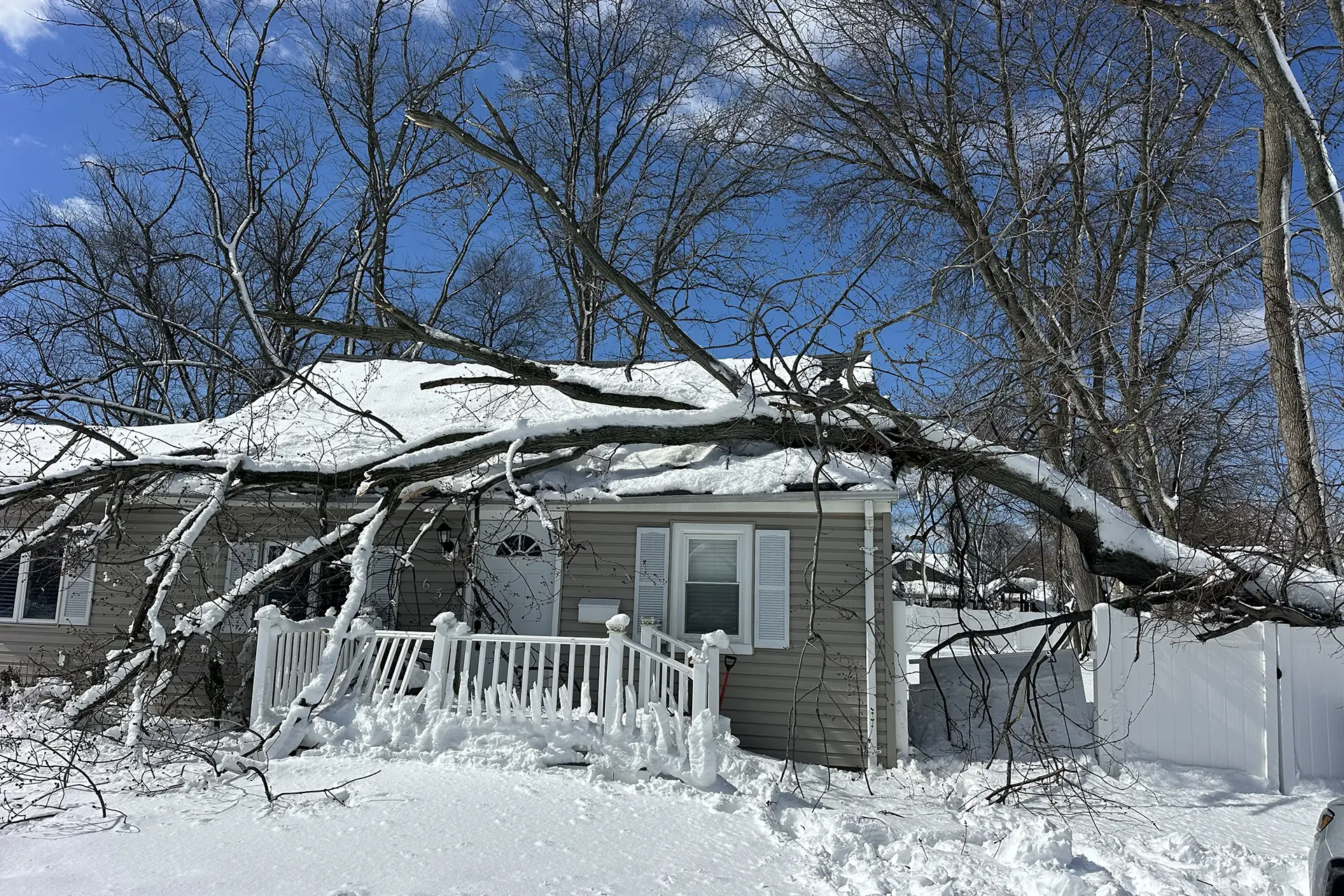
Restoration is mostly restraint. The International Society of Arboriculture advises that winter is one of the best times to prune because bare branches make the structure of a tree easy to see, but it also says to limit pruning to dead wood and poorly placed branches so that as many living branches as possible are saved. That is close to how we work. For most mature trees, good tree restoration in Sea Girt is hard to see from the street afterward, because the crown still looks like the species and the hanging limb over the roof is gone.
The photograph above, from this year’s winter blizzard cleanup, shows what a heavy bare limb can do once wet snow collects on it. The ISA release says heavy ice and snow can split or break branches, and Illinois Extension adds that frozen limbs are brittle. Its advice is to avoid shaking snow off a branch and to sweep it gently upward with a broom instead, without standing under the branch. Iowa State Extension makes the same point about ice, saying that letting the sun melt it is usually best and that beating the branches with a broom or rake only does harm.
Broken limbs need a specific cut. Illinois Extension says a broken young branch should be cut back to the main branch or trunk, and that large limbs belong to a tree care professional. Iowa State gives the same instruction for a broken limb in late winter, when it can be reached safely. We remove large limbs in stages so their weight does not tear bark down the trunk, which is why a job near a roof or a wire often involves ropes, a lift, or both. A limb already touching a service wire is not a do it yourself project. Stay back, photograph it, and call the utility.
Bent branches deserve patience. Iowa State notes that unbroken branches are flexible and often return to position over several weeks or months, and it advises against propping or tying them up in the meantime. If branches are still bent in early summer, broad flexible straps can retrain them, and the ties need to come off within two growing seasons because forgotten ties can girdle and kill a branch. We follow that timetable, and we photograph the bend so it can be compared with the same branch next spring.
Topping is the one cut we name only to reject. Cutting the top out of a tree to make it feel safer leaves stubs, weak regrowth, and open wounds, and it does nothing for the cracked union that caused the worry. When a crown truly has to be smaller, a measured reduction back to a suitable lateral serves the structure better. A tall tree is not automatically a problem. A tree with a defect over a target is, and that is what our tree trimming and pruning is designed to address.
Roots come with the work. ISA recommends a thin protective layer of organic mulch around a tree in the fall to retain water and reduce stress from temperature extremes, and Illinois Extension says to keep that mulch a few inches from the trunk. ISA also says winter droughts call for watering as much as summer ones do, as long as the soil and the tree are cool and not frozen. A tree that has lost limbs has less foliage to feed its roots, so a light hand on the ground does more good than any machine on a root zone that is already stressed.
How We Tell Careful Restoration Cuts From Damaging Ones
- Cuts that remove dead, hanging, or poorly placed wood and very little else.
- Broken limbs cut back to a main branch or to the trunk.
- Large limbs lowered in stages so bark does not tear down the trunk.
- A crown that still looks like its species, with no topping or stubs.
- Bent branches left alone to recover on their own, with no propping.
A job that passes those tests leaves a tree that is easier to read next year, and that matters because coastal trees change from season to season. The record we keep lets us choose between pruning, restoration, monitoring, or removal later, and it connects to our guide to weak tree roots for the trees whose problems begin below ground. The next step is the property, the borough code, and the way damaged wood leaves the site.
Borough Code, Wreck Pond Soil, and Replanting Shape the Plan

Restoration in Sea Girt also has to fit the borough code. Chapter 19, Tree Preservation, was amended in 2023 and states on eCode360 that its purpose is to prevent indiscriminate, uncontrolled, and excessive destruction and removal of trees, in order to maintain the character of the borough, prevent erosion, and restrict actions that cause a hazard to persons or property. We do not give legal advice, but the chapter shapes how we plan work, and we encourage owners to read it before any tree comes down.
Two definitions matter most for restoration. The chapter says removal includes actions that lead to the death of a tree through damage or poison, and it says removal does not include pruning for maintenance. That is one more reason we keep restoration cuts small, since the code looks at what happens to the tree and not only at the saw. The permit threshold is four inches or greater caliper, measured 54 inches above the ground, so most mature trees in town are covered if removal ever becomes the answer.
When removal is the honest answer, the code calls for a mitigation plan before a permit is issued. The owner either replants or pays into the Tree Replacement Fund, and the replacement value scales with the tree, from $500 for a tree of 4 to 6 inches up to $1,500 for a tree of 16 inches or greater. The Code Enforcement Officer must act on a complete application within 30 business days. Our our guide to tree removal permits explains the general process, and the borough’s code governs the details.
Other rules affect the day of the job. The code says no tree or portion of a tree may be felled, dropped, or cut further within the public right of way, so limbs over the street are lowered and not dropped. After approval, stumps and root balls may not stay on the property for more than 30 days, and a tree on a property line needs the written consent of the adjoining owner before removal. The code also lets a tree that poses an imminent public safety hazard, as determined by a New Jersey Certified Tree Expert or a competent public authority, be removed without applying first.
The photograph above shows a crew and a lift working among tall bare trees at the far edge of a paddock. Bare crowns are the reason we prefer the dormant season for planning, since limbs, unions, and dead tips show clearly against the sky. Near Wreck Pond and other low ground we also look at the soil itself, using the checks in our tree health management service, because a tree stressed by wet or compacted ground will not recover just because its limbs were corrected.
Planning in order keeps the visit focused. Hazards come first, structure second, and shape last. Wires and dead limbs over targets are handled before anything cosmetic, and the cut that matters most is made before the one that looks best. Where a tree cannot be managed safely, because the base is decayed or the roots are moving, removal is risk reduction and not a failure of care. Our storm proofing work often follows a restoration so that the next coastal storm meets a better tree.
Questions a Sea Girt Restoration Plan Should Answer
- Which limbs sit over roofs, wires, driveways, and the public street.
- Which dead or hanging limbs should come out first this winter.
- How much live crown can stay in place to keep the tree balanced.
- Whether any part of the plan counts as removal under the borough code.
- Which trees need a second look after the first heavy coastal storm.
Those five answers turn a general worry into a short list that an owner can follow. Some trees need only monitoring. Others need targeted pruning, restoration, support, or removal. When the list is clear, the work can be scheduled before the weather decides the order, and the owner knows why each step comes when it does. Our tree removal service is the last option on that list, never the first, and more local notes are collected on our Sea Girt page.
Call Hufnagel Tree Service About Tree Restoration in Sea Girt Before Winter
If you have mature trees near your Sea Girt home, driveway, or property line, schedule an evaluation before winter weather adds load. We provide tree restoration, tree trimming and pruning, tree risk evaluations, storm proofing, and removal when a tree cannot be managed safely.
Hufnagel Tree Service is led by a certified arborist with almost 30 years of local experience and more than 280 five star Google Maps reviews. We inspect first, explain what we found in plain terms, and recommend only the work that changes the outcome for your trees and your property.
Call or text (732) 291-4444 to schedule tree restoration in Sea Girt before the next coastal storm arrives.
Schedule Service Now!
From precision pruning and safe removals to health assessments and preventative care, Hufnagel Tree Service delivers expert solutions backed by decades of experience. We offer certified insight, fair pricing, and a commitment to doing what’s best for your landscape.
Learn More About Our Services


Related Articles
Fall Storm Proofing in Keansburg NJ: Prepare Trees Before Winter