Contents
Hedge Trimming in Keansburg Starts With a Borough Built on the Bay
Hedge trimming in Keansburg starts with how little ground the borough has. Wikipedia says Keansburg was formed on March 26, 1917, from parts of Middletown Township and Raritan Township, which is now Hazlet, and that a referendum approved it on April 17, 1917. The borough has about 1.07 square miles of land, 9,755 residents in the 2020 census, an elevation listed at zero feet, and Raritan Bay as its main body of water. Beachway, Main Street, Carr Avenue, Church Street, and Myrtle Avenue are among the streets it names.
That scale changes how we think about hedges. On a small Keansburg lot a hedge is rarely decoration alone. It marks a property line, screens a window, or shelters a front walk, and it often stands a few feet from a fence, a gutter, a meter, or a wire. Our hedgerow trimming and tree trimming and pruning work begins with what the hedge is for and what it stands next to, because that decides how and when it should be cut.
After almost 30 years working throughout Monmouth County, we have seen that the worst hedge damage is done with good intentions. A homeowner cuts hard in November, the cut looks tidy, and a browned face shows up in spring. This article explains why late fall is a time for looking and planning, and what we check on a Keansburg hedge before winter.
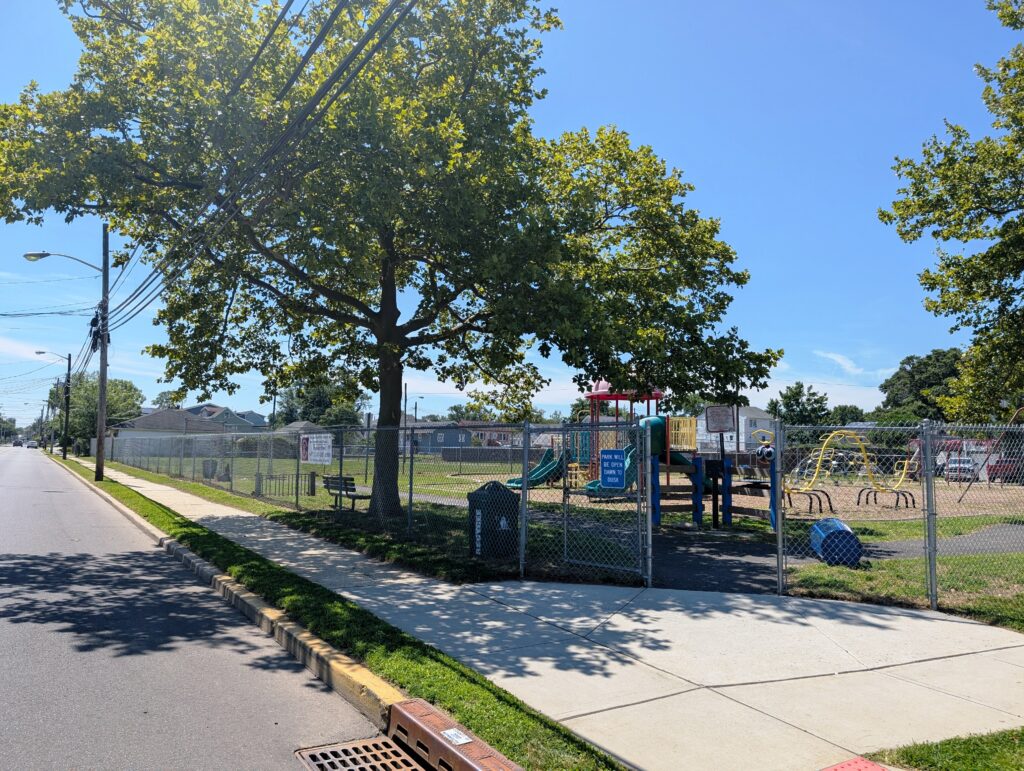
The photograph above shows Carr Avenue at Seeley Avenue looking southwest toward John J. Donohue III Park, according to the Wikimedia Commons description. A large street tree spreads over the sidewalk beside a chain link fence and a playground, with overhead wires along the road and only a narrow grass strip at the curb. Hedges in the borough live in the same tight arrangement, with a trunk or a row of shrubs, a lot line, and wires within a few feet of each other.
Water is the other fact of life here. Wikipedia puts water at 93.59 percent of the borough’s total area, says Hurricane Donna wiped out much of the waterfront in 1960, and says a $7.9 million Bayshore Hurricane Protection Plan widened the beaches in 1969. A January 2024 DVIDS story quotes a firefighter and state maintenance worker saying the tide gate on the Keansburg Beach storm damage project works as intended and stops local flooding, and the borough keeps a flood information page for residents. Even so, low ground stays wet, and a hedge that stands in soggy soil through winter tells us something about its roots.
Late Fall Is for Planning Hedge Work, Not for Shearing
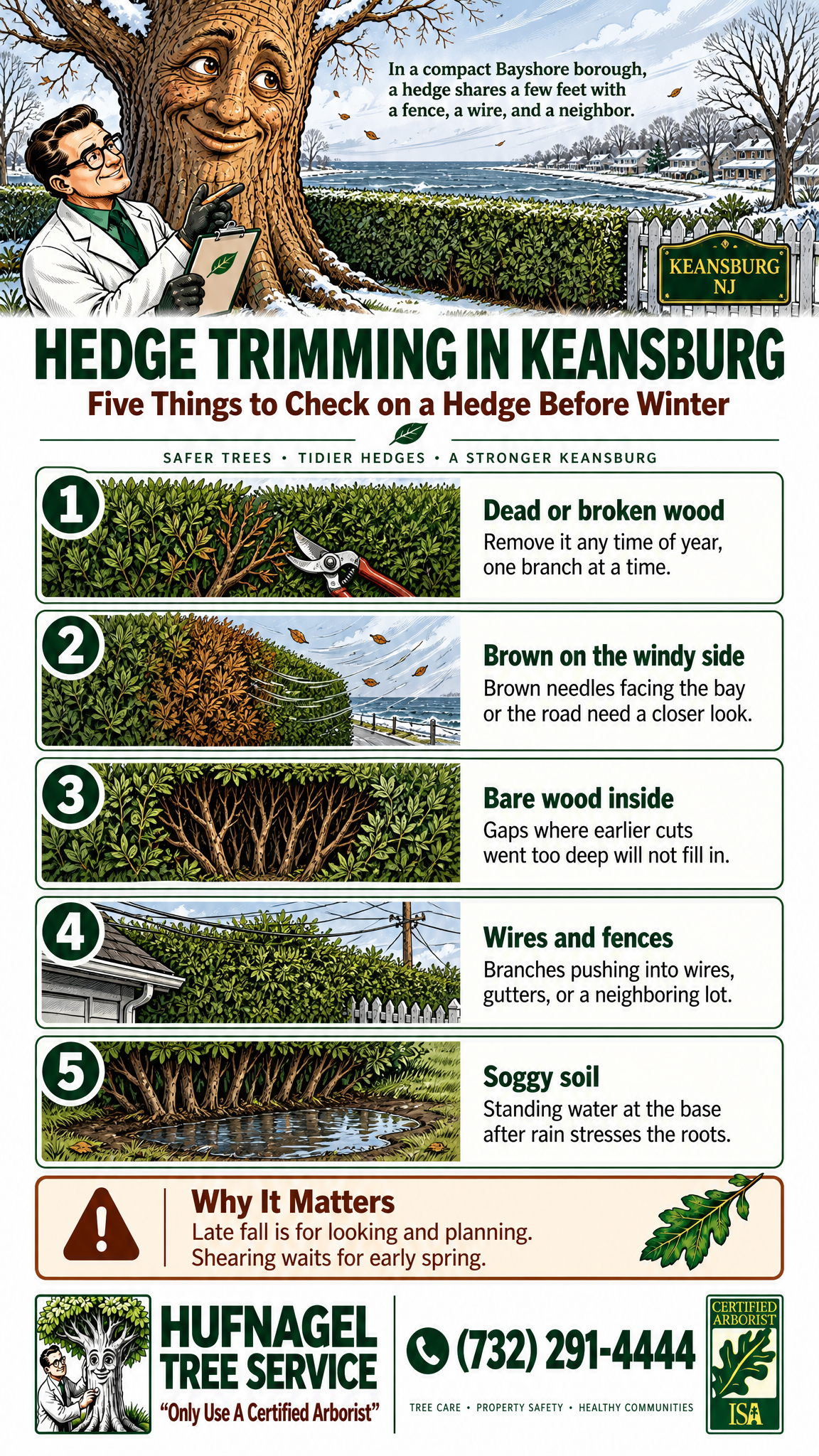
The first rule of hedge trimming in Keansburg is to match the month to the plant. The University of Delaware Cooperative Extension recommends late winter or early spring, just before growth begins, for most pruning, and says junipers, arborvitae, yews, and hemlocks do best with early spring pruning, with light trimming later in the season when needed. The Chicago Botanic Garden goes further and lists late fall as a time to avoid pruning evergreen hedges.
The reason is practical. A cut in November opens a wound that cannot begin to close until growth resumes, and it removes foliage the plant would otherwise carry through winter wind. Neither page tells a homeowner what one cold night will do to one cut, and we will not pretend to either. They simply agree on the calendar, and the calendar is the one thing a homeowner can control.
Dead, diseased, and broken wood is the exception. The Delaware sheet says it can be removed any time of year, which means a hedge with a snapped branch or a dead section can be cleaned up now without waiting for spring. That is selective work, done one branch at a time and cut back to a side shoot on most species, and it is very different from running a hedge trimmer along the whole face of the hedge.
Shearing and selective pruning are different jobs. The Delaware page describes shearing as removing new growth evenly to hold a set shape, such as a clipped hedge, and says it encourages denser growth. Boxwood, Japanese yew, and evergreen privet tolerate it well. Junipers are a different case, because the Chicago Botanic Garden advises tip pruning them rather than shearing so they keep their feathery look. A hedge of mixed plants, which is common on small lots, may need both approaches in the same row.
Cutting into bare wood is a mistake we see often. The Delaware page warns that new growth is not as readily produced from old wood, with yews as the exception because they withstand severe pruning into older wood. A hedge that has grown too wide cannot always be brought back to the line the owner wants in a single visit, and a plan that spreads the reduction over two springs often saves the plant. When a hedge is thin or discolored, we look at the whole plant, including roots and drainage, as part of our tree health management work.
Mike Hufnagel puts it simply: “A hedge is easy to cut and hard to repair. We would rather wait for the right month than leave a brown face on a hedge that took years to fill in.” That is why a good hedge plan has two parts, the cuts that can happen now and the cuts that wait, and why we write both down for the homeowner.
What to Check on a Keansburg Hedge Before Winter
- Dead, broken, or hanging branches that can be removed at any time of year.
- Brown needles or leaves on the side facing the wind or the road.
- Gaps or bare wood inside the hedge where earlier cuts went too deep.
- Branches pushing into wires, gutters, fences, or the neighbor’s lot.
- Soil that stays soggy or holds standing water at the base after rain.
None of these signs means a hedge has to be cut today, and several of them are better handled in March than in November. The goal is not to tidy the hedge before the weather turns. The goal is to know what the hedge is doing, remove what is clearly dead or in the way, and schedule the shaping for the month the plant prefers. Once the calendar is settled, the next question is which plants will actually last on a windy, salty lot.
Salt and Wind Decide Which Hedge Plants Last Near the Bay

Keansburg hedges live with wind off the bay and salt from the road, so plant choice matters as much as pruning. A Rutgers Cooperative Extension advisory by Ann Gould, dated March 20, 2013, on road salt and adjacent vegetation says salt ions bind water so tightly that roots struggle to take up enough of it, and that chloride builds up in growing tissue over time, causing leaf burn and twig dieback. The advisory is about road salt, not bay spray, but its plant lists are a reasonable starting point for any windy, salty lot.
It lists arborvitae, Leyland cypress, and Colorado blue spruce among the moderately tolerant to tolerant plants, and eastern hemlock, white pine, rhododendron, azalea, and flowering dogwood among the sensitive ones. It also notes that sources disagree and that tolerance depends on the species, its age, and the conditions, so a list is a guide and not a promise. A homeowner replacing a failed hedge near a salted road should weigh that before choosing.
The advisory adds that conifers are often hurt more than deciduous plants because they hold their foliage year round and cannot easily shed accumulated salt. That matters for hedges, since most privacy hedges are evergreen. Injury is most visible on the side facing the road, and the spray zone it describes reaches about 15 feet, farther downwind. On a Keansburg lot that sits only a few feet from the pavement, nearly the whole hedge can stand inside that zone.
Its remedies are simple. Clear snow before applying deicer, and use the least that does the job. Rinse salt coated foliage with salt free water, and use screens or barriers to protect plants in spray zones over winter. Products sold to reduce winter drying may help evergreens, and leaching affected soil with fresh water as soon as possible also helps. Late winter salt is more harmful because less time remains for it to wash out before growth resumes.
A browned hedge in March can have several causes, and cutting it in a hurry hides the evidence. The Chicago Botanic Garden says that when boxwood or yew has winter dieback or winter burn, a gardener should not prune in March but should wait until new growth appears and then remove the browned branches. Cutting early removes living tissue that might still leaf out, which is why we ask homeowners to wait before judging a brown hedge.
Wet ground is the other test of a hedge plant. Wikipedia lists the borough’s elevation as zero feet, and a hedge in soil that stays soggy after rain can lose roots to the same conditions we describe in our article on tree health in Sea Bright. The Rutgers advisory notes that salt leaches out of well drained soils but accumulates in poorly drained ones, so wet ground and salt compound each other. When a hedge fails in a wet low spot, replacing it with the same plant often repeats the failure, and our guide to weak tree roots shows what failing roots look like at ground level.
Hedge Plant Choices That Suit a Salty, Windy Lot
- Arborvitae and Leyland cypress, which Rutgers lists as moderately tolerant to tolerant of salt.
- Eastern hemlock, rhododendron, and azalea kept well back from the road, since Rutgers lists them as sensitive.
- Mixed plantings that spread the risk, so one pest or one hard winter does not take the whole screen.
- Planting sites with drainage, away from low spots where rain and meltwater collect.
- Enough room to grow to full width, so the hedge never needs hard cuts into bare wood.
A hedge is a long term plant, and the choice made on planting day is the one we end up trimming for years. The goal is not to find a plant that nothing can hurt. The goal is to match the plant to the exposure so that trimming stays light and the hedge keeps its density. Once the right plants stand in the right places, the last question is who should do the cutting, particularly on lots where wires and fences leave no room for error.
Small Lots, Ladders, and Wires Make Hedge Work a Professional Job

Hedge work looks easy from the ground, which is why it sends so many homeowners up a ladder. Keansburg streets, like the one in our first photograph, carry overhead wires, and service lines cross many front yards. The New Jersey Department of Health says fallen power lines are not readily visible because of storm debris, that contact with electrical sources is a high risk during cleanup, and that this work should be left to licensed tree care professionals. That page is about storm cleanup, but the same logic applies to any cut made near a wire. Stay clear, photograph the problem, and call us.
The photograph above shows a worker in a red helmet standing near the top of a tall ladder with a power hedge trimmer, cutting into a dense evergreen in late day sun. The picture is useful because of what it does not show, which is any easy way to reach the top. A tall hedge on a close lot leaves little room to set a ladder safely, and the work calls for training, the right equipment, and a plan for where every cut piece will fall.
Choosing who does the work matters as much as the plan. The Trees Are Good guide to hiring an arborist advises asking for proof of insurance and calling the insurance company, getting more than one estimate, not always accepting the lowest bid, getting the agreement in writing, and being wary of people who go door to door offering bargains. Those points apply to hedge work as much as to a large removal.
A hedge on a lot line is often a shared matter. Before work begins, we suggest the owner talk to the neighbor, because the cut face, the debris, and the ladder or lift all land on both sides. A hedge that looks like one plant from the street may have been planted by two owners at different times, and the two halves may need different cuts. Photographs of the hedge before and after a visit help everyone agree on what was done.
Disposal is the other practical question. Our article on tree trimming in Keansburg covers clearance, disposal rules, and timing, and the rules can change, so we suggest checking with the borough before piling brush at the curb. Our crews take the debris with them when that is part of the agreed plan, which is one more reason to write the plan down before the first cut.
Sometimes the hedge is the wrong plant for the place. When a hedge has failed from the inside, leans from root loss, or has grown into a structure that threatens a fence or a wire, pruning may not be the answer. We weigh pruning, tree restoration, monitoring, and removal, and we explain why each one is or is not on the table. A hedge that can be thinned and refilled over two springs is a better result than one that is removed and replaced, when the structure allows it. Our ornamental pruning in Middletown shows how we approach ornamental plants in the same way.
What a Written Hedge Plan Should Cover
- Which hedges and ornamental plants are included, and what each one is for.
- Which cuts happen now, and which wait for early spring.
- Where wires, fences, gutters, and neighbors set the limits of the work.
- How the work is done, who sets up equipment, and who handles the debris.
- What happens if a hedge is too thin, too wet, or too wide to save.
A plan like this turns hedge work from a surprise into a sequence. Each item can be answered before a crew arrives, and each one protects the homeowner as well as the plants. The same attention to wires, wet ground, and wind applies to the larger trees on a lot, and our fall storm proofing in Keansburg covers what we check on those before winter weather arrives.
Call Hufnagel Tree Service About Hedge Trimming in Keansburg
If you have a hedge or ornamental trees near your Keansburg home, fence, or driveway, schedule an evaluation before spring growth begins. We provide tree risk evaluations, tree trimming and pruning, storm proofing, tree restoration, and removal when a tree cannot be managed safely, along with hedgerow trimming planned for the right month. You can also read more local articles in our Keansburg category.
Hufnagel Tree Service is led by a certified arborist with almost 30 years of local experience and more than 280 five star Google Maps reviews. We inspect first, explain what we found in plain terms, and recommend only the work that changes the outcome for your plants and your property.
Call or text (732) 291-4444 to plan hedge trimming in Keansburg, or to ask whether a hedge needs trimming at all, before the next winter storm arrives.
Schedule Service Now!
From precision pruning and safe removals to health assessments and preventative care, Hufnagel Tree Service delivers expert solutions backed by decades of experience. We offer certified insight, fair pricing, and a commitment to doing what’s best for your landscape.
Learn More About Our Services


Related Articles
Fall Storm Proofing in Keansburg NJ: Prepare Trees Before Winter
Tree Risk Evaluation Services Near Marlboro NJ
Tree Risk Mitigation Services Near Monmouth Beach NJ