
Contents
In Keansburg, Tree Trimming Begins With What the Limb Is Over
Keansburg sits on Raritan Bay, and the borough’s own public works page shows how tightly the town is organized. Main Street and Church Street are the lines the borough uses to divide its household collection routes, and Borough Hall sits at 29 Church Street. Houses, garages, fences, and parked cars share the small lots in between, and nearly every curb doubles as working space.
That layout changes how we think about tree trimming and pruning, and it is why tree trimming in Keansburg starts with what a limb is over rather than how big the tree is. A branch here is rarely just a branch. It hangs over a roof, a driveway, a shared fence, a neighbor’s yard, or a wire, and the right cut depends on which of those it is. The tree does not have to be unusually large to matter. It only has to reach something.
After almost 30 years working throughout Monmouth County and the Bayshore, we have seen how many trees in compact towns are trimmed too late, too hard, or by someone without the training for the job. Fall is a good time to look at what summer left behind and to plan the work properly. A tree risk evaluation tells us which limbs need attention first, before winter weather adds load to wood that was already marginal.

Exposure matters here as much as space. The National Weather Service describes nor’easters as storms with winds typically from the northeast, most frequent and most violent between September and April, bringing gale force winds, heavy rain or snow, and occasionally coastal flooding. For a Keansburg tree with open water on the bay side, that wind arrives with very little to slow it. A crown that is dense on one side, or that carries long limbs reaching over a roof, catches the wind like a sail.
Trimming that removes the right limbs lowers that load. Trimming that removes the wrong ones, or too much of the live crown, does not, and it often makes the next storm worse. Our earlier article on storm proofing in Keansburg covers the structural side of the question. This article covers the trimming itself, the borough rules around it, and the timing.
A Good Trim Has a Reason Behind Every Cut
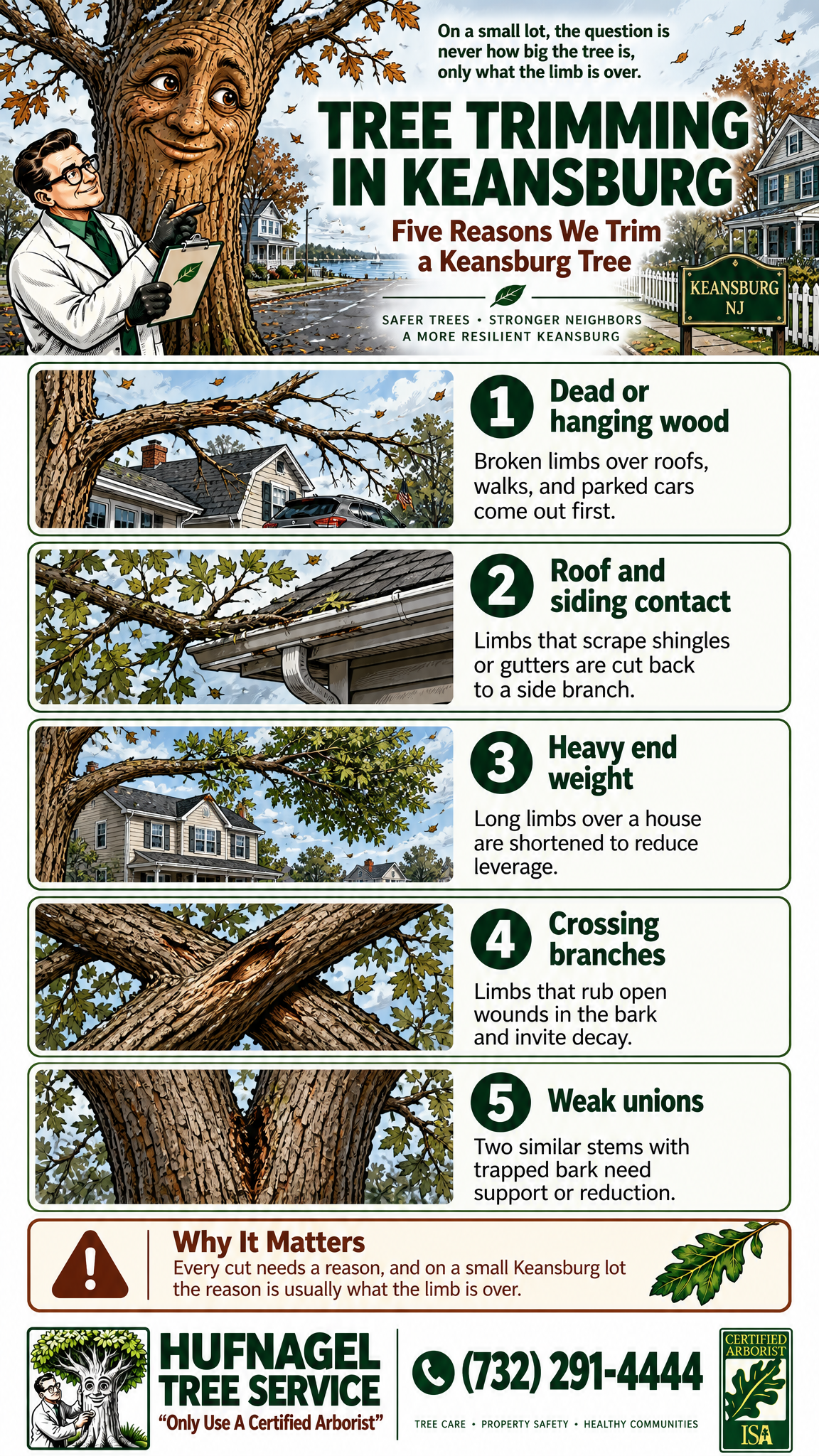
The International Society of Arboriculture puts the principle plainly in its mature tree care guidance: the removal of live branches creates a lasting wound, so no branch should be removed without a reason. We work the same way. Before any cut, we want to name what it accomplishes for safety, structure, clearance, or the health of the tree. If we cannot name it, the cut does not get made.
Clearance is the most common reason in Keansburg. Limbs touch shingles, scrape siding, shade gutters, and hang over driveways where cars park under them. The cut that solves this takes the limb back to a side branch that can become its new end, which keeps the tree’s natural shape and limits stress on the tree. A flat cut across the middle of a limb, with no side branch to take over, leaves a stub that tends to send out a flush of weakly attached shoots.
Deadwood is the second reason, and the simplest. Dead and broken branches over a roof, a sidewalk, or the street are the first wood to come down in a northeast wind, and removing them does not wound a healthy part of the tree. Broken limbs that hang partly attached are the ones we treat first, because they can drop at any moment and are easy to miss from the ground.
End weight is the third. A long limb with most of its foliage at the tip acts as leverage on the union where it joins the trunk. Shortening that limb back to a side branch of suitable size moves the weight closer to the trunk and reduces the strain on the union. Our guide to codominant stems explains why unions where two stems of similar size meet are among the first places to split.
Crossing branches are the fourth reason. Two limbs that rub together in the wind wear through the bark where they touch, and the open wound gives decay a place to start. Removing the weaker or less well placed of the two lets the other grow clear and heal, and it is a small cut that prevents a larger problem later. We look for these in the fall, when the leaves no longer hide the rubbing and the damage is easy to see.
Not every trim is decided by the crown alone. On a lot where the tree, the garage, and the neighbor’s fence share a few feet of ground, the plan also has to account for how each piece comes down. Sections are lowered on ropes or reached from a lift rather than dropped, and the lawn, the fence, and the wires decide the method. That planning is part of the work, and it is the part a homeowner never sees when it goes well.
Mike Hufnagel describes the working rule this way: “On a lot this size, I want to know what the limb is over before I decide where to cut it. A cut with a reason behind it helps the tree. A cut made just to make the tree smaller usually hurts it.” That is the difference between trimming and topping. We name topping only to reject it, because it removes the live crown at an arbitrary point and leaves the tree to rebuild itself from weakly attached shoots.
Five Reasons We Trim a Keansburg Tree
- Dead, broken, or hanging branches over roofs, sidewalks, driveways, and parked cars.
- Limbs that touch siding, shingles, gutters, or a neighbor’s fence line.
- Long limbs with heavy end weight reaching over a house or a yard.
- Crossing branches that rub against each other and open wounds in the bark.
- Weak unions where two stems of similar size trap bark between them.
Each of those reasons points to a specific cut in a specific place. None of them calls for thinning a tree out “for wind” as a blanket prescription, and none calls for cutting a tree back to a fixed height. Once the reason for each cut is clear, the next questions for tree trimming in Keansburg are practical ones: what the borough requires, where the wood goes, and who handles the debris.
Borough Rules and Curbside Pickup Shape the Job in Keansburg
Trimming a limb is not the same as taking a tree down, but the line between them matters in Keansburg. The borough’s tree removal permit form, published under Ordinance 1385 in 2005, requires a permit before anyone cuts down a tree with a base diameter of at least eight inches and a height of at least 20 feet. The language is about cutting trees down, not about pruning a limb. A heavy trim that leaves a tree with too little live crown can end in removal, and that is the point where the rule begins to apply.
The old permit form is not the last word. The borough’s ordinance page also lists a newer Ordinance 1730 on tree removal and replacement, dated September 18, 2024. We do not guess at current thresholds or replacement requirements, and a homeowner should not either. Contact the Borough Clerk at Borough Hall before a tree of any real size comes down, and ask what applies today. Our guide to tree removal permits explains the general process.
The same permit form carries a note that matters to anyone hiring work. Any tree cut down in Keansburg must be removed in its entirety by the owner or the contractor, and must not be placed for pickup by the Department of Public Works. The form calls a violation of that note a code violation. That is one more reason to agree before the job starts on who is hauling what, and to confirm that the wood leaves the property when the crew does.
Branches from ordinary trimming are a different matter. The public works page answers the question in its list of frequently asked questions: leaves and branches go to the curb during the months listed on the borough’s leaf and branch pickup schedule, and leaves should not be bagged. A trim planned around those months keeps the debris from sitting at the curb for weeks, which matters on streets where parked cars and narrow setbacks leave little room for a pile.
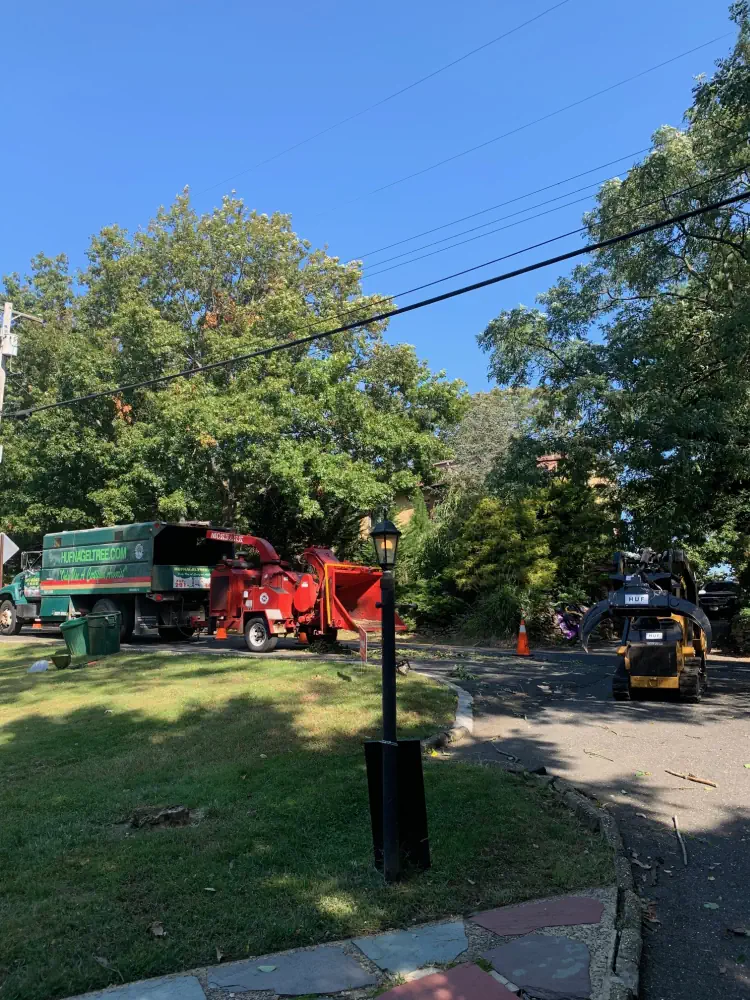
On our jobs, the debris is part of the work. Our crews arrive with a chipper and blowers, so the branches are chipped, the lawn and driveway are cleaned, and the wood leaves with the crew rather than waiting for the borough. You can read more about how we handle that in our article on protecting your property during service.
Shared fence lines add another wrinkle. On lots this narrow, a limb that crosses the property line is a conversation with a neighbor before it is a cut. We suggest photographing the limb from both yards, talking with the neighbor before the crew arrives, and agreeing on who will be present. A little planning avoids the situation where a trim finished on a Tuesday becomes a dispute by Friday, and it keeps the focus on the tree instead of the property line.
Utility wires are a separate category. A limb that touches or sits close to a wire is not a homeowner project and not a job for a pole saw. Contact the utility, or call a professional who is trained to work near energized lines. In a town as compact as Keansburg, where the wires run along the same streets as the trees, that situation comes up more often than people expect.
Questions to Settle Before Any Cutting Starts in Keansburg
- Whether the tree meets the borough size threshold for a removal permit.
- Who hauls the wood, and where it goes after it is cut.
- Whether any limb touches or sits close to a utility wire.
- Which limbs reach a neighbor’s property, and whether the neighbor knows.
- Whether the work falls inside the borough’s leaf and branch pickup months.
Settling those five questions first prevents most of the problems that follow a trimming job. They cost nothing and they take a short conversation. With the rules and the debris handled, the remaining decisions are about timing and about who does the work, which is where many Keansburg trees are helped or hurt.
Timing and Who Holds the Saw Decide How a Tree Responds

Timing matters differently for hedges and ornamentals than it does for mature shade trees, and fall is the season when the two get confused. Rutgers Cooperative Extension advises against pruning spring and summer flowering shrubs from mid August through leaf fall, because pruning stimulates new growth that may not harden off before winter and can lead to cold injury. The exception is wood that is dead, diseased, damaged, or crossing, which can come out at any time. A Keansburg hedge that needs shaping usually waits for late winter or spring.
For mature shade trees, fall is a good time to look and to remove dead, damaged, and hazardous wood. Leaves coming off help us read the structure. A bare crown shows where limbs overlap, where deadwood has been hiding, how much weight sits on one side, and where a union has cracked. That is why we like to walk a Keansburg property in late fall, before the first strong nor’easter, and decide what needs doing now and what can wait for the dormant season.
Large structural work is a different decision from cleanup. Reducing a heavy limb or correcting a weak union takes judgment about how the tree will respond, and that judgment is easier with the crown visible. Our tree health management work looks at the whole tree first, so that the trimming plan fits the tree’s condition and not just the calendar.
The question of who holds the saw matters as much as the question of when. Rutgers notes in its guide to hiring a tree care professional that pruning or removing large trees can be dangerous work, especially when it requires climbing or working from an elevated position, and that it should be left to trained and qualified professionals. The International Society of Arboriculture says the same in its mature tree guidance: pruning large trees takes special equipment, training, and experience, and personal safety equipment is a must when the work involves climbing, a chain saw, or large limbs.
Rutgers also explains what New Jersey requires. A business that provides tree care services must be registered with the New Jersey Board of Tree Experts and must employ at least one licensed individual. Rutgers advises homeowners to ask to see the company’s business registration, its insurance coverage, and the name of its Licensed Tree Expert, and it warns that a general business license or a pesticide license can mislead a customer. Those are fair questions to ask any crew before it touches a tree.
The dormant season has its own practical advantages. With the leaves down and the ground firmer than it is in summer, crews can move equipment across a yard with less damage to the lawn, and the open crown makes it easier to place each cut precisely. We do not treat dormant pruning as a rule for every tree, because some work cannot wait for winter. A cracked limb over a bedroom should not be left until January just because the calendar says to wait.
On a tight Keansburg lot, the risks add up quickly. A ladder set on soft lawn, a limb that swings into a fence, or a cut made near a service wire can turn a short job into an insurance claim. A crew with ropes, a lift, and a plan for each piece avoids that. It also tends to leave a better tree behind, because the person making the cut has the time and the position to make it in the right place.
Signs a Trimming Job Is Being Done Wrong
- A tree cut back to stubs or to a flat height, which is topping.
- Cuts left flush against the trunk or far out along a limb.
- Large live branches removed from one side, leaving a lopsided crown.
- No proof of registration or insurance when you ask to see it.
- Cutting from a ladder leaned on the tree, with no rope or lift.
A well trimmed tree should still look like the same tree, only lighter in the places that mattered and safer over the things beneath it. When a tree has already been cut badly, restoration pruning can rebuild its structure over more than one season. Where the tree can no longer be managed safely, removal is the honest answer, and we say so plainly.
Call Hufnagel Tree Service for Tree Trimming in Keansburg Before Winter
If you have mature trees near your Keansburg home, garage, driveway, or shared fence line, schedule an evaluation before winter storms arrive. We provide tree trimming and pruning, tree risk evaluations, storm proofing, restoration, and removal when a tree cannot be managed safely.
Hufnagel Tree Service is led by a certified arborist with almost 30 years of local experience and more than 280 five star Google Maps reviews. We inspect first, name the reason for every cut, and recommend only the work that changes the outcome for your trees and your property.
Call or text (732) 291-4444 to schedule tree trimming in Keansburg before the next coastal storm arrives.
Schedule Service Now!
From precision pruning and safe removals to health assessments and preventative care, Hufnagel Tree Service delivers expert solutions backed by decades of experience. We offer certified insight, fair pricing, and a commitment to doing what’s best for your landscape.
Learn More About Our Services


Related Articles

Tree Risk Mitigation in Rumson, NJ
Avoid Late Summer Tree Problems: Schedule An Inspection
Winter Tree Prep in Old Bridge: Schedule An Inspection
Lightning Strike Tree Damage in Interlaken NJ