Contents
In Spring Lake Heights, Tree Health Begins Where Wet Ground Meets Mature Trees
Spring Lake Heights is a small borough with a long edge of water. According to Wikipedia’s entry on Spring Lake Heights, the New Jersey Legislature formed it on March 19, 1927, from part of Wall Township, after a referendum on May 3 of that year. The 2020 census counted 4,890 residents, the elevation is 23 feet, and Route 71 runs through the borough along Seventh Avenue. For Spring Lake Heights tree health, the most important local feature is Wreck Pond, a tidal pond that Wikipedia describes as covering 73 acres and draining a watershed of about 12 square miles.
That wet ground shapes how we think about tree health management. Trees here do not only face wind and weather. They face soil that stays wet after heavy rain, lawns that are graded and mowed right up to the trunk, and mulch that gets added every spring on top of last year’s. Most of the problems we are asked to look at in a borough like this begin below ground, long before anything shows in the crown.
After almost 30 years working throughout Monmouth County, we have seen that October is the right month to look. The leaves are still on, so the canopy can be read, and the ground is not yet frozen, so roots and soil can be checked before winter. A fall review gives a tree months of recovery time before the next growing season asks more of it, and it separates the trees that need nothing from the few that need attention.
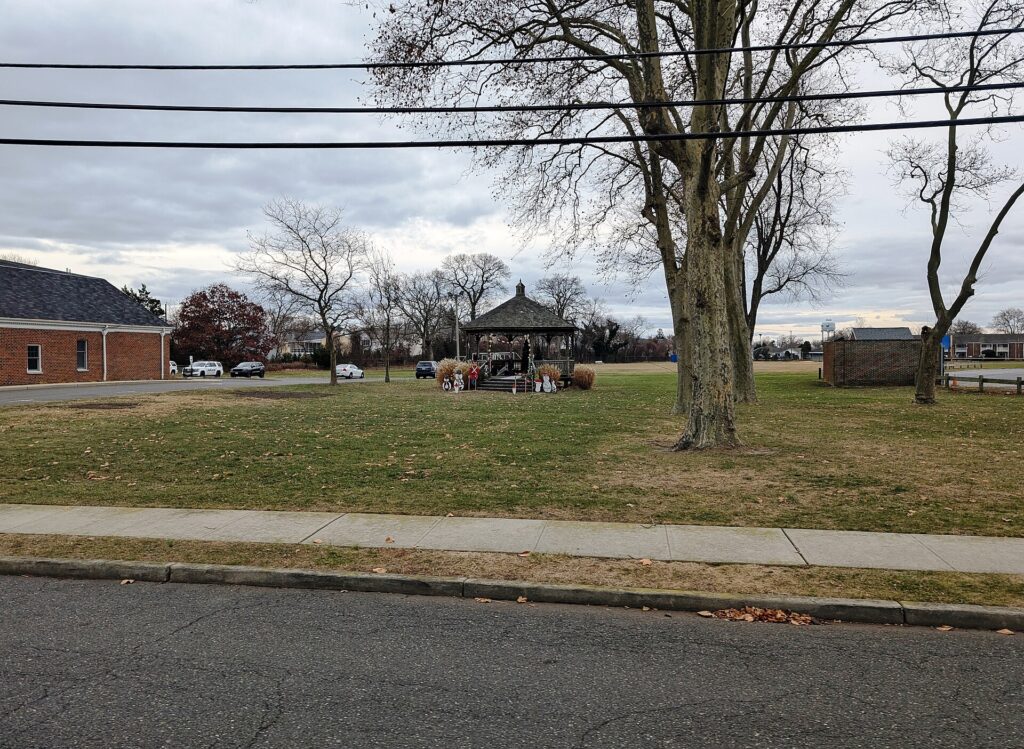
Wreck Pond sits among Wall Township and the boroughs of Spring Lake, Spring Lake Heights, and Sea Girt, and the same Wikipedia page names three brooks that feed it: Wreck Pond Brook, Hurleys Pond Brook, and Hannabrand Brook. It also notes that an expanded, gated culvert between the pond and the ocean was completed in 2016. For a homeowner, the lesson is not about engineering. It is that this is low, wet country, and a tree on a lot that drains toward the pond or one of its brooks spends more of the year with saturated roots than a tree on higher ground. We explain how that kind of soil loosens a tree’s hold in our guide to weak tree roots, and the same signs apply on the streets around Seventh Avenue and Allaire Road.
A Tree Health Review Reads the Crown, the Bark, and the Base Together
A tree health review is not a quick look at the leaves. It is a way of connecting what the crown shows with what the wood and soil are doing underneath. TreesAreGood describes plant health care as routine monitoring and preventive treatment, supported by a working relationship between the arborist and the property owner, and it tells owners to contact a local arborist when they notice discolored leaves, dead branches, or early leaf drop. We work from the same idea. The leaves and branches are symptoms. The cause is usually somewhere else.
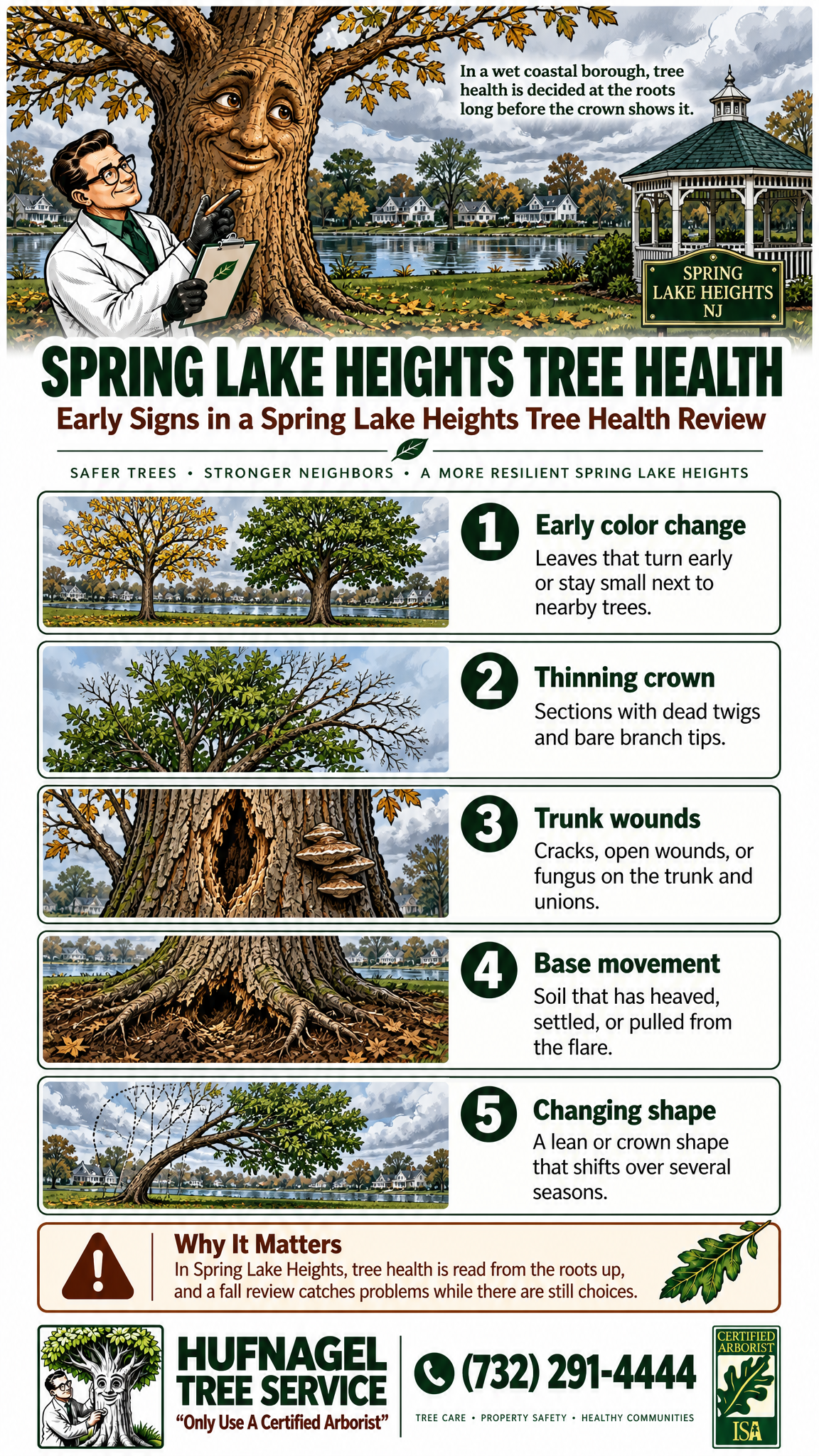
We start with the crown because October still lets us read it. Leaves that turn color early, leaves that are smaller than those on the neighboring tree, a section of canopy that is thinning, and dead twigs at the branch tips all tell us something. One of these on its own is a note for the file. Two or three that agree are a reason to look closer. We compare a tree with its own earlier seasons whenever we can, and we ask owners to photograph a tree from the same spot each fall, because change over time tells us more than a single visit does.
Next comes the bark and trunk. Cracks, open wounds, peeling bark, fungus, and cavities are all places where decay can start or has already started. A tree can look full and green while the wood that holds it up is being consumed from the inside, which is why our guide to hidden tree rot tells owners to look at the trunk and not only the canopy. Fungus on the bark does not decide anything by itself, but it suggests that decay has been working for some time.
Then we look at where large stems meet. Narrow unions with included bark are common in older shade trees, and they are where weight and weather do their worst work, as our guide to codominant stems explains. A tree can be vigorous and still be structurally weak. Health and structure are two different questions, and a good review answers both before it recommends any work.
The base of the tree is the last stop and often the most useful. We look for a visible root flare, soil that has heaved or settled, mushrooms or conks near the trunk, and any change in lean. In a borough where the ground stays wet, the base is where a decline usually begins. We also watch for signs of insects and disease, but we do not guess a cause from a photograph. Treatment depends on the right identification, and sometimes the right answer is to monitor and wait.
Mike Hufnagel puts it simply: “A tree rarely goes from healthy to hazardous overnight. It sends signals for years, and our job is to read them while there are still good choices to make.” That is the reason we like to see a tree in the fall, while the canopy is still readable and the options are wide.
Early Signs in a Spring Lake Heights Tree Health Review
- Leaves that turn color early or stay small compared with nearby trees.
- Thinning sections of the crown with dead twigs and bare branch tips.
- Cracks, open wounds, or fungus on the trunk and at branch unions.
- Soil that has heaved, settled, or pulled away at the root flare.
- A lean or crown shape that has changed over several seasons.
No single sign on that list decides the outcome. We weigh them together, and the answer is often monitoring, targeted pruning, or treatment at the roots. Once the crown and trunk have been read, the next part of a fall review happens at ground level, where most of the cause usually sits.
Spring Lake Heights Tree Health Depends on Roots, Mulch, and Grade
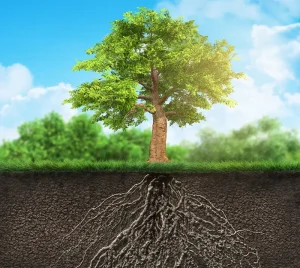
Roots do the quiet work in any tree, and they reach much farther than most owners expect. The borough gives a plain way to picture it in Ordinance 2024-05, which defines the critical root radius as the zone around the base of a tree where the majority of the root system is found. It is calculated by multiplying the trunk diameter at breast height by 1.5 feet, so a tree with a 6 inch trunk has a radius of 9 feet. That is a regulatory definition, not a biology lesson, but it is a useful one. Anything that happens inside that circle happens to the tree.
Mulch is the most common example. Rutgers fact sheet FS099, written by Bruce Crawford and Raul Cabrera, says total mulch depth, including the layers from earlier years, should stay at 3 inches or less, and at 2 inches on compacted or poorly drained soils. For mature trees it advises keeping mulch 8 to 12 inches away from the trunk. Spring Lake Heights tree health depends on following that advice, because so many lots here hold water and so many yards receive a fresh layer every spring.
The problems the same fact sheet describes are easy to recognize once you know them. Waterlogged mulch and soil reduce oxygen to the roots, which leads to decline and dieback. Mulch piled against the trunk keeps the bark moist, and moist, decaying bark lets trunk diseases take hold. Piles of mulch can also shelter mice and voles that chew the bark. None of this looks dramatic in October. It shows up as a tree that is slightly thinner each year and that no one can explain.
Our check is simple. We pull the mulch back from the base and look for the root flare, the place where the trunk widens as it meets the roots. The Rutgers sheet recommends exposing a buried root flare by removing soil or mulch down to the point where the trunk meets the roots. When we cannot find the flare, the tree has often been planted too deep or buried over time, and that is a finding worth writing down.
Grade and compaction are the second pattern. Patios, walkways, new lawns, irrigation trenches, and heavy equipment on wet ground all change what the roots live in. The borough ordinance lists improper grading and soil compaction within the critical root radius among the actions that can count as tree removal when they lead to decline or death. We cover the same ground from the root side in our article on weak roots, and we ask owners to tell contractors where the root zone is before the work begins.
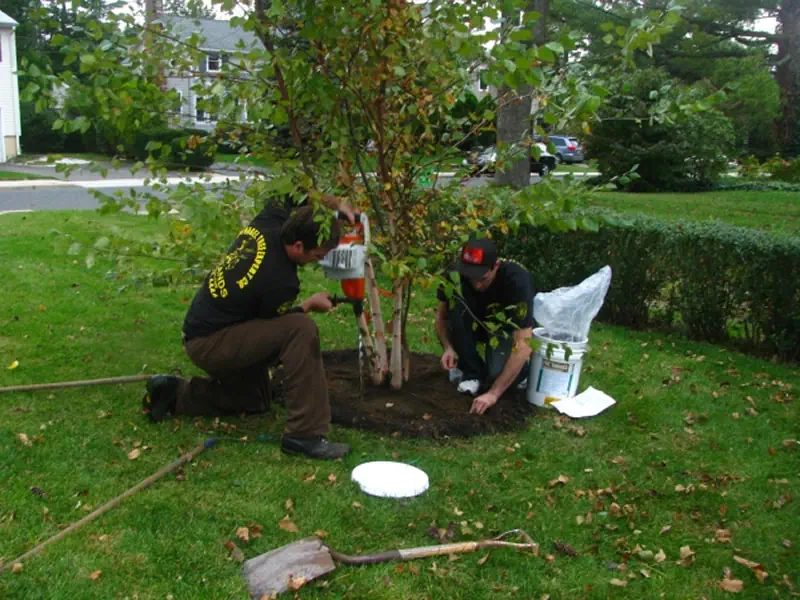
Some trees benefit from treatment at the roots, as the crew in the photo is doing around a multi stem birch. Whether that is needed is a decision we make from findings, never by default. We would rather identify the stress, remove the cause when we can, and treat only what the evidence supports. That approach is the heart of our tree health management work, and it usually costs a tree less than a long list of routine applications.
Root Zone Habits That Protect Trees in Spring Lake Heights
- Keep total mulch to three inches or less, and two inches on wet soil.
- Pull mulch eight to twelve inches back from the trunk of a mature tree.
- Leave the grade alone inside the root zone unless a plan says otherwise.
- Keep vehicles, storage, and trenching off tree roots when the ground is wet.
- Photograph heaving, settling, or fungus at the base and call before winter.
These habits cost almost nothing, and they remove the stresses we see most often. A tree that has air at its roots, a visible flare, and undisturbed soil can handle a wet year far better than one that has been buried and compacted. Once the root zone is in order, the question becomes what the borough expects when a tree has to be treated, pruned, or replaced.
The Borough Ordinance Makes a Written Tree Health Plan Worth Having
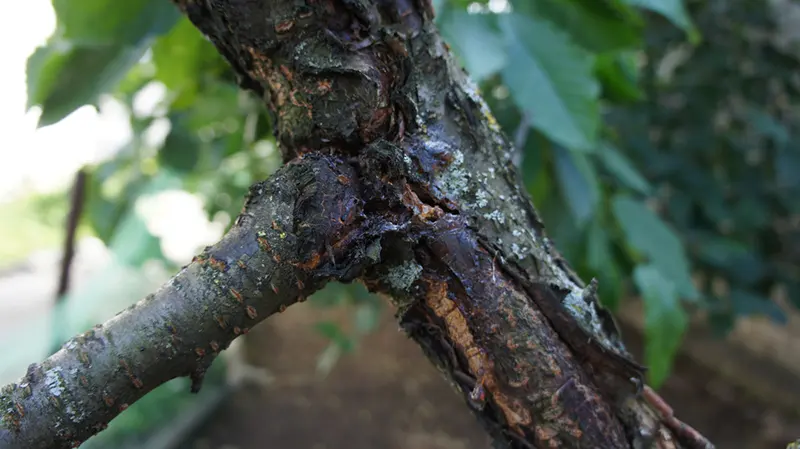
A wound at a branch union, like the one in the photo, is the kind of finding that starts a conversation about the whole tree. Cracked, peeling bark with dark staining can mean a simple injury that the tree is closing over, or it can mean decay that has been working for years. We look at how far the damage reaches, whether the wood around it is sound, and what the branch or stem is holding up. Then we explain which of four outcomes fits the tree: pruning, restoration, monitoring, or removal.
In Spring Lake Heights, that conversation now sits inside a local rule. Ordinance 2024-05 is posted on the borough’s stormwater management page, and its stated purpose is to reduce soil erosion and pollutant runoff, promote infiltration of rainwater into the soil, and protect the environment and public health. It defines tree removal broadly. The definition includes excessive pruning, toxic substances, over mulching, and improper grading or soil compaction within the critical root radius when those lead to a tree’s decline or death, and it says removal does not include responsible pruning and maintenance. We always tell owners to read the current text and confirm it with the borough.
The ordinance applies to street trees with a trunk diameter of 2.5 inches or more, and to other trees of 6 inches or more per acre. When a covered tree is removed, replacement is required. A tree of 6 to 12.99 inches is replaced with one tree of at least 1.5 inch caliper, and the number of replacements rises with trunk size. Replacements must be planted within 12 months and monitored by the applicant for two years. The ordinance exempts residents who remove fewer than four trees per acre in categories 1 through 3 within a five year period, and it exempts hazard trees, with written justification from a New Jersey licensed tree expert or arborist.
That last point is where a written inspection helps. The ordinance defines a hazard tree as one that has an infectious disease or insect infestation, is dead or dying, causes obvious damage to structures, blocks traffic signs or passage where pruning has not worked, or is determined to be a threat by a certified arborist or licensed tree expert. A tree risk evaluation that names the defect, shows where it sits, and says what it could reach gives an owner something concrete to bring to the borough. Our guide to tree removal permits explains how these requirements work across the area.
The ordinance carries a penalty of not less than $500 per tree that was improperly removed, which is a good reason to ask before a contractor starts. It also means that a tree in decline from over mulching or buried roots can become a regulatory problem as well as a health problem. Catching it in October, with a plan to fix the root zone, is far better than finding it in July.
Replacement is easier to plan when it is part of the review. The borough’s approved list, in Appendix A of the ordinance, includes red maple, northern red oak, scarlet oak, blackgum, and several lindens, among others. A tree that fits the lot and the soil is a better choice than the largest one in the nursery. Where a tree can be saved, our tree restoration and tree trimming and pruning work aims to do it with the smallest cuts that solve the problem. You can also read our other Spring Lake Heights articles for how we have handled trees in the borough.
What a Written Tree Health Plan for Spring Lake Heights Should Include
- The defect or stress found, with photographs and the location on the tree.
- Whether the tree is a candidate for pruning, treatment, monitoring, or removal.
- The root zone changes needed, such as mulch, grade, or compaction fixes.
- Any borough notice, fee, or replacement step that could apply to the work.
- A follow up date so the same tree is checked against these notes.
A plan like that turns a vague worry into a short list of decisions. Some trees need only monitoring. Others need targeted pruning, treatment, restoration, or removal. The choice should always follow the findings, and a certified arborist should be involved wherever the ordinance calls for one. The International Society of Arboriculture’s Find an Arborist directory lets owners search for certified arborists in their own area.
Schedule a Tree Health Review in Spring Lake Heights Before Winter Arrives
If you have mature trees near your Spring Lake Heights home, driveway, or sidewalk, or along Seventh Avenue, schedule a review before winter weather adds load. We provide tree health management, tree risk evaluations, tree trimming and pruning, storm proofing, restoration, and removal when a tree cannot be managed safely.
Hufnagel Tree Service is led by a certified arborist with almost 30 years of local experience and more than 280 five star Google Maps reviews. We inspect first, explain what we found in plain terms, and recommend only the work that changes the outcome for your trees and your property.
Call or text (732) 291-4444 to schedule a Spring Lake Heights tree health review before winter arrives.
Schedule Service Now!
From precision pruning and safe removals to health assessments and preventative care, Hufnagel Tree Service delivers expert solutions backed by decades of experience. We offer certified insight, fair pricing, and a commitment to doing what’s best for your landscape.
Learn More About Our Services
Related Articles
Late Summer Tree Service in Holmdel, NJ
Tree Risk Inspection and Health Assessment By Certified Pros
Tree Risk Mitigation Services Near Monmouth Beach NJ