Contents
A Clear Morning Failure That Shows Why Inspections Matter
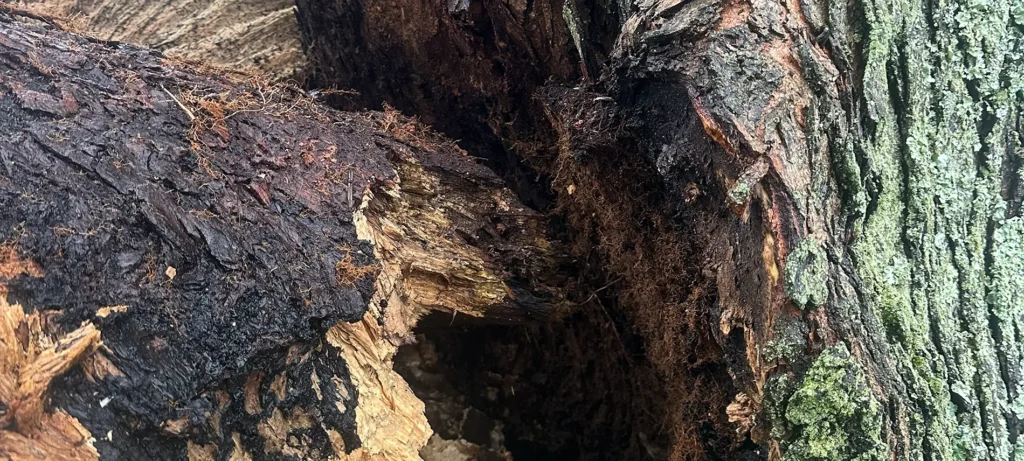
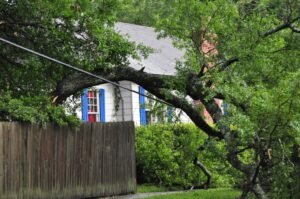
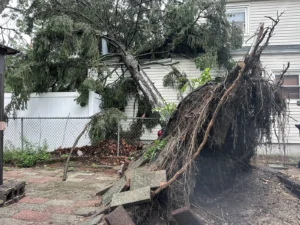
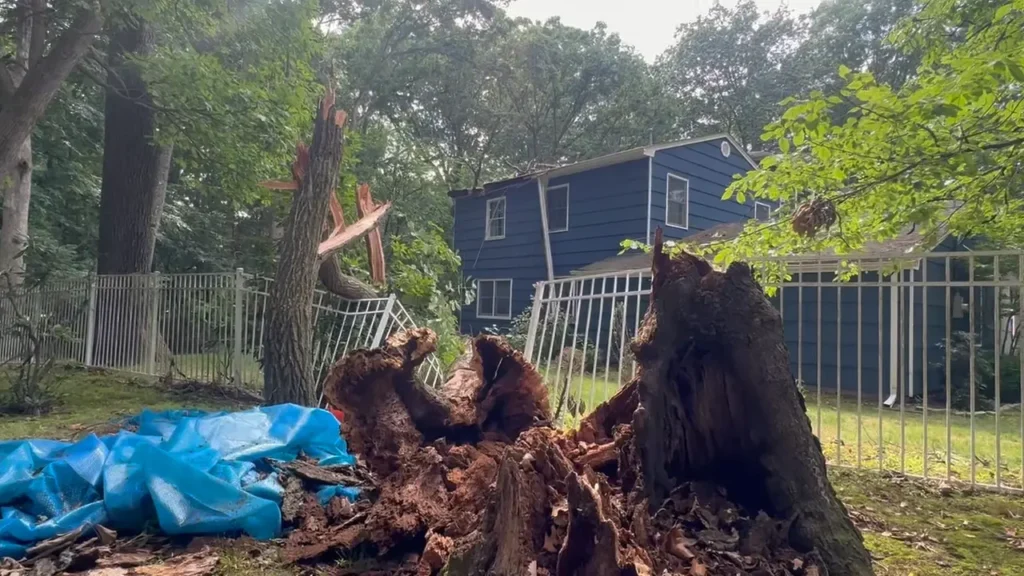
The video below shows the danger after it became real. At about 10:30 on a clear New Jersey morning, a tree taller than a two story house suddenly fell into the blue home. The owner was inside. The trunk struck the roof and side wall, and the broken interior revealed extensive rot. Hufnagel Tree Service was called to remove the tree and clean up the property.
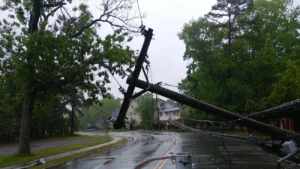
No thunderstorm was overhead when the tree failed. That makes the footage important for Middletown property owners. Wind often exposes weakness, but it does not create years of internal decay in minutes. The July Fourth weekend storms brought down trees and utility poles across Monmouth County, yet a decayed tree can also give way after the weather clears when its remaining wood can no longer carry the crown.
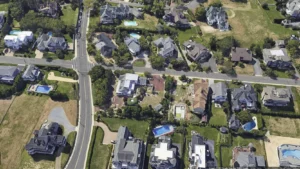
From Lincroft, River Plaza, and Oak Hill to Navesink, Locust, Belford, Leonardo, Port Monmouth, and North Middletown, mature trees stand close to homes and gathering areas. Our certified arborist provides tree health inspections, risk evaluations, restoration pruning, root care, monitoring, and removal when preservation is no longer responsible. This guide explains how rot develops, what we inspect, and how early mitigation can prevent a cleanup like the one shown.
How Hidden Tree Rot Develops Behind Living Bark
Tree rot is the breakdown of wood after fungi gain access through injury or dead tissue. Entry points include storm wounds, dead branch stubs, flush cuts, trunk cracks, mower injury, damaged roots, and bark loss. Trees do not heal like skin. They grow new wood around injuries and try to limit spread, but the affected interior does not become sound again.
That biology explains why a tree can carry green leaves while losing strength inside. Living tissues near the outside of the trunk may keep moving water and producing growth even as heartwood decays. A full summer crown can create false reassurance. The video tree looked substantial from the yard, but its broken trunk exposed missing and softened interior wood.
Middletown’s canopy includes oaks, maples, beeches, hickories, tulip poplars, and pines. The Monmouth County Park System documents mixed oak forests at Hartshorne Woods and Huber Woods, while Rutgers identifies northern red oak as a major New Jersey native. Mature local trees may carry old pruning wounds, construction disturbance, buried root flares, and repeated storm loading.
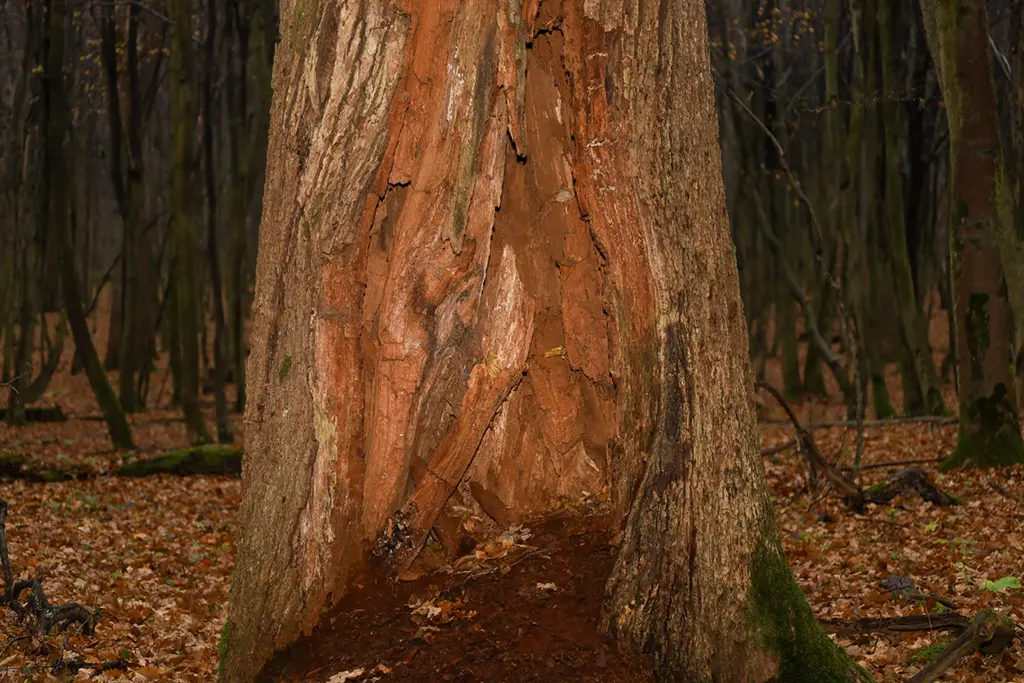
Decay can begin at the base or in the trunk. Rutgers notes that root rotting fungi such as Ganoderma, Armillaria, and Xylaria may affect living trees. A conk on the trunk, mushrooms at the root flare, soft bark, or a cavity near the soil line deserves evaluation. Ordinary mulch mushrooms are not automatically a structural emergency, so location matters.
Michael Hufnagel explains, “The tree in this video did not wait for wind. It failed because the wood holding it upright had already been consumed from the inside. A clear day does not make a rotten tree safe.” We look beyond leaf color and ask how much functional wood remains and what the tree can strike if that support gives way.
The quiet conditions that can turn into structural loss
- Old wounds that never closed around sound wood
- Cavities or seams where water and fungi can enter
- Root damage from grading, trenching, pavement, or compaction
- Buried root flares and excessive mulch holding moisture against bark
- Repeated branch failure that exposes larger sections of wood
Internal decay develops over time, but risk is not judged from age or hollowness alone. A structured inspection connects the defect to the rest of the tree and the property around it.
Tree Health Inspection Middletown NJ: What We Evaluate
A tree health inspection begins with the site. We identify the tree, recent changes, soil conditions, exposure, and likely targets. A tree beside a house requires different scrutiny than a similar tree in an unused wooded corner. The United States Forest Service illustrates how a severe cavity may be visible from one side while the opposite view appears normal.
We inspect the crown and major branches for deadwood, hanging limbs, weak unions, overextended growth, old failures, uneven loading, and abnormal dieback. The trunk is checked for cracks, seams, cavities, missing bark, conks, response growth, and changes in taper. These are among the defects documented in the International Society of Arboriculture basic tree risk assessment process.
The root zone often provides critical evidence. We look for a visible root flare, heaving soil, severed roots, excavation, drainage changes, compaction, paving, and mulch against the trunk. Rutgers warns that excessive mulch can hide the flare, retain moisture, and contribute to girdling roots. Additions, patios, utility work, and driveway changes can alter an older Middletown tree years after planting.
Most evaluations begin with a visual assessment from all accessible sides. When surface conditions raise questions that cannot be answered visually, we may recommend advanced assessment or diagnostic work. The Forest Service describes nondestructive tools that can help map internal decay, but those tools must answer a specific question. Random drilling or striking the trunk is not a reliable homeowner test.
Michael Hufnagel says, “A tree health inspection is not a quick look at the leaves. We connect the crown, trunk, roots, history, and target before we recommend anything.” Health and structure are also different. A stressed tree may remain structurally sound, while a green tree may contain a dangerous column of decay. The recommendation must fit the actual defect.
What our arborist connects before recommending work
- Tree species, size, age class, and normal growth pattern
- Crown condition, branch attachments, and evidence of past failure
- Trunk wounds, cracks, cavities, conks, and remaining sound wood
- Root flare visibility, soil movement, drainage, and construction history
- Homes, wires, vehicles, play areas, roads, and other potential targets
A systematic inspection establishes what is present today. Homeowners can help by recognizing changes that should move that inspection forward instead of waiting for a branch or trunk to fail.
Warning Signs That Should Trigger a Tree Risk Evaluation
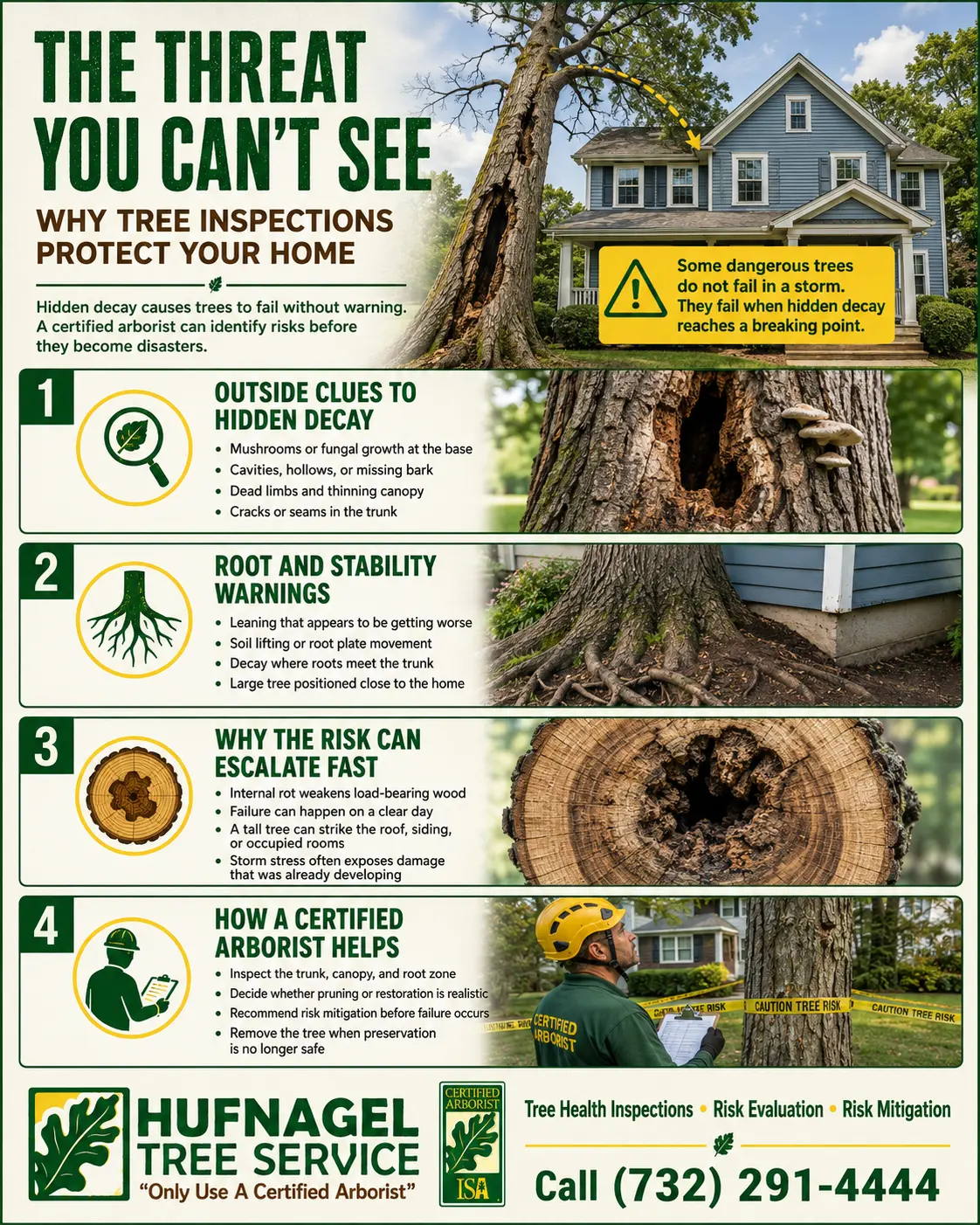
The clearest warning signs include a new lean, lifting soil, cracked roots, a widening trunk seam, fresh bark separation, a large cavity, or a fungal conk. Dead tops, crown thinning, large dead branches, and repeated limb loss also matter. ISA guidance identifies cavities, fruiting bodies, cracks, dead branches, and root problems as conditions that deserve professional attention.
Smaller clues become useful when they appear together. Look for frass near softened wood, carpenter ants entering a cavity, dark seepage, sunken bark, nesting holes, or sprouts below an old wound. Purdue’s tree defect guide emphasizes evaluating decay, missing wood, and fruiting structures closely. One symptom can have several causes, but a pattern is reason to investigate.
Summer adds load and stress. Leaves increase the surface area and weight carried by branches. Heat raises water demand. Heavy rain can saturate soil, and wind can test roots and old wounds. Recent July storms left hundreds of downed trees and broken poles across the region. After cleanup, a crack may remain open or a root plate may have shifted. Clear weather does not reverse that damage.
Priority also depends on what is beneath the tree. A tall trunk beside a bedroom, roof, deck, pool, driveway, school route, or neighbor’s property can cause severe damage. The video tree stood adjacent to the house and exceeded the roofline, so its failure path included the structure. Tree risk evaluation considers both failure likelihood and the consequences below.
Michael Hufnagel advises, “Do not wait for a tree to look dead. Compare it with past seasons, photograph changes, and call when something new appears at the base, trunk, or crown.” Homeowners can document changes after storms and during full leaf from a safe distance. Do not climb, probe cavities, cut major roots, or stand beneath hanging wood. If wires are involved, stay back.
Exterior clues that deserve more than a quick glance
- New lean, soil lifting, or exposed broken roots
- Fungal conks, cavities, soft wood, or missing bark
- Cracks that widen through the trunk or a major union
- Dead crown sections, hanging limbs, or repeated branch loss
- A defect positioned over a home or regularly occupied area
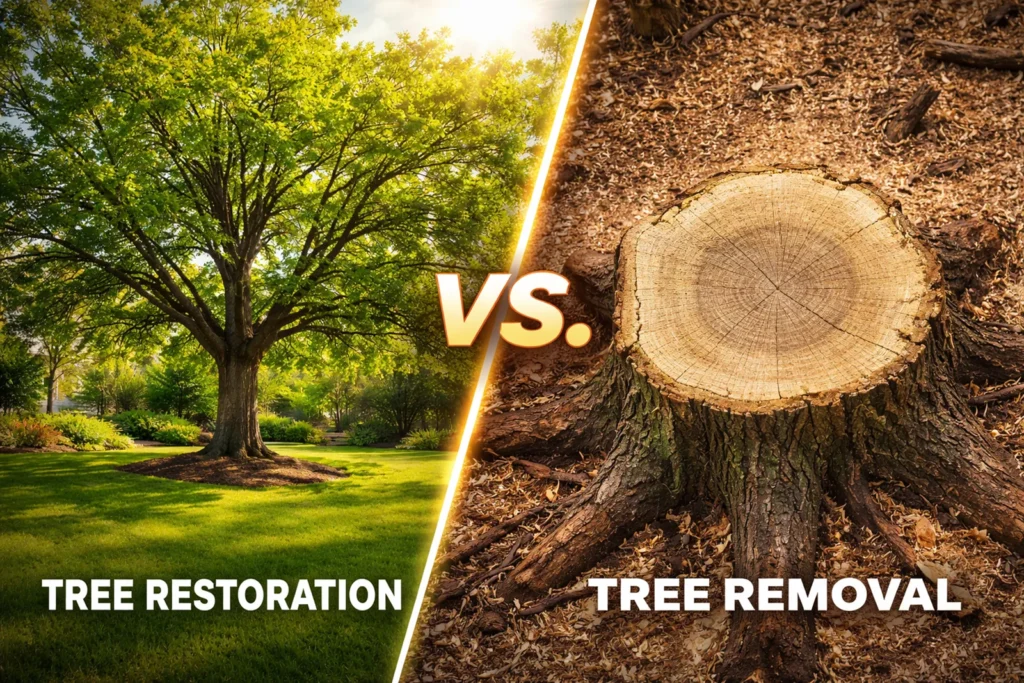
Warning signs do not automatically mean removal. They identify the need to choose a practical risk reduction plan while there is still time to preserve what can safely remain.
Tree Risk Mitigation From Rejuvenation to Removal
When the trunk and roots remain dependable, rejuvenation may begin with targeted pruning and better growing conditions. We may remove dead branches, reduce selected limbs, improve clearance, correct harmful mulch, or recommend root care. Mature tree pruning should have a purpose because every live cut removes energy producing foliage. Topping is not restoration and can create decay and weak growth.
Some trees need monitoring rather than immediate major work. We may use photographs, measurements, or return intervals to watch a cavity, crown response, wound growth, or root condition. A retained tree should be reevaluated after a significant storm, sudden change, or nearby construction. Tree health is dynamic, and a reasonable decision may need adjustment as the tree and site change.
Fertilizer, pest treatment, and soil amendments should only address a diagnosed need. None replaces structural wood that decay removed. When laboratory identification is useful, the Rutgers Plant Diagnostic Laboratory provides New Jersey plant health services. Our role is to separate a manageable health problem from a structural defect that leaves the tree unable to hold itself safely.
Removal becomes responsible when decay has reduced critical support, roots are failing, a crack is progressing, or the tree has an unacceptable path toward a home. The goal is not to remove every imperfect tree. It is to avoid gambling with a defect that cannot be reduced to an acceptable level. Middletown homeowners should review Township tree removal rules before nonemergency work.
Michael Hufnagel says, “We preserve trees when the structure gives us a safe path forward. When the remaining wood cannot reliably support a tree over a house, removal is risk mitigation, not a failure of tree care.” After removal, we can discuss stump cleanup and a better replacement location so the next tree has enough room to mature.
How the safest plan changes with the condition we find
- Restore structure with selective pruning when sound wood and roots remain
- Improve mulch, soil, moisture, and root conditions when stress is correctable
- Monitor stable defects on a defined inspection schedule
- Remove the tree when decay creates an unacceptable threat
- Plan replacement with mature height, spread, roots, and utilities in mind
Risk mitigation is most effective before a tree reaches the point shown in the video. The final step is scheduling an inspection while access is clear and choices are still available.
Expose The Rot: Call Hufnagel Tree Service for Tree Health Inspections in Middletown NJ
If a mature tree stands beside your Middletown home, or you see a cavity, conk, crack, lean, dead crown section, or changing root area, schedule a professional evaluation. Hufnagel Tree Service serves Lincroft, River Plaza, Oak Hill, Chapel Hill, Navesink, Locust, Belford, Leonardo, Port Monmouth, North Middletown, New Monmouth, and surrounding Monmouth County communities.
Call Hufnagel Tree Service at (732) 291-4444 now to schedule a tree health inspection or tree risk evaluation in Middletown NJ. A tree does not need wind, rain, or a warning sound to fail. The safest time to find hidden rot is before the trunk is on the roof and the cleanup has already begun.
Schedule Service Now!
From precision pruning and safe removals to health assessments and preventative care, Hufnagel Tree Service delivers expert solutions backed by decades of experience. We offer certified insight, fair pricing, and a commitment to doing what’s best for your landscape.
Learn More About Our Services
Related Articles