Contents
Lanternfly activity is easier to manage when homeowners use it as a prompt for better tree care, not as a reason to panic.
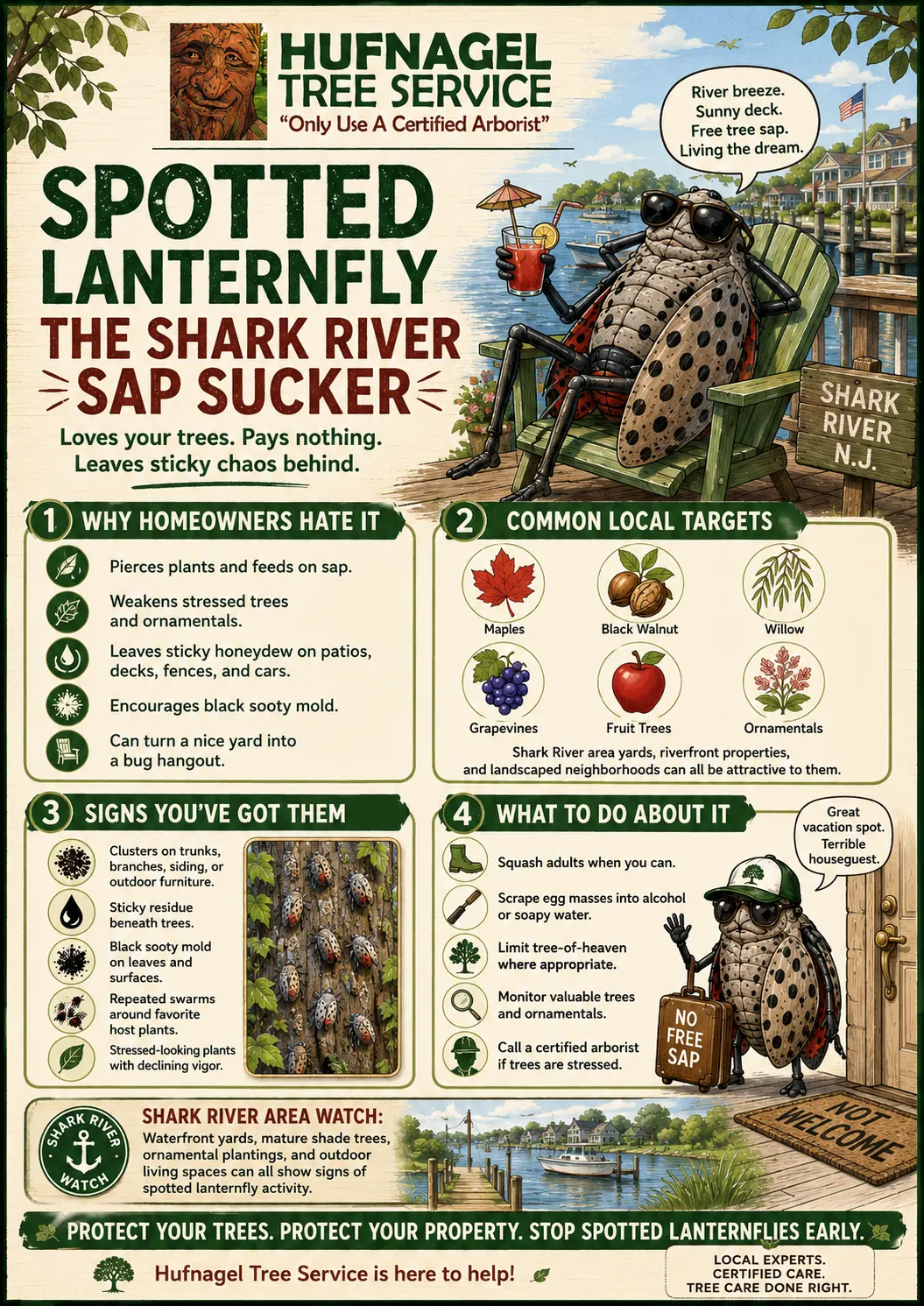
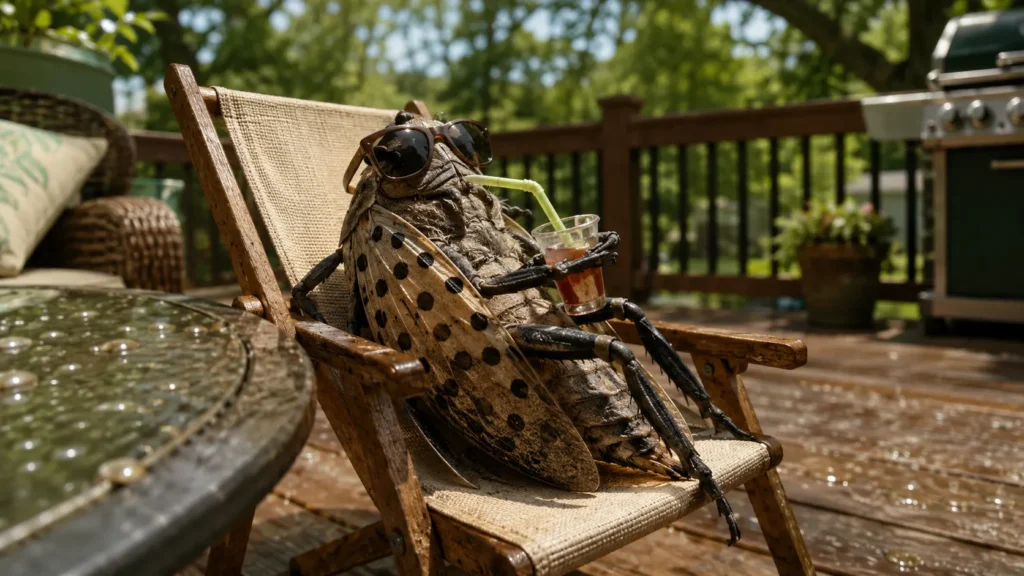
In the Shark River area, spotted lanternfly nymphs are not showing up in some distant agricultural field. Homeowners are seeing them where they actually live, on patio furniture in Shark River Hills, on deck railings near the marinas in Neptune City, along fence lines in Belmar, near wooded edges by Shark River Park, and around mixed landscape plantings in Neptune Township and Wall Township. When those small black insects with white spots start moving across outdoor furniture and young tree growth, they are more than a summer nuisance. They are a clue that the surrounding tree canopy deserves a closer look.
At Hufnagel Tree Service, we look at spotted lanternfly activity through the eyes of certified arborists, not pest control salesmen. We do not build our recommendations around spraying everything in sight. We look for stress, host trees, weak trees, poor structure, overgrown branches, and invasive Tree of Heaven growth that can help lanternflies settle into a property. That approach matters in the Shark River corridor because yards often combine mature shade trees, ornamentals, river moisture, dense fence lines, boat traffic, and tight residential layouts.
The Rutgers Cooperative Extension identifies spotted lanternfly as an invasive pest affecting New Jersey crops and hardwood trees, and the NJ Department of Agriculture notes that it feeds on many host plants while strongly preferring Tree of Heaven. For homeowners, the important point is practical. If nymphs are all over the property in early summer, the landscape may be offering them food, shelter, or a nearby host tree. A certified arborist inspection helps separate a messy seasonal problem from an actual tree health concern.
Michael Hufnagel often tells homeowners, “The bug is what gets your attention, but the tree is what we need to inspect. If the property has Tree of Heaven, weak maples, stressed birch, or overgrown branches near the house, that is where our work starts.” That is the difference between chasing insects for a few weeks and improving the long-term health and safety of the landscape.
This is especially important around the Shark River because tree problems rarely stay isolated. Wind off the inlet, saturated pockets near low-lying yards, heavy summer growth, and older trees near homes can turn minor stress into structural risk. Spotted lanternfly nymphs may not mean a healthy tree needs to come down, but they do mean a homeowner should stop, look closely, and consider whether a professional tree risk evaluation or tree health inspection is due.
Why Nymphs Show Up Around Homes
Spotted lanternfly nymphs usually get noticed because they move in groups and appear suddenly. In the Shark River area, that often means homeowners see them on deck posts, outdoor cushions, grills, fences, and low branches before they ever notice adults later in the season. The Rutgers spotted lanternfly FAQ explains that nymphs hatch from egg masses in spring and pass through juvenile stages before becoming adults. That timing lines up with the early summer calls we hear from homeowners who suddenly see insects where they sit, park, cook, and entertain.
The Shark River landscape gives nymphs plenty of places to move. Riverfront properties near Shark River Hills often have layered plantings for privacy. Neptune City and Belmar yards may have narrow side yards, mature ornamentals, vines, maples, and aging fence lines. Around Wall Township and the western side of the river, larger lots often include wooded edges and volunteer growth that can hide Tree of Heaven seedlings. Those mixed conditions create bridges from one food source to the next.
For property owners, the benefit of calling a tree service is not that we can identify every insect on every chair. It is that we can read the trees around the activity. We look for the species being fed on, whether the tree is already stressed, whether limbs are overextended, whether the canopy has enough airflow, and whether an invasive host tree is present. Our tree trimming and pruning recommendations are based on tree structure and health, not panic over one pest sighting.
Shark River conditions can make the situation feel worse because outdoor living areas are close to trees. A maple hanging over a deck, a birch near a driveway, or a line of ornamentals by a pool can collect honeydew, attract wasps, and leave surfaces sticky. The USDA APHIS spotted lanternfly page describes honeydew as a sticky sugary liquid that can promote sooty mold. That mess is often the first thing a homeowner cares about, but the larger question is what the feeding pressure is telling us about the tree.
“When a homeowner tells me the nymphs are all over the deck, I want to know what is over the deck,” says Michael Hufnagel. “Sometimes it is a healthy tree with a seasonal pest issue. Sometimes it is a declining tree, a weak limb, or Tree of Heaven growing where nobody noticed it. That is why an arborist visit matters.” Once we understand what is attracting activity near the home, the next step is identifying which trees actually matter most.
What the First Wave of Nymphs Tells a Shark River Homeowner
The early summer stage gives homeowners a chance to respond before the problem feels larger later in the season.
- Nymphs on decks and patio furniture often point to nearby feeding sites, not just random insect movement.
- Tree of Heaven, maples, birch, vines, and ornamentals should be checked when lanternfly activity is heavy.
- Honeydew and sooty mold are nuisance symptoms, but tree stress and structural risk still need arborist judgment.
- A certified arborist can determine whether pruning, monitoring, restoration, or removal is appropriate.
Seeing nymphs is the first clue. The more important inspection begins with the trees and plants that are supporting them.
Tree of Heaven, Maples, Birch, and the Shark River Canopy
Tree of Heaven deserves special attention because it is the preferred host for spotted lanternfly. The NJ Department of Agriculture homeowner resources advise removing host trees such as Tree of Heaven to avoid attracting spotted lanternfly, and the Penn State Extension management guide also emphasizes learning to identify Tree of Heaven on a property. In the Shark River area, this invasive tree is often found where ground has been disturbed, near roadsides, rear property lines, neglected corners, and wooded edges.
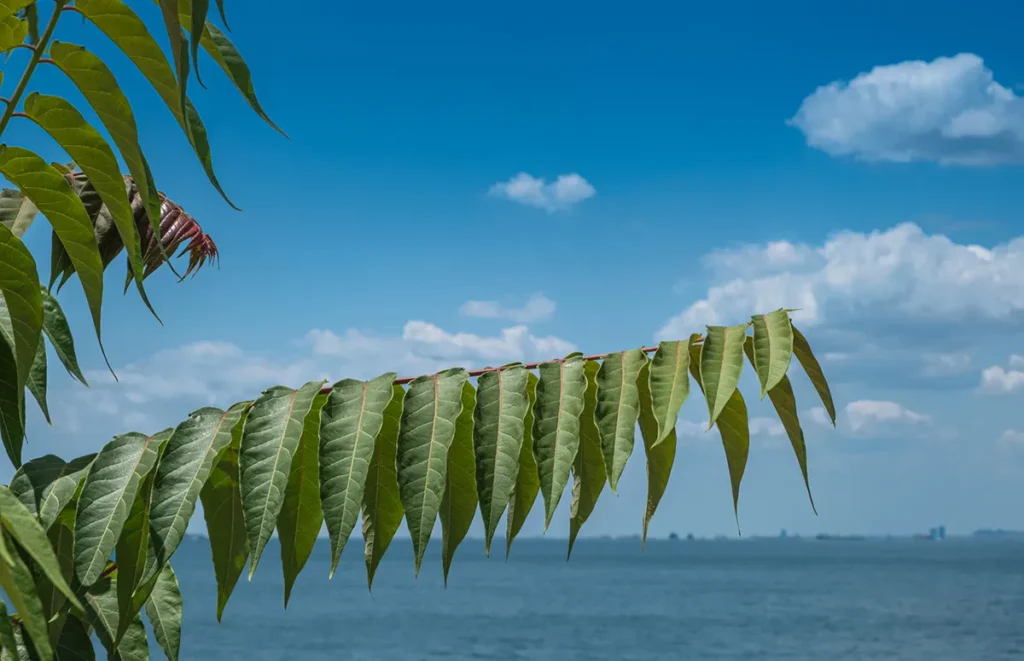
Tree of Heaven can be easy to miss because it does not look threatening when it is young. It can grow behind a garage, along a fence, near a parking area, or inside a mixed border where it blends with sumac, walnut, or other compound-leaf trees. Around older neighborhoods in Neptune Township, Neptune City, Belmar, and Wall, we often see volunteer trees that were never intentionally planted. By the time a homeowner notices lanternfly activity, the host tree may already be large enough to support more insects than expected.
That does not mean every tree visited by lanternflies should be removed. Maples and birch can be affected, but they are often valuable shade trees that deserve a measured inspection. A healthy maple over a yard in Shark River Hills may need selective pruning, monitoring, and better airflow, not removal. A declining birch with deadwood, poor vigor, and heavy insect pressure may call for a different conversation. Our role as a certified arborist tree service is to make that distinction clearly.
The local environment adds another layer. The Shark River corridor receives moisture, wind movement, and salt-influenced air closer to the inlet, while inland sections around Shark River Park and Wall Township can have heavier soils and larger wooded margins. Those differences affect tree stress. A tree already struggling with compacted soil, root restriction, storm wounds, or past improper pruning has less energy to tolerate additional sap-feeding pressure.
“Tree removal is not a blanket answer,” Michael Hufnagel says. “But when the tree is invasive Tree of Heaven, or when a tree is already declining and creating risk, removal can be the most responsible long-term choice. We do not remove a good maple just because a lanternfly landed on it. We inspect the whole situation.” That balanced approach is the difference between useful tree work and reactionary cutting.
The Host Tree Check That Changes the Whole Recommendation
Before deciding what to cut, prune, or monitor, the property needs a host tree review that separates nuisance from risk.
- Tree of Heaven should be identified because it strongly supports spotted lanternfly activity.
- Maples and birch need tree-specific evaluation before any major work is recommended.
- River moisture, coastal wind, soil compaction, and old pruning wounds can increase tree stress.
- Removal is most appropriate for invasive host trees, hazardous trees, or declining trees that cannot be reasonably restored.
Once the host trees and stressed trees are identified, the next step is choosing tree work that improves the property instead of simply reacting to insects.
Certified Arborist Guidance Before Lanternflies Become a Tree Problem
A certified arborist evaluation gives Shark River homeowners a practical plan. We inspect the canopy, trunk, root flare, nearby structures, and surrounding landscape. We look for deadwood, weak unions, cracked limbs, bark loss, poor taper, girdling roots, and signs of past storm damage. Our tree risk evaluation services are especially valuable when lanternfly activity is concentrated near homes, garages, driveways, pools, decks, docks, and outdoor gathering areas.
Pruning can help when a tree is structurally sound but overgrown, shaded, or holding too much deadwood. Good pruning improves clearance, reduces unnecessary limb weight, opens the canopy, and helps the homeowner see what is happening in the tree. It is not a lanternfly cure, and we would never present it that way. It is professional tree care that supports safety and vigor while making the landscape easier to monitor.
Tree restoration may be a better fit for valuable ornamentals or mature shade trees that still have good structure. Around Belmar, Neptune City, Avon-by-the-Sea, and Shark River Hills, many properties have older trees that contribute heavily to curb appeal and shade. When those trees are not hazardous, thoughtful care is often better than unnecessary removal. Our tree restoration and rejuvenation work focuses on preserving what can reasonably be preserved.
Removal becomes part of the discussion when Tree of Heaven is present, when a tree is structurally unsound, or when decline has advanced beyond practical correction. In tight Shark River neighborhoods, removal also has to be planned safely around roofs, fences, overhead wires, neighboring yards, and waterfront structures. That is why professional tree removal is not just cutting. It is controlled work based on access, rigging, equipment, cleanup, and risk.
“The best recommendation is the one that fits the tree and the property,” says Michael Hufnagel. “Sometimes that is pruning. Sometimes it is removing Tree of Heaven. Sometimes it is watching a healthy tree and telling the homeowner not to waste money on unnecessary work. That honesty is what a certified arborist owes the customer.” For Shark River homeowners seeing lanternfly nymphs this summer, that honest inspection is the right starting point.
A Practical Summer Plan for Shark River Properties
Lanternfly activity is easier to manage when homeowners use it as a prompt for better tree care, not as a reason to panic.
- Check decks, fences, vehicles, outdoor furniture, and low branches for early nymph activity.
- Look for Tree of Heaven along rear property lines, road edges, and disturbed soil areas.
- Schedule pruning or risk evaluation when trees overhang living spaces, driveways, or waterfront structures.
- Use removal selectively for invasive host trees, hazardous trees, or trees that are already failing.
- Contact a certified arborist before making major decisions about valuable shade trees or ornamentals.
If you are seeing spotted lanternfly nymphs around Shark River, Shark River Hills, Neptune Township, Neptune City, Wall Township, Belmar, Avon-by-the-Sea, or nearby Monmouth County neighborhoods, let Hufnagel Tree Service inspect the trees that may be contributing to the problem. We bring certified arborist experience, local knowledge, and a practical service-first approach to every property.
The goal is not to overreact to every insect. The goal is to protect the trees, the home, and the outdoor spaces that make Shark River properties valuable.
If you are seeing spotted lanternfly nymphs around Shark River, Shark River Hills, Neptune Township, Neptune City, Wall Township, Belmar, Avon-by-the-Sea, or nearby Monmouth County neighborhoods, let Hufnagel Tree Service inspect the trees that may be contributing to the problem. We bring certified arborist experience, local knowledge, and a practical service-first approach to every property.
For professional tree pruning, Tree of Heaven removal, tree restoration, or a ground-based tree risk evaluation, call Hufnagel Tree Service at (732) 291-4444 or use our contact form to schedule service. We have served Monmouth County for more than 25 years, earned more than 200 five-star Google reviews, and continue to believe the same thing Michael Hufnagel tells every homeowner: only use a certified arborist.
Schedule Service Now!
From precision pruning and safe removals to health assessments and preventative care, Hufnagel Tree Service delivers expert solutions backed by decades of experience. We offer certified insight, fair pricing, and a commitment to doing what’s best for your landscape.
Learn More About Our Services
Related Articles
Tree Pruning for Safer, Healthier Growth