Contents
West Long Branch Tree Preservation Starts With a Borough Code
West Long Branch became a borough on May 5, 1908, after voters in the West Long Branch section of Eatontown approved a separation, according to Wikipedia. The borough covers about 2.89 square miles at an elevation of about 26 feet, and Route 36 and Route 71 cross inside it. Monmouth University, founded in 1933, holds a 155 acre campus here, and the Great Hall at Shadow Lawn on that campus is a National Historic Landmark. A small borough with that much history and that much traffic leaves little room for careless decisions, which is why West Long Branch tree preservation deserves a plain explanation.
The borough has a Tree Preservation Code, Chapter XXIII of its ordinances, and it applies to trees on private property. Our tree removal work and our tree risk evaluation service both start by reading that code against what we find in the tree. The code does not ask whether an owner likes a tree. It asks whether the tree is healthy, whether it is a hazard, and what will replace it, and an arborist can answer those questions with evidence.
After almost 30 years working throughout Monmouth County, we have seen that November is when those questions come up. The leaves are down, defects are easy to read, and the National Weather Service says nor’easters are most frequent and most intense between September and April. A tree that is dead, declining, or leaning needs a decision before that season tests it, and a healthy tree needs a plan that keeps it.
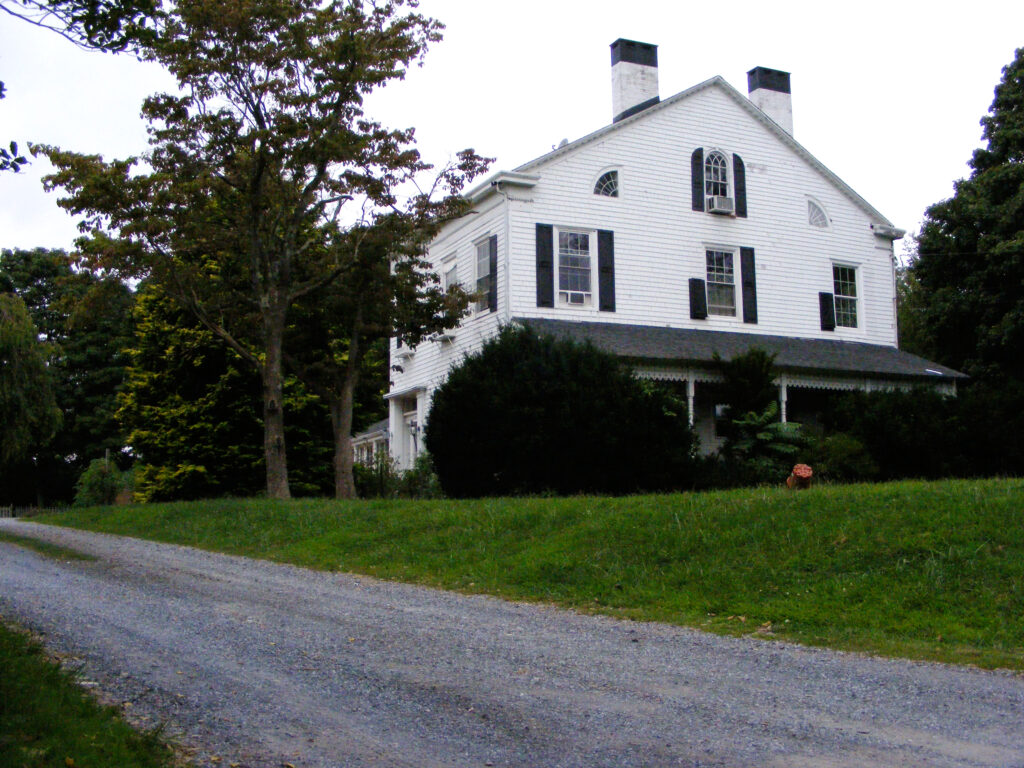
The photograph above shows the MacGregor-Tallman House in West Long Branch, a white frame house with two chimneys and dark shutters, with tall deciduous trees beside a gravel drive. The house is listed on the National Register of Historic Places. Old houses and old trees share a problem. Both were set on a lot for a street and a climate that may have changed since. A large tree beside a house can be an asset, but a limb over the roof, a root under the drive, or a trunk with a cavity changes the question.
The borough sits at about 26 feet above sea level, per Wikipedia, and low ground tends to hold water after heavy rain. Soil that stays soft gives roots less to grip when wind arrives. Our guide to weak tree roots explains the warning signs at the base, and our guide to hidden tree rot explains why a healthy looking crown can sit on a trunk that is not.
The Borough Code Ties Every Removal to a Replacement Plan
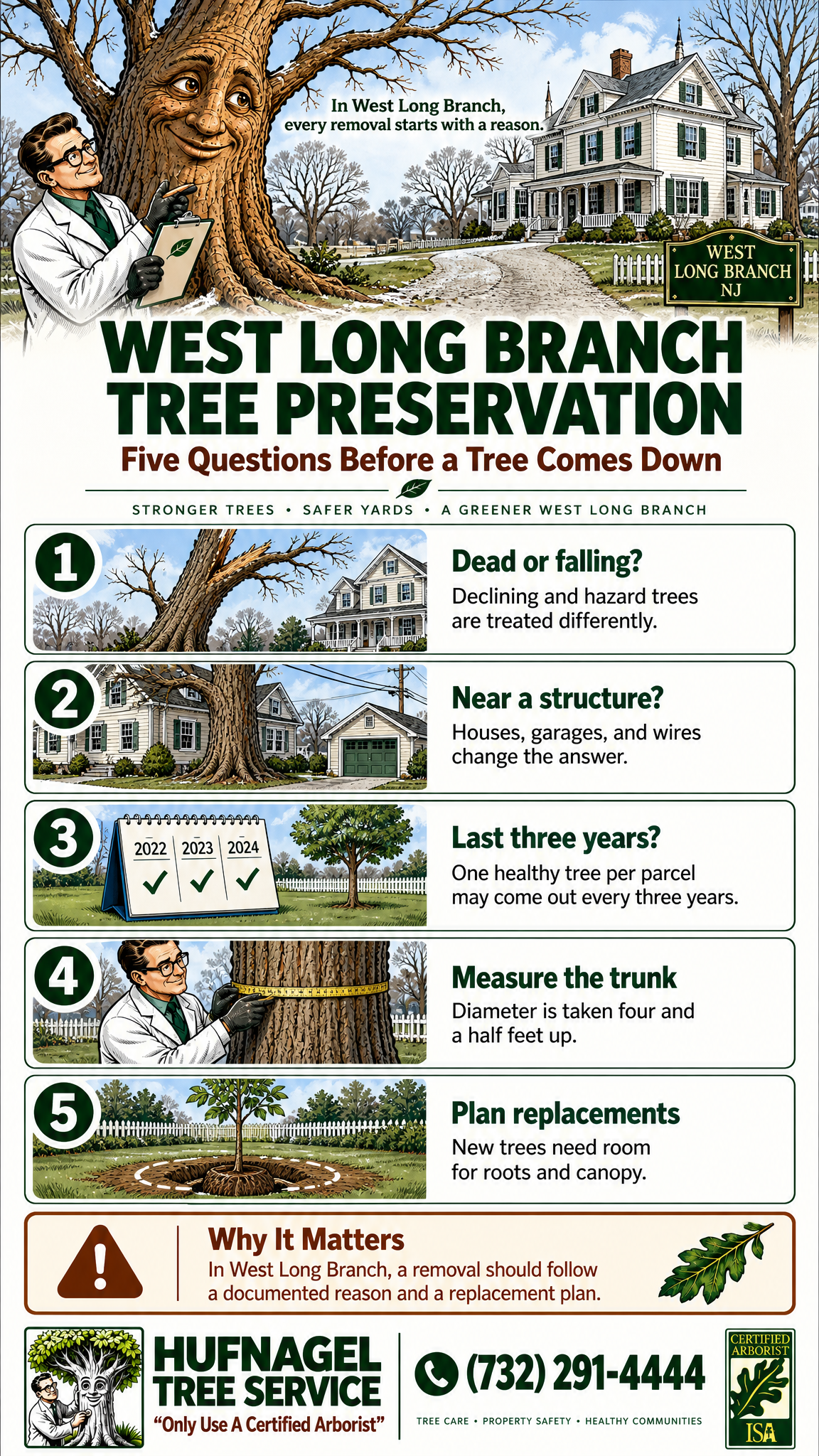
Chapter XXIII of the borough code, adopted as Ordinance O-08-10, is titled the Tree Preservation Ordinance of the Borough of West Long Branch. The text of the code says its purpose is to preserve, protect, replace, and properly maintain trees, and to protect the public from trees that pose a threat or danger. It lists the reasons trees matter, from filtering air pollutants and holding topsoil with their roots to reducing storm water runoff, screening noise, and sheltering birds and wildlife.
The rule at the center of the code is replacement. Removing a six inch tree, or a grouping of trees that adds up to six inches, must be followed by replacement trees whose combined trunk diameter equals at least 30 percent of the diameter that came out. No replacement tree may be smaller than two inches across. Diameter is measured at breast height, which the code defines as four and a half feet above the ground, and every measurement in the code uses that point.
Groupings matter more than most owners expect. The code counts two or more trees as a grouping when their combined diameter reaches six inches, and for removal purposes it applies that definition to any two or more trees removed within twelve months of each other. Taking out a small tree this fall and another next spring can therefore be treated as one removal. We tell owners to plan the whole property at once, and our guide to tree removal permits explains how borough rules like this usually work.
Some removals need no replacement at all. Under Rule 5 of the code, no replacement is required when a tree is dead or irreversibly declining, is in danger of falling, is too close to existing structures so as to endanger them, interferes with utility services, creates unsafe vision clearance, or constitutes a health or safety hazard. The Shade Tree Commission’s interpretive statement repeats that list in plain language for residents. A second exemption lets an owner remove one healthy, safe tree per parcel every three years without replacement.
That is where an arborist’s documentation earns its keep. A tree that is dead or declining looks different from one that is merely inconvenient, and the borough can only treat the two differently if the difference is recorded. Our tree risk evaluation work notes the defect, the target, and the photographs, and we leave the decision about what the code allows to the borough. We do not tell an owner that a tree qualifies for an exemption, because that finding is not ours to make. Good records make West Long Branch tree preservation a shorter and easier conversation for everyone involved.
Mike Hufnagel puts the working rule this way: “The borough code asks a fair question about why a tree has to come down. Our job is to answer it with what we can see in the wood and the roots, not with what we assume from the street.” That rule keeps the plan honest. It also gives an owner something concrete to hand the borough, because every finding comes with a reason a neighbor could understand.
Five Questions We Answer Before a West Long Branch Tree Comes Down
- Is the tree dead, irreversibly declining, or in danger of falling.
- Is it close enough to a house, garage, or service wire to endanger it.
- Has another tree come out of this parcel within the last three years.
- What is the trunk diameter, measured four and a half feet above the ground.
- Where will replacement trees fit once the old canopy and roots are gone.
Answering these in order keeps a sound plan from stalling. A tree that clearly meets the hazard language of the code can come down without a planting bill, while a healthy tree that an owner simply wants gone may need replacement trees to be planned. Either way, the answers are facts about the tree and the lot, and they are easier to gather before a crew arrives than after. Once the removal question is settled, the next one is about what goes back in the ground, and the borough has a commission that offers guidance on exactly that.
Replacement Planting and the Shade Tree Commission Shape the Plan

The borough’s Shade Tree Commission page says the commission was established under Ordinance 2-12 of the Revised General Ordinances and has five to seven members appointed by the Mayor. It meets on the second Thursday of each month at 7 p.m. in the Council Chambers at Borough Hall, with no meetings in July or December. The commission’s address is 965 Broadway, West Long Branch, NJ 07764, and the borough number on the page is (732) 229-1756. We suggest confirming the schedule with the borough before attending, since meeting dates can change.
The code suggests, but does not require, that replacement trees come from its Appendix A, a list of significant trees of New Jersey and the Mid-Atlantic States. The list includes tulip tree, American sweetgum, willow oak, red oak, Norway spruce, and eastern white pine, along with shrubs such as silky dogwood and buttonbush. Because the list is a suggestion, the choice of species stays with the owner. We usually start from the site: how much sun the spot gets, how much room the roots will have, and what is overhead.
The arithmetic is simple once the diameter is known. As we read Rule 4, a 20 inch tree works out to six inches of replacement diameter, which three trees of two inches each would meet. The borough makes the final call on any specific plan, so we encourage owners to bring the numbers to the borough before ordering trees. A short call can prevent a planting that has to be repeated.
When the math calls for more than three trees, the code lets an owner plant three trees and substitute shrubs for the rest, at one shrub per inch of diameter. A shrub used this way needs a root ball at least 12 inches across or a container of at least five gallons. Small lots can use that flexibility, and it is worth asking about before buying plants. It also fits our habit of matching a planting to the room a property really has.
The photograph above shows two people planting a small seedling against a sunset sky, with a shovel and a watering can beside them. It points to the part of the process owners tend to forget. A replacement tree is a young tree, and it needs water, mulch kept off the trunk, and protection from mowers and trimmers for several seasons. Our tree health management work covers that early care, and the commission’s page links a handout on proper mulching.
Property development has its own rule. When an application is before the Zoning Board or the Planning Board and the project would remove or transplant trees, the code requires a tree preservation plan with the application. The plan lists existing and proposed trees by common name and diameter and states whether each will be destroyed, relocated, replaced, or preserved. Trees inside the footprint of a new structure need no replacement. We can supply tree condition information for a plan, but the plan itself belongs to the owner’s design professional.
Planting Choices to Settle Before a West Long Branch Removal
- The total trunk diameter to replace, using the code’s 30 percent rule.
- Species chosen for the site, with Appendix A as a suggested starting list.
- Whether shrubs can stand in for trees when more than three are needed.
- Room for roots and canopy away from wires, walls, and the neighbor’s property.
- Water and mulch plans that protect a young tree through its first seasons.
Settling these early keeps a removal from turning into a second project. It also protects the trees that remain, because a new planting set too close to a house or a service line only moves the problem a few decades down the road. West Long Branch tree preservation works best as one plan for the whole lot. Once the ground plan is clear, the last question is how the trees already standing will face the winter, and what threats besides wind belong on an owner’s list.
Winter Weather and Lanternflies Add Two Reasons to Inspect Now

The National Weather Service says the winds over coastal areas in a nor’easter are typically from the northeast, that these storms nearly always bring gale force winds along with heavy rain or snow, and that a nor’easter could cut power. It adds that they peak from September through April. For a borough with Route 36 and Route 71 running through it, that means mature trees stand beside roads, wires, and houses for the whole stretch of the season that is still ahead of us.
A tree that is dead, leaning, or hung with broken limbs does not get stronger over winter. Under Rule 5 of the borough code, a tree in danger of falling is one of the cases where removal needs no replacement, but that finding depends on someone actually inspecting the tree. Our guide to storm season risk assessment explains how we rank trees when several need attention, and our storm proofing work focuses on reducing predictable leverage instead of cutting a crown back at random.
We have written about West Long Branch trees before. Our article on protecting trees from snow and ice in West Long Branch covers load on limbs, and our piece on tree pruning in West Long Branch explains why every cut needs a reason. Pruning and preservation are the same idea seen from two sides. A cut that removes a real defect helps a tree last, and a cut with no purpose can start the decline that ends in a removal.
The photograph above shows spotted lanternfly nymphs, the black, red, and white spotted stage, clinging to a reddish stem. The Shade Tree Commission page links several lanternfly resources, including a quarantine notice and a checklist for residents, and the New Jersey Department of Agriculture says all New Jersey counties are now quarantined. For egg masses, the department describes scraping reachable masses into an alcohol solution. It notes that eggs can sit on rocks, trees, fence posts, and furniture at any height, so reaching every one may not be practical.
The same department page recommends removing tree of heaven when it is found on a property, if that is possible and practical, and it says to use an herbicide when doing so. A removal is still a removal under the borough code, and we do not decide how the borough classifies any particular tree. We suggest asking the borough before cutting, and the commission’s page links handouts on invasive trees that explain what makes a tree invasive.
Choosing who does the work matters as much as the plan. The Rutgers fact sheet How to Hire a Tree Care Professional, which the borough hosts, says that in New Jersey anyone can claim to be an arborist or tree expert, so owners should ask about experience, training, insurance, and references. It describes the New Jersey Certified Tree Expert credential from the Board of Tree Experts and the separate ISA program, and it says certification is not a guarantee of quality work but does show a commitment to professionalism and education.
Winter Warning Signs West Long Branch Owners Should Photograph
- Cracks, splits, or included bark where two stems of similar size meet.
- A new lean, or soil heaving and cracking at the base of the trunk.
- Dead or hanging limbs over roofs, driveways, walks, and neighboring property.
- Fungus, soft wood, or cavities at the trunk or the root flare.
- Egg masses or insect activity on bark, stems, fences, and nearby objects.
Photographs taken from the ground, with dates, help us decide what to look at first. Stay clear of anything that looks cracked or hung up, never climb or cut it yourself, and keep away from any tree that touches a service wire. No tree service can honestly guarantee that a tree will never fail in severe weather. What an inspection can do is separate the trees that need work from the trees that need only watching, and that is the same distinction the borough code draws between a hazard and a healthy tree. Our codominant stems guide covers one of the most common structural findings.
Call Hufnagel Tree Service for West Long Branch Tree Preservation Before Winter Storms
If you have mature trees near your West Long Branch home, driveway, garage, or property line, schedule an evaluation before winter storms arrive. We provide storm proofing, tree risk evaluation, tree trimming and pruning, restoration, and removal when a tree cannot be managed safely.
Hufnagel Tree Service is led by a certified arborist with almost 30 years of local experience and more than 280 five star Google Maps reviews. We inspect first, explain what we found in plain terms, and recommend only the work that changes the outcome for your trees and your property.
Call or text (732) 291-4444 to schedule a tree inspection and a West Long Branch tree preservation plan before the next nor’easter arrives. Our West Long Branch tree articles list more local guidance.
Schedule Service Now!
From precision pruning and safe removals to health assessments and preventative care, Hufnagel Tree Service delivers expert solutions backed by decades of experience. We offer certified insight, fair pricing, and a commitment to doing what’s best for your landscape.
Learn More About Our Services
Related Articles
Old Bridge Fall Tree Inspection: Catch Hidden Hazards Early
Winter Tree Prep in Old Bridge: Schedule An Inspection