Winter Tree Preparation in Belmar NJ: Salt, Snow Load, and Tree City Rules

In Belmar, trees stand between the Atlantic Ocean and the Shark River, where wind, salt, and snow all test them. Learn what we check on a bare canopy before the first nor’easter arrives.
Share This Article

Contents

Winter Tree Preparation in Belmar Matters in a Borough Between Ocean and River

Belmar began as the borough of Ocean Beach on April 9, 1885, when the New Jersey Legislature set it apart from Wall Township, and it took the name Belmar on November 20, 1890, according to Wikipedia. It covers about 1.6 square miles, and more than a third of that total area is water, with the Atlantic Ocean to the east and the Shark River along its north side. The 2020 census counted 5,907 residents, and Routes 35 and 71 are the two main highways through town. The borough’s own Shade Tree Commission page adds that Belmar holds Tree City USA status.

That setting shapes winter tree preparation in Belmar. A tree here usually grows in a small lot, a narrow planting strip, or a yard close to a street, with water on one side and open ocean on the other. Our tree risk evaluation service looks at each tree as a structure with a target beneath it, and winter tests that structure in ways summer never does.

After almost 30 years working throughout Monmouth County, we have seen that mid November is the right moment to look up. The leaves are down, so every union, crack, and dead limb is easy to see from the ground. The National Weather Service says nor’easters are most frequent and most violent from September through April, which means most of the season is still ahead of us. A problem found now can be corrected on a calm day.

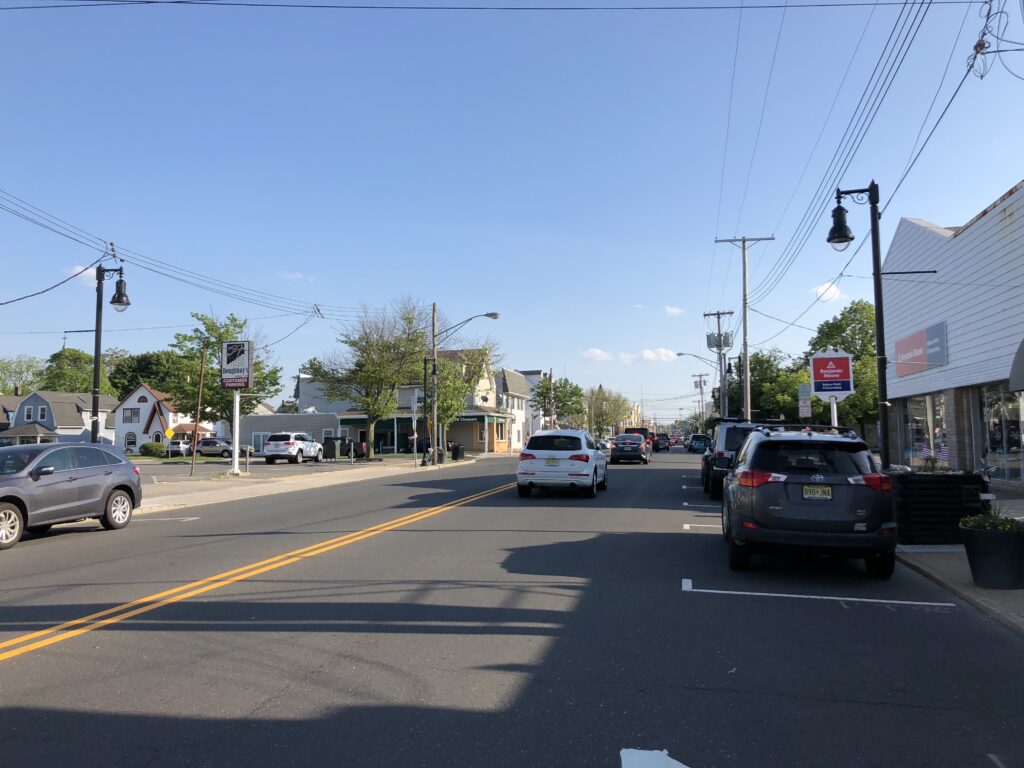
Main Street in Belmar NJ looking south with a yellow center line, parked cars, shops at the right, street lamps, overhead utility wires, and several leafy street trees under a clear blue sky
Main Street (Route 71) looking south between Fifth and Sixth Avenues in Belmar, May 2018. Photo: Famartin, CC BY-SA 4.0, via Wikimedia Commons.

The photograph above shows Main Street, which Wikipedia identifies as Route 71, looking south between Fifth and Sixth Avenues. It was taken in May 2018. Street trees stand along both sides, lamp posts and utility wires run above the roadway, and shops and parked cars line the curb. We see the same mix all over the shore. A tree grows in a small opening between pavement and a building, and wires cross the air above its crown.

Water is part of the planning too. Wikipedia gives the borough an elevation of about 13 feet, and the borough homepage links a flood zone lookup for property owners. We do not claim to know which blocks hold water after a storm. We do know that a tree beside either edge can stand in soil that stays soft for days after heavy rain or a high tide, and that wet ground is when roots and trunks are asked to do the most.

Winter Tree Preparation in Belmar Starts With Structure, Not the Forecast

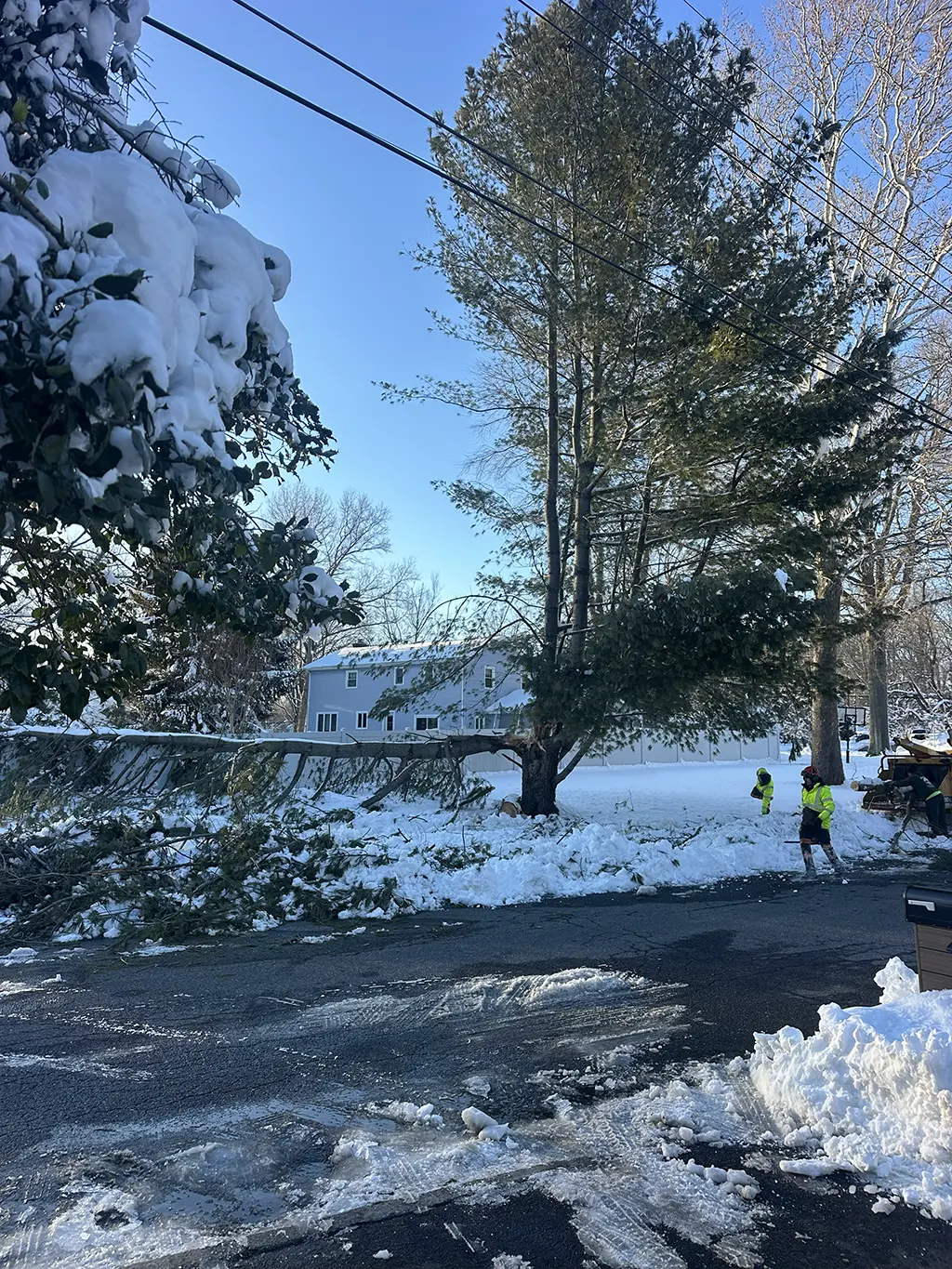
Winter hurts trees by adding weight and wind at the same time. The North Carolina State University Extension explains that heavy snow and ice pile onto branches and can snap limbs or bring down a whole tree, and that branches attached to the trunk at narrow angles are the most likely to break or split. That is a structural point, not a weather point. A union that was fine in July can fail in January because it was never as strong as it looked.

The University of Illinois Extension names the same culprits: weak, narrow unions, trees with multiple leaders, and upright evergreens such as arborvitae and juniper. The North Carolina page also lists Bradford pear, silver maple, green ash, and willow among the trees most vulnerable to snow and ice damage. Those species are common in shore towns, so a walk around a Belmar block usually turns up at least one tree on that list.

Our guide to codominant stems explains why two stems of similar size can be a problem. As they thicken, bark can get trapped in the seam between them, and the union is weaker than the wood on either side. A bare November canopy lets us see that seam clearly. We check how tight the angle is, whether the bark turns inward, and whether there is a crack, a stain, or old decay in the fork.

Timing matters as much as technique. The Illinois page warns against late summer pruning because it pushes tender new growth and uses up reserves the tree needs for winter, and both extension pages point to proper pruning as the best prevention. We prune to correct a defect, reduce end weight, or remove deadwood, and we do not prune just because the calendar has turned. Our tree trimming and pruning work follows that rule, and we name topping only to reject it.

There are small jobs a homeowner can do from the ground. The North Carolina page advises taking lights, feeders, and wind chimes off branches so they do not add weight, and it says never to shake a tree or chip at ice, because that causes more damage. It also says not to cut limbs that are tangled in power lines, which is a job for the utility. We would add one rule of our own. Stay clear of anything leaning, cracked, or hung up, photograph it, and call.

Mike Hufnagel puts the order of work this way: “Before I think about the snow, I want to see where a tree is already weak. If the union is sound and the limbs are clean, the snow has very little to work with.” That sentence is the whole method. We find the weak point first, rank it by what sits beneath it, and only then decide whether the answer is pruning, support, monitoring, or removal.

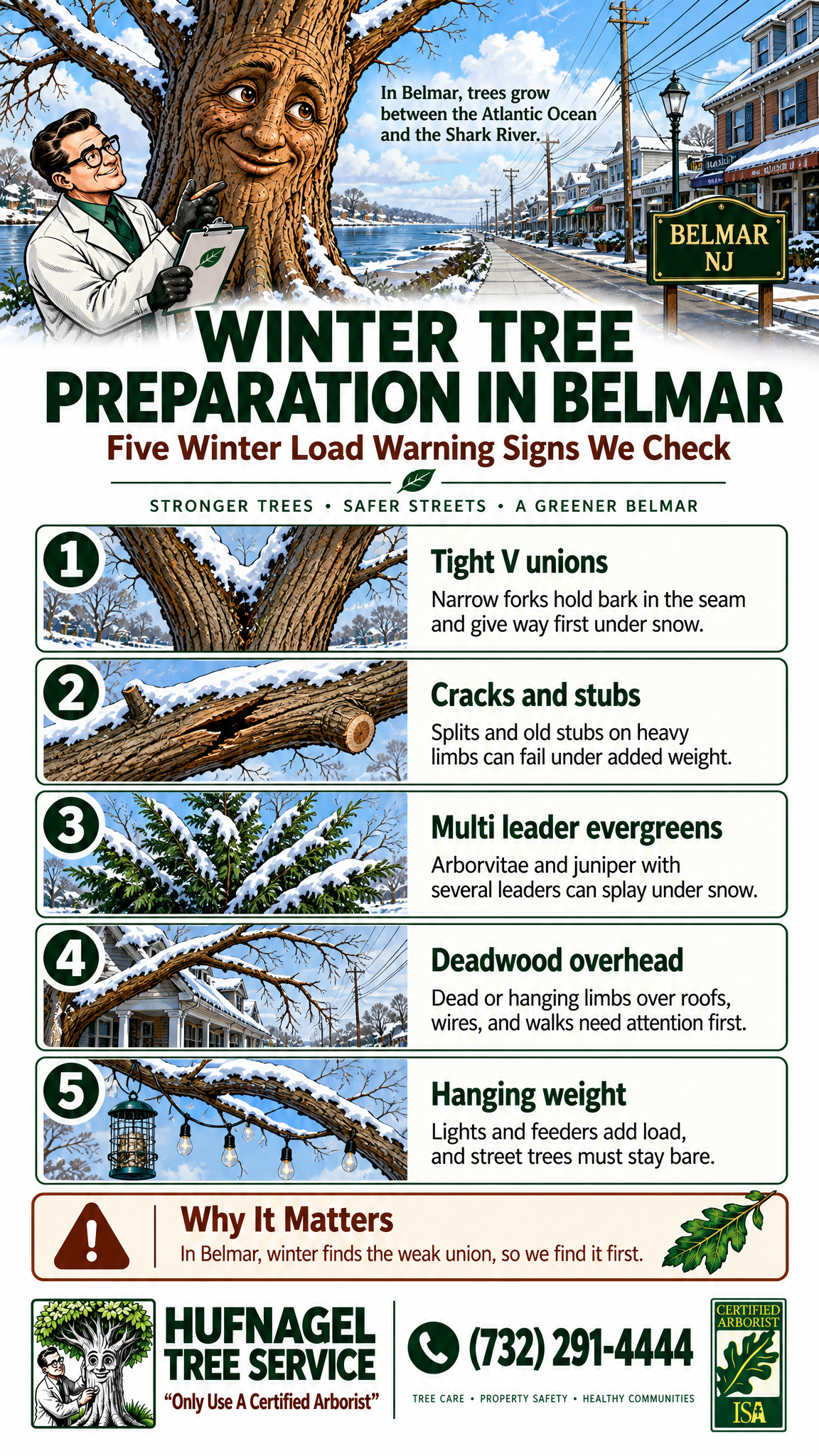
Five Winter Load Warning Signs We Check in Belmar

  • Narrow unions where two stems or limbs meet in a tight V.
  • Cracks, splits, or old stubs on limbs that carry heavy end weight.
  • Upright evergreens such as arborvitae and juniper with several leaders.
  • Deadwood and hanging limbs above roofs, wires, driveways, and walks.
  • Lights, feeders, and other items hung on branches that add weight.

These signs often appear together, so we weigh them together. A tight union on a small tree over a lawn is a minor concern, and the same union over a roof or a parked car is a serious one. Once the structure is understood, the next question is what the site itself does to a tree between December and March, and a town between an ocean and a river has a lot to say about that. Our guide to storm season risk assessment covers the same ground at greater length.
Salt and Nor’easter Wind Reach Belmar Trees From Two Directions

Two forces reach Belmar trees in winter, and they come from different directions. The first is wind. The National Weather Service describes a nor’easter as a storm with coastal winds from the northeast, gale force in the stronger events, and it notes that these storms can bring coastal flooding along with heavy rain or snow. A crown that has been shaped by years of ordinary weather can still be loaded unevenly by one long northeast blow.

The second is salt. The Rutgers Plant and Pest Advisory article by Ann Gould, Impact of Road Salt on Adjacent Vegetation, explains that salted water thrown from pavement by passing vehicles injures leaves, and that the damage is worst on the side of a plant facing the road. Plants within about 15 feet of traffic lanes sit in what the article calls the spray zone, and injury can reach farther downwind. We do not assume which streets are treated in any given winter. We simply look at which trees stand within that distance of pavement.

Rutgers adds that plants cannot excrete salt, so evergreens, which keep their foliage, are more vulnerable than trees that drop their leaves each year. Its list of sensitive species includes red maple, dogwood, American beech, hemlock, yew, and white pine. Its tolerant list includes Norway maple, honeylocust, and several oaks. The article cautions that many of these ratings rest on anecdotal evidence, so we treat them as a guide and not a promise.

Salt also works through the soil. The article says salty water that soaks into the ground makes it harder for roots to take up water, and that late winter and early spring applications do more harm because less rain or snowmelt has leached the salt out before growth resumes. For owners, that points to a short list of habits. Clear snow first and use only a little deicing product. Keep plowed, salty snow from being piled against trunks. Rinse salt from evergreen foliage with plain water when temperatures are above freezing. North Carolina State adds that sodium chloride can hurt roots and foliage within about 30 feet and suggests alternatives for walks near plants.

Soft ground adds to the wind problem. Our guide to weak tree roots describes how a root plate holds a mass of soil, and when that soil stays saturated, the whole plate can shift under load. We look for soil that is raised or cracked on one side of the trunk, a new lean, and mulch piled against the base. Any of these tells us the tree is carrying less margin than it did last winter.

We also keep a second guide in mind, hidden tree rot, because decay and wind combine badly. A trunk with a hollow or a soft patch at the base can look healthy in the crown. Wet soil and a northeast gale are exactly the conditions that expose it. A clear day does not make a rotten tree safe, which is why we look at the base, the trunk, and the crown together rather than judging a tree by its leaves alone.

Winter Exposure Signs Along Belmar Streets and Water Edges

  • Scorched or browned evergreen foliage on the side facing treated pavement.
  • Soil that is raised, cracked, or soft on one side of a trunk.
  • A trunk or crown that leans differently than it did last season.
  • Plowed snow and salt piled against the base of a trunk.
  • Fungus, soft wood, or thin branch tips near the root flare.

Findings like these steer the plan more than any forecast does. A tree with a sound base and clean structure can stay as it is. A tree with a weak union, a soft base, or a lean over a roof may need pruning, support, restoration, or removal before the next nor’easter. Our storm proofing and tree risk evaluation services are built to sort one from the other. Once the exposure is clear, the last piece of the plan is the borough’s own rules, because in Belmar they shape who may do what to which tree.

Planting Strips, Wires, and Borough Rules Shape the Winter Plan

Belmar takes its trees seriously on paper as well as in practice. The borough’s Shade Tree Commission page says the commission controls the planting, care, and removal of trees in public highways, parks, and parkways, and that it can order the removal of any tree or part of a tree that is dangerous to public safety. It also says a permit is required to remove, plant, or prune trees in the planting strip or on private property under the Belmar Shade Tree Ordinance, with an application form linked on the page.

That makes the planting strip, the strip between sidewalk and curb, an important place to understand. The same page says homeowners are responsible for pruning trees that originate on their property or in the planting strip, and that it is unlawful to attach anything to a street tree. For winter, that means no lights or hangers on a street tree. Our guide to tree removal permits explains how permit steps usually work across the area, and our earlier article on street trees and permits in Belmar goes deeper on the strip itself.

Wires change the plan. The borough page says not to trim trees near electric wires and tells residents to call JCP&L at 800-662-3115 instead. We agree with that rule completely. A limb touching a line is not a homeowner project, and a snow loaded limb above a line is not either. We photograph it from a safe distance, keep everyone clear, and coordinate through the right channel, because the line can be live even when nothing looks wrong.

The same page gives some plain rules for the root zone. It says to keep mulch rings 2 to 4 inches deep, to avoid string trimmers and mowers near trunks, and to remove planting strip stumps to 8 to 12 inches below grade and backfill them. A shallow ring of mulch protects roots through the cold months, and a deep volcano of mulch hides the root flare and holds moisture against the bark. Our tree health management work often starts with simply pulling mulch back to expose the flare so we can read it.

Debris is part of winter planning as well. The borough’s Public Works page lists leaf pickup and brush pickup, and it gives the department’s number as 732-681-0452 for questions about schedules and rules. We always ask owners to check those details before cutting, since a pruning plan should fit when and how material can leave the property. We have seen good work waiting at the curb for weeks simply because it was bundled the wrong way.

We also pay attention to where a tree stands on the lot. A tree on private property, in the planting strip, or in the public right of way can each follow a different path to approval. We do not guess. We tell owners which of the three we think applies, point them to the commission’s contact information, and help them describe the problem clearly. The page lists the commission at Shadetree@belmar.com and 732-681-3700, extension 782, and a clear description of a defect, with photographs, gets a faster answer than a general question.

What a Belmar Winter Tree Plan Should Cover

  • A bare canopy inspection of unions, deadwood, and limbs over targets.
  • A check of the planting strip and permit status before any pruning.
  • Mulch pulled back to expose the root flare, ringed 2 to 4 inches deep.
  • A plan for evergreens, including ties, salt barriers, and rinsing.
  • A clear rule to stay clear of wires and call the utility.

A plan like this does not promise that no tree will ever fail. No tree service can honestly say that. What it does is shrink the list of surprises. Each item on the list is either fixed, watched, or consciously accepted, and the owner knows which. That is the point of winter tree preparation in Belmar done early, on a dry day, instead of during the first storm warning. Our restoration and removal services stay in reserve for the trees that cannot be managed any other way, and we explain why before we recommend either.

Call Hufnagel Tree Service About Winter Tree Preparation in Belmar Before the Next Storm

If you have mature trees near your Belmar home, driveway, planting strip, or property line, schedule an evaluation before winter storms arrive. We provide storm proofing, tree risk evaluation, tree trimming and pruning, restoration, and removal when a tree cannot be managed safely.

Hufnagel Tree Service is led by a certified arborist with almost 30 years of local experience and more than 280 five star Google Maps reviews. We inspect first, explain what we found in plain terms, and recommend only the work that changes the outcome for your trees and your property.

Call or text (732) 291-4444 to schedule winter tree preparation in Belmar before the next nor’easter arrives. Our Belmar tree articles list more local guidance.

Schedule Service Now!

From precision pruning and safe removals to health assessments and preventative care, Hufnagel Tree Service delivers expert solutions backed by decades of experience. We offer certified insight, fair pricing, and a commitment to doing what’s best for your landscape.

Where Do You Need Service?
Please Enter Your Contact Information
Are You A New or Existing Customer?
How Can We Help You?

Thank You!

Your Message Has Been Sent

We Will Contact You About Your Inquiry Shortly.

We Could Not Find A Direct Link To A Tree Removal Permit Application For The Town You Selected.

Please contact your local municipality to determine if a permit is required for your tree removal project. They will provide you with the most accurate and up-to-date information.