Contents
Tree Removal in Loch Arbour Starts With a Village of 0.14 Square Miles
Tree removal in Loch Arbour starts with how small the place is. Wikipedia says the village was incorporated on April 23, 1957, after a referendum that carved it out of Ocean Township, and that it covers about 0.14 square miles with 224 residents in the 2020 census. It borders Allenhurst to the north, Interlaken to the west, and Asbury Park to the south, with the Atlantic Ocean on its eastern edge, and Route 71, also called Norwood Avenue, is its main road.
That scale changes how we think about taking a tree down. Almost every tree in the village stands within reach of a roof, a wire, a neighbor’s fence, or a street, and many share a lot line with a house on the other side. Our tree removal work here starts with the question of whether the tree can be saved, and it moves to removal only when the structure leaves no dependable alternative.
After almost 30 years working throughout Monmouth County, we have seen that a tree rarely announces the day it becomes a removal. The signs build over seasons, and November is a practical time to read them, because the leaves are down, the crown is visible, and winter weather has not yet loaded the branches.
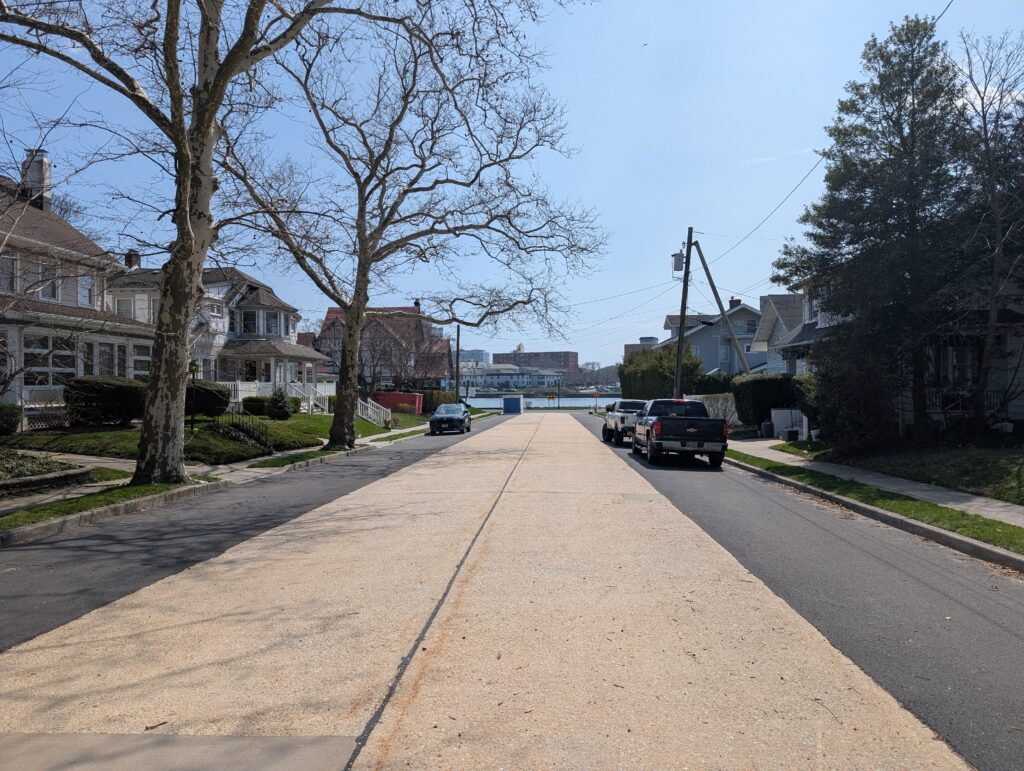
The photograph above shows southbound Evergreen Place in April 2026, with large leafless street trees overhead, porches on both sides, a utility pole with wires, and Deal Lake at the end of the block. The scene is typical of the village, where mature trees, close houses, and open water share very little ground. A tree that fails on a street like this has a short distance to travel before it meets something.
Water and wind complete the picture. Wikipedia puts Deal Lake at 158 acres, with seven municipalities around about 27 miles of shoreline, and it lists the village at an elevation of about 10 feet. The National Weather Service says nor’easters are most frequent and most intense between September and April. Saturated ground, gale force wind, and old wood are the usual ingredients of a removal call, which is why the coming months matter.
A Tree Comes Down When Its Condition Leaves No Safe Alternative
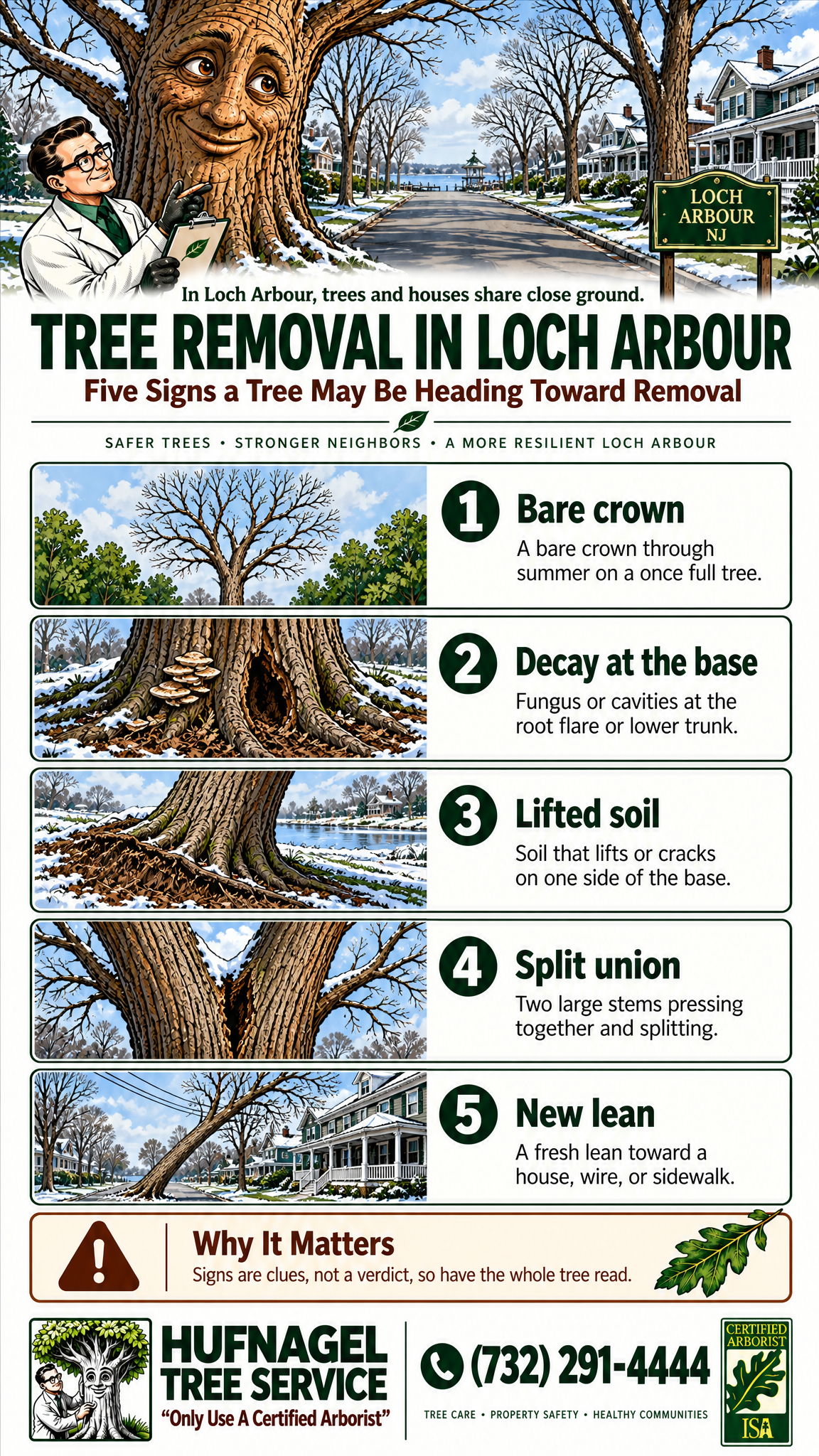
We do not remove a good tree because it is large or inconvenient. Pruning, restoration, monitoring, and removal are the four outcomes we weigh, and most trees land in the first three. Our tree risk evaluation work exists to separate the trees that can be managed from the ones that cannot, and it does so by connecting each defect to what the tree could hit if it failed.
A dead tree is the simplest case. Dead wood dries, decays, and sheds limbs without warning, so a dead tree over a roof, a driveway, or a walkway has a clock running. A bare crown in July, when the neighbors’ trees are in full leaf, is the clearest sign, and a bare crown in November is harder to read, which is why summer photographs of the same tree are so useful.
Decay at the base is the next case. Fungus growing from the root flare, a cavity in the lower trunk, or soft, crumbling wood can mean the base of the tree is no longer holding it up. Our guide to hidden tree rot explains how a tree can look sound from the street while the wood inside has been lost.
Root failure is quieter. Soil that lifts or cracks on one side of the base, a new lean, or roots pulled out of the ground after a wet spell can mean the root plate has moved. Our guide to weak tree roots shows what this looks like at ground level. A tree in that condition is not a candidate for pruning, because the problem is anchorage, not weight in the crown.
Structure matters too. Two stems of equal size growing from one point can press against each other and trap bark between them, and a split in that union can open slowly over years. Our guide to codominant stems covers the signs. A split that has reached the trunk rarely closes, and when the stem leans over a house, cabling and pruning may not be enough to manage it.
Even then, the answer is not automatic. Mike Hufnagel puts it simply: “A removal should be the end of a conversation about the tree, not the start of one. We want to show the homeowner what the tree is doing and what it could reach before anyone talks about taking it down.” That is why we photograph the defect, explain it in plain terms, and leave the decision with the homeowner.
Signs a Loch Arbour Tree May Be Heading Toward Removal
- Dead branches or a bare crown through summer on a tree that was once full.
- Fungus, cavities, or crumbling wood at the root flare or the lower trunk.
- Soil that has lifted or cracked on one side of the base.
- A split or tight fork where two large stems press against each other.
- A lean that looks new, especially toward a house, a wire, or a sidewalk.
None of these signs proves that a tree must come down, and several of them can be managed with pruning, support, or monitoring. The goal is not to guess from the driveway. The goal is to document what changed, keep people and vehicles clear of the area under the tree, and have the whole tree read in context. Once a tree is judged to be beyond management, the next question for a homeowner is what the village expects before the work begins.
Loch Arbour Posted a Draft Tree Ordinance Homeowners Should Review
The Village of Loch Arbour posted a document on its website titled Ordinance No. 2023-489, an ordinance establishing the protection of trees. The notice at the end says it was introduced at the Board of Commissioners meeting on June 12, 2023, and read for the first time, with final passage scheduled for the meeting of July 5, 2023. We could not confirm from the posted file which version was finally adopted, so homeowners planning tree removal in Loch Arbour should treat what follows as a summary of the draft and ask the Village Clerk for the current text.
In that draft, a tree is any woody perennial plant with a single stem at least two inches across, measured six inches above the ground, and a heritage tree is one with a circumference of 19 inches or more. Removing a heritage tree requires a tree removal permit, with limited exceptions such as trees removed under an approved development application, under a state forestry management plan, or at the direction of a public authority.
A permit can be granted when a heritage tree is dead, severely damaged, in an advanced state of decline, severely diseased, or an imminent public safety hazard, as determined by a New Jersey Licensed Tree Expert or a competent public authority. It can also be granted when a construction permit requires the removal, or for compelling reasons based on the totality of the circumstances. The New Jersey Board of Tree Experts says a Licensed Tree Expert becomes licensed by passing an examination, and that licensees may perform pruning, removal, stump grinding, cabling and bracing, diagnosis, and risk assessment.
The draft application comes from the Village Clerk and asks for the owner’s details, the lot and block, the purpose of the removal, and a survey or diagram showing the heritage trees on the lot and those to be removed. It calls for a replacement plan or a fee to the village of $500 per tree removed, plus an application fee of $25 that can cover more than one tree. The enforcing officer is to act within thirty days of a complete application, and the draft treats silence after thirty days as approval.
Emergencies and the public side of the lot are handled differently. The draft lets a person responsible for the property act first in an emergency, defined as a clear and immediate danger to a person or property, and then apply for a permit no later than the end of the second business day after the work. Separately, it prohibits cutting, removing, or disturbing the roots of a tree on village property, including the strip between the sidewalk and the curb, without approval from the enforcing officer. Penalties in the draft run up to $1,250 per removed tree.
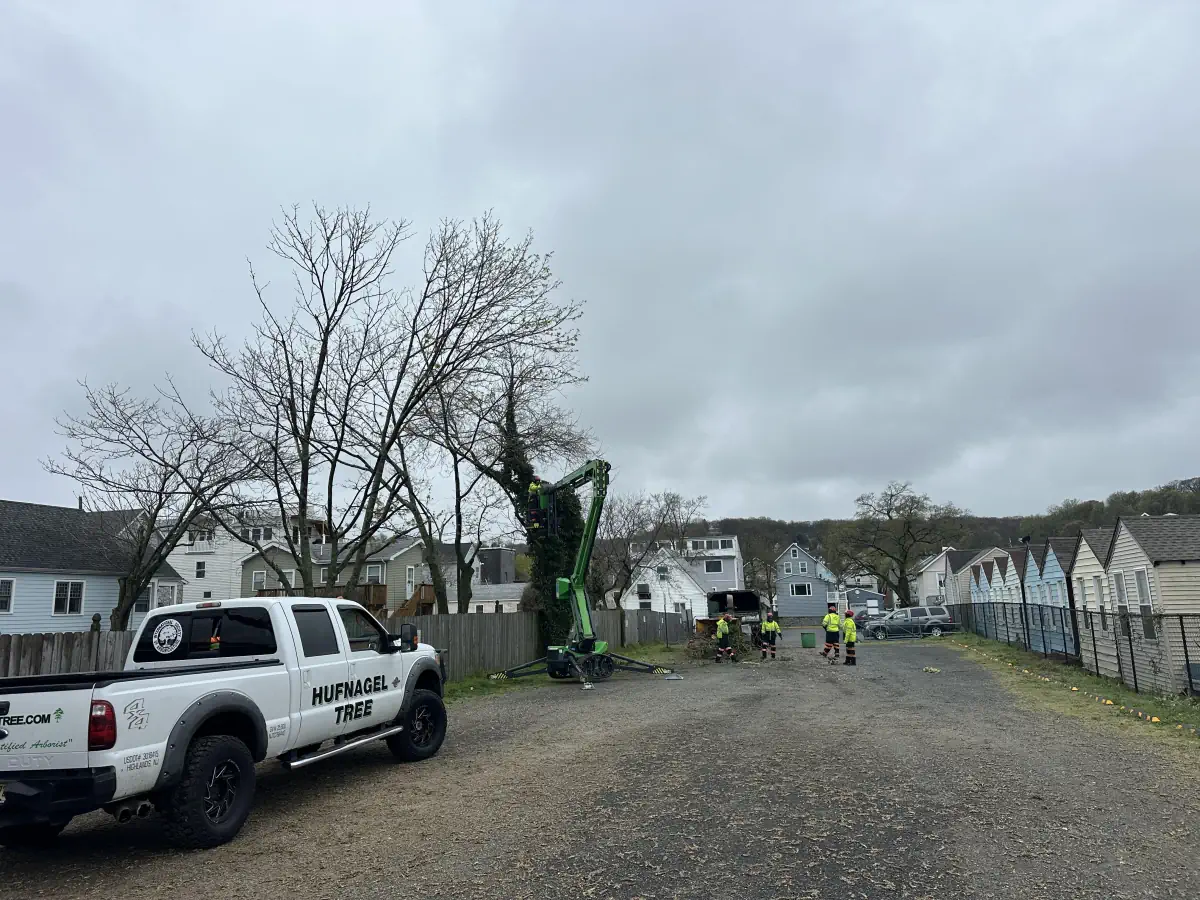
Nothing in this replaces a call to the Village Clerk, but a written risk evaluation makes that call easier. The draft names a Licensed Tree Expert’s finding as the basis for the dead, diseased, and hazard categories, so a findings letter with dated photographs gives the village what it needs to see. Our guide to tree removal permits covers the general process, and our article on tree removal in Neptune City shows how another shore borough handles the same question. The photograph above shows a crew with a lift taking down a tall ivy covered tree in a close neighborhood while ground crew work below.
Questions to Ask the Village Clerk Before a Removal
- Which version of the tree ordinance is in force, and where to read it.
- Whether the tree counts as a heritage tree at its measured circumference.
- Whether the tree stands on private land or on village property.
- What the application, survey, and replacement plan or fee must include.
- How emergency work is reported when a tree threatens a house after a storm.
Those questions take a few minutes and can save a homeowner from a penalty or a stalled job. We can describe what we see in the tree and put it in writing, but the permit decision belongs to the village. When a tree stands on or near the lake, a second authority may be involved, and that is the subject of the next section.
Deal Lake and Tight Lots Shape How a Removal Is Done
Deal Lake adds a layer that inland towns do not have. The Deal Lake Commission says NJDEP regulations apply to land within 50 feet of the Deal Lake shoreline and of any stream that drains into the lake, and that neither the municipalities nor the commission issue permits for shoreline or near lake work. Only NJDEP does, so the commission tells owners to contact NJDEP, not the local building department, before starting.
The commission also says improper clearing, soil grading, or filling along the lakefront can destabilize the shoreline and worsen flooding, and that a well vegetated shoreline resists erosion and filters stormwater. For a removal near the water, that means the plan has to consider the bank as well as the tree. A good plan keeps heavy equipment and fill off the bank, and it starts with a call to NJDEP, as the commission recommends.
Most removals in Loch Arbour are not simple falls. With houses close together, overhead wires on streets such as Evergreen Place, and fences on every lot line, a trunk usually comes down in sections that are lowered on ropes or taken out with a lift, and the crew works from the top down. That is why tree removal in Loch Arbour is a planning job first and a cutting job second.
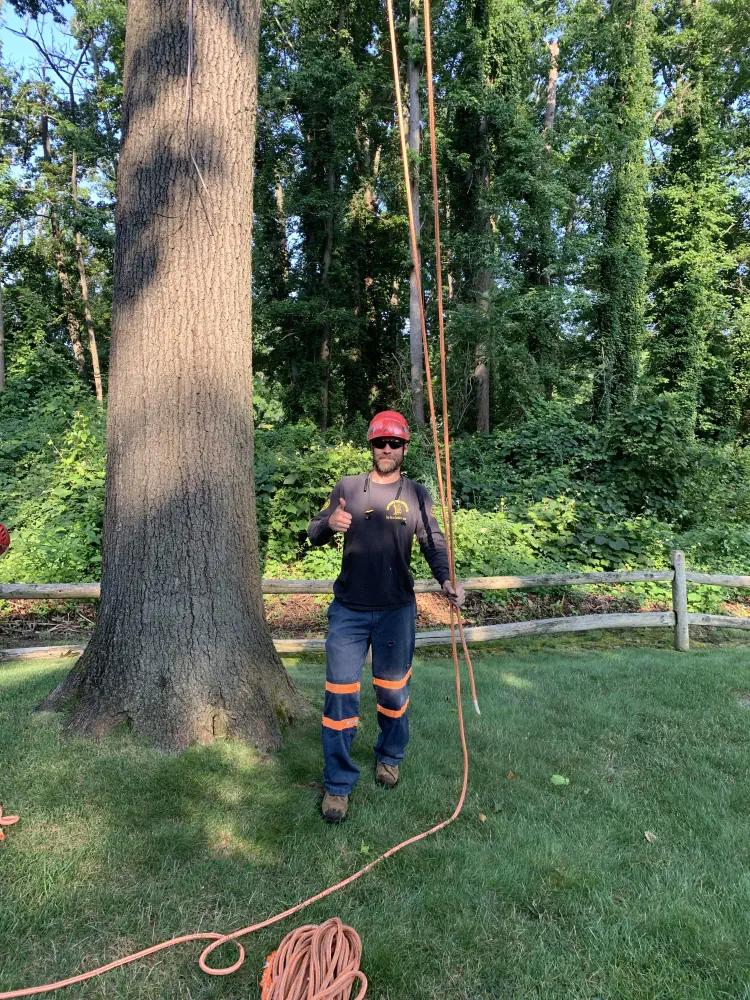
Rigging is the other half of a close lot removal. In the photograph above, a crew member in a helmet and harness stands beside a very large trunk holding a rope that runs up into the tree. Ropes let limbs and trunk sections be lowered under control, which keeps weight off roofs, fences, and wires, and they are a reason the work takes preparation rather than speed.
Ground and roots come next. A large tree removed from a small lot leaves a stump, a hole, and a root zone that neighboring trees may share. The draft ordinance asks that snow fencing or another protective barrier be placed at the dripline of trees that are to stay during construction, and that no equipment, chemicals, soil, or materials go inside it. The same idea applies to a removal, because the trees that remain, including the neighbor’s, deserve protection from machines and debris.
Replanting belongs in the conversation as well. The draft asks for replacement trees or a fee, and the village lists shade, erosion control, stormwater, and a buffer against noise among its reasons for the ordinance. Choosing the species and the spot is easier while the old tree is still standing, because the owner can see the light, the wires, and the room a new tree will have. Our tree restoration and storm proofing work for the trees nearby fits into the same plan, and our article on root flare care in Allenhurst covers mulch and grade for the village’s neighbor to the north.
Storm cleanup is a separate matter. The New Jersey Department of Health says fallen power lines are not readily visible because of storm debris, that contact with electrical sources is a high risk during cleanup, and that this work should be left to licensed tree care professionals. A tree that has already fallen is a hazard to stay clear of, while a tree that is merely suspect is a planning problem, and the difference is worth knowing.
Choosing who does the work matters as much as the plan. The Trees Are Good guide to hiring an arborist advises asking for proof of insurance and calling the insurance company, getting more than one estimate, not always accepting the lowest bid, getting the agreement in writing, and being wary of people who go door to door offering bargains.
What a Written Removal Plan Should Cover
- Which trees are involved, where they stand, and why each one is included.
- How each tree comes down, and what it must stay clear of.
- What protects the lawn, the neighbors, and the bank beside the lake.
- Who handles the permit, and what the village needs from the owner.
- What happens to the stump, the debris, and the planting space.
A plan like this turns a removal from a surprise into a sequence. Each item can be answered before a crew arrives, and each one protects the homeowner as well as the property. Once the work is done, the open space becomes the starting point for the next decision, which is what should grow there and how the trees nearby should be cared for through the winter.
Call Hufnagel Tree Service About Tree Removal in Loch Arbour
If you have mature trees near your Loch Arbour home, driveway, or the Deal Lake side of the village, schedule an evaluation before winter storms arrive. We provide tree risk evaluations, tree trimming and pruning, storm proofing, restoration, and removal when a tree cannot be managed safely. You can also read more local articles in our Loch Arbour category.
Hufnagel Tree Service is led by a certified arborist with almost 30 years of local experience and more than 280 five star Google Maps reviews. We inspect first, explain what we found in plain terms, and recommend only the work that changes the outcome for your trees and your property.
Call or text (732) 291-4444 to discuss tree removal in Loch Arbour, or to ask whether a tree needs removal at all, before the next coastal storm arrives.
Schedule Service Now!
From precision pruning and safe removals to health assessments and preventative care, Hufnagel Tree Service delivers expert solutions backed by decades of experience. We offer certified insight, fair pricing, and a commitment to doing what’s best for your landscape.
Learn More About Our Services
Related Articles
Tree Health Inspection Services Near Fair Haven, NJ
Matawan Tree Storm Damage: What Summer Wind Leaves Behind
Tree Pruning in West Long Branch NJ: Cut for a Reason Before Winter