Contents
Tree Removal in Neptune City Begins With a Small Borough and Close Neighbors
Neptune City is a borough of 0.90 square miles that counted 4,626 residents in the 2020 census and was incorporated on October 4, 1881, according to Wikipedia’s entry on Neptune City. It borders Avon-by-the-Sea, Bradley Beach, and Neptune Township, with Route 35 running through the center as Sylvania Avenue and Route 33 along the northern edge. Memorial Park sits along the Shark River, and smaller parks such as Laird Avenue Park, Joe Freda Park, and Adams Field are tucked between older streets of closely set houses.
That scale changes how we think about tree removal. Tree removal in Neptune City is rarely a question of whether a tree fits the yard, because the lots are small and the houses are near each other. It is a question of what a tree can reach, what the borough requires before it comes down, and what has to be planted in its place. A tree that cannot be managed safely still has to go, and in this borough the removal now comes with a written process.
After almost 30 years working throughout Monmouth County, we have seen that late fall is a calm time to make these decisions. The leaves are thinning, the structure is easier to read, and a tree risk evaluation can sort the trees that need to come down from the ones that only need pruning, monitoring, or restoration. Removal is a legitimate outcome, but it is never the first one we reach for.
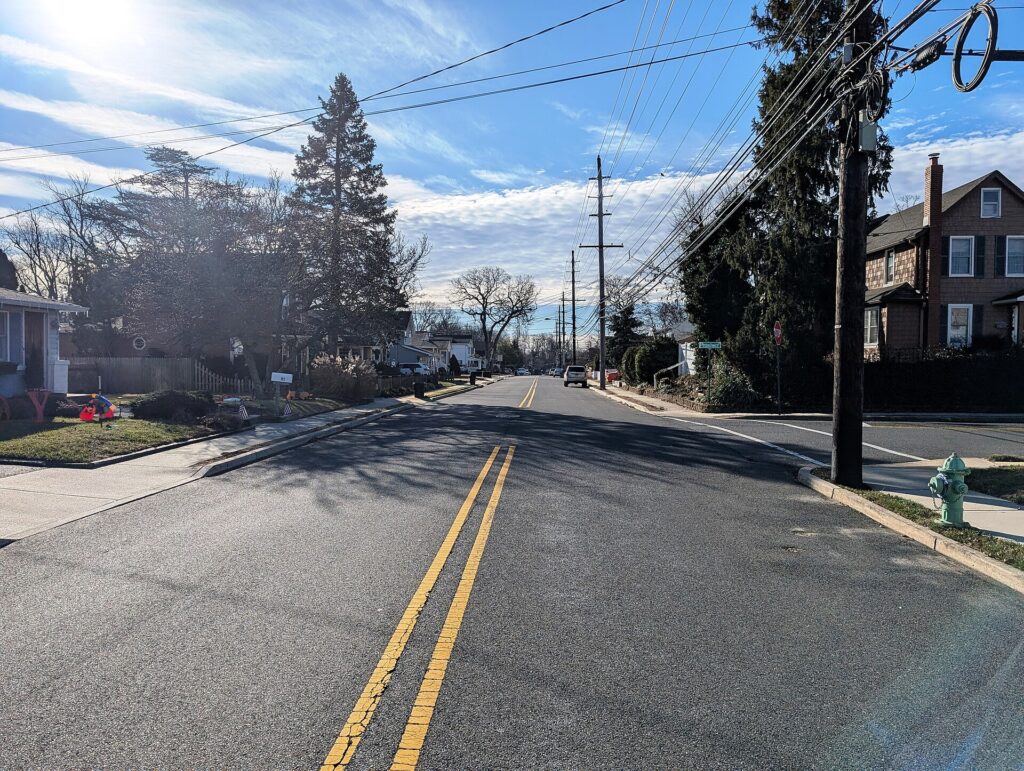
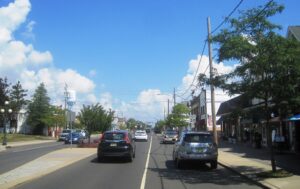
The photograph above shows Neptune Avenue looking south in December 2024. It is a two lane street with a double yellow line, small houses close to the road on both sides, overhead wires crossing the pavement, and tall evergreens standing near the poles and the rooflines. A tree in a setting like this one has very little room around it, and a trunk or limb that fails here lands on a wire, a porch, a parked car, or a neighbor’s fence, not on open lawn.
The ground adds its own risk. Wikipedia lists the borough’s elevation at 23 feet and reports 39 days of coastal flooding between 2005 and 2014, more than three times the average for the decades before. Soil that stays wet after coastal rain holds roots less firmly, and a heavy evergreen crown catches wind in every season. Those two facts together are why we look at the roots and the base of a tree before we look at its height.
Removal Is the Last of Four Outcomes, Not the First
Removal is the last of four outcomes we weigh for any tree: monitoring, pruning, restoration, or removal. Most trees we look at in Neptune City end up in one of the first three. A tree with a minor defect and nothing meaningful underneath it can wait and be checked again in spring. A tree with a problem that selective cuts can correct gets those cuts. Removal comes when the structure or the roots no longer give us a dependable way to manage the risk.
The International Society of Arboriculture is direct about the baseline. Its brochure on recognizing tree risk says there is no such thing as a completely safe tree, that all trees have the potential to fall, and that only a small number actually hit something or someone. It also says a tree owner is responsible for the safety of others around the trees on the property. In a borough where one front yard tree can reach a sidewalk, a neighbor’s roof, and a service wire in a single fall, that responsibility is practical, not theoretical.
The same brochure offers a checklist that we use as a starting point. It asks whether a tree has large dead branches, detached or hanging limbs, loose bark, cracks or splits in the trunk or where branches attach, cavities or rotten wood, mushrooms at the base, a history of topping or heavy pruning, or recent changes to the soil level, pavement, or construction around it. A yes to any of those is a reason to have the tree examined, not a reason to cut it down. The checklist finds trees worth a closer look. It does not decide the outcome.
What decides the outcome is the combination of defect, target, and load. The brochure calls dead branches probably the most obvious hazard in a canopy, and says the risk depends on the size of the branch and its distance from a target. Cracks or separations in the soil near the base can point to root movement, especially in a leaning tree. Narrow unions where stems of similar size meet can fail, and our guide to codominant stems explains what we look for. Decay at the base, shown by fungus or a cavity, changes the picture the most, because the wood holding the tree up is gone, and our guide to hidden tree rot covers why a full canopy can sit on a hollow trunk.
Neptune City adds its own conditions to that list. A root plate that spends part of the year in saturated ground has less grip, and a tree that already leans or has heaved the soil near its base has less margin when a nor’easter pushes on the crown. Our work on weak tree roots describes the changes at the base that tell us a tree is losing its hold. We look for them first on the older trees beside Neptune Avenue and Sylvania Avenue, where wires, pavement, and tight setbacks leave the roots little room.
Mike Hufnagel puts it simply: “A tree is not a candidate for removal because it is big or because it drops leaves. It becomes one when we can name the defect, name what it can hit, and say why pruning cannot fix it.” That rule keeps the decision honest. If we cannot explain the case for taking a tree down in a few plain sentences, we keep looking until we can, or we leave the tree alone.
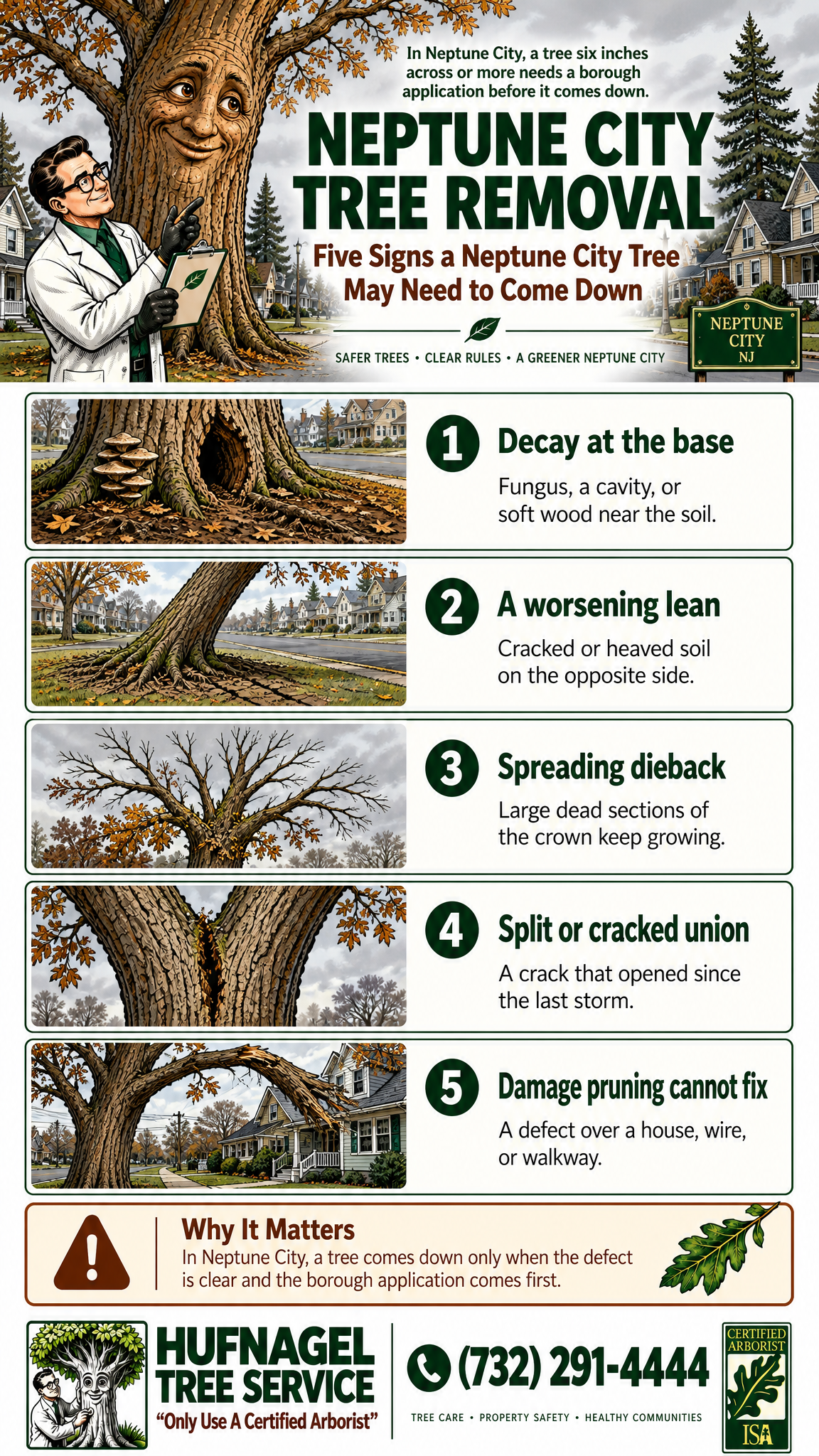
Signs That Move a Neptune City Tree Toward Removal
- Decay at the base, shown by fungus, a cavity, or soft wood near the soil.
- A new or worsening lean with cracked or heaved soil on the opposite side.
- Large dead or dying sections of the crown that continue to spread.
- A split union or trunk crack that has opened since the last storm.
- Damage or decline that pruning cannot correct over a house, wire, or walkway.
Every item on that list describes a condition, not an opinion. A tree can show one of them and still have years of useful life with the right correction, which is why we look at the whole tree and its surroundings before we recommend anything. When several of them appear together over a target, removal stops being a question of preference. At that point the next question is not how to cut the tree down but what the borough requires first.
The Borough Code Sets the Path From Application to Approval
Neptune City regulates removal in Chapter 124 of its borough code, titled Trees, which is published on eCode360. Section 124-6, added on August 26, 2024, by Ordinance 2024-10, covers tree removal and replacement. The text explains that it follows the 2023 Tier A stormwater permit renewal, which asks municipalities to adopt a community wide ordinance controlling tree removal and replacement, and it states the purpose as reducing soil erosion and pollutant runoff and promoting infiltration of rainwater.
Under that section, anyone planning to remove a street tree with a trunk diameter of 2 1/2 inches or more, or any other tree with a diameter of six inches or more on their property, must submit a Tree Removal Application to the Conservation Officer. No tree may be removed until the Conservation Officer has reviewed and approved it. Diameter is measured at breast height, which the code places about four and a half feet above ground level. A trunk of that size is modest, so many ordinary yard trees fall under the rule.
Trees on public ground follow a separate rule. Section 124-1 says no one may cut, trim, break, climb with spikes, disturb the roots of, spray with chemicals, or remove a living tree or shrub on a public highway without the written permit of the Mayor and Council. The borough’s Shade Tree Committee was created to remove, maintain, plant, and supervise the borough’s public trees, and its volunteers are appointed by the Mayor. A tree standing on the public right of way is part of that system, so we confirm who owns a tree before anyone touches it.
The code defines a hazard tree as one that meets at least one of five conditions. It has an infectious disease or insect infestation, it is dead or dying, it obstructs the view of traffic signs or the free passage of pedestrians or vehicles where pruning has not worked, it is causing obvious damage to structures such as foundations or sidewalks, or it is determined to be a threat to public health, safety, or welfare. Hazard trees may be removed with no fee or replacement requirement. A tree proposed for removal solely for development is specifically not a hazard tree.
Claiming that exemption takes proof. The code asks for written justification that includes photos or statements from a New Jersey licensed tree expert or arborist. When an emergency forces a removal before the borough has granted the exemption, documentation from the removal company or photographic evidence must be provided to the Borough afterward. That is why we photograph a tree from several sides before work and describe the defect in writing, and why our guide to tree removal permits is worth reading before a homeowner picks a date.
Other exemptions cover tree farms, orchards, nurseries, and garden centers, approved forest stewardship plans, municipal or state decommissioning plans, approved environmental clean ups, and approved game management practices. Residents who remove fewer than four qualifying trees over a rolling period also have an exemption, and the code explains how that count works. Enforcement belongs to the Police Department and the Conservation Officer, and a violation carries a fine per tree that cannot be less than the cost of the required replacement trees and their planting.
What to Have Ready Before a Neptune City Removal
- Trunk diameter for each tree, measured four and a half feet above the ground.
- Confirmation of whether each tree stands on private land or the public right of way.
- Dated photographs of the defect from the base, the trunk, and the crown.
- A written description of the condition if the tree may qualify as a hazard tree.
- A plan for where replacement trees will go if the code requires them.
A package like this turns a vague request into something the Conservation Officer can review quickly. It also protects the homeowner, because the record shows what the tree looked like and why the decision was made. Tree removal in Neptune City is easier when the paperwork and the defect tell the same story. Once approval is settled, the work moves to the part of the code that many homeowners have not read, which is what goes back into the ground.
Replacement, Roots, and the Right Crew Finish the Job
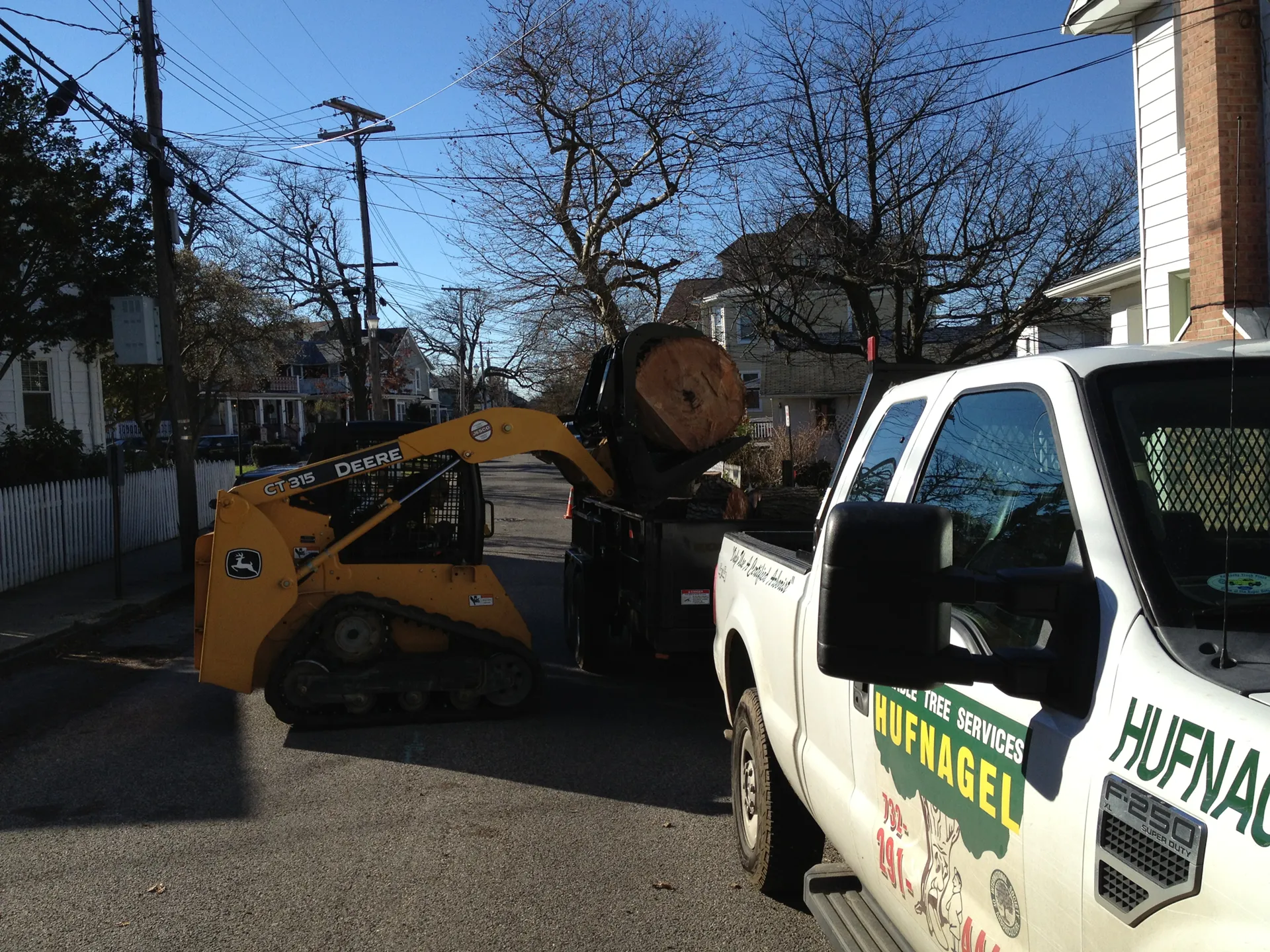
Replacement is the part of the code that surprises people. For a tree with a trunk diameter from the application threshold up to 12.99 inches, the code calls for one replacement tree for each tree removed. Trees from 13 to 22.99 inches call for two, trees from 23 to 32.99 inches call for three, and trees of 33 inches or more call for four. Each replacement must have a minimum caliper of 1 1/2 inches, and the species follow an appendix to the chapter that is meant to keep the planting varied.
Timing and care are written into the code as well. Replacement trees must be planted within 12 months of the removal or by a date the borough sets, monitored by the applicant for one year, and replaced if they fail. They may not stay in temporary containers or pots. If some or all of the replacements cannot fit on the property, the applicant can plant them in another area the borough approves or pay into a fund dedicated to tree planting and continued maintenance. On a small Neptune City lot that second option may matter, since four new trees need more room than most yards have.
The roots below a removed tree deserve a plan too. A stump left in place decays slowly, and grinding it below grade lets a homeowner replant, lay turf, or install a walkway. The code that regulates removal also lists improper grading and soil compaction within the critical root radius as ways to kill a tree, and it defines that radius as the trunk diameter multiplied by 1 1/2 feet. A neighbor’s tree whose roots reach under the work area can be hurt by heavy equipment as easily as the tree coming down, so we plan access and protect the ground before the first cut.
Trees that remain need attention after a neighbor or a storm opens the canopy. A tree that grew in the shelter of another may suddenly carry wind it never met before, and the first season after a removal is when weak unions and old pruning wounds show themselves. A short follow up visit lets us decide whether the remaining trees need selective trimming, storm proofing, or restoration pruning to correct earlier damage. The point is to take out one problem without creating a second.
Choosing who does the work matters as much as the work. The ISA brochure on hiring an arborist advises checking for an ISA arborist credential, asking for proof of insurance and calling the insurance company, getting more than one estimate along with references, and putting the agreement in writing. It also warns about people who go door to door and offer bargains. After a storm those visitors appear on many streets, and a removal done wrong beside a roof or a wire is hard to undo.
New Jersey adds its own layer. The state’s Board of Tree Experts licenses Licensed Tree Experts, who may perform services such as diagnosis and risk assessment, and Licensed Tree Care Operators, who are limited to pruning, brush cutting, removal, and stump grinding. The Board’s licensing page points homeowners to a licensee directory and a business directory, and no one may present themselves to the public as a licensed expert or operator without that license. A homeowner can look a crew up before signing anything.
How to Vet a Tree Removal Crew in New Jersey
- Ask for an ISA arborist credential and confirm it through the ISA directory.
- Ask for proof of insurance, then call the insurance company to confirm it.
- Look the business up in the state Board of Tree Experts directories.
- Get a written agreement that names each tree, the work, and the cleanup.
- Be wary of door to door offers and compare more than one estimate.
Two safety points never change. A tree touching or leaning into a service wire is a call to the utility first, and the ISA brochure says never to remove branches or any tree part from or near power lines and never to go near downed lines. A tree that is cracked, leaning, or hanging over a house is not a weekend project either. Homeowners should look, photograph, stay clear, and call, and the record they build becomes part of the borough application.
Call Hufnagel Tree Service Before a Neptune City Tree Becomes an Emergency
If you have a tree near your Neptune City home, driveway, sidewalk, or the roofline along Sylvania Avenue or Neptune Avenue that you think may need to come down, schedule an evaluation before winter weather arrives. We provide tree risk evaluations, tree removal, tree trimming and pruning, storm proofing, and restoration when a tree can be saved.
Hufnagel Tree Service is led by a certified arborist with almost 30 years of local experience and more than 280 five star Google Maps reviews. We inspect first, explain what we found in plain terms, and recommend removal only when the tree leaves no responsible alternative.
Call or text (732) 291-4444 to schedule tree removal in Neptune City before the next coastal storm arrives.
Schedule Service Now!
From precision pruning and safe removals to health assessments and preventative care, Hufnagel Tree Service delivers expert solutions backed by decades of experience. We offer certified insight, fair pricing, and a commitment to doing what’s best for your landscape.
Learn More About Our Services

Related Articles
Avoid Late Summer Tree Problems: Schedule An Inspection
Tree Pruning in West Long Branch NJ: Cut for a Reason Before Winter