Contents
Tree Pruning in West Long Branch Starts With Compact Lots and Mature Street Trees
West Long Branch covers 2.86 square miles of Monmouth County and counted 8,587 residents in the 2020 census, according to the borough facts page, so it is small and closely settled. The borough history page says residents voted 163 to 73 on May 5, 1908 to separate from Eatontown Township, and that the new borough was formed on June 16, 1908. Earlier maps named the area Hoppersville, Mechanicsville, and Branchburg, and the page notes that several large estates were a significant source of taxes for Eatontown.
That history still shows in the trees, and it shapes tree pruning in West Long Branch. Route 36 and Route 71 cross the borough, and the older centers around Cedar Avenue and Monmouth Road, Kensington Park, and the Wall Street section known as Lane’s Corner sit close together. A mature oak or maple often stands within a few feet of a roof, a wire, a sidewalk, or a neighbor’s fence. Our tree trimming and pruning work is built around that fact, because every cut has to answer to whatever sits beneath it.
After almost 30 years working throughout Monmouth County, we have seen that most pruning problems begin with a cut nobody could explain. Fall is a good time to correct that, while the leaves still help us read the crown and before winter wind, wet snow, and ice add load to limbs that were already weak.
The borough is not one kind of property. The Monmouth University campus, which the borough facts page describes as a private university founded in 1933, and the Great Hall at Shadow Lawn, which Wikipedia lists as a National Historic Landmark, sit within a few minutes of narrow residential streets. Large grounds and small lots call for very different pruning decisions, and a single borough can hold both within a short drive.
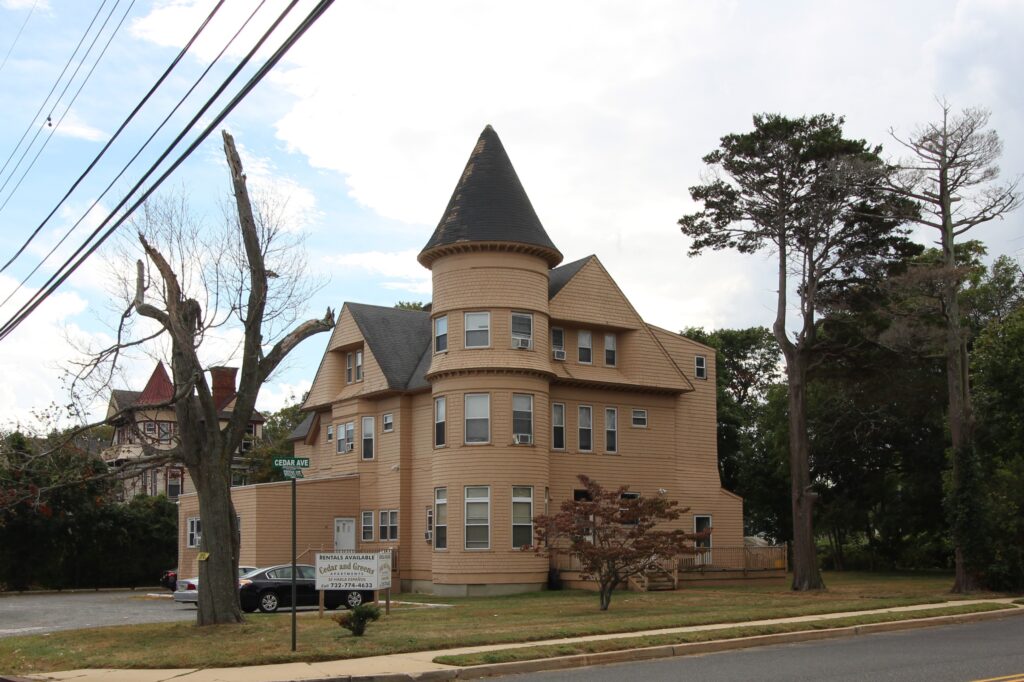
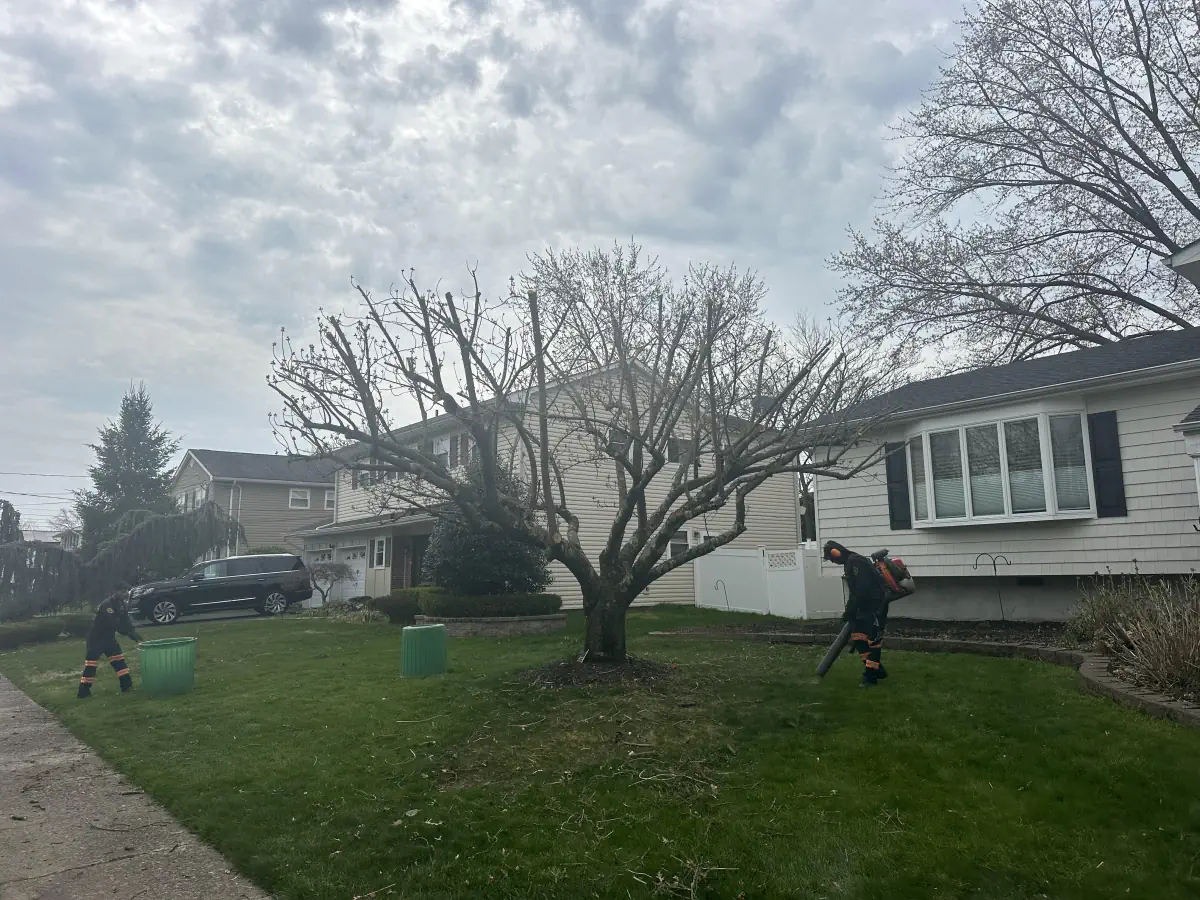
The photograph above shows a house on Cedar Avenue with a leafless tree beside it. We cannot tell from one frame whether a tree like that is dormant, stressed, or dead, and we do not guess from the street. What we can say is that the first job in any pruning visit is to read the whole crown and decide which limbs have a reason to come off.
Every Cut Needs a Reason, and Deadwood Is the Easiest One to Defend
The International Society of Arboriculture states the principle plainly in its brochure on pruning mature trees. Because each cut can change how a tree grows, no branch should be removed without a reason. The brochure lists removing dead branches, improving form, reducing risk, and letting light and air reach the crown or the ground below as the common reasons, and it says mature trees are generally pruned as a corrective or preventive measure.
That is why deadwood is the easiest cut to defend, and why we start there on almost every visit. The same brochure says light, routine pruning to remove weak, dead, or diseased limbs can be done at any time of year with little effect on the tree. A dead limb has no job left in the tree, and it is a load that can come down on whatever is underneath. In a borough where lots are small, what is underneath is often a roof, a car, or a neighbor’s patio.
Routine thinning is a different matter. The brochure says thinning does not necessarily improve a tree’s health, because leaves make the sugars that feed growth and removing foliage can reduce growth and stored energy. We treat a request to thin a healthy crown with no purpose as a question to ask before any cut, and not as an order to follow.
Dieback in a crown can mean more than a dead branch. Our article on hidden tree rot explains how a tree can lose limbs because decay is working inside the trunk, and pruning the limb alone does nothing about that cause. When we see thin leaves or bare twigs high in a crown, we look at the trunk and the base before we decide what the cut should be.
Clearance is the other common reason, and it deserves the same discipline. A limb that rubs a roofline, scrapes siding, or leans into a service wire is moving a little with every gust, and the damage it does is slow and easy to miss. Shortening or removing that limb back to a proper union solves the problem for good, while a quick trim at the tip only invites regrowth in the same spot.
Structure matters as well. A tree with two heavy stems on one weak seam needs a different plan than a tree with a single trunk, and our guide to codominant stems and multi stem trees explains why a fork that looks solid from the street can still be the weakest point in the whole tree. Pruning that reduces the weight on a weak union is one of the most useful cuts we make, and it is also one of the easiest to do wrong.
In compact neighborhoods the question we ask first is what the limb can reach. A dead branch over an empty back corner and the same branch over a bedroom roof are different jobs, even on the same tree. Mike Hufnagel puts the working rule this way: “A cut should answer a question. If we cannot say what it does for the structure, the clearance, or the health of the tree, we leave the branch where it is.” That rule keeps us from cutting for its own sake, and it keeps us from ignoring a limb that really is a hazard.
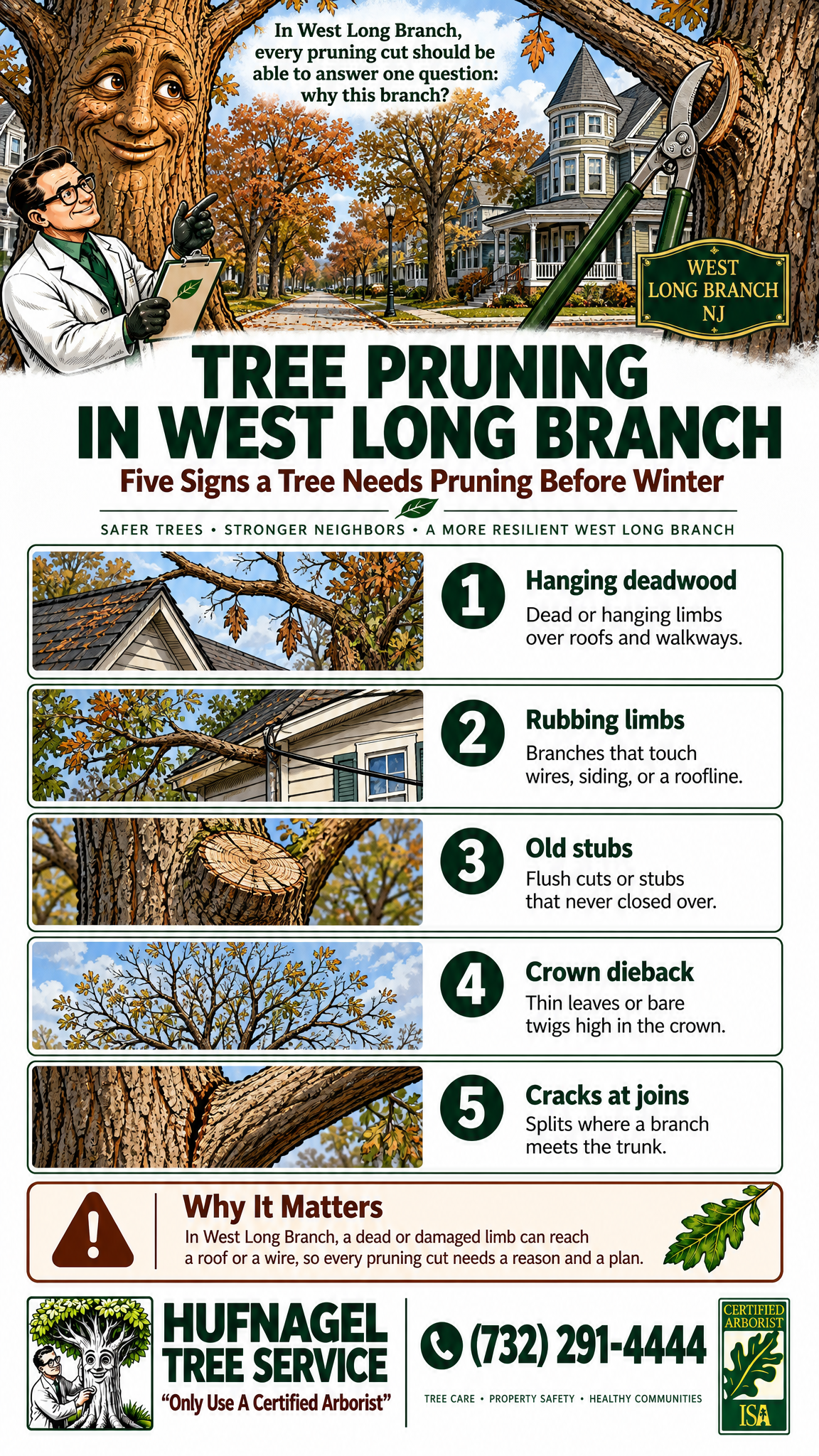
Pruning Signs to Check Before Winter Reaches West Long Branch Trees
- Dead or hanging branches over roofs, sidewalks, driveways, and neighboring property.
- Limbs that rub, cross, or grow into wires, siding, or a roofline.
- Old pruning stubs or flush cuts that never closed over with new wood.
- Dieback in the upper crown, with thin leaves or bare twigs.
- Cracks, splits, or fresh scars where a branch meets the trunk.
None of these signs means a tree is doomed, and none is a reason to reach for a saw. They are reasons to look closely and to photograph the spot from the same place each season. A short series of photographs tells us more than a single visit can, and it shows quickly whether a problem is changing. Once we know which limbs have a reason to come off, the next question is how to cut them correctly.
Where and How Much We Cut Matters More Than the Light It Lets In

Where a cut is made matters as much as whether it is made. The ISA brochure says a correct pruning cut removes the branch just outside the branch collar and that cuts should not be made flush to the trunk, because the trunk tissue above and below a flush cut often dies and leaves dead spots. If a collar has grown out on a dead limb, the cut goes just beyond the collar and leaves the collar intact.
Heavy limbs need a different method. The brochure describes reducing the weight of a large limb first with an undercut about 12 to 18 inches from the point of attachment, then a second cut from the top, and finally removing the remaining stub back to the collar. The sequence exists to stop the limb from tearing bark off the trunk as it falls. It is one reason large pruning cuts are a job for trained climbers with rigging and not a weekend project from a ladder.
Timing and species matter, and the brochure is open about it. Maples and birches tend to bleed sap when they are pruned early in the spring, which can look unsightly but is of little consequence to the tree. A few diseases, such as oak wilt, can spread through pruning wounds, so susceptible trees should not be pruned during active transmission periods. We plan each visit around the species in front of us.
The amount removed matters too. The brochure says that as a general rule no more than 25 percent of the crown should be removed at once, and less for mature trees, and it warns that removing a single large limb can leave a wound that may not be able to close. Heavy pruning of live tissue just after the spring growth flush is also best avoided, since the tree has just spent a great deal of energy making new leaves.
Topping is the opposite of everything above. The borough Shade Tree Commission page links a brochure titled Why Topping Hurts Trees, and we agree with the title. We never top a tree, and we do not thin a crown as a blanket answer to wind. The goal is not to make a tree smaller. The goal is to take weight off the right places, remove what is clearly unsafe, and leave healthy structure alone.
The ISA brochure on recognizing tree risk treats a tree that has been topped or heavily pruned as a warning sign, and the reason is easy to see in the field. A topped tree sends up fast, crowded regrowth from the cut, and those new stems are attached more weakly than the limbs they replaced. Repairing that kind of damage is possible, and our tree restoration work is built for it, but it takes years of careful, selective cuts.
Weather is the test of every pruning decision, and pruning in West Long Branch faces a full range of it, from coastal wind to wet snow and ice. Wind loads a crown unevenly, wet snow and ice add weight to the ends of limbs, and saturated soil lets the whole tree move more at its base. A crown that has been shaped for good structure handles those forces better than one that has been cut hard or left alone for decades. That is why we connect pruning to storm proofing and not to appearance alone, and why a good cut in October can matter more in January than most homeowners expect.
What a Correct Pruning Cut Looks Like on a Mature Tree
- A cut made just outside the branch collar and never flush to the trunk.
- A heavy limb shortened in stages so its weight cannot tear the bark.
- No more than a quarter of the live crown removed in one visit.
- Live pruning avoided just after the spring flush of new leaves.
- Topping and stub cuts rejected because they leave weak regrowth behind.
These points sound simple, and they are the difference between a tree that stays healthy for decades and one that struggles after a bad visit. A tree cannot undo a bad cut, so the care has to come before the saw. When pruning is the wrong answer, the honest next step is to decide whether the tree can be kept at all, and in West Long Branch that decision involves the borough code as well as the tree.
Pruning Is Not Removal, and the Borough Has Rules for Both
A routine pruning cut is not a removal, but the two decisions sit close together, and homeowners often move from one to the other. Chapter XXIII of the borough code, published as the Tree Preservation Code, is titled the Tree Preservation Ordinance of the Borough of West Long Branch. It defines tree removal as the cutting down, destruction, removal, or relocation of any tree, and it sets replacement rules for removals.
Under the code, the removal of a six inch tree or a six inch grouping of trees must be replaced with trees whose total diameter at breast height equals at least 30 percent of the inches removed, and no replacement tree may be smaller than two inches. The code excuses replacement when a tree is dead or irreversibly declining, is in danger of falling, is too close to a structure, interferes with utility service, creates unsafe vision clearance, or is a health or safety hazard. It also allows one tree per parcel to be removed every three years without replacement, even if the tree is healthy.
The penalty section is worth knowing. A person found guilty of violating the chapter faces a fine of not less than $100 and not more than $1,000 plus replacement of the tree, and each tree intentionally cut down, destroyed, damaged, or removed without replacement counts as a separate offense. We read the published code as a reason to document what a tree looks like before any large cut, and as a reason to confirm the current rules with the borough before work begins.
The borough also has a Shade Tree Commission. Its page says the commission was established under Ordinance 2-12, has five to seven members appointed by the Mayor, and meets at 7 pm on the second Thursday of each month at Borough Hall Council Chambers, except in July and December. The same page links borough guides on hiring tree professionals, licensing of New Jersey tree experts, mulching, and why topping harms trees. Our own guide to tree removal permits explains how permit rules work across Monmouth County.
Good pruning in West Long Branch often keeps a tree that a rushed removal would lose. Pruning is often the better answer, and removal is sometimes the only responsible one. Some trees need only monitoring. Others need targeted pruning, restoration, support, or removal. What decides it is the structure of the tree, the condition of the roots, and what stands beneath the crown. Our guide to weak tree roots explains why a perfectly pruned crown cannot make up for a base that has lost its hold in the soil.
When removal is the right call, we say so plainly, and we explain which of the borough rules apply. We never push removal, and we never treat a tree as a problem just because it is large. A tree that can be kept safely with good pruning is a better result for the property and for the neighborhood, and it is the result we try for first.
Questions to Answer Before Any Large Cut in West Long Branch
- Whether the branch is dead, declining, or only inconvenient to look at.
- What the limb could reach if it came down, from roof to wire to sidewalk.
- Whether the problem is one limb or decay in the trunk or weak roots.
- Whether the work is pruning or a removal that triggers replacement under borough code.
- Whether a certified arborist has read the whole tree before anyone climbs.
Answering these questions in order keeps the work honest. It also keeps the homeowner in control, because each answer points to a specific choice with a specific reason behind it. We would rather spend an extra twenty minutes on the tree than make a cut that cannot be explained, and that habit is what separates pruning that helps a tree from pruning that only makes a yard look tidy for one season.
Call Hufnagel Tree Service About Tree Pruning in West Long Branch Before Winter
If you have mature trees near your West Long Branch home, driveway, garage, or lot line, schedule an evaluation before winter storms arrive. We provide tree trimming and pruning, tree risk evaluations, tree health management, storm proofing, restoration, and tree removal when a tree cannot be managed safely.
Hufnagel Tree Service is led by a certified arborist with almost 30 years of local experience and more than 280 five star Google Maps reviews. We inspect first, explain what we found in plain terms, and recommend only the work that changes the outcome for your trees and your property.
Call or text (732) 291-4444 to schedule tree pruning in West Long Branch before the next winter storm arrives. More of our local work is collected in the West Long Branch location archive.
Schedule Service Now!
From precision pruning and safe removals to health assessments and preventative care, Hufnagel Tree Service delivers expert solutions backed by decades of experience. We offer certified insight, fair pricing, and a commitment to doing what’s best for your landscape.
Learn More About Our Services
Related Articles
Old Bridge Fall Tree Inspection: Catch Hidden Hazards Early
Tree Risk Evaluation Services Near Marlboro NJ
Tree Risk Inspections in Deal, NJ