Contents
In Bradley Beach, Tree Restoration Starts With Small Lots and Shore Exposure
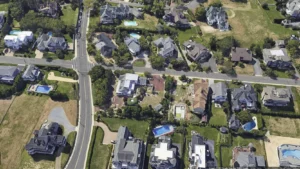
Bradley Beach is small, dense, and tied closely to the shore. It was named for James A. Bradley, and according to Wikipedia’s entry on Bradley Beach, 54 acres were bought in 1871 north of Avon-by-the-Sea and south of Ocean Grove. Residents voted on March 6, 1893 to separate from Neptune Township, and the borough was incorporated on March 13, 1893. Today it covers 0.63 square miles and counted 4,282 residents in the 2020 census, a number that the same entry says can swell to 30,000 in summer. Main Street carries Route 71 through the middle of town, and Brinley Avenue crosses it.
That scale shapes how we think about tree restoration. In a borough this compact, a tree that lost a limb in a summer storm, was cut badly years ago, or has lived with salt and wind rarely has room to hide its problems. Tree restoration in Bradley Beach is about deciding what a damaged tree can still become, then guiding it there with the fewest and smallest cuts that will work. The aim is a sound structure that can carry its own weight through the next winter.
After almost 30 years working throughout Monmouth County, we have seen that October is the right time to ask that question. The leaves are thinning, the summer record is behind us, and a tree risk evaluation can separate the trees worth restoring from the few that cannot be managed safely.
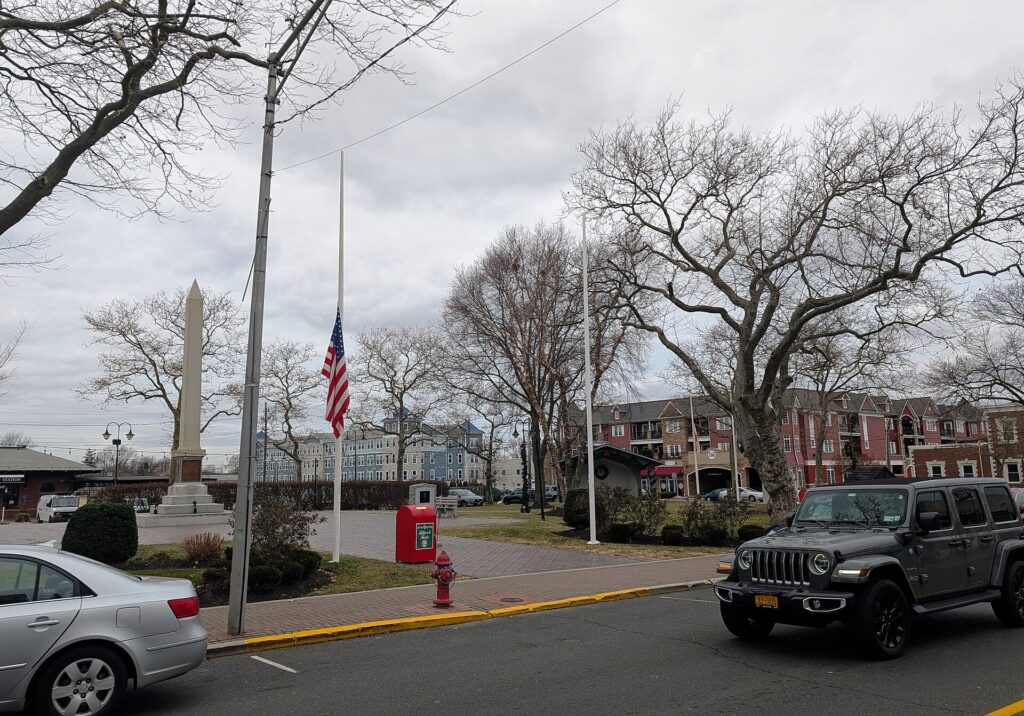
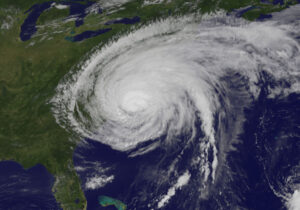
Exposure matters here more than most people expect. The same Wikipedia entry notes that the borough sits at an elevation of only 16 feet, and it describes how Hurricane Sandy in October 2012 flattened the dunes the borough had built in 2000 from snow fencing and discarded Christmas trees, with damage to beach areas and nearby homes above $3 million. Trees a few blocks back from the boardwalk live with the same wind, the same salt in the air, and ground that stays wet after heavy rain. A tree that has been bent, torn, or pruned too hard under those conditions does not recover on the same schedule as one in a sheltered inland yard, and restoration plans have to account for that. We cover what hidden damage looks like in our article on hidden damage from seasonal storms, and the same signs apply on the Bradley Beach side of Route 71.
Tree Restoration in Bradley Beach Begins With Whether the Tree Can Be Kept
Restoration starts with an honest question: is the tree worth saving, and what is the clearest evidence either way? Utah State University Extension advises that a tree with at least half of its canopy undamaged should recover, and that when more than half is damaged the owner should call a professional about possible removal, because recovery becomes difficult. That is a useful rule of thumb, and we treat it as a starting point rather than a verdict. A crown that is half gone can still be a good tree if the trunk, the unions, and the roots are sound. A crown that looks full can still be a poor candidate if there is a crack at the base of the main stem.
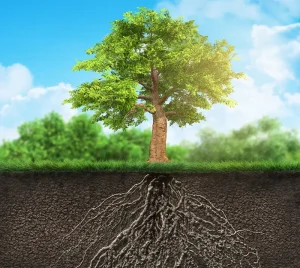
So we read the tree from the bottom up. We start at the root flare and the soil around it, looking for heaving, cracks, fungus, or fresh movement, which is the same ground we describe in our guide to weak tree roots. We move up the trunk to old wounds, cavities, and bark that has begun to separate. Then we look at every union where large stems meet, because a narrow union with included bark is where storms do the most harm, as our guide to codominant stems explains. Only after that do we look at the crown, since broken tips and torn limbs are the part of the problem that homeowners can already see.
Targets decide how urgent each finding is. A hanging limb over a sidewalk on Main Street or over a parked car on a narrow side street is a different problem from the same limb over an empty corner of a yard. Bradley Beach lots are tight, so the distance between a defect and a roof, a wire, a fence, or a neighbor is often a few steps. We write down what each defect could reach, because that is what sets the order of the work.
Species and history matter as well. Shore trees often carry old topping cuts, uneven side growth from years of wind, or crowded crowns from decades of being squeezed against buildings. Those histories tell us how a tree is likely to answer new cuts. A tree that has already produced weak sprouts after one bad pruning cannot be asked to do it again. We would rather leave a defect under observation than add a second wound to a tree that is already working hard to close the first.
Photographs are part of the record. We photograph cracks, tears, and dead tips so they can be compared with what we see in the dormant season and again after the next storm. A crack that has not changed is a very different finding from one that has opened by a few millimeters. That comparison is often what lets us keep a tree, because it replaces a guess with a trend.
Mike Hufnagel puts it simply: “A damaged tree is not a lost tree until the wood tells us it is. We look at what is holding the tree up first, and only then decide how much of the crown we are allowed to touch.” That order keeps the work honest, and it keeps us from removing a tree that still has a dependable structure or from keeping one that does not.
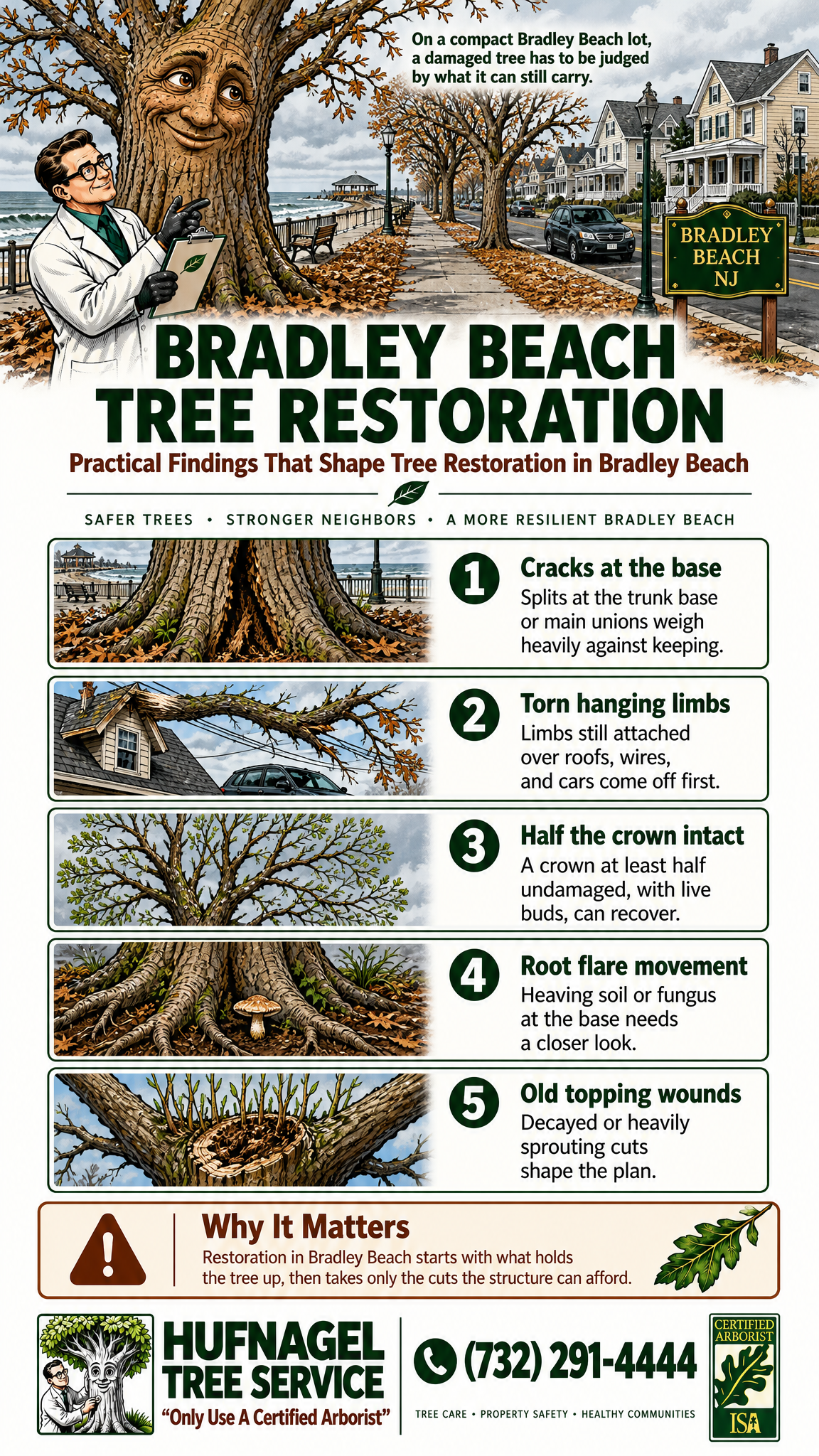
Practical Findings That Shape Tree Restoration in Bradley Beach
- Cracks or splits at the base of the trunk or where main stems join.
- Torn or hanging limbs still attached over roofs, sidewalks, wires, and parked cars.
- At least half of the crown intact, with live buds and healthy twigs.
- Root flare movement, soil heaving, or fungus near the base after wet weather.
- Old topping cuts or wounds that are decayed, sprouting heavily, or still open.
No single item on that list decides the outcome. We weigh them together, and the answer is usually some mix of pruning, restoration, monitoring, or removal. Once we know which trees are worth keeping, the next step is how the cuts are made, because the way a wound is shaped and the time of year it is made both affect how well the tree seals it.
The Way a Wound Is Cut Decides How a Tree Answers It
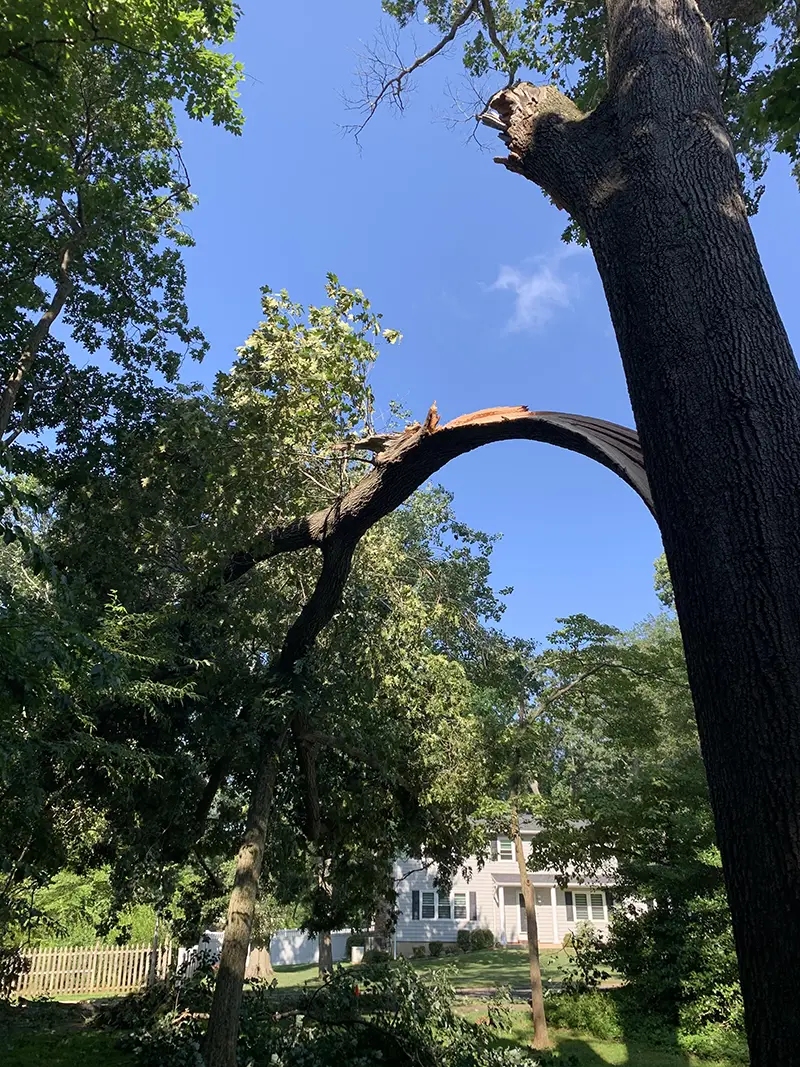
The cut itself matters as much as the decision to cut. Utah State University Extension says broken branches should be cut back to the spot where they join a larger, healthy branch, and that owners should not top the tree or over prune it, since that can increase stress and invite insects. That matches how we work. A torn limb is taken back to its collar, not left as a stub, and the cut is kept as small as the structure allows. Topping is named here only to be rejected, because it produces weakly attached regrowth that is more likely to fail in a later storm than the limb it replaced.
Restoration pruning is rarely one visit. We take off what is a hazard now, then plan the rest for the dormant season, when a leafless crown shows structure clearly and the tree can close wounds before spring growth begins. Light, corrective cuts can be made at many times of year, but larger structural work waits. That sequence protects the tree and gives the owner time to see how it responds before deciding on the next step. Our tree trimming and pruning follows the same order.
Bark and wound wood get the same respect. Damaged bark on a trunk is usually left alone unless it is clear it will not survive, because wound wood forms at the edges of an injury and begins closing it on its own. Peeling away bark that is still attached can enlarge the wound. We clean up ragged edges only where they would trap water or invite decay, and we avoid wound dressings that suggest the tree needs a bandage rather than a plan.
Where a tree has a weak union that is still sound enough to keep, reduction cuts on the heavier stem can lower leverage and give the union time to strengthen. Support systems can be considered in some cases, and we say plainly when a structure is beyond what support can responsibly fix. The same honesty applies in the other direction: if a lower trunk is cracked or a large stem has split away, removal is risk reduction, not a failure of care.
Tension is a safety issue that homeowners rarely see. Utah State University Extension warns that branches bent under tension or compression can shift or break while they are being cut and can be thrown or fall. A limb that looks as if it is simply leaning on another limb may be holding a great deal of stored force. That is one of the reasons we ask homeowners to stay clear, photograph, and call, rather than climb or cut a hung up limb themselves. Power lines and trees touching them are a job for the utility first.
Aftercare is part of restoration. A tree that has been pruned back needs steady moisture in dry spells, mulch kept in a flat ring and away from the trunk, and a second look in the following season. We check regrowth, new cracks, and dieback, and we adjust the plan if the tree is not responding. Our tree health management work covers that follow up. The goal is not to perform every possible cut. The goal is to give the tree the work it actually needs.
Pruning Choices That Support Tree Restoration in Bradley Beach
- Cut broken limbs back to a larger, healthy branch or the branch collar.
- Remove only what is dead, torn, or hazardous during the first fall visit.
- Leave damaged but attached bark alone so wound wood can close the injury.
- Plan heavier structural work for dormancy, before the spring growth flush.
- Reject topping and blanket thinning for wind, which weaken regrowth.
These choices keep the tree’s remaining structure working in its favor. Once the crown is sorted out, the next question is who owns the tree and what the borough requires, because in Bradley Beach many removals and plantings are reviewed before they begin.
A Bradley Beach Restoration Plan Follows the Findings and the Borough Rules
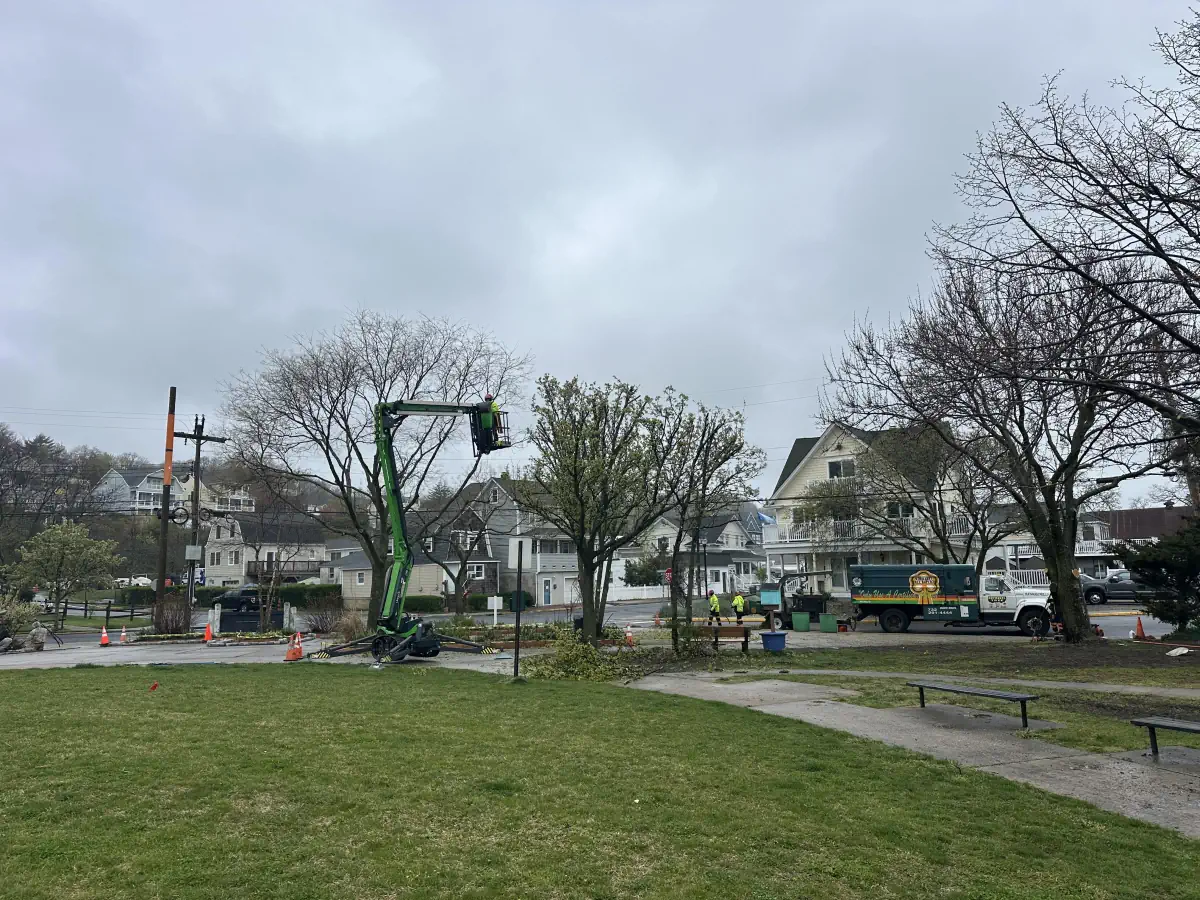
Ownership comes first. The Shade Tree Commission’s resident quick reference guide states that permits are required for planting in the planting strip, the area between the sidewalk and the curb, and for removing trees both in the strip and on private property, and that owners are responsible for pruning and removing trees in both places. The borough has kept refining those rules, and Ordinance 2026-13 amended Chapter 425 of the borough code in 2026. Because the code has changed more than once recently, we always point owners to the borough for the current version rather than relying on memory.
The ordinance sets out how a permit application is handled. Under its section 425-11, the commission or its licensed tree expert has 25 business days from a completed application to inspect the site and grant or deny the permit, in whole or in part, or recommend changes. The considerations listed include effects on flooding, soil stability, the contiguous canopy, specimen trees, and whether the replacement plan offsets the loss. A permit expires 12 months after it is first granted unless an extension is agreed in writing.
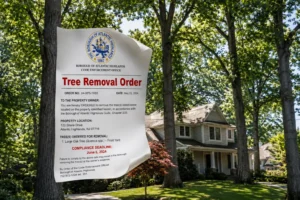
The newest addition is a Tree Removal Permit Card. Once an application is approved, the card must be displayed in a street facing window or another conspicuous place for the duration of the removal and replanting, and it must be returned within 14 days of the replacement planting or final approval. For a homeowner, the practical point is simple: an approved removal should show a card, and a removal without a required permit can bring a fine.
The commission is active, and that is good news for owners trying to keep trees. Its 2025 annual accomplishments report says it reviewed 27 tree removal applications in 2025, covering 39 trees, and that 52 replacement trees were slated to replace those approved for removal. It also describes a new procedure in which a commission member contacts each applicant personally and can take photographs of the tree. The same report notes that Bradley Beach was named a Tree City USA for the fifteenth year in a row, along with a $40,000 grant from the NJ Urban and Community Forestry program for new plantings.
That context shapes our advice. Where a tree can be restored, a documented inspection and a clear plan make it easier for an owner to talk with the commission about alternatives to removal. Where removal is the responsible answer, a written assessment of the defect supports the application. Our guide to tree removal permits explains how those permits work across the area, and we are glad to meet an owner at the tree to talk through what the findings mean. You can also see other Bradley Beach articles for how we have handled trees along the Bayshore and the Atlantic side of the county.
Replacement is part of the picture too. Many owners are surprised that planting a replacement is often as important to the borough as the removal itself. We suggest thinking about the next tree while the old one is still standing: where its roots will have room, what it will reach in thirty years, and which species handle salt and wind. A good restoration plan sometimes includes a younger tree beside the old one, so that the property keeps its canopy while the older tree is managed.
Questions to Settle Before a Bradley Beach Tree Is Cut or Kept
- Whether the tree stands in the planting strip or on private property.
- Whether a permit is required for the work and who must approve it.
- What the defect can reach if the tree or a limb fails.
- Whether pruning or support could keep the tree sound.
- What replacement tree will fit the site after the work is done.
When those questions are answered in order, the plan usually becomes clear. Some trees need only monitoring. Others need restoration pruning, support, or removal. A written inspection also gives an owner something concrete to bring to the borough, to an insurer, or to a neighbor when a tree line is shared. Choosing a professional is the last piece, and the International Society of Arboriculture’s Find an Arborist directory lets owners search for certified arborists in the area.
Schedule Tree Restoration in Bradley Beach Before Winter Weather Arrives
If you have mature trees near your Bradley Beach home, driveway, or sidewalk, or along Main Street or Brinley Avenue, schedule an evaluation before winter weather adds load. We provide tree trimming and pruning, tree risk evaluations, storm proofing, tree restoration, and removal when a tree cannot be managed safely.
Hufnagel Tree Service is led by a certified arborist with almost 30 years of local experience and more than 280 five star Google Maps reviews. We inspect first, explain what we found in plain terms, and recommend only the work that changes the outcome for your trees and your property.
Call or text (732) 291-4444 to schedule tree restoration in Bradley Beach before the next coastal storm arrives.
Schedule Service Now!
From precision pruning and safe removals to health assessments and preventative care, Hufnagel Tree Service delivers expert solutions backed by decades of experience. We offer certified insight, fair pricing, and a commitment to doing what’s best for your landscape.
Learn More About Our Services
Related Articles
Tree Health Inspections in Middletown: Hidden Rot
Fall Storm Proofing in Keansburg NJ: Prepare Trees Before Winter
Tree Risk Inspections in Deal, NJ