Contents
Vines and Tree Health: How Climbing Growth Can Weaken and Destabilize Trees
A tree wrapped in green vines can look established, natural, and even attractive. Across Middletown and wooded neighborhoods throughout Monmouth County, we regularly see English ivy, wisteria, bittersweet, honeysuckle, wild grape, poison ivy, and other climbing plants covering trunks and reaching into mature canopies. The problem is that dense vine growth can hide what is happening underneath while adding stress above.
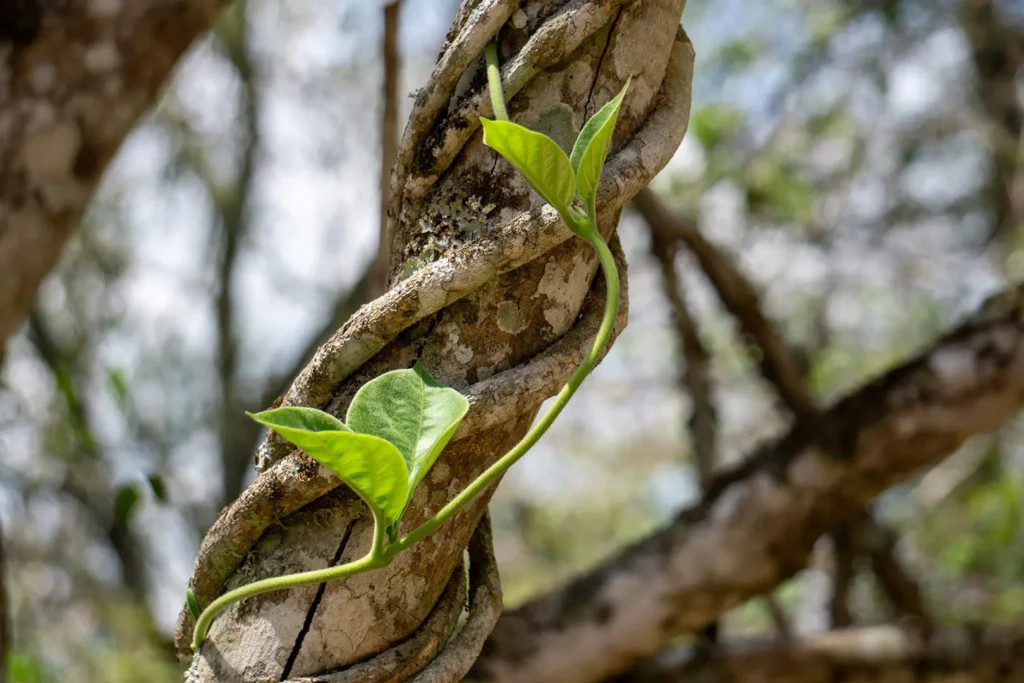
At Hufnagel Tree Service, we evaluate vines as part of the entire tree, not as a separate landscaping issue. A vine may be using the trunk only for support, or it may be twisting around stems, competing at the root zone, blocking sunlight, concealing decay, and increasing the amount of wind caught by the crown. The correct response depends on the vine species, the tree species, the amount of growth, and the condition of the tree below it.
Monmouth County trees already face demanding conditions. Coastal wind, summer thunderstorms, saturated soil, winter snow, ice, road salt, compacted residential soil, and limited rooting space can all reduce a tree’s margin for additional stress. Vines become more concerning when they cover long limbs over a house, driveway, patio, sidewalk, utility corridor, or neighboring property.
We have more than 25 years of local tree care experience, and our priority is to preserve healthy trees whenever that can be done responsibly. This guide explains how vines affect tree health, which vines deserve prompt attention, why removal must be handled carefully, and when a vine-covered tree should receive a professional tree risk evaluation.
Vines and Tree Health: Why Identification Comes First
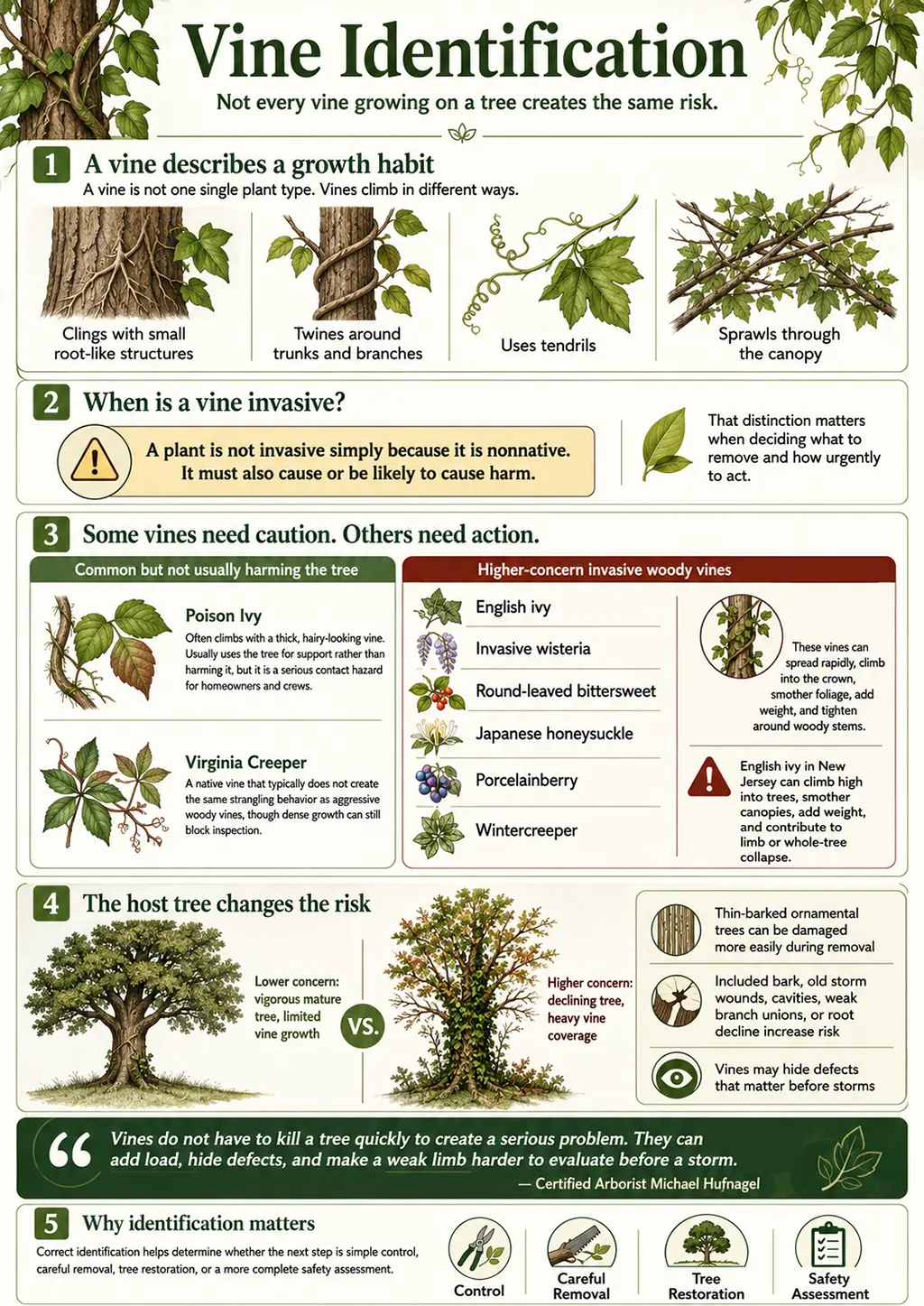
The word vine describes a growth habit, not one single type of plant. Some vines cling to bark with small root-like structures. Others twine around trunks and branches. Some use tendrils, and others sprawl through the canopy. The federal National Invasive Species Information Center also makes an important distinction: a plant is not considered invasive simply because it is nonnative. It must also cause or be likely to cause harm.
That distinction matters on residential properties. Poison ivy can climb a tree with a thick, hairy-looking vine, but the University of Maryland Extension notes that poison ivy does not harm the tree it uses for support. It is still a serious contact hazard for homeowners and crews. Native Virginia creeper may also climb trees without the same strangling behavior associated with aggressive woody vines, although very dense growth can still interfere with inspection.
English ivy, invasive wisteria, round-leaved bittersweet, Japanese honeysuckle, porcelainberry, and wintercreeper deserve a different level of attention. Their growth can spread rapidly, reach the crown, cover foliage, or tighten around woody stems. Rutgers describes English ivy in New Jersey as an invasive vine capable of climbing high into trees, smothering canopies, adding weight, and contributing to limb or whole-tree collapse.
The host tree matters too. A vigorous mature oak with a small vine beginning at the base is a different situation from a declining maple covered from root flare to outer canopy. Thin-barked ornamental trees may be damaged more easily during removal. Trees with included bark, old storm wounds, cavities, weak branch unions, or root decline may already have limited structural reserve before vine load is added.
“Vines do not have to kill a tree quickly to create a serious problem,” says certified arborist Michael Hufnagel. “They can add load, hide defects, and make a weak limb harder to evaluate before a storm.” Correct identification gives us the information needed to decide whether the priority is simple control, careful removal, tree restoration, or a more complete safety assessment.
What Homeowners Should Identify Before Cutting a Vine
- Whether the vine clings, twines, uses tendrils, or simply rests in the canopy
- Whether the plant is native, nonnative, invasive, or hazardous to touch
- How high the growth reaches and whether it covers major branch unions
- Whether the host tree already shows dieback, cracks, cavities, lean, or root problems
- What people, structures, vehicles, wires, or neighboring property are below the tree
Identification establishes the level of urgency. The next concern is the physical load that mature vine growth can place on a tree during wind, rain, snow, and ice.
How Vines Increase Weight, Wind Resistance, and Branch Failure
Dense vines add living weight to trunks, limbs, and fine branches. That weight increases as stems thicken and foliage expands. Rainwater can make the mass heavier, while snow and ice may accumulate on a tangled mat of vines. A long limb already carries substantial leverage near its attachment point, and extra weight toward the outer canopy increases the force at that union.
Wind resistance is often the larger concern. A healthy crown is naturally shaped to move and allow some air to pass through. A vine-covered crown can become denser and less predictable. The International Society of Arboriculture tree risk assessment instructions specifically identify vines as a crown condition when they significantly increase load or wind resistance.
Twining vines create another form of mechanical pressure. Wisteria and bittersweet can wrap tightly around trunks and branches as both plants increase in diameter. Rutgers reports that invasive wisteria can twist around trees, cut into them, and eventually kill them. The University of Maryland similarly explains that oriental bittersweet can girdle trees and break branches under its weight.
These forces become more important in Monmouth County because local trees are repeatedly tested by coastal gusts, nor’easters, tropical systems, pop-up thunderstorms, wet snow, and ice. Trees near Raritan Bay, the Navesink and Shrewsbury rivers, and the Atlantic shoreline may experience strong or shifting winds. Inland trees on wet or compacted soil may have reduced root stability when the crown suddenly catches more wind.
A vine-covered limb is especially concerning when it extends over a roof, bedroom, driveway, play area, pool, sidewalk, or road. Homeowners should not judge safety only by whether leaves are green. A living tree can have weak attachments, internal decay, or damaged roots. Vine growth may increase the stress on those defects at the exact time weather conditions are most demanding.
Warning Signs That Vine Load Has Become a Safety Concern
- Thick vine stems extending into the upper canopy or across major limbs
- Large mats of foliage that move as one mass during wind
- Broken, hanging, or sharply bent branches trapped in vine growth
- Cracks, seams, cavities, or swelling visible between vine stems
- New lean, lifting soil, or root plate movement after rain or storms
Mechanical load is visible when growth becomes heavy, but vines create a second problem that is easier to miss. They can block the canopy and conceal the tree’s trunk, branch attachments, and warning signs.
How Dense Vine Growth Hides Decline and Blocks the Canopy
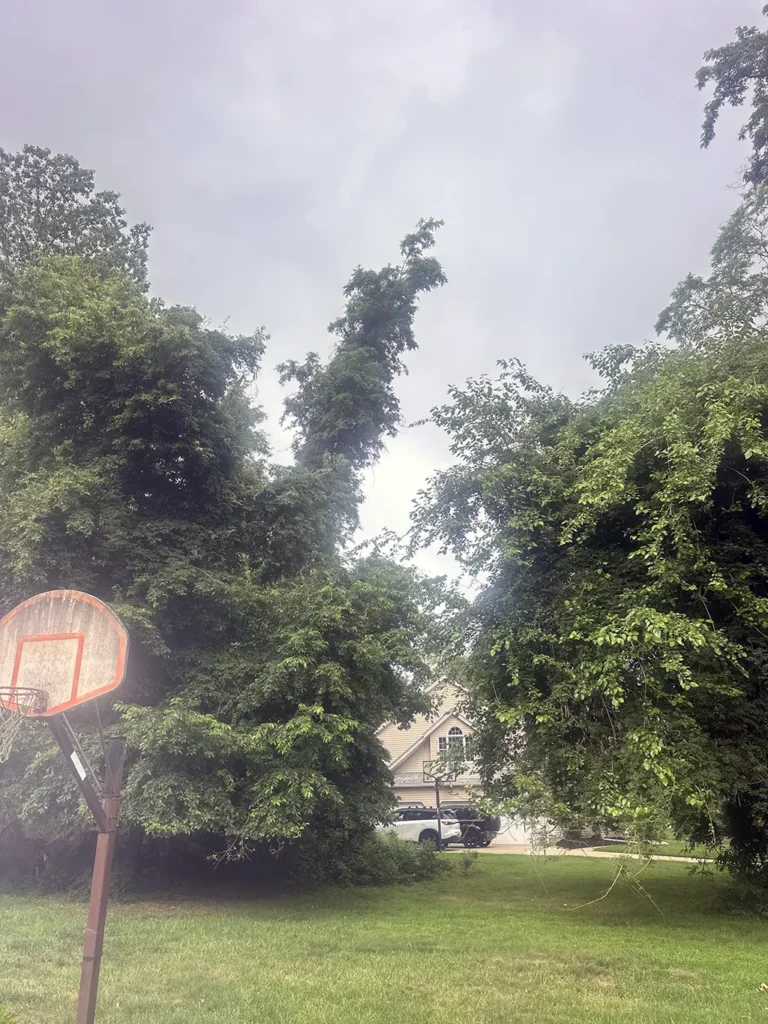
Trees manufacture energy through photosynthesis in their leaves. The Colorado State Forest Service explanation of tree physiology describes leaves as the primary location where trees capture light and produce the sugars needed for growth. When aggressive vines climb above the tree’s foliage and spread across the crown, they compete directly for that light.
Evergreen English ivy has an added advantage because it can remain active when many native plants are dormant. Rutgers notes that ivy can form a carpet on the forest floor, climb trees, shade the canopy, and prevent the host from receiving adequate light. The problem develops gradually. The tree may produce thinner foliage, smaller leaves, dead twigs, and reduced annual growth before the decline becomes obvious from the ground.
Thick vines also make inspection difficult. They can cover trunk flares, old pruning wounds, cavities, included bark, cracks, cankers, decay pockets, mushrooms, and branch attachments. A tree may appear full because the vine has green leaves even when the actual tree canopy is sparse. This is one reason we separate vine foliage from tree foliage during a ground-based evaluation.
Vines do not automatically cause trunk rot simply by touching bark, and it is important not to overstate the connection. However, a dense layer can keep the surface shaded, limit visibility, trap debris, and make it harder to notice bark damage or moisture-related problems. Penn State also notes that English ivy in landscapes can create sheltered conditions around shrubs and trees that may increase problems from rodents and other hidden activity.
Competition also occurs below ground. Ivy, honeysuckle, bittersweet, and other vigorous plants occupy soil around the root flare and absorb water and nutrients. Penn State’s guidance on weed management around trees and shrubs explains that competing plants can reduce growth and affect plant health by competing for light, water, and nutrients. A stressed tree has less energy available for wound response, root growth, and recovery after storms.
What a Clear Trunk and Canopy Allow an Arborist to Evaluate
- The tree’s true foliage density, dieback pattern, and branch structure
- Cracks, cavities, wounds, cankers, decay, and weak branch unions
- The root flare, girdling roots, soil movement, and basal mushrooms
- Deadwood, broken branches, overextended limbs, and canopy imbalance
- Whether tree pruning, health care, restoration, monitoring, or removal is justified
Once the tree can be seen clearly, the vine itself must be evaluated in the local context. Several aggressive species are now common in New Jersey landscapes and wooded property edges.
Invasive Vines Commonly Found on New Jersey Trees
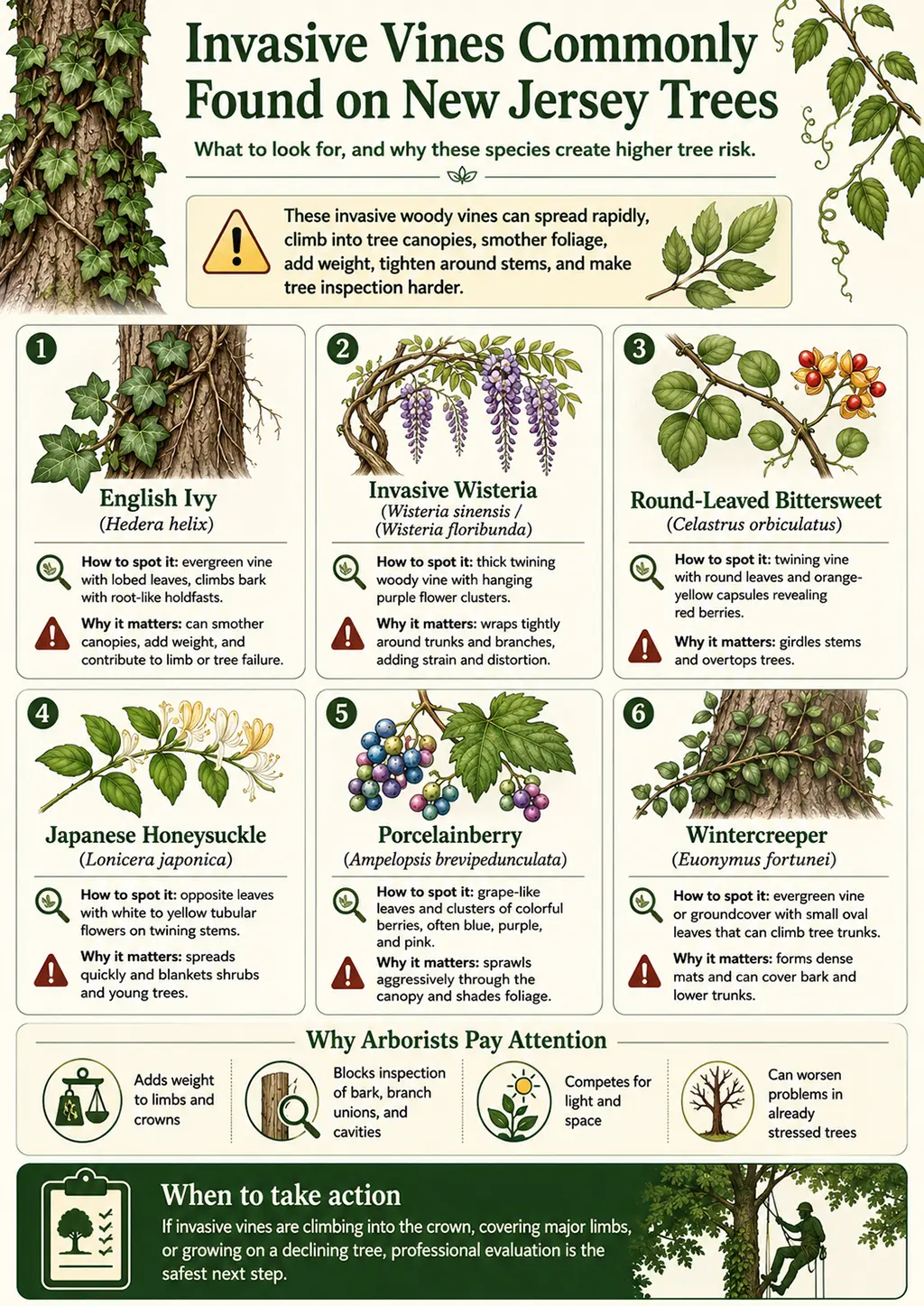
English ivy is one of the most recognizable. It often begins as groundcover, reaches a trunk, and climbs using small aerial rootlets. Once it reaches brighter conditions in the crown, mature ivy can flower and produce fruit that birds spread to new locations. The Rutgers English ivy profile reports that it has become increasingly vigorous and common in New Jersey natural areas.
Chinese and Japanese wisteria were widely planted for their flowers, but unmanaged plants can escape arbors and spread into trees, forest edges, roadsides, and neighboring properties. Their thick woody stems twist around trunks and branches. Rutgers advises that invasive wisteria can kill mature trees, while native American wisteria has a different growth pattern and is a better landscape choice when properly supported away from valuable trees.
Round-leaved bittersweet, often called oriental bittersweet, climbs by spiraling around its support. Its attractive red and yellow fruit helped spread it through ornamental use, but the vine can constrict stems, shade foliage, and add substantial weight. Rutgers recommends a careful window-cut removal method for bittersweet and warns against pulling overhead vines down from trees.
Japanese honeysuckle, porcelainberry, wintercreeper, and invasive clematis may also spread through property lines, neglected beds, fences, and wooded edges. The Jersey-Friendly Yards invasive plant guide identifies several of these vines as plants New Jersey property owners should avoid. Early control is easier than waiting until woody stems are woven through a mature canopy.
Not every replacement must be bare soil. Rutgers provides native alternatives for invasive landscape plants, and Jersey-Friendly Yards lists Virginia creeper and bearberry as alternatives to English ivy in appropriate locations. The important principle is right plant, right place. Even a native vine should be placed on a suitable trellis or structure rather than allowed to overwhelm a specimen tree that needs open bark and canopy access.
New Jersey Vines That Deserve Prompt Attention
- English ivy climbing beyond the lower trunk and entering the crown
- Chinese or Japanese wisteria twisting around trunks and scaffold limbs
- Round-leaved bittersweet spiraling around young or mature trees
- Japanese honeysuckle or porcelainberry forming dense canopy mats
- Any unidentified woody vine covering a tree with visible decline or storm damage
Recognizing the vine is only the beginning. Removal methods must protect the tree, the property, and the person doing the work.
Safe Vine Removal, Tree Restoration, and Risk Decisions
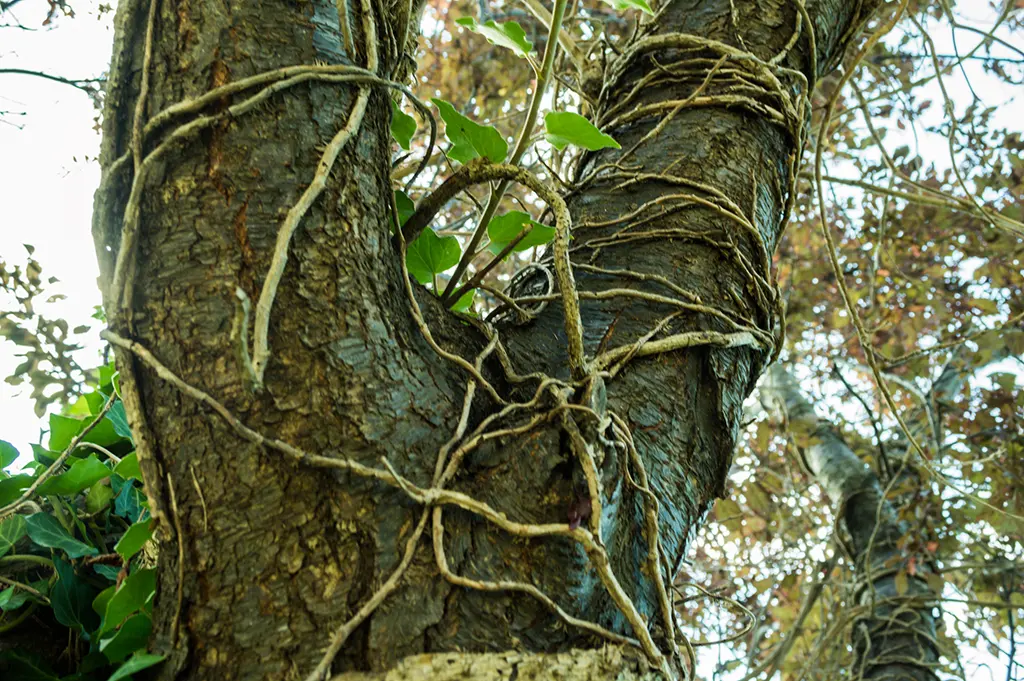
Do not pull mature vines down from a tall tree. Dead branches, loose bark, hidden hangers, and sections of vine can fall unexpectedly. Pulling can also strip bark or break small branches that are still attached. Both the University of Maryland English ivy guidance and Rutgers recommend cutting vines near the ground and allowing the upper growth to die before it releases naturally.
A common manual technique is to create a clear band or window around the lower trunk. Vines are cut low and again several feet above the ground, then the section between cuts is carefully removed without slicing into bark. Thick stems may be under tension. Cutting tools must be controlled, and no one should stand beneath overhead vine growth while attempting removal.
Cutting the climbing portion does not eliminate the root system. English ivy, wisteria, bittersweet, and honeysuckle may resprout repeatedly. The University of Maryland invasive vine control guide explains that control methods vary by species and may require repeated cutting, digging, or carefully selected herbicide treatment. Any herbicide must be applied according to its label and kept away from the tree’s bark, roots, foliage, and nearby desirable plants.
After the vine begins to die back, we can evaluate the host tree more accurately. A viable tree may benefit from targeted tree pruning, deadwood removal, reduction of overextended limbs, root-zone correction, and a monitored tree health management plan. Restoration is most successful when the tree still has a stable root system, adequate live crown, and enough sound structure to recover.
Some trees are revealed to have advanced decay, severe dieback, unstable roots, major trunk damage, or branch failures that were hidden by foliage. “At that point, the job is not simply vine removal,” says Michael Hufnagel. “We need to determine whether the tree can safely recover or whether structural damage has already gone too far.” If preservation is not responsible, professional tree removal may be the safer decision.
A Practical Sequence for Managing Vines on Trees
- Identify the vine and check for poison ivy or other contact hazards
- Inspect the ground, trunk, crown, targets, and nearby utility conditions
- Cut accessible vines without pulling overhead growth from the canopy
- Control roots and resprouts using species-appropriate methods
- Reinspect the exposed tree and choose restoration, pruning, monitoring, or removal
The sequence matters because cutting vegetation is not the same as evaluating the tree. A vine-covered tree near people or property should be assessed as a complete risk system.
Call Hufnagel Tree Service To Determine How To Best Deal With Vines
Vines are easier to manage before they dominate the crown, and tree defects are safer to address before wind, rain, snow, or ice exposes them. A vine-covered tree should receive a certified arborist evaluation when growth reaches major limbs, hides the trunk or root flare, covers a tree with visible decline, or hangs above a house, driveway, road, patio, or utility corridor.
Hufnagel Tree Service is based in Middletown and serves communities throughout Monmouth County. Our certified arborists bring more than 25 years of local experience and the trust reflected in more than 200 five-star Google reviews. For an honest evaluation of vines and tree health, call or text (732) 291-4444 or request a consultation with Hufnagel Tree Service. Only use a certified arborist to determine whether the tree needs vine control, pruning, restoration, monitoring, or safe removal.
Schedule Service Now!
From precision pruning and safe removals to health assessments and preventative care, Hufnagel Tree Service delivers expert solutions backed by decades of experience. We offer certified insight, fair pricing, and a commitment to doing what’s best for your landscape.
Learn More About Our Services

Related Articles
Tree Pruning for Safer, Healthier Growth
Avoid Late Summer Tree Problems: Schedule An Inspection
Tree Risk Evaluation in Colts Neck, NJ
Storm Damaged Trees in Aberdeen: We Can Help