Contents
Professional Tree Pruning in Monmouth County NJ Starts With Knowing the Tree
Professional tree pruning in Monmouth County NJ is not just cutting branches. It is a careful tree care service that helps trees stay healthy, strong, balanced, and safer around homes, driveways, sidewalks, fences, and outdoor living spaces. As certified arborists, we look at the whole tree before we make a cut. That includes the trunk, branch structure, canopy weight, root area, species, age, growing conditions, and the way the tree responds to wind and weather.
In our part of New Jersey, tree pruning has to account for many different conditions. A mature oak in an older neighborhood does not need the same pruning approach as a flowering cherry near a front walkway. A maple growing in compacted soil does not respond like a holly near the shore. A tall evergreen exposed to salt air and wind needs different care than a backyard ornamental tree protected by surrounding homes. That is why professional tree pruning should never be treated as one-size-fits-all yard work.
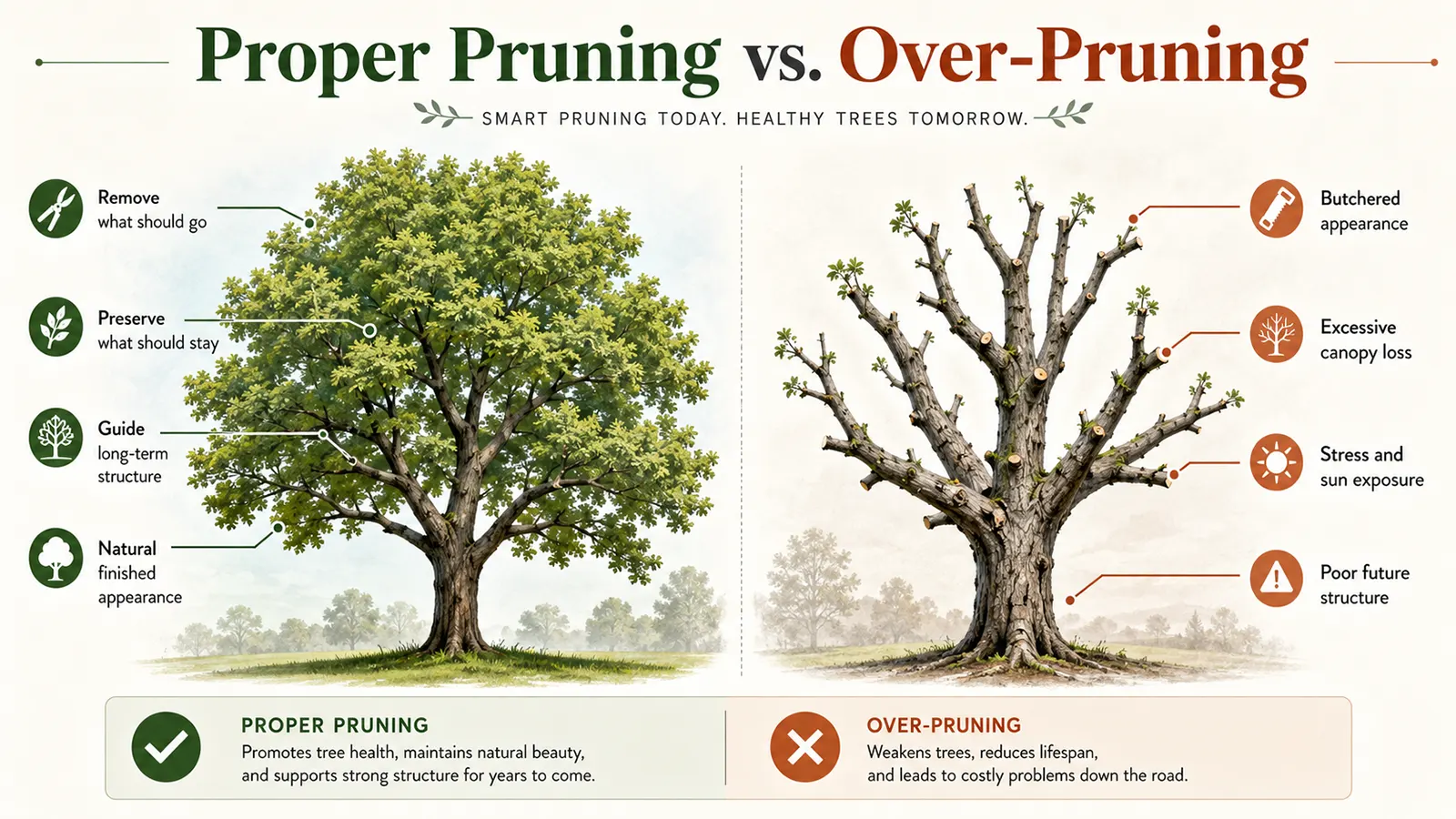
At Hufnagel Tree Service, we approach pruning as both a safety service and a tree health service. The goal is not to make a tree smaller just because it looks large. The goal is to remove what should be removed, preserve what should stay, and guide the tree toward better long-term structure. A good pruning job often looks natural when it is finished. The tree should not look butchered, stripped, or shocked.
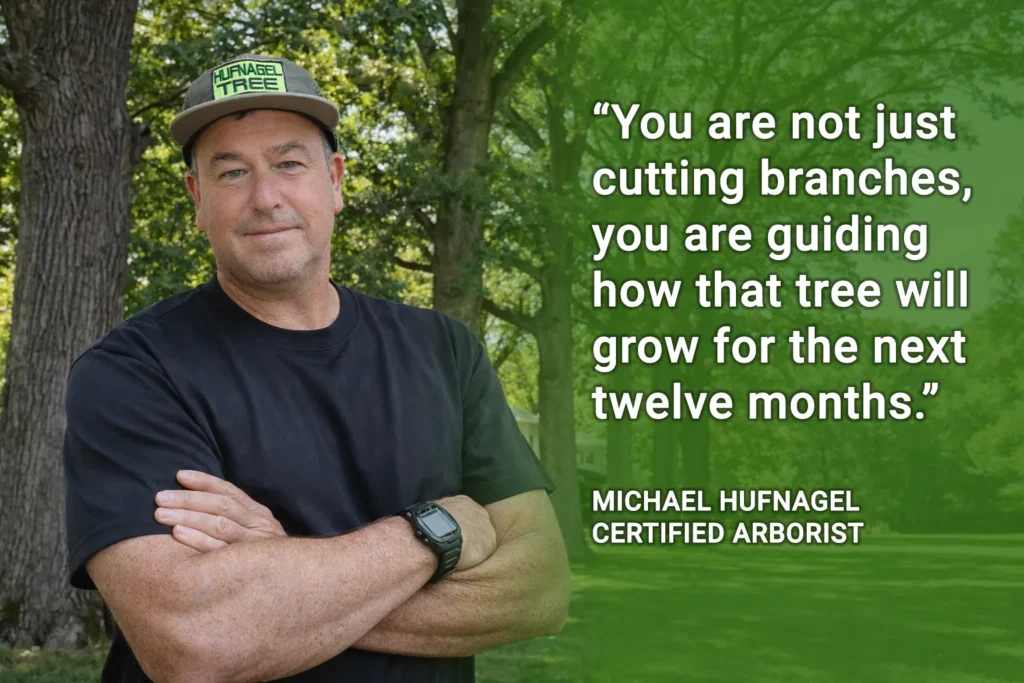
Michael Hufnagel explains it this way: “A proper pruning cut should have a reason. We are not there to attack the tree. We are there to help it function better, grow safer, and hold up better when the weather turns.” That mindset is the difference between professional tree pruning and random trimming.
For homeowners across Monmouth County, tree pruning is one of the most important services for protecting both property and tree value. Done correctly, it can reduce weak limbs, improve clearance, manage canopy weight, encourage better airflow, and help prevent damage before storms expose hidden problems.
Why Professional Tree Pruning Is Different From Basic Tree Trimming
Tree trimming and tree pruning are often used like they mean the same thing, but they are not always the same in practice. Basic tree trimming usually means cutting branches back for clearance, shape, or convenience. Professional tree pruning goes deeper. It considers the health, structure, safety, and future growth of the tree.
When we prune a tree, we are looking for deadwood, crossing limbs, weak attachments, overextended branches, storm-damaged areas, rubbing limbs, heavy end-weight, poor canopy balance, decay signs, and branches that may interfere with homes or utility areas. Each of those issues calls for a different kind of cut. Some branches should be removed completely. Some should be reduced. Some should be left alone because removing them would weaken the tree.
This matters because a tree can be damaged by too much cutting. We have seen plenty of trees across Monmouth County that were over-pruned by crews trying to “thin them out” quickly. Too many interior branches removed at once can create stress, sun exposure, weak regrowth, and poor structure. Topping or aggressive cutting can also force a tree to produce fast, weak sprouts that become future hazards.
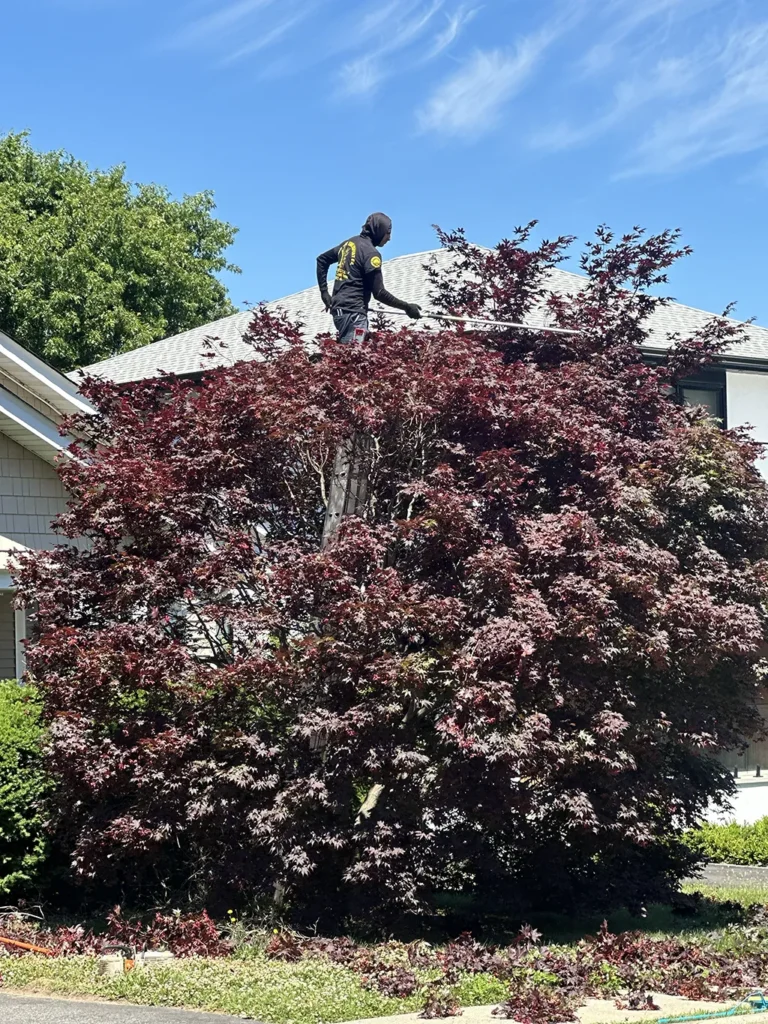
Professional pruning respects the tree’s natural form. A white oak should not be shaped like a lollipop. A Japanese maple should not be hacked into a ball. A magnolia should not be stripped so heavily that it loses its character. A privacy screen should not be cut in a way that opens holes that never fill back in. Every species has a growth habit, and good pruning works with that habit instead of fighting it.
Michael Hufnagel often tells homeowners, “The best pruning is not about how much you cut. It is about knowing what not to cut.” That is especially true for mature trees, ornamental trees, and trees near homes where one bad cut can change the tree for years.
Structural Pruning Helps Trees Handle Wind, Weight, and Weather
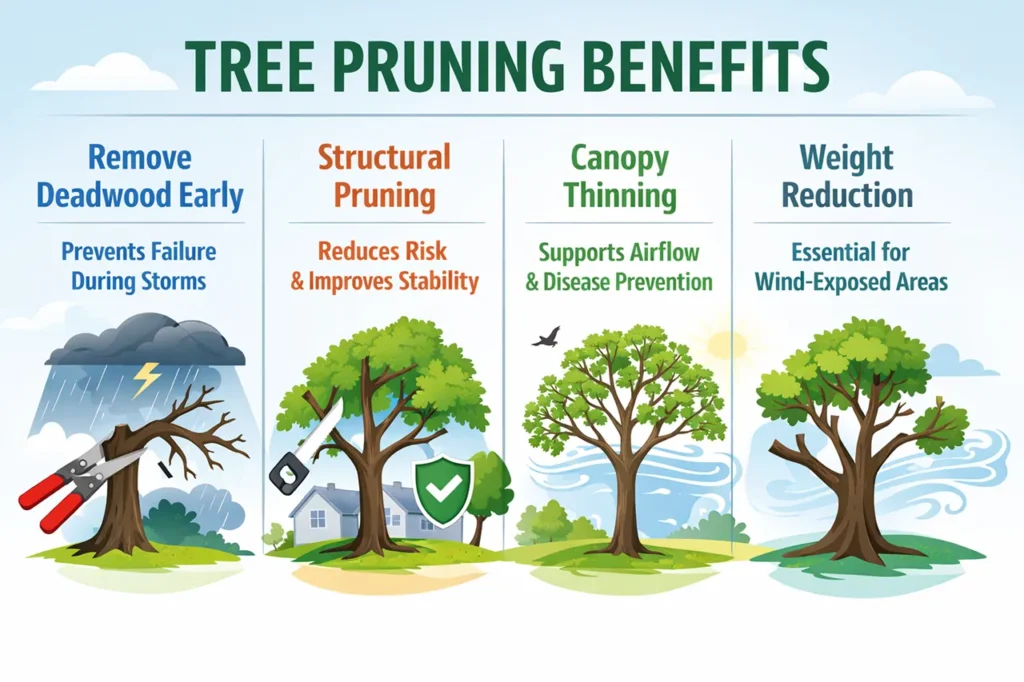
Structural pruning is one of the most valuable forms of professional tree pruning. It focuses on the framework of the tree. The goal is to reduce weak branch unions, improve spacing, correct competing leaders when appropriate, and manage limbs that are likely to fail as they grow heavier.
Many storm failures begin years before the branch actually breaks. A tight V-shaped branch union, a heavy limb growing too far over a roof, or a codominant stem can look fine during calm weather. Then a thunderstorm, tropical system, nor’easter, or wet snow event adds force and weight. Suddenly the weak point becomes obvious, usually after damage has already happened.
In Monmouth County, structural pruning is especially important because trees face different seasonal pressures. Summer storms can bring strong wind and heavy rain. Coastal weather can push trees from one direction for years. Winter storms can load branches with snow or ice. Spring growth can add weight quickly to trees that already have poor balance. A tree with bad structure may survive for a while, but every storm tests it.
Good structural pruning does not mean stripping the tree. It means making careful decisions that lower risk while preserving strength. Sometimes that means reducing the length of an overextended limb. Sometimes it means removing a smaller competing stem while the tree is still young. Sometimes it means cleaning out deadwood so falling limbs do not become a routine problem around the property.
This is where experience matters. We are not only looking at what the tree looks like today. We are looking at how it will behave when it grows, when the wind hits it, and when the next storm comes through.
What Strong Pruning Decisions Usually Protect Against
- Large dead limbs falling near homes, patios, cars, or walkways
- Weak branch unions splitting during wind or snow load
- Overextended limbs placing too much weight over roofs or driveways
- Poor canopy balance that increases storm stress
- Fast, weak regrowth caused by improper cutting
Professional pruning is prevention work. It is much easier to correct a branch before it fails than to repair a roof, fence, gutter, deck, or landscape bed after the branch comes down.
Tree Pruning for Health, Airflow, and Long-Term Growth
Tree pruning is also important for health. When a canopy becomes too crowded, branches may rub, decay pockets may worsen, and airflow may be limited. While trees do not need to be opened up aggressively, selective pruning can help reduce problems that build inside the canopy over time.
Dead, diseased, broken, or rubbing branches should often be addressed before they create larger issues. Deadwood can fall without warning. Broken limbs can tear bark and leave the tree exposed. Rubbing branches can create wounds that pests and decay organisms may exploit. A crowded canopy can also hide structural defects that are easier to manage when found early.
For flowering and ornamental trees, careful pruning can also help preserve form and improve future performance. Dogwoods, cherries, magnolias, ornamental pears, crabapples, hollies, and Japanese maples all need thoughtful handling. These trees are often close to homes, entryways, patios, and front yards, so both appearance and health matter. Bad pruning can ruin their shape. Good pruning can keep them attractive and manageable.
Evergreens and privacy plantings also need a careful approach. Many homeowners assume an evergreen will “just grow back” after heavy cutting, but that is not always true. Some species do not push new growth from old bare wood. Cut too deeply, and the damage can remain visible for years. This is common with privacy screens that were trimmed too hard or too late.
Michael Hufnagel says, “A tree tells you how it wants to grow. Our job is to read that before we cut.” That is why we do not treat pruning as cosmetic cleanup only. We treat it as plant health care, risk reduction, and property protection in one service.
The Right Time to Prune Depends on the Tree and the Goal
There is no single perfect pruning season for every tree. Timing depends on the species, the reason for pruning, and the condition of the tree. Dead, broken, or hazardous limbs can often be addressed when they are found. Safety concerns should not wait just because the calendar says it is not the ideal season.
For many shade trees, dormant-season pruning can be useful because the branch structure is easier to see and the tree is under less active growth stress. For some flowering trees, pruning after bloom may be better if the goal is to preserve flowers. For storm preparation, pruning should be done before the severe weather pattern arrives, not after the tree has already been damaged.
In Monmouth County, timing also depends on local conditions. A property near the shore may see more wind exposure and salt stress. An inland yard with heavy clay soil may hold water longer after rain. A mature property with large oaks and maples may need routine inspection because large limbs carry more weight. A newer landscape with young ornamental trees may benefit from early structural pruning before problems become expensive.
Homeowners often call after they notice branches touching the house, limbs hanging low over the driveway, or deadwood collecting in the canopy. Those are good reasons to schedule pruning. But the better approach is to inspect trees before the problem becomes obvious. Many defects are easier to correct when caught early.
The right pruning plan considers both immediate needs and future growth. That is what separates long-term tree care from quick cutting.
When a Pruning Call Makes Sense Before the Next Storm
- You see dead limbs hanging in the canopy
- Branches are touching the roof, siding, gutters, or windows
- A heavy limb reaches over a driveway, deck, or play area
- The tree has multiple trunks or tight branch unions
- The canopy looks unbalanced after recent growth or storm damage
These warning signs do not always mean a tree must be removed. Many times, professional pruning can reduce the concern while preserving the tree.
Why Homeowners Should Avoid Over-Pruning and Topping
One of the biggest mistakes we see is over-pruning. Homeowners may ask for a tree to be cut back hard because it feels too large. Some crews respond by removing too much interior growth, cutting large limbs without a plan, or topping the tree. That can create more problems than it solves.
Topping is especially harmful. When the main upper limbs are cut back to stubs, the tree often responds with fast, weak shoots. Those shoots may grow quickly, but they are poorly attached. Over time, they can become more dangerous than the original branches. Topping also leaves large wounds that may not close properly, increasing decay risk.
Over-thinning is another issue. Removing too much from the inside of the canopy can shift weight to the branch ends. That can make limbs more likely to whip in the wind. It can also expose bark and interior limbs to sun stress. A tree may look “cleaned out” at first, but it may actually be weaker.
Proper pruning keeps enough live canopy to support the tree. Leaves are how the tree makes energy. Remove too much at once, and the tree has to respond under stress. For mature trees, this can be a serious problem. Older trees do not recover as quickly as young trees.
Michael Hufnagel puts it plainly: “If a tree looks like it got a bad haircut, it probably got bad pruning. Good pruning should make the tree safer without taking away its natural strength.” That is the standard we work from.
Professional Tree Pruning Protects Homes, Landscapes, and Tree Value
Trees add real value to a property. Mature shade trees cool yards, frame homes, soften streetscapes, provide privacy, and create character that cannot be replaced quickly. But trees also need care. A neglected tree can become a hazard. A poorly pruned tree can lose beauty and strength. A well-pruned tree can remain a major asset for decades.
Professional tree pruning is especially important near homes. Limbs rubbing on roofs can damage shingles. Branches touching siding can trap moisture. Overhanging limbs can drop debris into gutters. Low limbs can block driveways or make lawn areas harder to use. Heavy branches over patios, pools, and play areas can create safety concerns that should be addressed before failure occurs.
For landscapes with ornamental trees and privacy plantings, pruning also protects the investment. Many of these trees were planted for a specific purpose, such as screening, curb appeal, shade, or flowering interest. Bad cutting can undo years of growth. Good pruning keeps those trees useful and attractive.
As certified arborists with deep local experience, we consider tree health, property layout, species, weather exposure, and homeowner goals before we prune. We do not believe in cutting just to cut. We believe in pruning with purpose.
Call Hufnagel Tree Service for Professional Tree Pruning
If your trees are overgrown, crowded, storm-damaged, touching the house, or showing dead limbs, professional tree pruning can help protect your property and improve long-term tree health. Hufnagel Tree Service has served Monmouth County homeowners for more than 25 years, backed by certified arborist knowledge, local experience, and more than 200 five-star Google reviews.
Call Hufnagel Tree Service at (732) 291-4444 to schedule a professional tree pruning consultation and get honest guidance from a certified arborist before the next storm, growth cycle, or seasonal change creates a bigger problem.
Schedule Service Now!
From precision pruning and safe removals to health assessments and preventative care, Hufnagel Tree Service delivers expert solutions backed by decades of experience. We offer certified insight, fair pricing, and a commitment to doing what’s best for your landscape.
Learn More About Our Services
Related Articles