
Contents
Tree Root Problems in Eatontown Start Below Ground, Where the Water Collects
Eatontown sits where Route 35 and Route 36 meet, and the borough history on Wikipedia begins with Thomas Eaton, who built a grist mill around 1670 in what is now Wampum Lake Park. The community was set off as a township in 1873 from parts of Ocean and Shrewsbury Townships and became a borough in 1926. Today about 13,600 residents live on 5.89 square miles that include Wampum Lake, Oceanport Creek, and the South Shrewsbury River, and a Shade Tree Commission meets on the third Thursday of each month at Borough Hall.
That geography changes how we think about tree root problems in Eatontown. Most homeowners look up when they worry about a tree, at the dead limb or the branch over the roof, yet the roots hold all of that weight in place. In a borough that has a lake, creeks, and busy state routes, the ground under a tree changes more than the crown does. It gets wet, dug up, paved, and compacted, and a tree can carry the effects for years before anything shows overhead. That is why our tree risk evaluation starts at the base of the trunk and works upward.
After almost 30 years working throughout Monmouth County, we have seen that a tree rarely fails without an earlier sign near the ground. A crack in the soil, a lifted edge of turf, a trunk that sits at a new angle, or mushrooms at the base are all worth a closer look. Fall is a good time to check, while the leaves still help us read the crown and before winter weather adds load to roots that may already be wet.
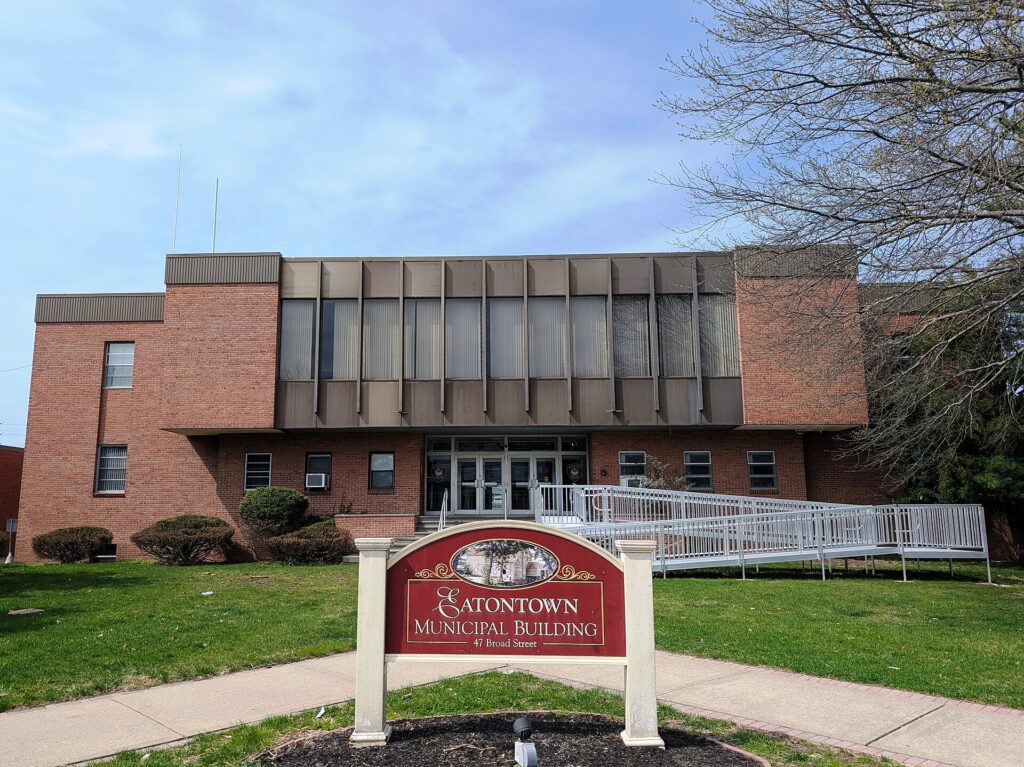
Water is the clearest local pressure on roots. In July 2022, Patch reported that U.S. Representative Chris Smith had asked for federal money to reduce flooding in the Eatontown historic district, describing runoff that backs up from Wampum Lake into nearby properties during high intensity rainfall, including the Eatoncrest apartment homes. The report does not mention trees, and we cannot say how that water affects any one yard. It does tell us that the ground near the lake is wet enough to be a public concern, and every root system growing in that ground lives in the same conditions.
Weather adds the second pressure. The National Weather Service describes nor’easters as storms that are most frequent and most violent between September and April, with gale force winds and heavy rain or snow. Wind pushes on the crown while saturated soil holds the roots less firmly, and the two often arrive together. Cal OES puts it plainly in a post on storm hazards: saturated soil makes it easier for trees to uproot, and floodwater can scour soil from around them. A tree with sound roots handles that load. A tree with a root problem has the least margin.
Roots Show Trouble at the Base Long Before the Crown Does
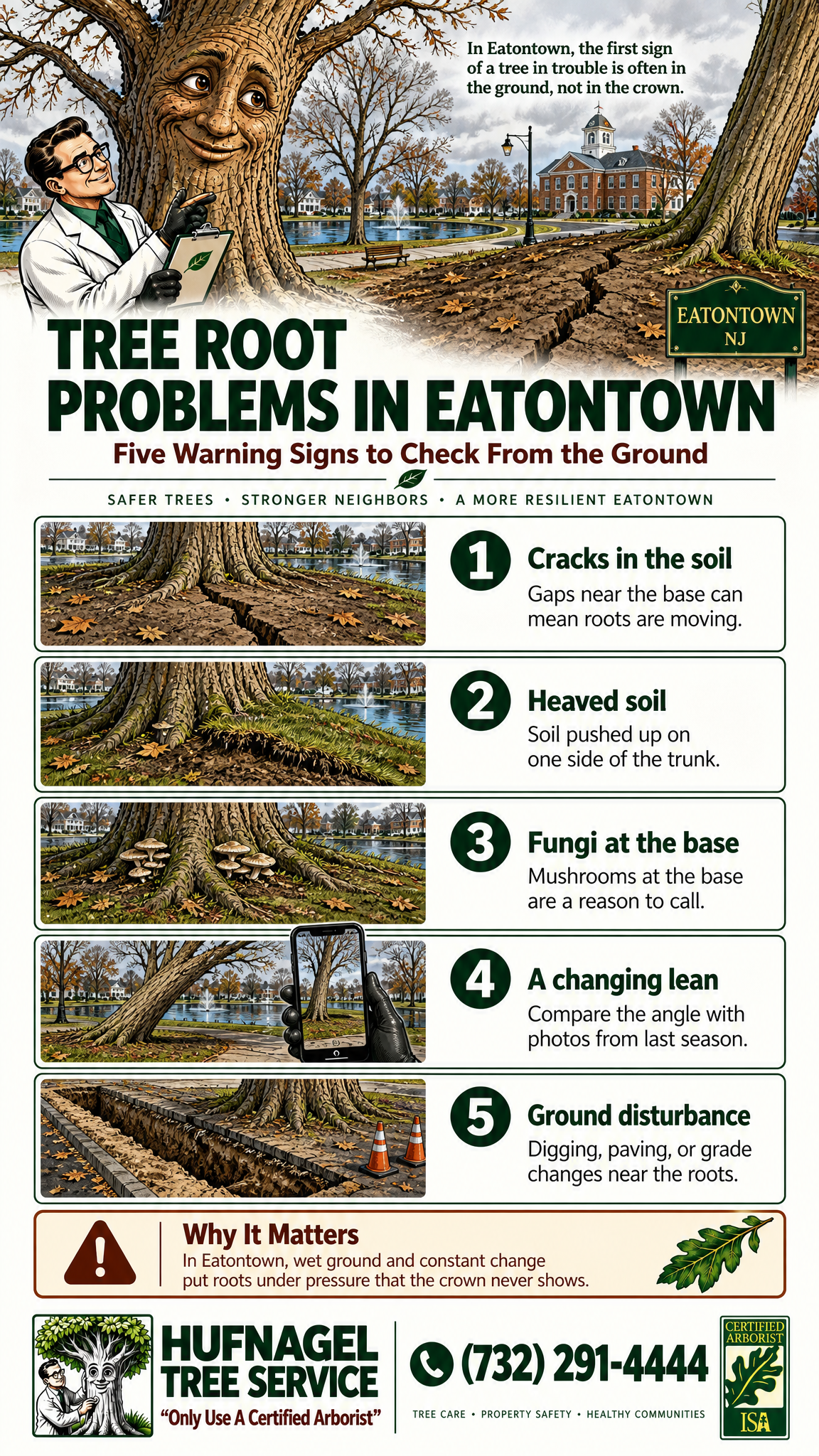
The International Society of Arboriculture gives homeowners a simple checklist in its brochure on recognizing tree risk. Among the questions are whether mushrooms are present at the base of the tree, whether the area has been altered by construction, changes in soil level, or new lawns and pavement, and whether the leaves have developed an unusual yellow color or seem smaller. The brochure also describes root failure this way: cracks or separations in the soil may point to soil heaving from excessive movement of the roots, which is a warning sign for failure, especially if the tree is leaning. It adds that judging how serious a defect is belongs to a professional arborist.
That description matches what we see on the ground. A tree does not stand on a single post. It stands on a wide, shallow plate of roots and soil, and the crown acts as a lever that tries to tip that plate. When the plate starts to move, the first evidence is often small: a hairline gap in the soil, turf lifted along one edge, or a trunk that no longer sits where it did. Our guide to weak tree roots walks through the signs a homeowner can see without touching the tree.
Change near the roots matters as much as the weather. The same ISA brochure lists human caused defects such as root loss, grade changes, and soil compaction from construction. Eatontown has seen change on a large scale. The Army ran Fort Monmouth here from 1917 until it closed in September 2011, and the former post has been through redevelopment since, according to the borough history on Wikipedia. Trenching for utilities, regrading a yard, widening a driveway, or parking equipment over the root zone can cut or crush roots that a mature tree depends on, and the tree can carry that loss for years before the crown shows it.
The ISA checklist also asks whether a tree has been topped or heavily pruned, and that question matters for roots too. A tree that has lost much of its crown carries a different balance above ground, and we look at the base before we recommend any further pruning. We do not top trees, and we do not thin a crown as a blanket answer to wind. We look for the specific defect, name it, and choose the smallest correction that addresses it, so that the roots are not asked to support a structure that keeps changing.
In a place with this much paving and construction, we treat the ground around the base as part of the tree. Mike Hufnagel describes the approach this way: “A tree does not have to lean to be in trouble. If the ground around the base has changed, the roots may be telling us something the crown has not shown yet.” That is a working rule and not a diagnosis. It keeps us from judging a tree by its leaves alone, and it sends us to the soil first, where the earliest evidence often shows.
Five Warning Signs of Tree Root Problems in Eatontown You Can Check From the Ground
- Cracks or separations in the soil near the base, especially beside a leaning tree.
- Soil heaved on one side of the trunk or turf lifted at its edge.
- Mushrooms or fungal growth at the base of the trunk or on exposed roots.
- A trunk that leans more than it did last season, compared with old photos.
- Recent digging, regrading, paving, or compaction within the spread of the crown.
Any one of these signs is a reason to look more closely and not a reason to panic. Soil cracks can have other causes, and a lean can be old and stable. What matters is change, which is why we ask homeowners to photograph the base of a large tree and note the date. A series of photos tells us far more than a single visit can. Once we know what the roots are doing, the next question is what water is doing to them, and in Eatontown that question usually involves heavy rain and saturated ground.
Standing Water and Saturated Soil Harm Roots in Two Different Ways
Flooding stresses a tree in two ways, and the first is invisible. Waterlogged, poorly drained soil can keep oxygen from reaching the roots, and Iowa State Extension notes that most trees and shrubs escape injury if floodwater recedes within about seven days. Species differ a great deal. Iowa State lists sugar maple, white oak, red oak, black walnut, and most pines and spruces among the flood intolerant trees that suffer severe injury or die when their roots stay submerged for a month or less. Oaks, maples, and pines are familiar shade trees across Monmouth County, so the list is not an abstract one for local homeowners.
The signs of that kind of injury are slow and easy to misread. Iowa State describes leaf yellowing, downward curling, leaf drop, and branch dieback, and in extreme cases the tree dies. Silt or sediment left over the roots can also block oxygen, and the same page says deposits deeper than 3 inches may impede it, especially on small or newly planted trees. Fertilizer does not fix any of this. The page states that fertilization is not a cure for root injury caused by flooding, and it advises homeowners to be wary of experts who recommend rescue treatments.
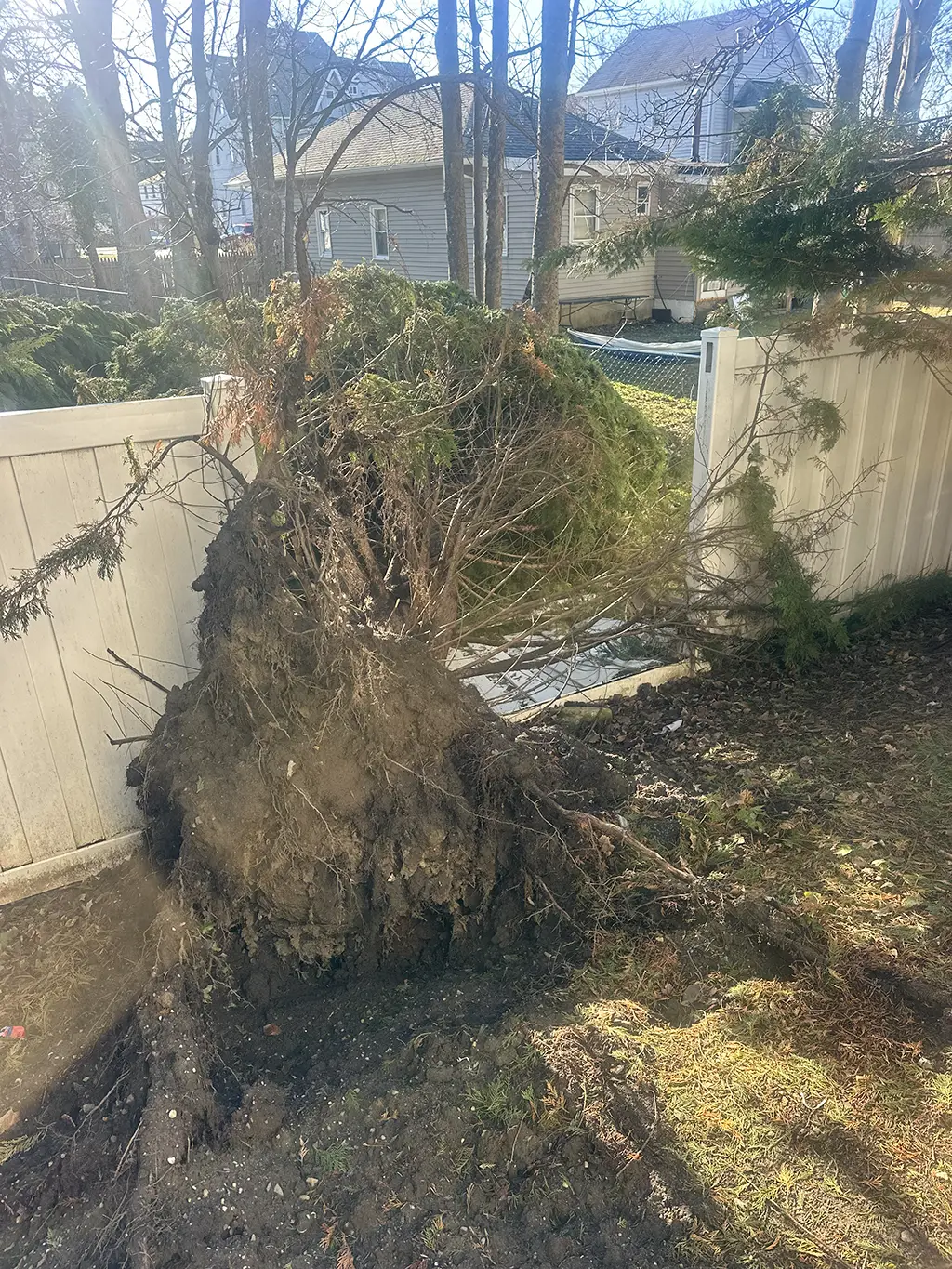
The second kind of harm is mechanical, and it matters most during a storm. Saturated soil makes it easier for trees to uproot, and floodwater can scour soil from around a trunk. A tree does not need to stand in a flood for this to apply. Several days of rain can leave the ground soft enough that a strong gust meets less resistance than it would in August. That is the combination we think about when a nor’easter is in the forecast, and it is the reason we look at the root plate before we judge the upright trunk. For trees that show yellowing or thinning after a wet season, our tree health management work reads the crown and the soil together.
Timing and species both change the outcome. A tree that stood in water for a day after a nor’easter is in a different position from one whose roots sat submerged for weeks, and the Iowa State figures of about seven days and one month give homeowners a rough way to think about it. We do not treat those numbers as a prediction for any single tree. They are a reason to note how long water stood around the base, to record the date, and to compare the crown next spring with photographs taken now. That record gives us something concrete to measure against.
Eatontown is also working on the water itself. The borough keeps a public notice page for its Wampum Lake Dam flood mitigation project, which shows that flooding around the lake is being addressed at the municipal level. We do not know how that project will change the ground around nearby trees, and we do not pretend to. Any work that changes drainage or grades near a mature tree deserves a follow up look at the roots, because the ISA brochure lists grade changes and root loss among the causes of structural defects.
Practical Steps After Heavy Rain Soaks the Ground Around Large Trees
- Photograph the base of each large tree after heavy rain and note the date.
- Keep vehicles, equipment, and stored materials off saturated ground beneath the crown.
- Watch for yellowing, curling, or early dropping leaves on trees that stood in water.
- Skip fertilizer as a fix, because it does not cure flood injury to roots.
- Stay clear of any tree that has started to lean and call us.
These steps are about observation and restraint, not repair. We do not ask homeowners to cut roots, prune limbs, or test a tree by pushing on it. If a tree that stood in wet ground shows a new lean, a gap in the soil, or thinning leaves, a trained eye can usually tell whether the tree needs monitoring, pruning to reduce weight, support, or removal. The decision then moves from the tree to the paperwork, because in Eatontown the borough code shapes what can happen next.
Eatontown's Borough Code Shapes What Happens After We Find a Root Problem
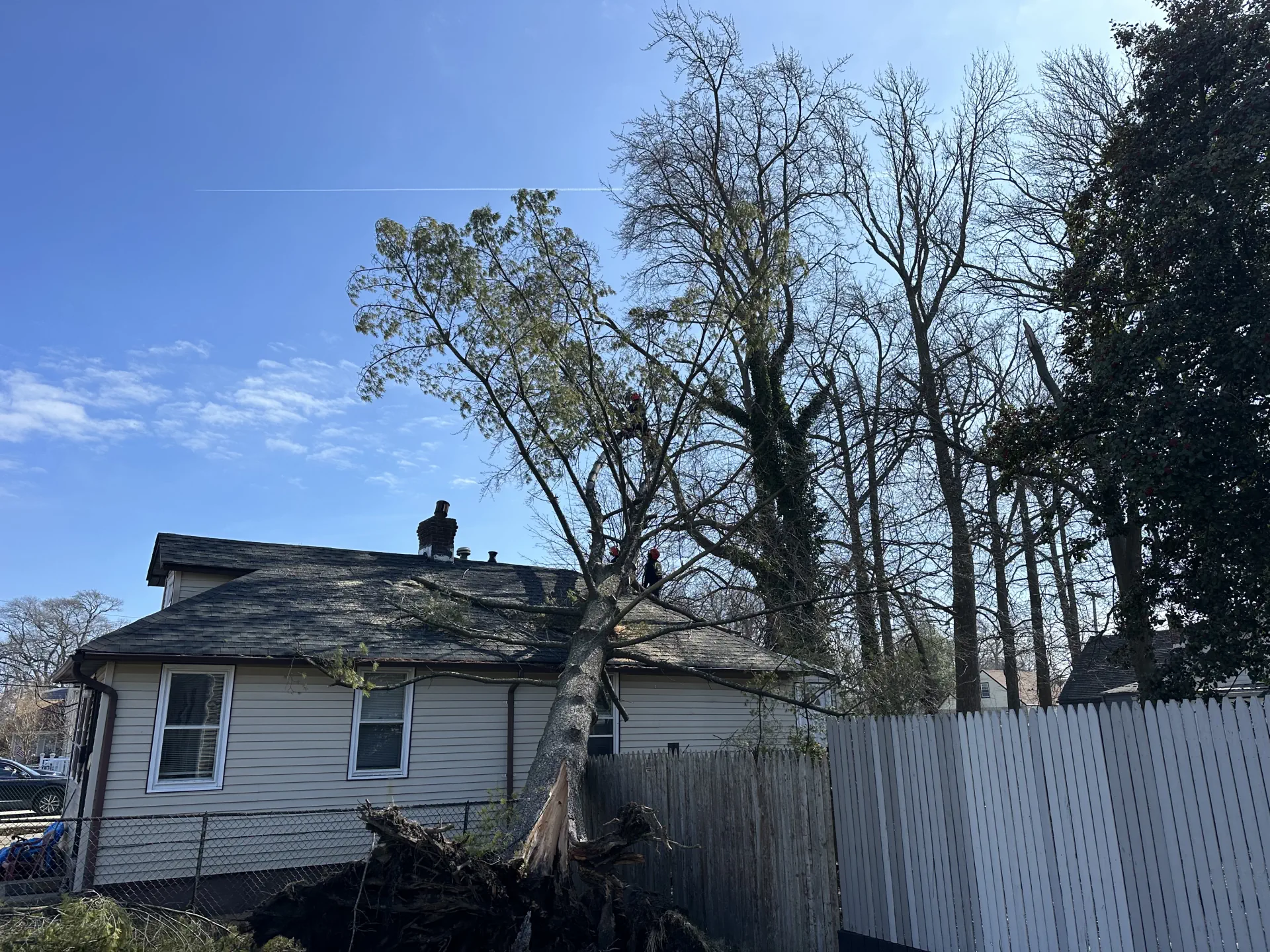
Eatontown regulates tree removal through Chapter 307 of its borough code. The chapter on tree removal was adopted in May 2023 and amended in 2024, and its stated purpose is to control the indiscriminate and excessive cutting of trees in line with the borough’s 2023 Tier A MS4 stormwater permit from the NJ Department of Environmental Protection. For a residential property, the process begins with a Tree Removal/Pruning request form filed with the Zoning Officer and Land Use Administrator. Anyone planning to cut a tree should read the chapter or call the borough first.
Location decides the next step. The Zoning Officer and Land Use Administrator determine whether a tree stands in the public right of way. If it does, the request goes to the Department of Public Works, which decides whether there is an emergent need to remove or cut it. Without an emergent need, the resident is referred to the Shade Tree Commission for a public hearing. That is why we ask where the trunk stands before we talk about removal, and why a planting strip tree and a backyard tree follow different paths.
The code also defines a hazard tree, and the definition is practical. It includes a tree that is dead or imminently dying, one with an infectious disease or insect infestation, one causing obvious damage to structures such as building foundations, and one that a New Jersey licensed tree expert or a licensed arborist determines to be a threat to public health, safety, or welfare. A root plate that has started to move, or decay at the base of a trunk, is the kind of finding that can support that determination, which is one more reason to document the base of a tree before anything fails.
Removal carries a replacement duty. Under section 307-6, a removed tree must be replaced, or a payment must be made into the borough Tree Fund, and the requirement scales with trunk diameter. Replacement trees must be planted within 12 months, cannot come from the borough Do Not Plant List, and must be monitored for two years. The chapter also lists exemptions, so the details of each property matter. We would much rather help an owner keep a sound tree than start that process, and our article on tree removal permits explains how rules like these usually work.
Not every root problem leads to removal. Many trees can be helped by reducing end weight, pruning out deadwood, correcting a poor union, or monitoring the base over time, and a tree that was cut badly in the past may be a candidate for restoration pruning. Our earlier article on tree care in Eatontown covers that range of options. When tree removal is the honest answer, because the roots or the base no longer give us a dependable way to manage the risk, we explain why in plain terms and follow the borough process with the owner. More of our local work is collected in the Eatontown location archive.
Questions to Settle Before Any Eatontown Tree Work Begins
- Whether the tree stands on private ground, in a planting strip, or in the right of way.
- Whether a Tree Removal/Pruning request form must be filed before any cutting begins.
- Whether the condition of the tree fits the code’s definition of a hazard tree.
- Whether a replacement tree or a Tree Fund payment applies to the planned removal.
- Whether the roots, and not the crown, are the part of the tree causing the problem.
Settling those questions first protects both the tree and the owner. A homeowner who knows where the property line sits, which form applies, and what the tree is actually doing can make a calm decision instead of a rushed one. The Shade Tree Commission meets on the third Thursday of each month, and the borough Department of Public Works handles public trees, so one call to the borough can clarify who decides. With the paperwork understood and the roots examined, the plan can be built around the season, before winter weather adds load.
Call Hufnagel Tree Service for Tree Root Problems in Eatontown Before Winter
If you have a mature tree near your Eatontown home, driveway, patio, or lot line, schedule an evaluation before winter storms arrive. We provide tree risk evaluations, tree health management, tree trimming and pruning, storm proofing, restoration, and tree removal when a tree cannot be managed safely.
Hufnagel Tree Service is led by a certified arborist with almost 30 years of local experience and more than 280 five star Google Maps reviews. We inspect first, explain what we found in plain terms, and recommend only the work that changes the outcome for your trees and your property.
Call or text (732) 291-4444 to schedule an inspection for tree root problems in Eatontown before the next nor’easter arrives.
Schedule Service Now!
From precision pruning and safe removals to health assessments and preventative care, Hufnagel Tree Service delivers expert solutions backed by decades of experience. We offer certified insight, fair pricing, and a commitment to doing what’s best for your landscape.
Learn More About Our Services


Related Articles

Summer Ornamental Tree Pruning in Middletown, NJ

Winter Tree Risk Inspections in Loch Arbour NJ
Tree Risk Mitigation Services Near Monmouth Beach NJ