Contents
In Neptune City, Trimming Has to Fit Small Lots and Close Neighbors
Neptune City is one of the smaller boroughs we serve. It was incorporated on October 4, 1881, after a referendum that March, and its first boundaries took in what are now Avon-by-the-Sea and the southern part of Bradley Beach, according to Wikipedia’s entry on Neptune City. Today the borough covers 0.90 square miles and counted 4,626 residents in the 2020 census. Memorial Park sits along the Shark River, Route 35 runs through town as Sylvania Avenue, and the streets between them are close, older, and full of mature trees.
That scale changes how we think about tree trimming and pruning. In a borough this compact, tree trimming in Neptune City is rarely about opening a view or shaping a crown for looks. It is about what hangs over a roof, a service wire, a driveway, or a neighbor’s fence, and how to correct it without leaving the tree weaker than we found it. A limb that is a minor nuisance on a large lot becomes a real problem when the house is only a few steps away.
After almost 30 years working throughout Monmouth County, we have seen that fall is the best time to read a tree. The summer storms have left their marks, the leaves are thinning, and the structure that matters is easier to see. A fall tree risk evaluation can sort the branches that need to come off now from the ones that can wait for the dormant season.
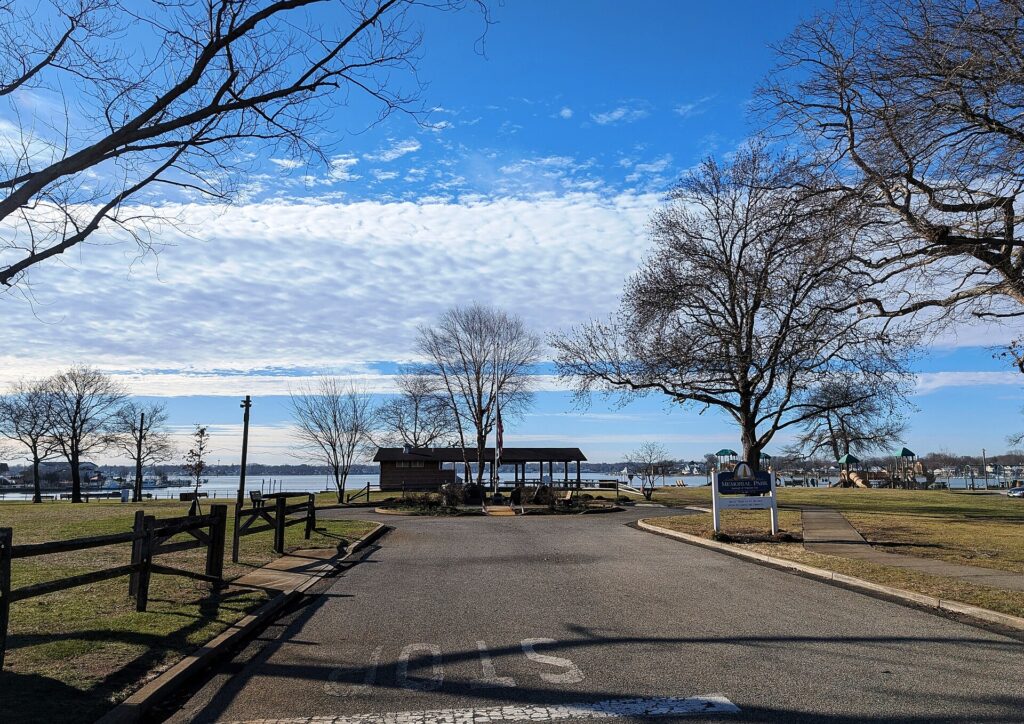
The Shark River shapes the ground under many of these trees. It rises in eastern Monmouth County, runs about 11.7 miles, and reaches the Atlantic at the Shark River Inlet between Belmar and Avon-by-the-Sea, and the lower river is tidal salt water, as Wikipedia’s article on the Shark River explains. The entry on Neptune City adds that the borough logged 39 days of coastal flooding between 2005 and 2014, more than three times the average of the decades before. Wet ground, salt, and wind each change how a tree holds its crown and its roots, so trimming decisions on the low side of town are not the same as trimming decisions on higher ground.
Tree Trimming in Neptune City Should Start With a Reason for Every Cut
Trimming and pruning are often used as if they mean the same thing, and on a compact Neptune City lot the difference matters. Trimming keeps a tree clear of the things around it. Pruning shapes how the tree grows. Good tree trimming in Neptune City does both at once, and it begins by asking why a branch needs to come off rather than how much of the tree can be removed.
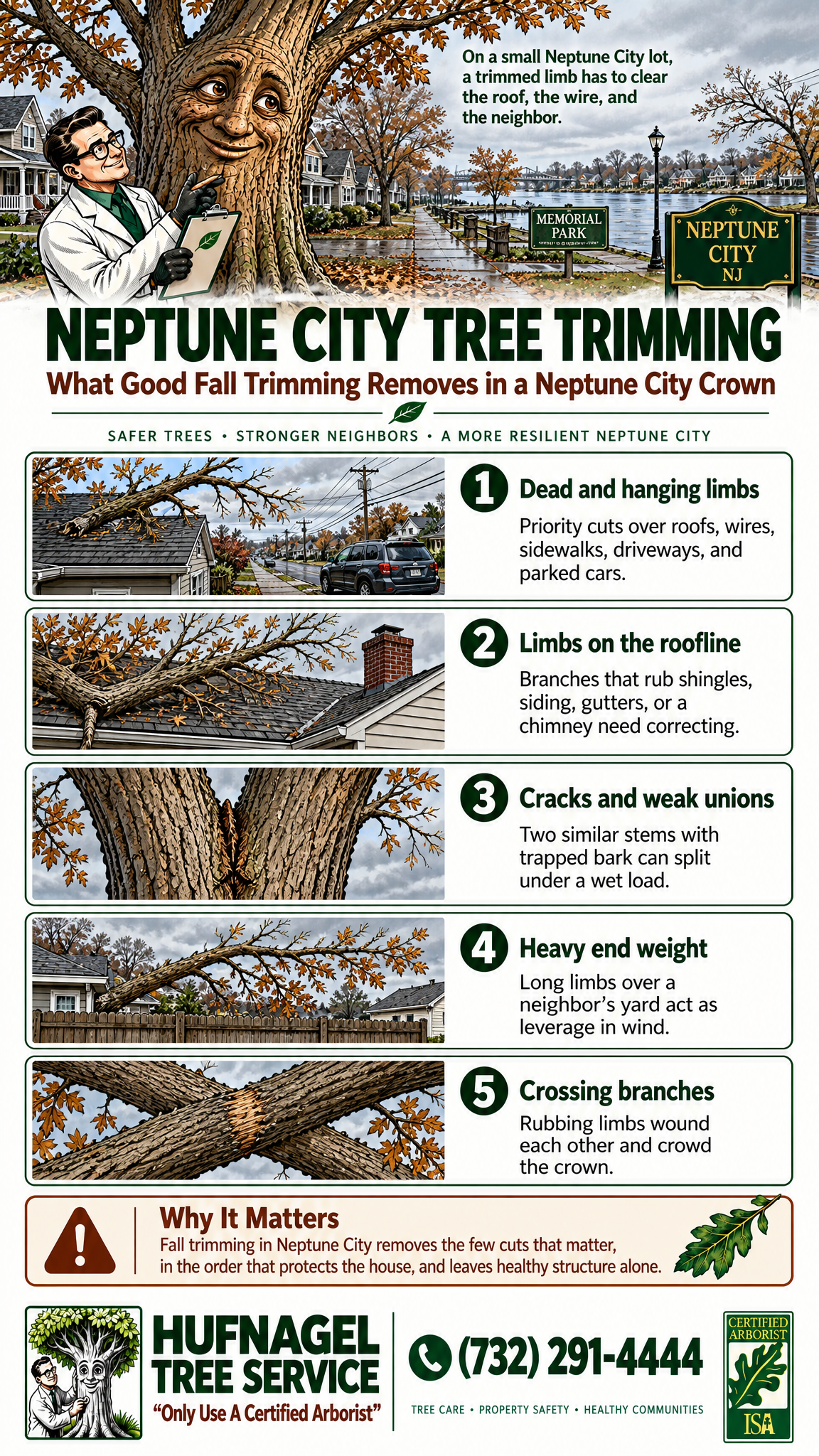
We start with the crown and the targets under it. Dead and hanging branches over a roof, a sidewalk, or a parked car are the simplest problem and the most urgent one. Branches that cracked in a summer storm often stay in the tree, look normal from the street, and come down in the first wet wind of November. Those limbs are the first ones we mark.
Next we look at clearance. On a Neptune City street, limbs reach siding, gutters, chimneys, and service wires because the houses sit close to the trees. A branch that scrapes a roof in every breeze is a branch worth correcting. Shortening it back to a sound side branch solves the problem, while cutting it to a stub only invites weak regrowth. Our article on codominant stems explains why a weak union deserves attention before it splits.
Then we look at weight. A long limb that reaches out over a neighbor’s yard carries its load at the far end, and that end weight acts like leverage when wind and wet leaves load it. Taking a few small branches off near the tip lowers that load without changing the shape of the tree. The International Society of Arboriculture ranks topping among the most harmful pruning practices in its guidance on pruning trees, and we agree. We do not top trees, and we do not try to “thin a tree out for wind” as a blanket prescription.
Crowded crowns need attention too. Two branches that cross and rub each other wear through the bark, and the wound becomes a place for decay to start. Where one of them has to go, we remove the weaker one and keep the branch with the better attachment. Trees that grew up close together on narrow lots often compete for the same space, and a few precise cuts can separate them without leaving a hole in the canopy.
Fall also shows what summer hid. As the leaves thin, dead tips, dieback, and small cracks become visible from the ground, and a canopy that looked full in July may turn out to have a dead section on one side. We photograph those findings so they can be compared with what we see in winter. A limb that is dead in October will not leaf out in May, and it is safer to remove it on a calm day than to wait for it to come down on its own.
Mike Hufnagel puts it simply: “On a small lot, every cut shows. I want to be able to say what each one is doing for the house, the neighbor, or the tree, and if I cannot say it, we leave that branch alone.” That standard keeps the work honest, and it keeps a trimmed tree looking like a tree instead of a stump with a few limbs.
What Good Fall Trimming Removes in a Neptune City Crown
- Dead, broken, or hanging branches over roofs, wires, sidewalks, driveways, and parked cars.
- Limbs that rub the roofline, brush the siding, or sweep across a chimney.
- Cracks and weak unions where two stems of similar size meet.
- Long limbs with heavy end weight reaching over a neighbor’s property.
- Crossing branches that rub each other where the crown is crowded.
Notice what is not on that list: the green, healthy branches that are simply in the way of a view or a preference. Removing live wood has a cost to the tree, and we spend it only where it buys safety, clearance, or better structure. Once the crown is sorted out, the next question is timing, because when a cut is made and what the soil is doing around the tree both affect how well the tree answers it.
Timing and Wound Care Decide How a Tree Answers the Cut
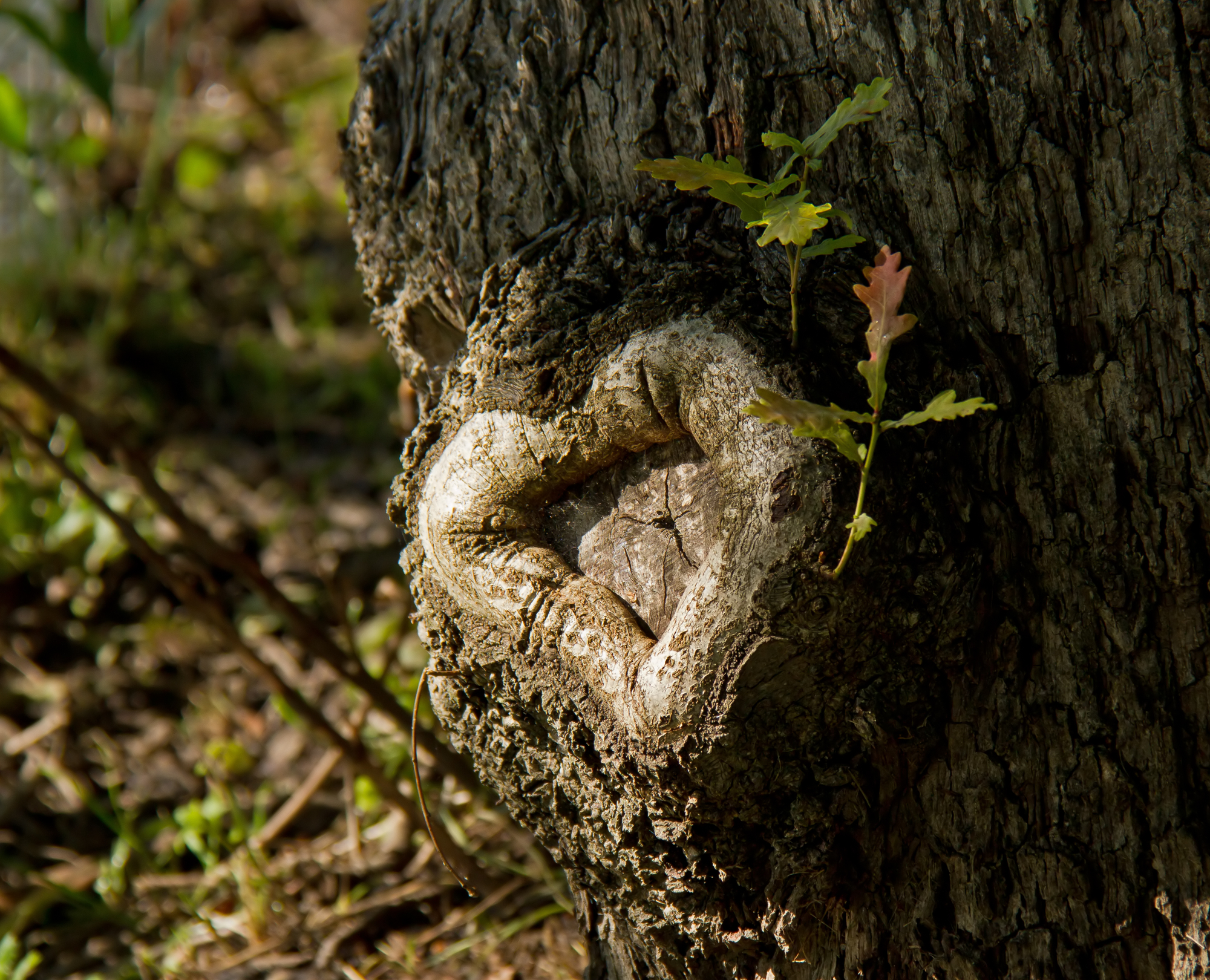
Light, routine pruning to remove weak, dead, or diseased limbs can be done at nearly any time of year, according to the International Society of Arboriculture, which also notes that growth and wound closure are best when larger cuts are made before the spring growth flush. That guidance explains how we sequence the work. In the fall we take off what is a hazard now, and heavier structural work waits for the dormant season.
Dormancy has a practical advantage as well. Rutgers Cooperative Extension’s guidance on pruning trees in winter points to the way a leafless crown lets the shape and structure of the tree show clearly. We use that. A fall visit lets us mark the limbs that matter while the summer record is fresh, and a winter visit lets us make the larger cuts with the whole frame in view.
How a cut is made matters as much as when. We see it every season: a cut made just outside the branch collar closes cleanly over the years, while a flush cut or a stub stays open and invites decay. That is why we cut back to a sound branch or to the collar rather than leaving a stump, and why a tree that was topped by someone else usually needs restoration pruning to work its weak regrowth back toward good structure over more than one season.
Salt and wet ground add a local layer. Winter plowing brings road salt and salty snow to the curb, and the low ground near the Shark River stays wet after coastal rain. A tree that is already dealing with salt in its root zone has fewer reserves to close large wounds, which is one more reason to keep cuts small and purposeful. Our guide to weak tree roots covers the changes at the base that tell us a tree is struggling below ground.
Mulch is part of this too. Rutgers notes that soils which are frequently waterlogged may not need mulch at all, and that repeated mulching in wet ground can push roots toward oxygen starved conditions. Neptune City treats the problem seriously. The borough’s tree ordinance lists over mulching and improper mulching among the ways a tree can be killed, in the definitions of Chapter 124 of the borough code. Mulch belongs in a flat, shallow ring that stays off the trunk.
Flowering ornamentals deserve a lighter hand in the fall, because many of them set next spring’s buds on wood they grew this year. Heavy cutting now removes the bloom the homeowner is waiting for. On those trees we limit fall work to deadwood and hazards, and we shape them after they flower, when the cuts can serve the tree and the yard together.
Wires deserve a plain warning. The same chapter requires anyone who controls an electric wire along a public street to guard the trees it passes through, and a branch near a service line is never a homeowner project. We stay clear of energized lines and call the utility when a limb is touching one. Homeowners should look, photograph, stay back, and call.
Cuts and Habits That Hurt a Neptune City Tree
- Topping a tree to make it shorter, which leaves stubs and weakly attached regrowth.
- Flush cuts or leftover stubs instead of a cut just outside the branch collar.
- Taking a large share of the live crown off in a single season.
- Mulch piled against the trunk or deepened every spring in ground that stays wet.
- Cutting near service wires without the utility or a trained crew involved.
Every item on that list is common, and most of them come from good intentions. A homeowner wants a tree smaller, a yard tidier, or a roof cleaner, and the quickest cut is the wrong one. A plan that matches the cut to the defect avoids all five. With the how and the when settled, the remaining question for a Neptune City homeowner is whose tree it is and what the borough requires.
A Neptune City Trimming Plan Follows the Findings and the Borough Rules
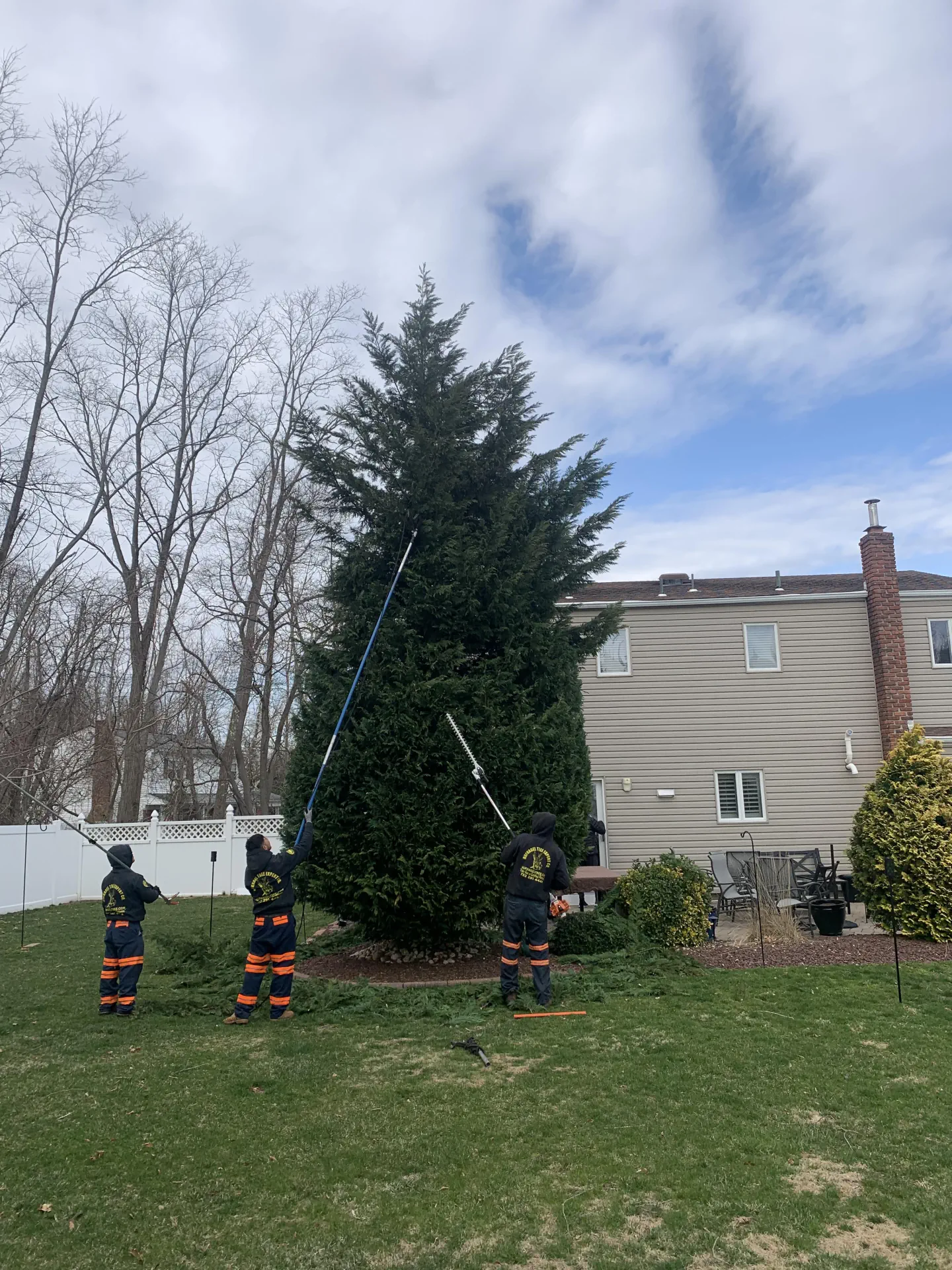
Ownership comes first. The borough code says that no person may cut, trim, climb with spikes, or otherwise injure or remove a living tree on a public highway without the written permit of the Mayor and Council, and that rule sits in the borough’s tree chapter, Chapter 124. The Shade Tree Committee exists to remove, maintain, plant, and supervise the borough’s public trees. A tree on the right of way between the curb and the sidewalk is part of that system. A tree behind the sidewalk on a private lot is the owner’s decision, though removal rules still apply.
Those removal rules were added to the code on August 26, 2024. A street tree with a diameter of 2 1/2 inches or more, or any other tree with a diameter of six inches or more, needs a Tree Removal Application reviewed and approved by the Conservation Officer before it comes down. Hazard trees, meaning trees that are dead or dying, diseased, damaging a structure, or a threat to public safety, can be removed without the replacement requirement, and the code asks for documentation from the removal company or photographs when an emergency removal happens first.
The same chapter defines removal broadly. It includes excessive pruning, over mulching, and soil compaction around the base when they lead to the decline and death of a tree. That matters for a trimming plan, because it means a heavy handed cut can create the same problem as a removal. Responsible pruning and maintenance are specifically not counted as removal, which is the standard we work to. If a permit question comes up, our guide to tree removal permits is a good place to start.
Neighbors are part of the conversation. In a borough of 0.90 square miles, a limb often crosses a property line, and a trimming plan works best when we know exactly where it does. We look at which side the weight sits on and which side the target is on, and we talk through the cuts with the property owner before the work starts. A clear conversation up front prevents most disagreements later.
The inspection itself produces a short list, not a long invoice. For each tree we note the defect, the target, and the recommended action, and we put the items in order. The limb over the bedroom comes before the deadwood over the back fence. Work that reduces a real hazard comes before work that only tidies a canopy.
Most Neptune City trees we look at end up in one of four outcomes: monitoring, pruning, restoration, or removal. Monitoring is a legitimate result, and a tree with a minor defect and no meaningful target can wait and be checked again in spring. Pruning handles most of the rest. Removal is the outcome we reach when the structure or the roots no longer give us a dependable way to manage the risk. Not every defect means removal.
Timing on the coast also deserves respect. The National Weather Service describes nor’easters as coastal storms that bring strong northeast winds, heavy precipitation, and coastal flooding between September and April. No tree service can honestly guarantee that a tree will never fail in severe weather. What we can do is make sure the predictable failures are handled before the weather tests them, and our work on tree storm proofing follows the same logic as fall trimming.
What a Neptune City Homeowner Should Have Ready Before Winter
- Confirmation of whether each tree stands on the borough right of way or on private land.
- Dated photographs of cracked, hanging, or leaning limbs to compare after each storm.
- A short list of branches over the roof, the wires, the driveway, and the neighbor’s yard.
- A decision on any tree whose roots or trunk can no longer be managed safely.
- A clear plan for which cuts happen this fall and which wait for the dormant season.
A plan built this way is specific to the property. It is not a list of every service we offer. It is the handful of actions that change the outcome for this house when the next coastal storm arrives, in the order that matters. When the work is done, the homeowner knows what was found, what was cut, what is being watched, and why, and the paperwork the borough expects is already in hand.
Schedule Tree Trimming in Neptune City Before Winter Weather Arrives
If you have mature trees near your Neptune City home, driveway, sidewalk, or the roofline along Sylvania Avenue or near Memorial Park, schedule an evaluation before winter weather arrives. We provide tree trimming and pruning, tree risk evaluations, storm proofing, restoration, and removal when a tree cannot be managed safely.
Hufnagel Tree Service is led by a certified arborist with almost 30 years of local experience and more than 280 five star Google Maps reviews. We inspect first, explain what we found in plain terms, and recommend only the cuts that change the outcome for your trees and your property.
Call or text (732) 291-4444 to schedule tree trimming in Neptune City before the next coastal storm arrives.
Schedule Service Now!
From precision pruning and safe removals to health assessments and preventative care, Hufnagel Tree Service delivers expert solutions backed by decades of experience. We offer certified insight, fair pricing, and a commitment to doing what’s best for your landscape.
Learn More About Our Services
Related Articles
Storm Damaged Trees in Aberdeen: We Can Help
Schedule Your End-of-Summer Tree Inspection